You might laugh [please do] but when I came across this saying recently my literal mind skipped it’s metaphorical intention and took its meaning to the letter [I often do this]. My thoughts wandered to when we have walked an extra mile or so on a beach or in the hills or cycled just that bit further and felt smug as we left the crowds behind. The saying is spot on; going that extra mile often takes us to a quiet corner and to somewhere special that we can embrace as our own for a short time. By just taking a bit more effort I can enjoy an undisturbed experience of a location with the space and tranquillity to really see, smell and feel the place.
The quote attributed to Wayne Dyer, author and self-development guru, is, ‘It’s never crowded along the extra mile.’ After thinking about all those idyllic places we have found it eventually dawned on me that this quote isn’t to be read literally and instead encourages everyone to believe that by putting in the extra effort you can reach the top. My mind turned to those times when I have gone the extra mile on a task. Doing just the minimum required can be an easy option and I have times when I need to cruise through jobs because my mind is preoccupied with other stuff. But I feel much better about myself when I put the extra effort in and give my absolute best. And yet, the number of people who will reach the heights of the elite in any field is limited [or never crowded] and unfortunately not everyone can be outstanding otherwise outstanding becomes the average. For myself, I don’t expect to be award winning, I go the extra mile to compete against myself, stretching my performance and improving my skills.
I consider myself a slow writer; certainly each time I write a travel article or blog post I spend hours rigorously writing, editing and re-editing. I do this for two reasons; I am certainly terrified of the shame of making a mistake that makes it in to print [although they do and I have to deal with it] but I also want to produce work I can feel proud of. I constantly review, learn new techniques and apply these and I feel that my writing has improved over the years. I don’t go the extra mile for promotion or a higher salary, my editor is not pushing me to write differently, I am self-motivated to do better and throwing together a piece of writing with the minimum effort has never been an option. By going the extra mile I might not reach the top but I do maintain my self-respect.
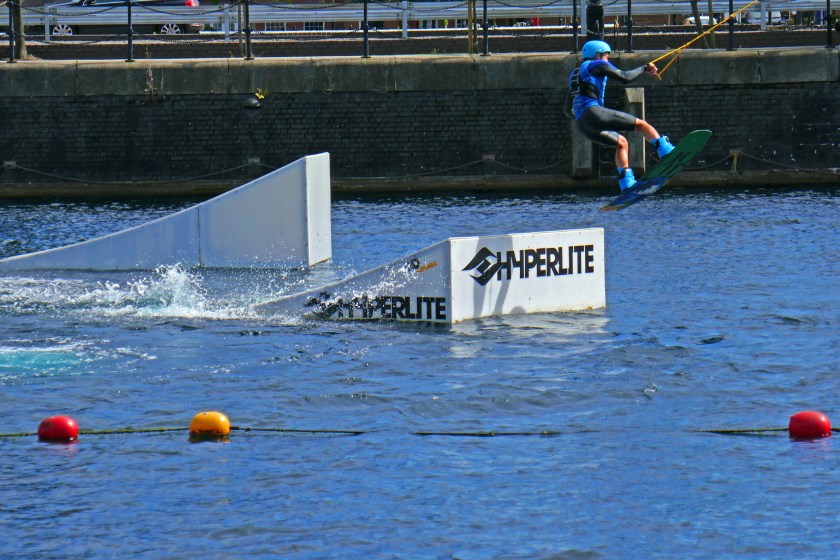
We like to get out and stretch our legs and get the heart pumping after writing at the laptop for much of the day. Salford Quays is the place we take one of our favourite regular walks and we often swing by the Watersports Centre as there is usually something going on there which gives us an excuse to linger and lean on the railings and watch. Sometimes there are groups of young people learning how to manage a kayak, on other occasions there are acrobatic wakeboarding sessions. Those of us not taking part in these water-focused activities [and we are never alone here] can idly enjoy the spectacle.
I am always pleased to see the Manchester Ship Canal at Salford Quays being used. When I used to cycle to work over the canal I would often see groups rowing along the canal in the early morning. In winter it would be barely dawn and the sun would be coming up over Manchester, the rowers were out on the water and wrapped up against the cold. On other trips around Salford Quays we have stumbled upon open water swimming events when the noise from splashing arms and legs echoes around the blocks of flats.
My first experience of the Watersport Centre was when our son took part in the Salford Dragon Boat Festival. His workplace had a team in the race and we came along to watch the fun. The dragon boats themselves are stunning, each decorated boat is 40-foot long and holds 18 people. One of these is a qualified helm, 16 people row and one person is the drummer beating time. We cheered our son’s team on and for novices they did pretty well, getting through a number of the heats but the main thing was that they enjoyed taking part. This event is a great spectacle if you can get to Salford Quays next time it is on.
Okay, so this won’t be the most trendsetting and smart bit of gear you will ever see me wearing but it is certainly proving to be practical. We both own cagoules, waterproof jackets that are perfect for when the heaven’s open. We live in the north-west of England and have been bought up to carry these cagoules on every walk, even if there isn’t a cloud in the sky, as in our unpredictable climate you just never know.
Cagoules are fantastic in winter but even when made of Gore-tex they can get hot and sticky in a summer shower. Last year at the Upton Blues Festival I noticed lots of people were wearing ponchos in the rain and these looked both practical and comfortable. We don’t buy anything on the spur of the moment but started the process of thinking and researching ponchos.
It seemed the poncho market is broad and we could buy expensive or cheap. Generally with hiking gear I will opt for quality over budget options but as this was a new bit of kit that we were not completely sure would ever be useful we decided to be cautious and frugal. Dipping our toes in to the waterproof poncho market we bought these Trekmates ponchos for £20 each in 2018. [2025 update: Trekmates now do a range of ponchos from £35-£55.]
After even a short time these ponchos are proving to be perfect for those short sharp summer shower that we often get in the Alps and in UK. In this sort of weather the temperature doesn’t plummet too much and putting on a cagoule, even a breathable one, can be a sweaty experience. We prefer to stay dry and walking in the countryside there isn’t always a bus stop or hut nearby to shelter in. As well as being perfect at a festival these ponchos are now our go-to option on those hiking days when there isn’t a cloud in the sky and but we want to pack a just-in-case waterproof. As the ponchos are lighter and less bulky than our cagoules I am sure we will use them often in our trips to southern Europe. This will mean that our expensive Gore-tex cagoules will last that bit longer.
The Trekmate poncho has a number of other plus points over a cagoule:
They come in one size so if you are as short as me [162 cms] the poncho is long enough to cover your shorts and keep them dry. Mr BOTRA is a bit taller but the poncho would still cover his short shorts!
The poncho’s are big enough to go over your rucksack as well as you and keep that dry
The poncho’s come with a stuff bag so they pack away neatly
This is a light piece of kit that doesn’t take up much room in your pack
These ponchos only come in black and the design is very simple. At the front there is a large pocket that might be useful to keep any map dry during the shower. There is a zip at the neck and a flap and the hood is a generous size. In the body of the poncho there are two holes with Velcro to stick your hands and arms out of if you need to.
The only downside we have found is that if it gets windy the ponchos can billow. I think if it is that windy it will most probably also be cold and we would be carrying cagoules and waterproof trousers anyway.
We decided to buy at the cheaper end of the poncho market for our first purchase in case these proved to be something that we never actually used. We have now owned these ponchos a almost seven years and they have more than proved themselves. Other than one of the press studs at the neck breaking off, they continue to keep us dry in short summer storms and light rain and are perfect to carry just-in-case.
I am now a convert to a different way of keeping dry on the hills, even if I don’t look like the most stylish walker. If you see me please don’t laugh too much!
The Blue Bus parked at Artajona in northern Spain – a perfect place for jousting!
The mishap came as a bit of a surprise. The road from Torla to Aínsa in Aragon is a secondary road but a good one and we were pottering along in the sunshine, enjoying the views over the Rio Ara and of the villages perched on hilltops. The road has a white line down the centre but the carriageways are on the narrow side and the light traffic was driving considerately giving enough space to oncoming traffic.
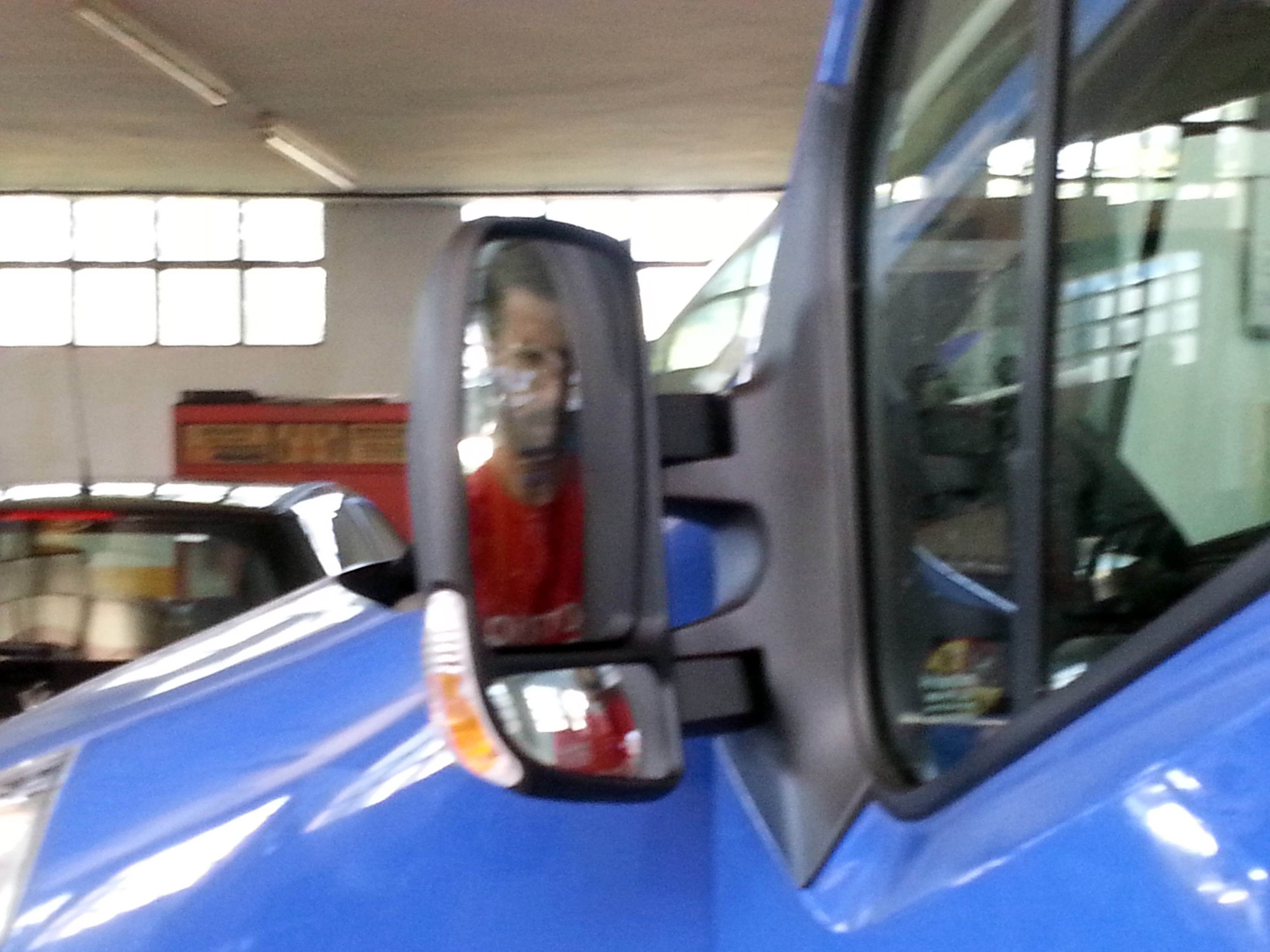
Coming towards us were two massive white motorhomes in convoy. The leading motorhome was taking up more than his fair share of the road and we moved over to the edge of the road to ensure everyone could pass by safely. We assumed the big guy would do the same but it seemed he too had been watching Game of Thrones and fancied a bit of wing mirror jousting with our Blue Bus. Bang! We both cursed him as our passenger side wing mirror was slammed inwards and the glass broke.
We know this isn’t a tragedy, it is really just one of those things that will happen to lots of people in campervans. Those big wing mirrors are a perfect target after all and this is the first time we have broken a wing mirror in our 13 years of having a ‘van. The idiot in the motorhome didn’t stop – to be honest there wasn’t really anywhere safe to stop – and we limped along for a couple of kilometres until we found a lay-by to pull in to. Shaken we gave each other a hug and investigated the damage. The glass of the main mirror was shattered but fortunately the small blind spot mirror at the bottom was still intact. The mirror no longer responded to being moved. Our only consolation was that the big white motorhome would most likely have the same damage to his wing mirror and we hoped his replacement mirror was even more expensive than ours.
Our Renault has no internal central mirror, so the wing mirrors are essential. We had a go at fixing a shaving mirror we carry in to the housing of the wing mirror to help the driver see behind but we couldn’t get this to work. We have since found that you can buy temporary ‘mirrors’ and may invest in one or two of these. After some thought and consideration we felt it was safe to drive using just the blind spot mirror for the remaining 25 kms to Aínsa. Although this mirror is small it functioned pretty well.
A call to our breakdown sorted out a garage that was expecting us and the mechanics there spent some time ensuring they were ordering the correct mirror for our Renault. The next day it took them 15 minutes to fit the new wing mirror and it cost us around £200! An expensive jousting session.
Always keen to explore other parts of Salford further from my home I found myself walking north from the familiar Buile Hill Park and in to the unfamiliar Claremont and Irlams O th’ Height areas of Salford. Here I found Lightoaks Park and was delighted by what a lovely and pleasant park it is. Lightoaks Park is one of Salford’s larger parks and it offers a varied landscape that is worth an hour or two of anyone’s time.
The park was officially opened in 1925 and as it rapidly approaches its centenary it has an active friends group that helps to take care of the park and organises events and activities throughout the year.
I walked through the park to the pond with Mr BOTRA and leaning on the fence we chatted to a local who was also out enjoying the park. He told us he was a regular to this park and shared his love of the park, expressing with his smile how important his local green space was to him. We meandering around the paths through woodland and lawns and found the outdoor gym to play on for a short while. We stumbled upon a section of wall set with old carved stones, presumably from a mansion that was on the site previously.
Maps from around 1940 show that the pond was a feature in the new park and that in those days Lightoaks Park had a pavillion, tennis courts and a shelter with a lodge at the Claremont Road entrance. In the higher part of the park was Crimble Lodge and Claremont Farm.
Irlams O th’ Height is a former village and is a tough name for locals and visitors to spell. I hope I have got it right!
For anyone with a campervan, motorhome or a caravan there are two good reasons for visiting Sedan in northern France. Firstly for around €9 a night you can stay at the municipal campsite. This municipal site is easy to find and is pleasantly placed by the river Meuse, with moorings for boats alongside the site and an open aspect that helps it feel more rural than urban. We were greeted warmly by the member of staff who gave us a map of the town and told us enthusiastically about the castle and told us we could pitch where we liked on the grassy site. The ground is a little uneven but nothing the levelling blocks couldn’t deal with. The sanitary facilities were not the most up-to-date but were clean and the showers were good and hot and we don’t need much more than that and you can’t expect much more for the price.
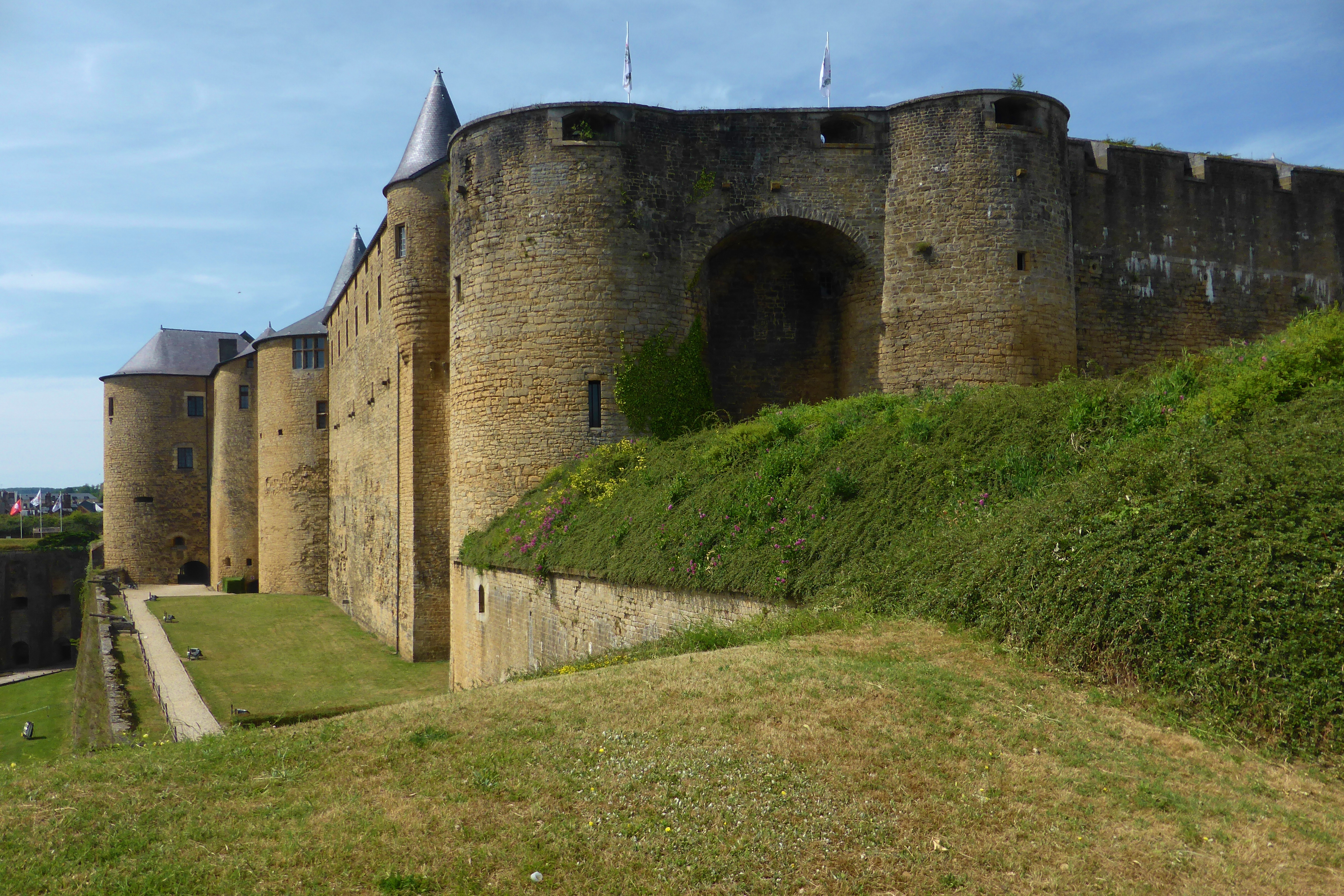
Sedan is handily placed for us to reach our ferry at Zeebrugge but we arrived with enough time to visit the second reason to visit Sedan. It has what is claimed to be the largest medieval fortified castle in Europe.
It is about a 15 minutes’ walk to the castle from the campsite and it is as magnificent and immense as you could hope, with an impressive curtain wall around the castle and courtyard and lovely views over the town from the corner bastions and the ramparts. We explored the dark corners, alleys and stairwells that were designed to confuse the enemy and from the information boards learnt how the castle had grown over time. I was particularly fascinated by the view into the interior of a round tower that had been enlarged over the years and seeing the interactive scale model of the castle in 1870 during the Franco-Prussian First Battle of Sedan. The Second Battle of Sedan was in May 1940 during the German invasion of France.
After exploring the castle, we strolled around the town that has a history of cloth-making; some think that upholstery from Sedan gave the Sedan chair its name. We found narrow streets and charming shops, lovely botanical gardens and bridges over the river Meuse. Sedan also has an open and covered market on Wednesday and Saturday mornings.
It isn’t often that Ordsall in Salford is mentioned in the Chancellors budget! In 2011 I was only half listening to the Chancellors statement on the radio but my ears pricked up when he proposed funding the construction of the Ordsall Chord. What was the Ordsall Chord and what sort of musical instrument would need government support? As we live near to Ordsall in Salford I investigated further and discovered this was a much needed railway project joining two Manchester railway stations; Manchester Piccadilly and Manchester Victoria. The Ordsall Chord takes a curved route around the city centre, skirting the boundary of Ordsall, hence its name.
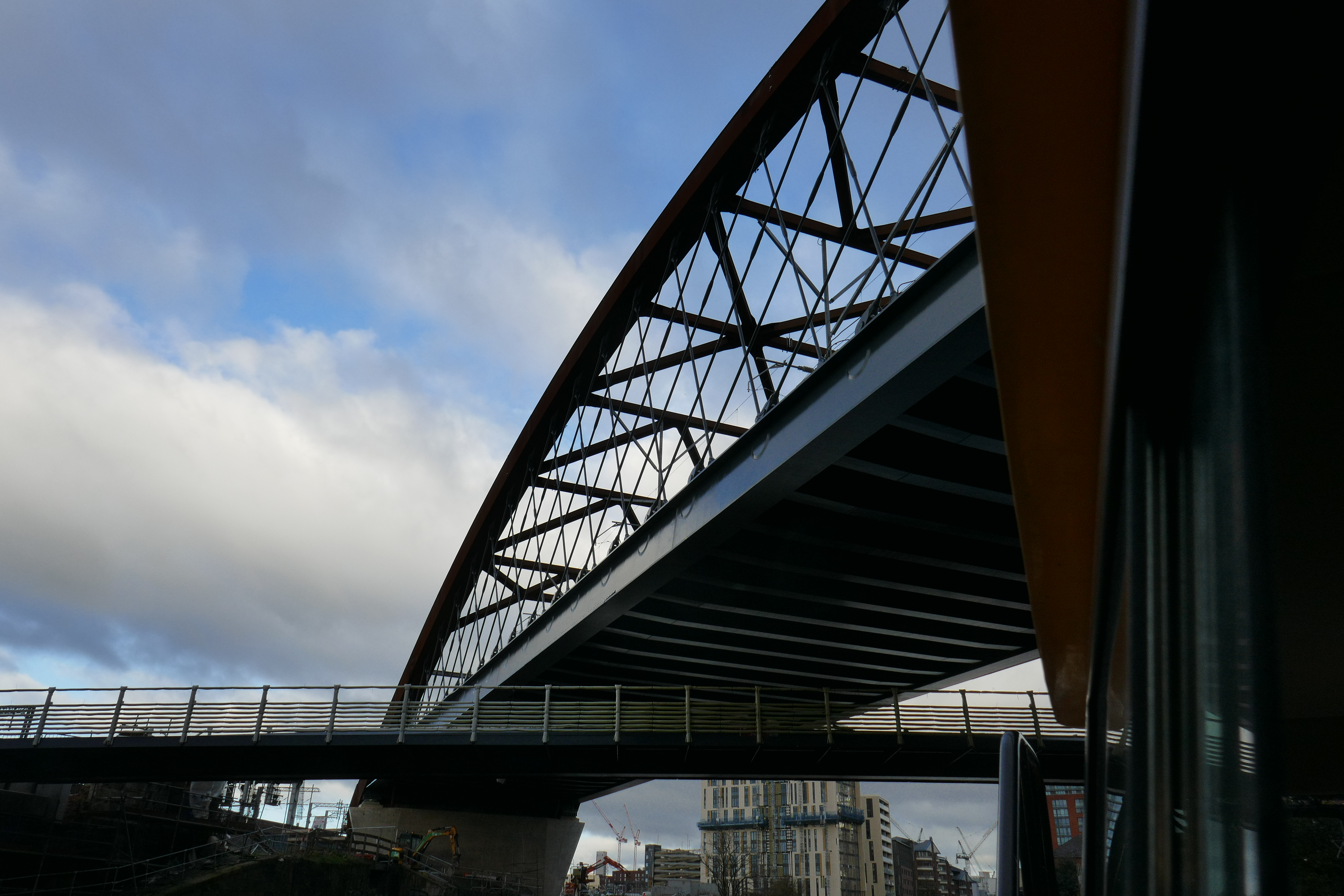
As with many railway projects nothing happened for a long time but eventually construction work started. I watched the new line taking shape through 2016 and was excited to see the bridge over the Irwell erected [watch the video] and the completion of the project at the end of 2017. This arched bridge is a stunning addition to the local skyline and is a thing of beauty. The weathering steel of the bridge over the River Irwell gives it an attractive rusty appearance as well as being practical.
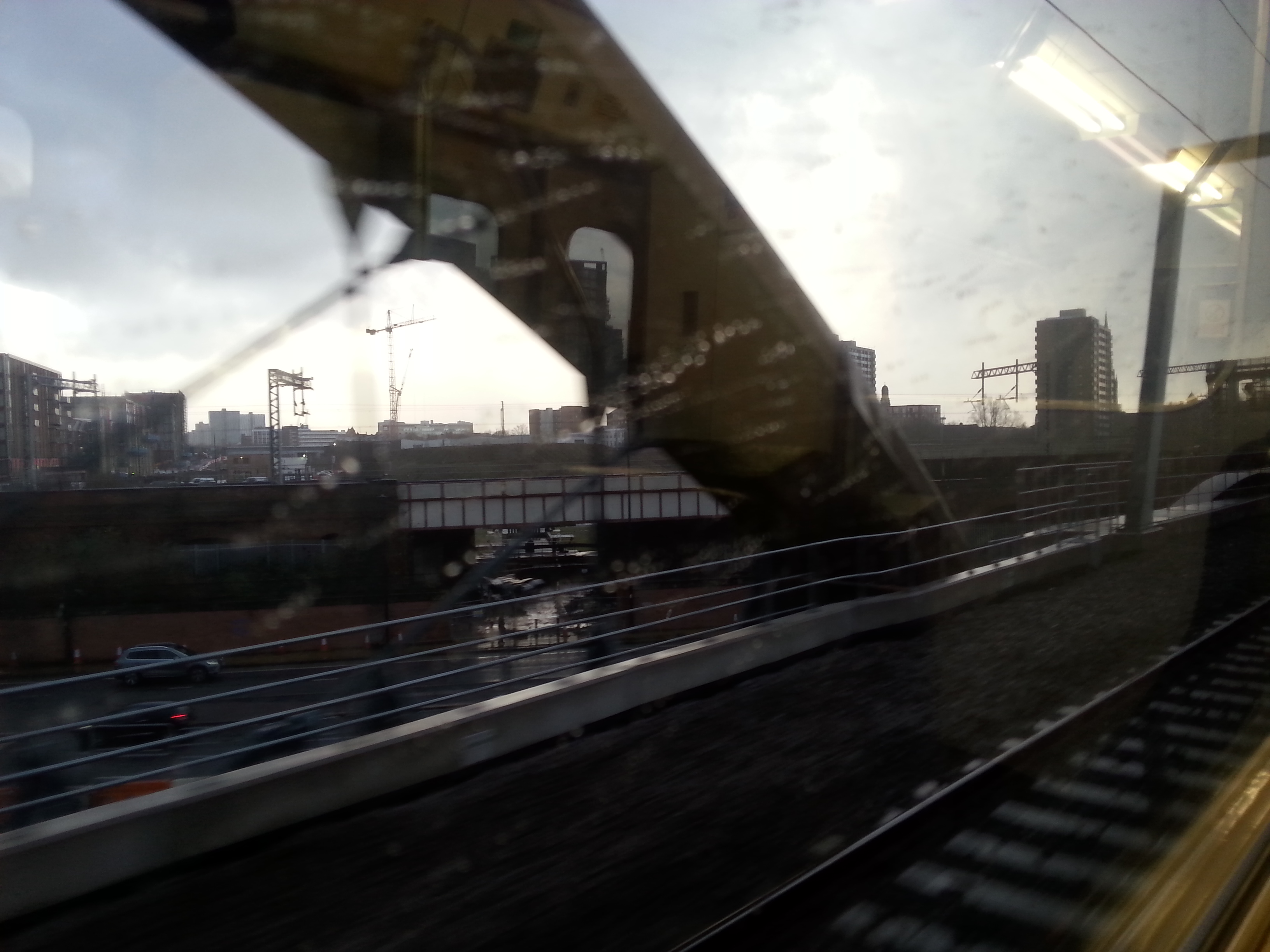
In December 2017 the Ordsall Chord opened for trains, providing that much needed direct link between the two stations. On my Waxi trip along the canal we sailed under the bridge but I couldn’t wait to take my own trip on this new bit of railway line. In January this year we used a trip to Bradford as an excuse to take a trip along the Ordsall Chord.
This work has also revealed the historic stone bridge or viaduct built by George Stephenson in 1830 for the Liverpool to Manchester railwayline. This elegant bridge is being restored and will be part of the public space around the Ordsall Chord. I for one am looking forward to this part of the project being completed.
I can’t resist cats, pretty tea-towels and net curtains
I heard the author Louis de Bernieres talking on the radio and {as so often happens with radio programmes] he took me to a new place – Ithaka by Constantine Cavafy. He was sharing a poem that had changed his life and it resonated with me too. The Greek island of Ithaca or Ithaka identifies with Homer’s Ithaca, home of Odysseus and his odyssey to return there. Ithaka is our goal, the thing we get up for every morning or our own quest. But like Odysseus, it is the adventures and discoveries along the way to our quest that are important and there are good reasons why we shouldn’t rush the journey just to get to the end of our odyssey. Constantine Cavafy speaks of the importance of enjoying the road to our own Ithaka, pausing to appreciate the route but keeping ‘Ithaka always in your mind’. We can then hope to arrive at our Ithaka older and wiser after years of learning on the way. ‘Without her you wouldn’t have set out’, Constantine Cavafy reminds us.
Louis de Bernieres interprets Ithaka and ‘what you’re destined for’ as every human’s inevitable journey to death. We take the first steps on this journey as soon as we are born and we all hope that this is a long and interesting journey. ‘Ithaka’ and Louis de Bernieres’ response, ‘When the Time Comes,’ are poems that intimate that we would do best to enjoy whatever life throws at us and hope that we don’t reach the end of our journey until we are old. Louis de Bernieres poem has become popular as a reading at funerals and I can see why.
To someone who adores to travel those words, ‘And if you wish, let there be Spanish music, Greek seas, And French sun, the hills of Ireland if you loved them’, make me smile. Even if my own Ithaka comes tomorrow, I have been lucky enough to have found those and other treasured places … but hopefully my journey will continue a little longer.
Ithaka, Constantine Cavafy
As you set out for Ithaka
hope your road is a long one,
full of adventure, full of discovery.
Laistrygonians, Cyclops,
angry Poseidon—don’t be afraid of them:
you’ll never find things like that on your way
as long as you keep your thoughts raised high,
as long as a rare excitement
stirs your spirit and your body.
Laistrygonians, Cyclops,
wild Poseidon—you won’t encounter them
unless you bring them along inside your soul,
unless your soul sets them up in front of you.

Hope your road is a long one.
May there be many summer mornings when,
with what pleasure, what joy,
you enter harbors you’re seeing for the first time;
may you stop at Phoenician trading stations
to buy fine things,
mother of pearl and coral, amber and ebony,
sensual perfume of every kind—
as many sensual perfumes as you can; and may you visit many Egyptian cities
to learn and go on learning from their scholars.

Keep Ithaka always in your mind.
Arriving there is what you’re destined for.
But don’t hurry the journey at all.
Better if it lasts for years,
so you’re old by the time you reach the island,
wealthy with all you’ve gained on the way,
not expecting Ithaka to make you rich.

Ithaka gave you the marvelous journey.
Without her you wouldn’t have set out.
She has nothing left to give you now.

And if you find her poor, Ithaka won’t have fooled you.
Wise as you will have become, so full of experience,
you’ll have understood by then what these Ithakas mean.
When the Time Comes, Louis de Bernieres
When the time comes, it is better that death be welcome,
As an old friend who embraces and forgives.
Sieze advantage of what little time is left,
And if imagination serves, if strength endures, if memory lives,
Ponder on those vanished loves, those jesting faces.
Take once more their hands and press them to your cheek,
Think of you and them as young again, and running in the fields,
As drinking wine and laughing.
And if you wish, let there be Spanish music, Greek seas
And French sun, the hills of Ireland if you loved them,
Some other place if that should please, some other music
More suited to your taste.
Consider, if you can, that
Soon you’ll shed this weariness, this pain,
The heaped-upon indignities, and afterwards — who knows? —
Perhaps you’ll walk with angels, should angels be ,
By fresher meadows, unfamiliar streams.
You may find that those who did not love you do so now,
That those who loved you did so more than you believed.
You may go on to better lives and other worlds.
You may meet God, directly or disguised.
You may, on the other hand — who knows? — just wander off
To sleep that seamless, darkest, dreamless, unimaginable sleep.
Do not be bitter, no world lasts forever.
You who travelled like Odysseus,
This is Ithaca, this is your destination.
This is your last adventure. Here is my hand,
The living to the dying;
Yours will grow cold in mine, when the time comes.
A gorgeous view from a Welsh Rees Jeffreys rest stop
My introduction to William Rees Jeffreys was quite by accident one sunny Sunday in the summer of 2011. Travelling back to Manchester after a weekend camping in Dolgellau to walk the Mawddach Trail to Barmouth. Keen to extend the carefree holiday feeling as long as possible, my partner and I took the country road from Llan Festiniog over the hills. Spotting a car park with a view, we couldn’t resist stopping for a brew and a stroll. The splendidly positioned car park had a plaque and always one to check out such things I learnt that the car park had been funded by the Rees Jeffreys Road Fund. It certainly was an excellent place for a motorhomer to stop; no height barrier, an extensive view, a babbling stream and Rhaedr y cwm waterfall and enough bilberries to fill a pie all within a few 100 metres.
Like many brief encounters, I didn’t give Mr Rees Jeffreys another thought until twelve months later I had another chance meeting with this enigmatic fellow. Once again on the lookout for a good place to pull up in the Blue Bus and have a brew, although without the good weather, we pulled off the M6 at Tebay (Junction 38) and followed the road towards Kendal. Spotting a lay-by with a view across the M6 and the railway line to the Howgill Fells we pulled in and realised we were parking next to a familiar plaque. The kettle went on and I climbed out, despite the drizzle, to read that the Rees Jeffreys Road Fund had also funded the construction of this road side parking. Over a brew I starting wondering what the story was behind this man, why he felt the need to pay for car parks as far apart as Wales and Cumbria and why he deserved a plaque.
Back home, an internet search revealed some information about William Rees Jeffreys. He was born in 1872, before Karl Benz had patented his internal combustion engine for a Motorwagen in 1886. William Rees Jeffreys was a keen cyclist and was initially motivated in his campaigning to improve roads for cyclist. As cars became more widespread, William Rees Jeffreys held positions with the Road Board (the precursor of the Department of Transport), the RAC, the Roads Improvement Association and the Institute of Automobile Engineers. From 1919 he was a leading light in the classification and numbering of the roads in Britain to help drivers navigate. The road classification project was complete in 1926.
Following his death in 1954, William Rees Jeffreys generously wanted to continue improving facilities for road users and his estate provided the endowment for the Rees Jeffreys Road Fund. This gives financial support every year for education and research related to road transport and also for physical road transport projects, hence all the lovely road side parking areas.
Motorhomers always need car parks and lay-bys and those next to roads often suit our purpose of a rest stop on a trip, giving a chance for a brew and a quick stretch of the legs without going out of our way and here was an organisation providing just the facilities the motorhoming community needs. So, interesting as the Rees Jeffreys website was, it lacked a list of the road side rest areas the Rees Jeffreys Road Fund had supported and I wanted to know more. An email to the Secretary quickly led to the arrival of a Rees Jeffreys Road Fund roadside rests list in the post a few days later. This typed list showed 68 rest stops they had supported, from Wester Ross in Scotland to Cornwall. With the list, I was now able to plan holiday routes to include a Rees Jeffreys Road Fund road side rest areas.
2025 update – the Rees Jeffrey’s Road Fund website now has photographs and information about finding some of the roadside rest areas. It is certainly worth taking a look.
My next opportunity to meet my double-barrelled friend was on an early March trip to Pembrokeshire. The delight of a quest like this is that you never know exactly where it will take you. We had the small Cardigan Caravan and Camping site to ourselves and after star-gazing in the clear night sky; we woke to sunshine, white frosty fields and a frozen tap at the outside washing up facilities. A warming breakfast slowly got us going and we drove the short distance to the small parking area on the B4582 for the Crugiau Cemmaes barrow. The parking did not really merit the title car park but it had the usual Rees Jeffreys Road Fund plaque and did mean that we visited the round barrow, thought to be Bronze Age, and enjoyed the clear views over the Welsh countryside.
It is evident from the typed list that some local authorities have cottoned on to the availability of funding from the Rees Jeffreys Road Fund better than others and Pembrokeshire is clearly one of those, with six rest stops on the list, only matched by the Isle of Wight. However, it soon also became clear that the list had some limitations; with no grid references or even road numbers, some were tricky to find. Even with the help of online maps with street view, I never found the rest stop located at St David’s Road, Haverfordwest.
Not a person to give up on a friendship easily, the exploration continued further south with a couple of nights near Saundersfoot. The generously sized lay-by at Wood near Newgale on the A487 was easier to find, although the extreme slope meant that even walking up and down the van was challenging. Ditching the idea of brewing we enjoyed the wide view over Newgale Sands and St Brides Bay with fruit juice!
Heading north back through Wales, I sought out the only roadside rest listed in Powys. Pont Marteg on the A470 north of Rhayader in the stunning river Wye or Afon Gwy valley was easy enough to find. The beautifully sited car park had room for the Blue Bus and provided the opportunity I sought to stretch my legs and watch the Red Kites circling above. It looked like a Rees Jeffreys Road Fund road side rest but a thorough search didn’t reveal the familiar plaque, so I couldn’t be sure.
The Rees Jeffreys Road Fund has over £7 million in the bank and uses the interest earned on this investment each year to fund mostly research projects and educational bursaries. In 2017 no new car parks or road side rests were built but funding was given to encourage wild flowers on road side verges. In 2016 The Rees Jeffreys Road Fund published a report on the need for a Major Road Network across England.
Having visited Rees Jeffrey Road Fund rest stops in England and Wales, I thought it was time to seek one out in Scotland. Only twelve locations feature in the list for Scotland, so I wasn’t overwhelmed by the choice but a trip up to Oban and Mull at Easter was coming up and I got the list out and checked the map for possibilities. I soon spotted that just north of Glasgow a rest stop was listed at Queen’s View on the A809 between Mingavie and Drymen that would work well with our route. Only 45 minutes from the centre of Glasgow, the car park, funded by my old pal WRJ, enables the locals to park up and enjoy some fresh air and exercise. From the car park a quick five minute pounding of the legs will take you to the view point where it is said Queen Victoria stopped to take in the view of Loch Lomond, the more energetic can spend two or three hours walking up to the crags of the strangely named hill, the Whangie.
The list of road side rests doesn’t give a year when a particular site was funded but the Queen’s View car park must have been some time ago, as even given the extremes of Scottish weather, the tarmac would benefit from renewing. On a bank holiday, it was also busy and this spot didn’t provide the peaceful respite from driving I have come to associate with our esteemed friend.
We also visited the Iron Gate car park in Flintshire on foot, as part of a snowy walk over Moel Famau and so now have 62 of the 68 roadside rests funded from the endowment of William Rees Jeffreys left to visit. The list travels with us in the glove compartment of our campervan and I have no doubt that my acquaintance with William Rees Jeffreys will be maintained and I will continue to be grateful for his generosity to motorhomers and other road users.
Like many other campervans our Devon Tempest has just a small combined oven and grill that runs on gas. While the grill is useful for comforting toast, I use the oven much less. I sometimes whip up some garlic bread or make pitta breads but we don’t heat up ready meals in the ‘van [preferring to cook from scratch] and I usually cook meals on the hob. I know there are those who cook a full Sunday roast in their oven but for others the oven is just the place to store the frying pans. Recently I decided to get my money’s worth out of this piece of campervan equipment and make cakes.
We were taking a camping trip in the Peak District and were being joined for the weekend by working friends who were due to arrive on Friday evening. As the two retirees with time on our hands we had arrived a day early and were in charge of the first evening cooking rota. We wanted to spoil our hard-working friends and as well as a selection of curries we were keen to provide a pudding, but with one friend joining us who is a vegan, a shop-bought cake was not an easy option.
I spent a happy hour on the Friday morning having my very own bake-off in our tiny kitchen, not really expecting it to be too successful. I have made vegan cakes at home and they are generally easy to throw together, not requiring the time consuming techniques you need for traditional sponge cakes. In the ‘van I used reusable silicone cup cake cases to make a dozen lemon cup cakes and was pleased when they came out looking great. Decorating cakes is not my strong point, I don’t have the patience for delicate work, so I cheated with ready-made icing to give the cakes the finishing touch to make them look special.
That evening the cakes were all wolfed down in no time and there is now no stopping me in terms of campervan baking, look out Martin Dorey!
Recipe for Vegan Lemon Cakes – makes a dozen cup cakes or one loaf
255 gms plain flour
1 teaspoon baking powder + 1 teaspoon baking soda
65 gms sugar + pinch of salt
Zest + juice of 1 lemon [around 60 mls]
120 mls vegetable oil
1 1/2 tablespoons of water
240 mls of vegan yoghurt [milk-based plain yoghurt is fine if you are not vegan]
1 teaspoon vanilla essence
50 gms melted vegan margarine
Preheat the over to 160C or similar. Grease & line a 1 lb loaf tin if you are using this.
Sift the flour with the baking powder & soda and salt in to a bowl. Add the lemon zest & sugar.
Add water, oil, yoghurt, lemon juice & melted margarine, combine quickly so that the flour is mixed in but do not over mix.
Pour your mixture in to your cup cake cases or loaf tin & bake until firm [about 40 minutes for the loaf tin, around 15 mins for the cup cakes].
Remove from the tin or cup cases & cool. A simple topping is a glaze of 100 gms icing sugar mixed with the juice of a lemon [add this while the cake / cakes are still warm] or with other icing or topping of your choice.





 Back on the road again