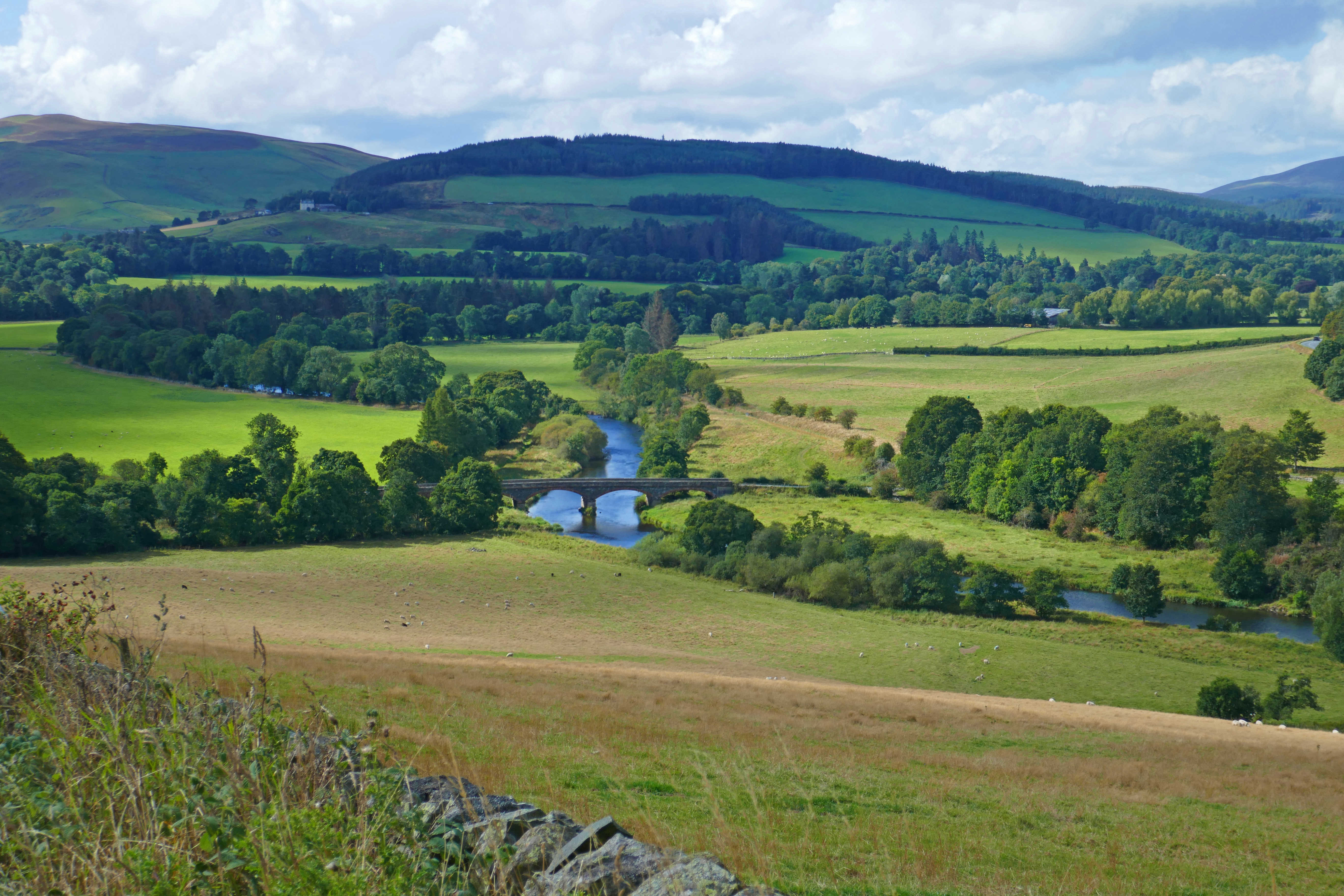
Looking below me and taking in the view in to the steep-sided hollow of The Devil’s Beef Tub I was aware we weren’t far from the source of the River Tweed. The ridge we were following over Annanhead Hill and Great Hill is a dividing line, a watershed. To the south and Moffat I could see the valley of the River Annan as it flows west to the Solway. To the north of the ridge the Tweed flows east to the North Sea. I peered over the trees and grassy lumps and bumps but the young Tweed was still hidden.
The River Tweed runs for 156 kms from the hills above Moffat to Berwick-on-Tweed in England, near the Scottish border. The river flows through the borderlands and some suggest its name comes from an old word for border but this name is also closely associated with a woven woollen fabric. Tweed is often in herringbone or hounds tooth check patterns and has been used for years for coats and jackets.
Moffat
From the high ridge above the unforgettably named Devil’s Beef Tub we descended through restored woodland. Since 2009 The Borders Forest Trust have been bringing back the native woodland, wetlands and heathlands around Corehead, restoring the Ettrick Forest. This already flourishing woodland was delightful walking, with the hillside to ourselves we hiked through varied montane scrub and wildflower meadows, joined by butterflies and bird song. We reached the road at Ericstane from where the walking was long but easy back to Moffat, where we were camping.
When in Moffat we always visit Cafe Ariete, a tradition that began some thirty years ago when we lived in Preston and Moffat was the perfect distance for our first brew stop on any trip north. In all this time the cafe has hardly changed, the coffee is excellent and the breakfasts, lunches and cakes are all tasty and served with a smile. Cafe Ariete is always worth the short detour off the M74!
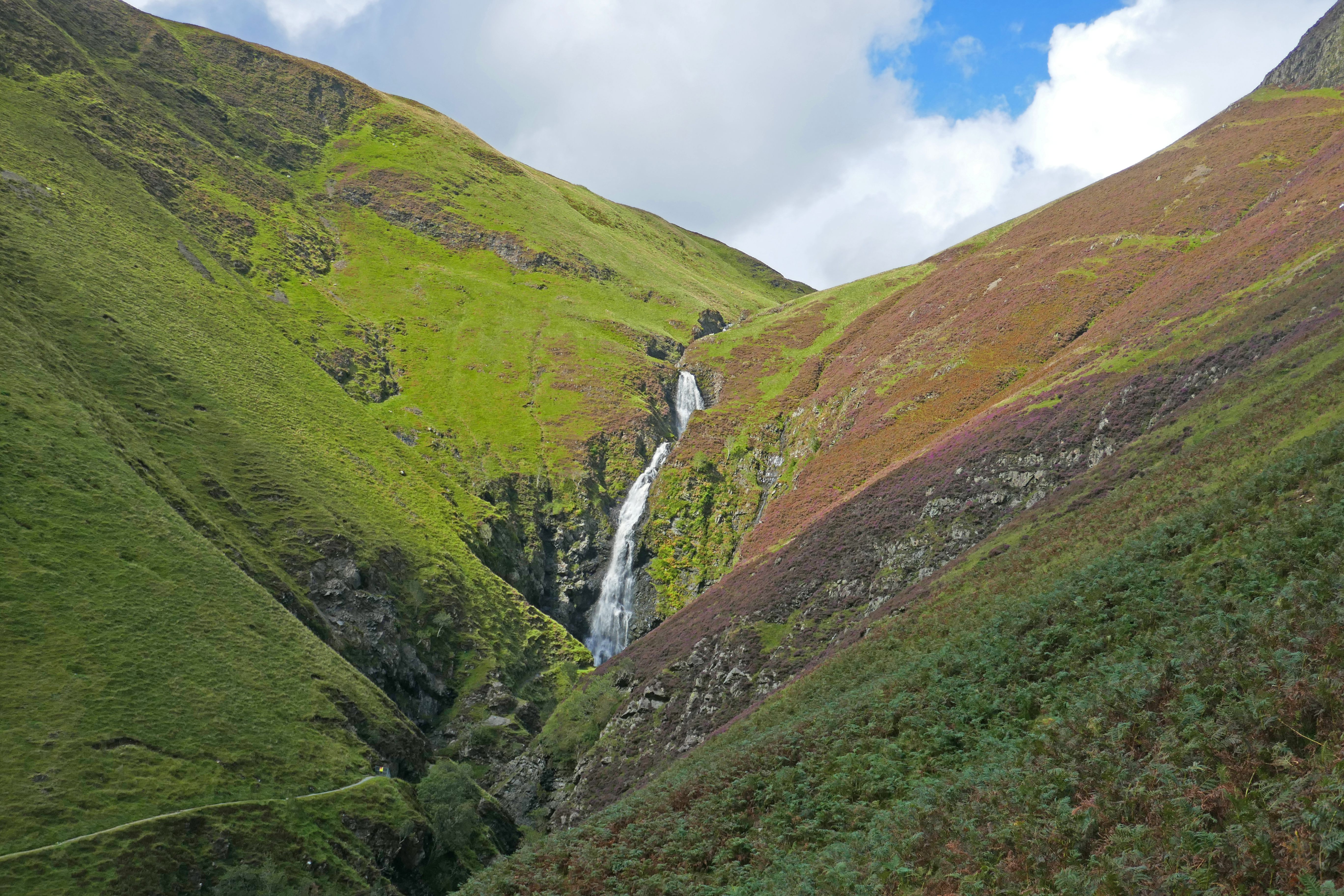
Grey Mare’s Tail, a waterfall with a 60m drop, is about 20 minutes drive from Moffat. There are two National Trust car parks at the foot of the cascade and from there you can take the short walk to view the falls. We wanted to do more and climbed the steep well-made path above the series of waterfalls. Eventually, the path levels out and meanders through a hummocky landscape to the hidden shore of Loch Skeen, a mountain loch surrounded by crags.
This trip had been planned to follow the River Tweed and we picked it up on the road to Peebles, stopping at Dawyck Botanic Gardens, one of four botanic gardens in Scotland, including Edinburgh. The woodland garden of Dwyck climbs the hillside from the River Tweed floodplain. The landscaping has created a network of sinuous paths among the trees and along the stream, dotted with sculptures and information boards about plant collectors and notable trees. It is a joyful place to visit and worked well on a sunshine and showery day; we could run back to the cafe when dark clouds loomed or shelter under a huge redwood. In September the autumn crocuses were flamboyant and there were early signs of leaves turning.
Peebles & Innerleithen
We had planned this trip after stopping in Peebles briefly last year. It seemed such a lovely small town we wanted to get to know it better. The next morning we parked by the river and walked into the town, filling our bags with goodies, including Selkirk Bannock, from the bakery, browsing the charity shops and enjoying coffee in one of the many cafes.
Our circular walk from Peebles along the River Tweed was only six kilometres long but packed in so much, including natters with friendly locals! From the riverside path we spotted a kingfisher and dippers and had views of Neidpath Castle. On the opposite bank we joined centuries of walkers crossing the hump-backed Old Manor Bridge and climbed uphill, stopping to enjoy the views over the Tweed valley. Our descent through the shady lushness of South Park Wood eventually took us to the old railwayline and back to Peebles.
A little further downstream is the small town of Innerleithen, a spa town and former woollen mill centre. We explored the lovely town and its history and were surprised to meet a local with a grumpy dislike of Peebles! Climbing Pirn Hill [apparently known locally as Windy Knowe], we found a set of stone cairns topped with carved tablets on the Iron Age hillfort site. The view over the town and the Tweed valley is well worth the exertion and I can confirm, it is windy!
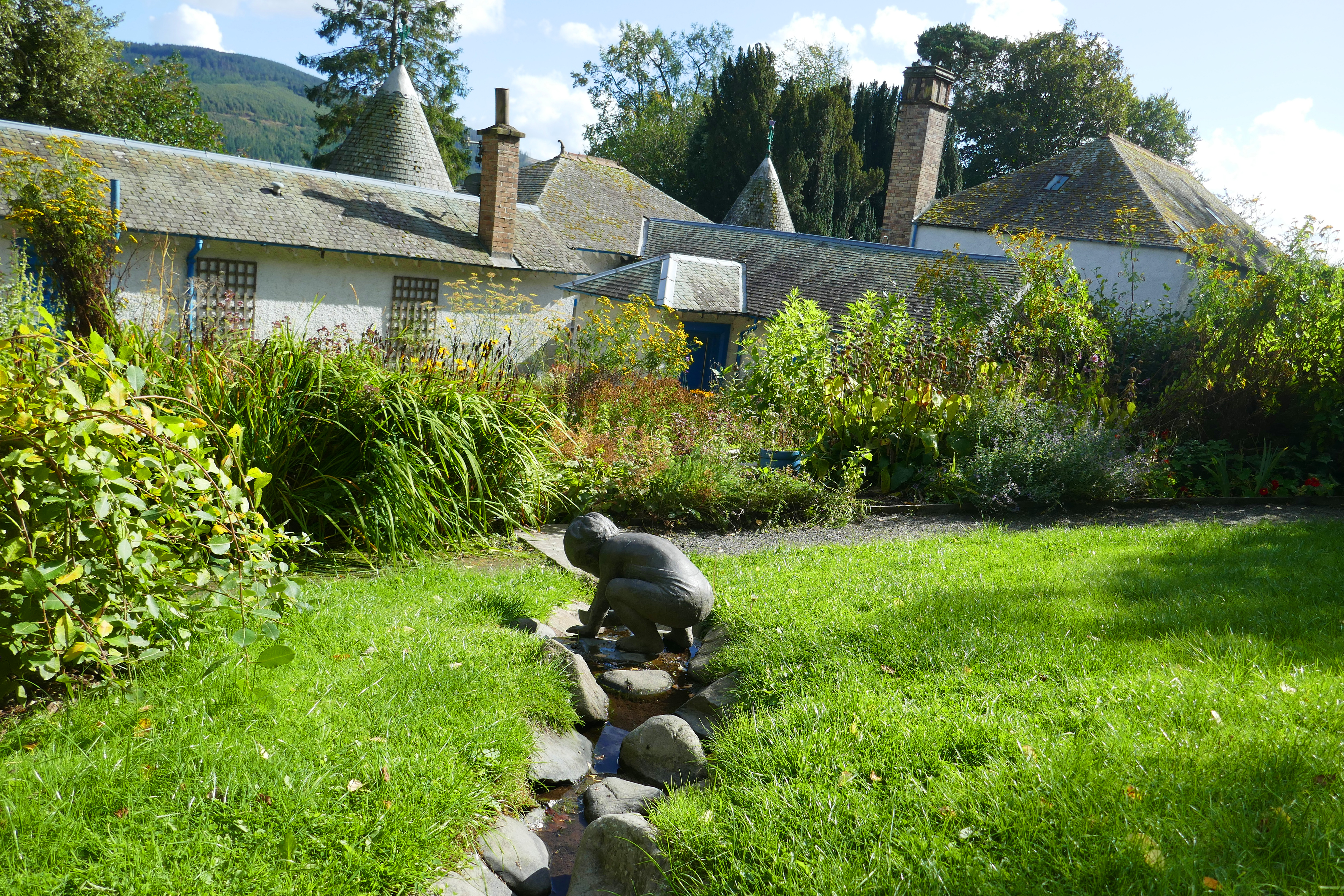
Back in the warmth of the valley, we made our way to Innerleithen’s St Ronan’s Wells. The elegant and colourful 19th century pavillion is unmissable on the hillside. In the past two Scottish writers provided advertising for the health-giving properties of the local springs. Robert Burns wrote about the spa during his 18th century travels and Walter Scott’s novel St Ronan’s Well in 1823 encouraged literary tourism. Behind the pavillion we found an idyllic community garden. Full of flowers and herbs, insects and butterflies, with a trickling spring running through it, the garden has winding paths, seating areas and the love that created it seeps from every leaf.
Selkirk
Selkirk is a hilly town that sits on Ettrick Water, a tributary of the Tweed. It is a thigh busting walk from the campsite at the leisure centre to the town, but worth it for the good and ethically-sourced coffee from Three Hills Coffee on the main street.
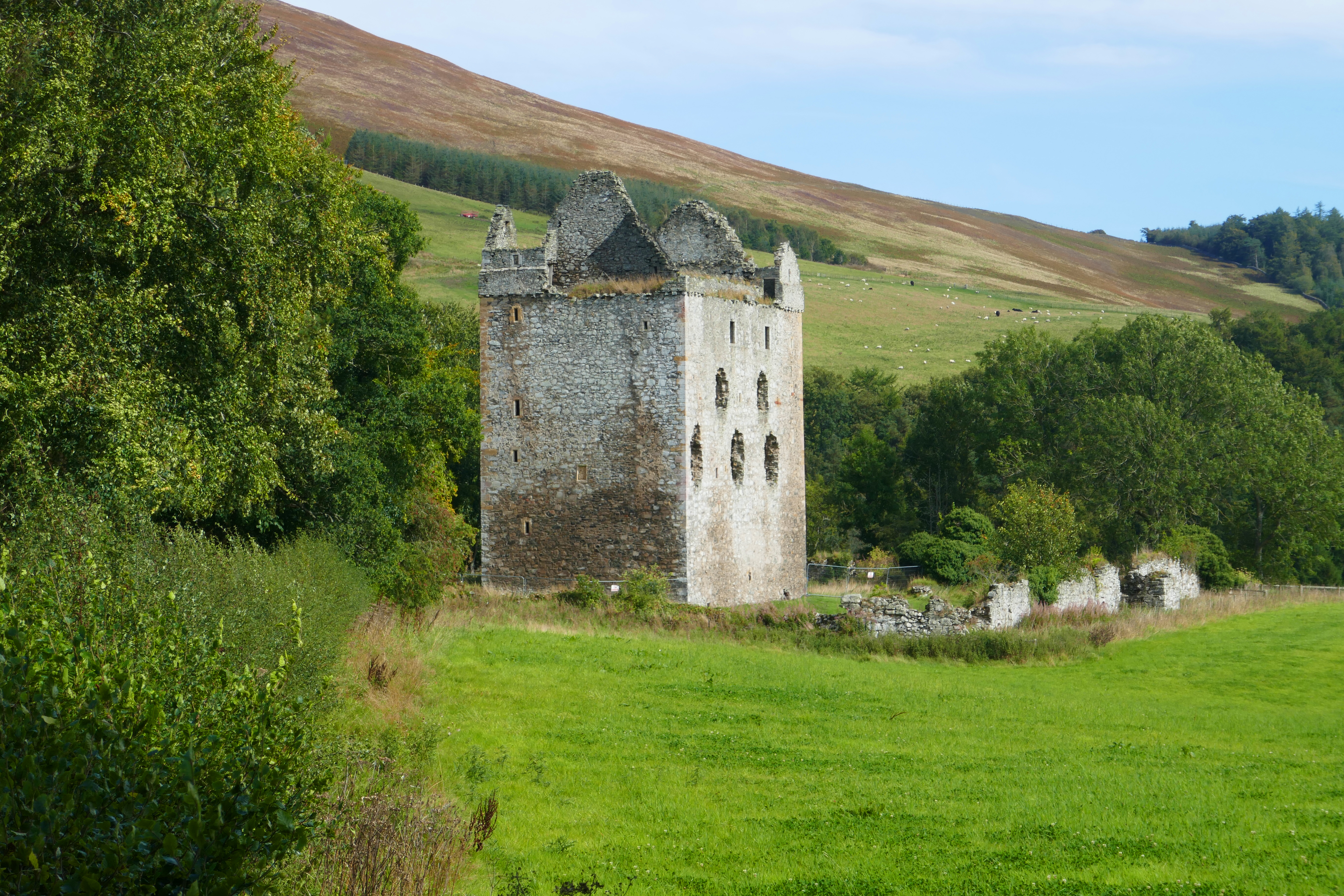
The sun was shining and we planned to complete the Three Bretheren Walk, a classic hike near Selkirk. However, the small car park was packed by the time we arrived. Checking our trusty Walk Highlands app we drove the short distance to Bowhill Estate. The Duchess’s Drive route on the Bowhill Estate was designed for showing off the land to visitors, ascending through woodland to the open moorland. Although on good tracks, the walk was more exhausting than we expected but full of variety and good views across the lumpy Borders countryside. We returned to the car park by the ruins of Newark Tower, whose white stones were bleached by the sun.
Melrose
We picked up the River Tweed again at Abbotsford, the home of the writer Walter Scott. The large rambling house looks interesting to visit but we concentrated on walking up to Cauldshiels Loch, returning along the bank of the secluded Faldonside Loch before completing our circuit on a woodland path along the River Tweed.
In Melrose we visited the abbey, although due to works being carried out we could only walk around the outside, admiring the red sandstone that blushes when caught by the evening sun. Nearby are two National Trust gardens, Harmony House and Priorwood and, keeping an eye on the weather as showers were heading our way, we sauntered through these two walled gardens. They were both well-stocked and interesting, still full of colour and scents even in mid-September. Priorwood Garden also has an orchard and a stall selling produce from the gardens.
We had planned to spend some time at Berwick-on-Tweed, completing our trip along the River Tweed. However, stuff at home unexpectedly got in the way and Melrose was as far as we got. Until next time!

Walking details
Unless otherwise noted, the walks can be found on the Walk Highlands website and app.
The full Devil’s Beef Tub circuit from Moffat is 22.5 km with 521m of ascent. We used a taxi [Moffat Taxis] to get us to the Devil’s Beef Tub viewpoint on the A701 [£10] and walked along the ridge and back to Moffat, reducing the exertion to approximately 15.25 km of walking and only 230m of ascent while retaining lots of interest.
Grey Mare’s Tail and Loch Skeen in the Moffat hills, this 4.5 km walk with 278m of ascent climbs past the series of waterfalls and on to Loch Skeen that is overlooked by craggy hills.
Neidpath Castle and the Tweed walk from Peebles is 6.25 km long with just 89m of ascent. Kingsmeadows car park in Peebles is a large car park and has motorhome spaces.
Pirn Hill Fort Trail in Innerleithen is 2.5 km long with 79m of ascent. Parking is available in a roadside parking area near the entrance to the paths.
The Duchess’s Drive, Bowhill is 11.25 km and 339m of ascent on easy to follow tracks and lanes. There is good parking on the Bowhill Estate for a small charge. The walk is through woodland and across moorland and on lanes by Newark Castle.
Abbotsford has a leaflet of walks you can download, with routes from 2 to 10 km. The Cauldshiels Loch walk is 6.5 km long and takes about two hours from the car park. It was mostly easy to follow, although we did resort to our OS maps as we descended to the River Tweed.
Where we stayed
Moffat Camping & Caravanning Club Site – a good and level site only a few minutes walk from the town.
Tweedside Caravan Park at Innerleithen – this site on the edge of Innerleithen has a small touring area, surrounded by static caravans.
Selkirk Victoria Campsite – on the edge of Selkirk, the pitches are marked out on the tarmac car park at the community-run leisure centre. Campers have keycode access to move the height barrier and access to the three shower rooms and a wash-up sink.
Lilliardsedge Holiday Park – in the countryside between St Boswells and Jedburgh, this is a large site with many statics and a tidy touring area of hardstanding pitches. The site has a restaurant and golf course.
Melrose Caravan and Motorhome Club site – A level site in the town of Melrose and just a few minutes walk from the abbey.

 Back on the road again
Great post and photos Carol, really enjoyed reading this. I love this area, I’d never explored it before we got our van and it seems to lend itself so well to meandering campervan travel 😊
LikeLiked by 1 person
Thank you Sarah. Rivers are perfect for meandering along in a campervan :).
LikeLiked by 1 person