
Exploring the Île de Ré
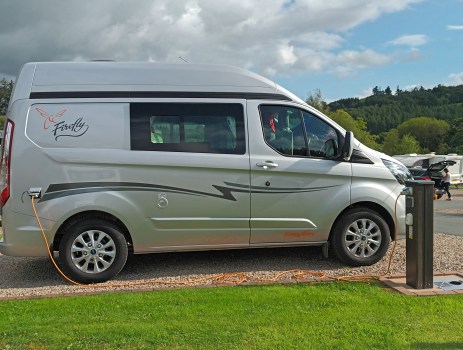
The Île de Ré, on France’s Atlantic coast, had been on my must-visit list for as long as we’ve had a campervan. Photographs on social media of the network of traffic-free cycle lanes on a low-lying and beautiful island tempted me, so my expectations were high as we crossed the elegant arched bridge that joins the island to the mainland at La Rochelle. At just 30 kilometres long, rarely more than a few kilometres wide and almost flat, it didn’t take us long to reach our chosen campsite on the Île de Ré and already we had spotted throngs of cyclists. I felt as if the toll bridge had sneaked in a trip through a space-time portal and we had been swept away to the Netherlands!
Based near central La Couarde-sur-Mer, we quickly settled on our hedged pitch and exchanged smiling nods with our Belgian neighbours. We studied the cycling map we had been given by the polite receptionist and my fingers excitedly followed cycle paths heading to every point of the compass.
Saint-Martin-de-Ré
Our first excursion took a path that hugged the coast to the town of Saint-Martin-de-Ré. The tailwind propelled us like flying machines but highlighted the only downside to cycling on the Île de Ré; the breeze sweeps off the Atlantic and a headwind is hard to avoid. Those social media posts never mentioned the daily battle with the wind!
Crossing the moat into Saint-Martin-de-Ré we admired the herd of Poitou donkeys. These special donkeys have a shaggy coat that takes the uncombed look to the extreme and they are adorable. Entering through the monumental Porte des Campani we found ourselves inside a fortified enclosure, designed to protect the residents from siege. Narrow cobbled streets lined with handsome ivory-coloured houses, each trimmed with eye-catching shutters, led to the harbour. Roses arched over doorways and self-seeded flowers poked through pavements; it is literally wall-to-wall attractive.
Securing our bikes we drank strong French coffee at a pavement café overlooking the boats while chatting to an English couple in search of an oyster-focussed lunch, a local speciality. We pointed them in the direction we had come as we had passed several oyster bars. The extent of the harbour fortifications suggested the Île de Ré was once strategically important, but it was the aerial view when we climbed the steep narrow steps to the top of the Saint-Martin bell tower that laid out the town’s defences most clearly. I took photographs of the town’s red roofs that contrasted prettily with the deep-blue sea. Carefully descending I flinched as the bells loudly boomed the hour.
Salty excusions
Over the coming days, the winding paths though the Île de Ré’s salt marshes unrolled before my wheels revealing new panoramas. We pedalled around mudflats that changed with the ebb and flow of the sea; shallow pools that are managed to produce salt from evaporation and marshland packed with a disarray of colourful wild flowers. There were so many excuses to stop and take in the natural beauty our progress was never fast! At salt producers’ stalls we propped up our bikes and dithered over which salt to buy before popping coins in the honesty box. We halted often to watch graceful avocets and long-legged black-winged stilts on the pools and admire the swifts that performed acrobatics overhead. One afternoon a gecko crossed our path, scurrying into the grass and a tiny rabbit huddled as cyclists raced by.
Cyclists need food and drink and these were another excuse to rest. A café in Ars-en-Ré provided good coffee and a bonus was the treasure trove of memorabilia inside, including a collection of oars arranged in the shape of a fan on the ceiling. Stumbling upon weekly markets we meandered through the colourful and tastefully arranged stalls that sold everything from bread to soap and fresh vegetables to sunhats.
An area of forested dunes that sheltered us from the usual breeze was a perfect picnic spot. While we ate I took deep breaths to get the full benefit of the sharp woody scent of the pine trees. Beyond the woodland the tall Phare (lighthouse) des Baleines became visible. This turned out to be a tourist hotspot with rows of busy restaurants and shops and we bought creamy pistachio ice-cream that was exquisite sustenance for two hot cyclists.
Picturesque villages
Climbing out of the ‘van to get our breakfast bread I noticed the calm; the usual breeze was taking a day off. After a cycle trip along a lane lined with plush white bungalows shaded under umbrella pines to the supermarket and a long French-style lunch, we set off for a short cycle ride to Loix. From the salt marshes, we crossed a narrow bridge to Loix’s attractive and sheltered port. If we had noticed the looming dark clouds we would have stayed in this safe haven. As it was we were cycling along an exposed stretch of coastline when a squall rushed across like a wet puppy, drenching us before we could reach the inadequate shelter of a hedge until the sun returned.
The scattered villages of the Île de Ré punctuated our cycling trips. The island is busy in high season but in May the winding narrow village streets, tightly packed with impossibly lovely white cottages trimmed with shutters painted ice-blue or sage, are sleepy backwaters. The labyrinth of streets was often confusing but by aiming for the church spire we usually found a square with a café, grocery shop and a stylish homeware establishment. The distinctive steeple in Ars-en-Ré is visible for some distance. It is painted black and white and served as a landmark for sailors before the lighthouse was built.
Île de Ré is an island of two halves. The salt pans dominate the north and west and in the southeast forest and agriculture separate the villages. Between Le Bois-Plage-en-Ré and Sainte-Marie-de-Ré we cycled around rows of potatoes, dodging the sprinklers. There were grapevines and meadows dotted with bright-red poppies that led to a forest trail deep with pine needles that crossed the island to the seaside at La Flotte.
In La Flotte we sat on the delightful promenade lined with benches overlooking an azure sea awash with boats. The village was buzzing with lunchtime diners as we wandered through. We continued to a peaceful ruined abbey, where the former cloisters have been transformed into a pretty garden.
Île de Ré had certainly not disappointed as a place to explore all that is fabulous about France by bicycle. If you don’t have your own, there are plenty of places to hire bikes on the island, including at our excellent campsite, La Tour des Prises.


 Back on the road again
I haven’t visited Île de Ré, but it will always have a special place in my heart as the home of the World Windsurfing champion, Antoine Albeau.
We met him at Poole Windfest. Mark wandered up and saw a board on the beach and asked its owner if he could demo it, not realising he had just asked the world champion if he could have a go on his board. Like asking Lando Norris if you could have a drive in his F1 car! Antoine was very nice about it 🙂
We stayed on Noirmoutier next door. It was so beautiful!
LikeLiked by 1 person
I’m glad to hear Antoine Albeau was gracious! It can be breezy on the Île de Ré so I’m not surprised he took up windsurfing. Of course, almost all of France is beautiful but it was a treat to be somewhere with so many cycling options.
LikeLiked by 1 person
For sure! 🙂
LikeLiked by 1 person