
Three days and five trains, plus one planned replacement bus, across Europe to Firenze [Florence] in Tuscany and not a hitch. Given our experiences of appalling train reliability in the northwest of England, this seemed remarkable.
Why Travel by Train?
We have been trying to save the planet for decades and choosing sustainable travel options is second nature. We first travelled across Europe by train in 1991 with our five-year old son. Strikes in France disrupted the ferries and the trains on that journey and our trip to Milan was memorable for a lot of waiting around, some thoughtful French train staff and not always having enough food. For some reason, we were not put off and continued to use public transport to Slovakia, Spain, Germany and Austria through the 90s and 2000s
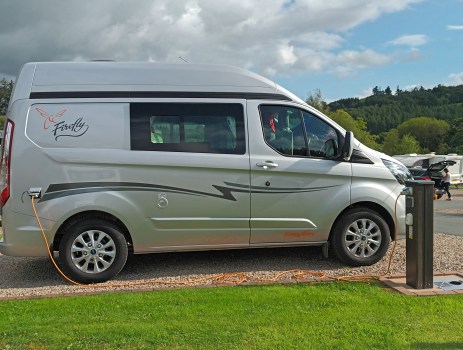
Since buying a campervan, our train travel has been in the UK and from campsites. We wanted to travel on the rails across Europe once again.
Why Firenze?
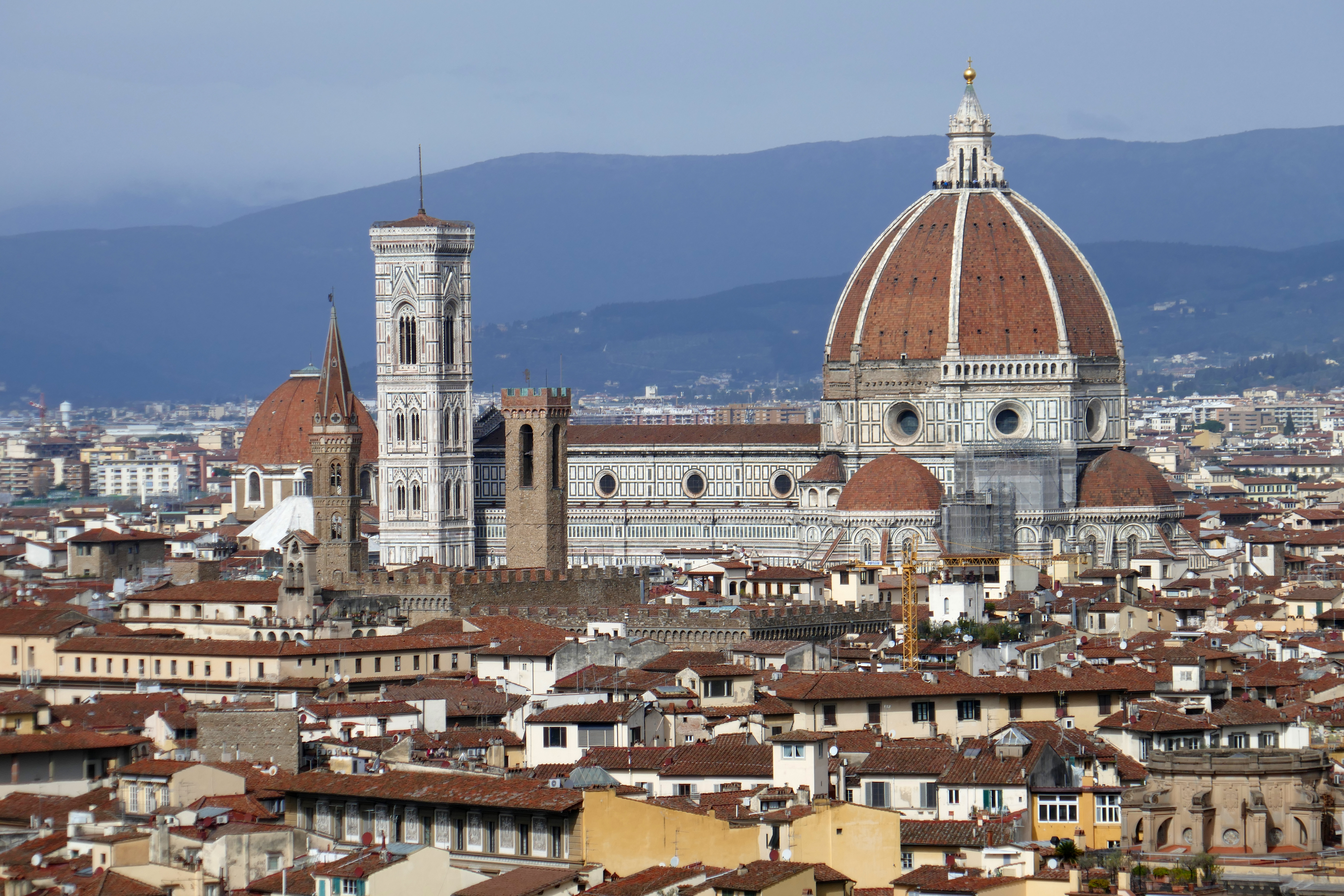
Somehow, we have travelled around Firenze and Tuscany plenty of times but never visited the city. Everytime, we thought about how busy it would be and how hot and bothered we would get and we stayed in the countryside. It was last winter’s jigsaw project that inspired us. The jigsaw showed the Duomo di Firenze and, as we worked on the pieces, a plan to visit began to emerge. Firenze is easy to reach by train, has plenty of accommodation, lots to see and do and the Duomo looked awesome! An out of season trip sounded perfect.
The Journey, Day One
The Lancaster to London Euston train was the part of the journey I was most nervous about but Avanti managed to run a service. We gave ourselves plenty of time for a leisurely walk to St Pancras via Camden. We had selected an evening Eurostar as this was cheaper and the journey was uneventful. A top tip was to buy Metro tickets on the Eurostar so that we could get straight to our hotel when we arrived. We stayed at the Novotel right outside the Gare de Lyon, which I highly recommend.
The Journey, Day Two
Leaving our bags at the hotel, we walked to the Cimetière du Père-Lachaise, as our Gare du Lyon train didn’t leave until mid-afternoon. This vast cemetery is crammed with monumental graves, arranged around rows of narrow paths that climb the hillside. There are so many famous people buried here, you will want to look out your own heroes. We firstly looked for the grave of the author Colette, finding a simple black granite stone adorned with flowers. Oscar Wilde’s grave was a modernist fanciful creation in concrete. Cobbled lanes and narrow earth paths wind around the hillside and we eventually found Jim Morrison’s grave. This American singer-songwriter and lead singer with the band The Doors is popular. His life was not without controversy and his actions not always exemplary but we came in respect of his music.
The 14.48 TGV from the Gare de Lyon to Milano hurtled through the French countryside faster than our campervan. We cruised through the snow-covered mountains in the dusk until we reached Saint Jean-de-Maurienne, where, thanks to a landslide, we had to leave the train for a replacement bus through the Frejus Tunnel to Oulx. We had about 40 minutes to wait in Oulx in the chilly mountain air before the train arrived for the last stretch. We arrived in Torino [Turin] at around 22.00 and walked briskly to The Turin Paradise Hotel.

Day Three in Torino
Torino has been on my must-visit list since I saw The Italian Job and the minis racing through all those arcades. Breaking our journey here for a couple of days was an easy thing to arrange when we booked our tickets with Rail Europe.
Everything about The Paradise Hotel was lavish, including the breakfast buffet. Served in a high ceilinged airy room there were cheeses, yoghurts, cereals, fruit and veg, different breads, four types of honey and a whole table stacked with various croissants, including charcoal ones! This was better than anything we could serve up in our campervan.
It was a sunny day and we had a ball exploring Torino. From the fascinating National Mountain Museum on Monte di Cappuccini, where they seemed to have some of our old camping gear to Café Fiori, one of Torino’s elegant and historic cafes. We tried the local beverage, bicerin, a chocolate-coffee combo that was confusingly sweet and bitter at the same time. We walked around the large outdoor market, under grand arcades, found some of the locations from The Italian Job and window shopped.
Vermouth rosso [rojo in Spain] is one of my passions and Torino is where this aperitif was first concocted. At the stylish hotel bar we ordered vermouth rosso and the bartender spotted two interested amateurs and organised an impromtu tasting. Having chosen our vermouth he poured glasses, added a curl of lemon and bought bowls of olives, crisps and peanuts. This felt such a luxurious start to our evening we needed bringing back down to earth and we ate in the nearby M**Bun, a slow fast-food restaurant.
The Journey, Day Four
Our final train to Firenze was just three hours. There was no buffet car, just a vending machine that dispensed nothing that resembled coffee! The appartment we had booked was about 25 minutes walk across the River Arno. We had a week in a flat that overlooked The Boboli Gardens and we felt in the centre of things. We dropped our bags and set off to explore.
Walking in and around Firenze
Over the next seven days, we walked around the city, getting our bearings and enjoying finding quiet corners as much as the big sights. We crossed the Ponte Vecchio many times, had evening aperitifs in the Piazza di Santo Spirito and were often drawn to the Duomo, just to enjoy its magnificence.
The dancing starlings in the evening sky in Piazza Santa Maria Novella was one of the unforgetable sights and sounds of Firenze. This grand piazza was also where we joined the rally to remember Ukraine on the second anniversary of the full-scale war and invasion by Russia and it became a special place for us.
Bellosguardo – Steep hilly lanes from Porta Romana in the southwest of Firenze took us along the Via San Carlo and to Bellosguardo. Dotted with grand villas, olive groves and vineyards the views over Florence were wide. Cimitero di Soffiano, a vast cemetery with burials on different levels and an art deco style was a highlight on this walk.
Fiesole to Settignano – The number seven bus climbed high into the hills of northeast Firenze to Fiesole. After coffee, we visited the remains of a Roman theatre and baths and an Etruscan Temple. Setting off hiking, we followed narrow lanes and tracks to Monte Ceceri, a maze of trees and small quarries. The network of paths was confusing and online maps such as Lokus and Komoot were useful. At viewpoints we stopped to enjoy the panoramas over Firenze. It was a spring-like day, the birds were singing and breathing in we got a lungful of pine. We descended into Maiano and then doubled back, contouring around the hillside on paths through varied woodland and by terraced olive groves. This part of the walk was much quieter than Monte Ceceri. A damp path took us steeply down to a stream and then climbed up to the houses of Settignano that perched on the hillside. In this sleepy village we caught the next bus back to Firenze.
South of the River Arno along Via Colli to Piazzale Michelangelo – Skirting around the Boboli Gardens, lanes packed with villas took us to Forte Belvedere, which wasn’t yet open for the season. Following Via Colli we wound above Firenze, each turn opening up new views over the city. We turned off the main road, picking up paths to Chiesa di San Miniato al Monte. The church is surrounded by a crowded cemetery and has Firenze spread below. Piazzale Michelangelo thronged with visitors, even in February, but the views of the River Arno, the bridges and the magnificent Duomo are spectacular. We descended through a pretty garden with sculptures.
We visited some sights
The Boboli Gardens cost €10 per person and are perfect for strolling, although beyond green there is little colour from flowers. In February they close at 16.30 and for the last 20 minutes a continuous announcement that the garden is closing is broadcast. This reverberates around the, until then, peaceful gardens! We felt we were in a public announcement torture chamber!
The Galleria dell’Accademia for a dose of art and to see Michelangelo’s David. We had to queue for about 30 minutes, even in February!
The Duomo is a full day in itself. We booked Brunelleschi tickets that can be used over three days, although you still have to join queues. We climbed the cupola and the campanile [both 400+ steps] because we love getting above the roofs of a city. The views were astounding. We also visited the interior. Travel light as you will be searched over and over again!
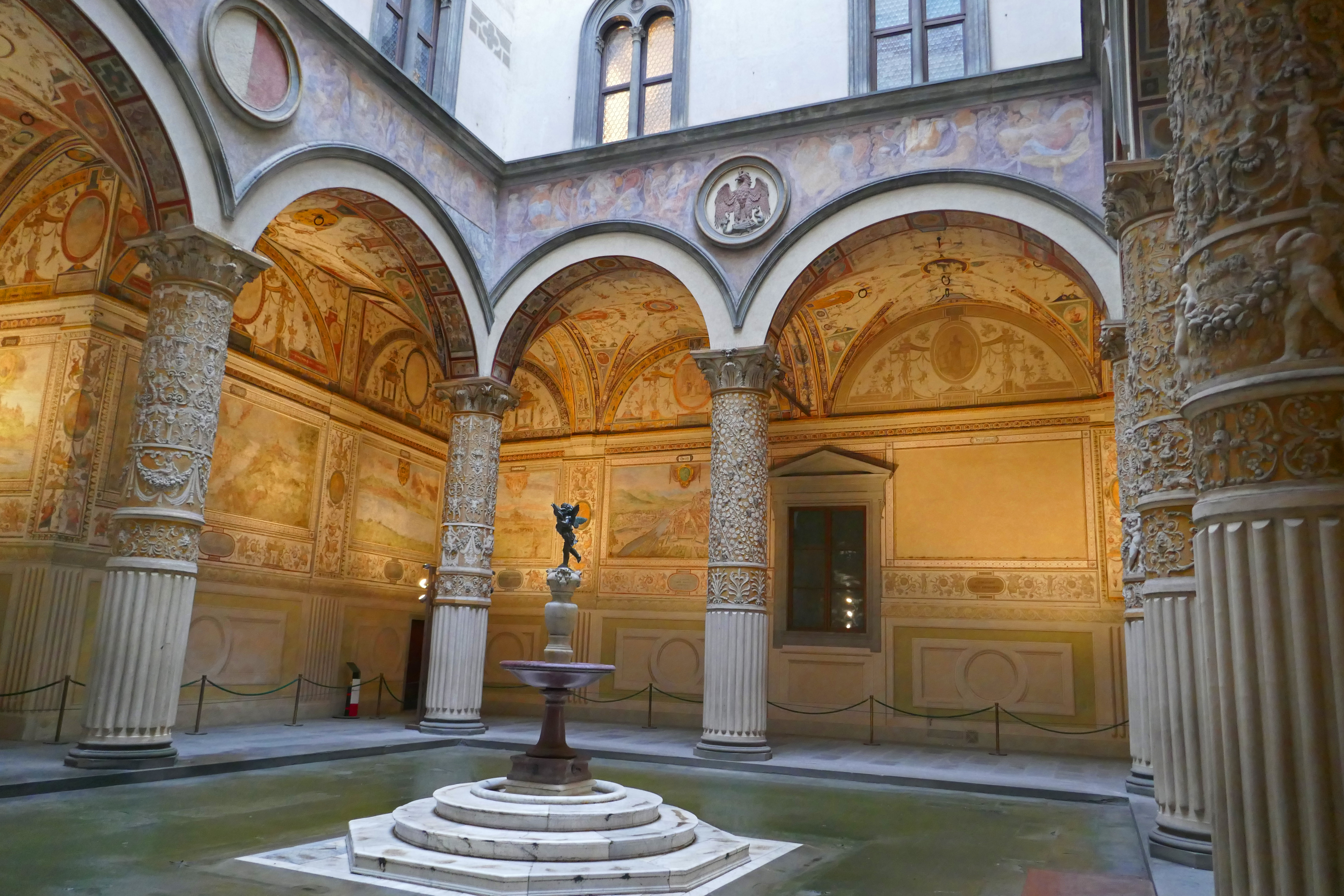
Palazzo Davanzati is a Firenze palazzo on four floors and arranged around a covered atrium with internal balconies. The rooms are all interesting and sumptuously decorated and at the top of the house is the kitchen. There are vases and paintings and ornate furniture from different centuries from the 14th to the 19th centuries. For €6 this was great value in a generally expensive city and interesting and I am suprised how few people seem to visit.
Museo Galileo – Seeing the actual telescopes that belonged to Galileo was astonishing and it was hard for other exhibits to compare to this. It is the place to help you appreciate intricate and shiny scientifi instruments as works of art. There is also an interactive room where we could play at being Galileo!
We visited a couple of churches – The Basilica di San Lorenzo had an austere air to it but the cloisters are light and airy. There are paintings and sculptures by Donatello. Santa Croce, a Franciscan Monastery in front of a handsome piazza, has many memorials and frescoes and double cloisters. There was some information about the 1966 flood that caused so much devastation.
Siena – It was a chilly grey day when we caught the train to Siena for the one hour and twenty minutes journey. Steps and escalators climb up to the city level inside the walls. The streets are narrow and hemmed in by stone buildings, that open up at Il Campo, an undulating public space used for horse racing twice a year. Santa Maria della Scala was the highlight of our Siena trip, this large building complex is a former hospital and is now a museum and art gallery on many floors. The 15th century frescoes showing life in the hospital delighted us with their colour and life, telling stories of the everyday. This warren-like building had other exhibitions, including works by 20th century artist Giuseppe Gavazzi.
A couple of notable places to eat
Caffe Scudieri near the Duomo was expensive but charming. The pinenut torta was tasty and not too sweet and the cappuccino was the best ever, the perfect combination of bitterness and creamy smoothness.
Brac, a bookshop and restaurant that is all veggie and all delicious. We ate surrounded by shelves of bottles of wine and cookery books and had a piatto unico each. This was three dishes, a salad, a pasta and a special dish. The food was elegantly presented and so tasty. The ginger sauce on my tortellini was exquisite. Anthony’s fennel salad was fresh and the pasta with a spicy sauce was excellent. My mouth is still watering thinking of this meal!
Return Journey
Day One – Firenze to Torino and Torino to Paris, with a replacement bus service in the opposite direction. We stayed at the same hotel in Paris.
Day Two – Paris to London and London to Lancaster.
Summing up
We were away for eleven nights, seven in a self-contained flat and four in hotels. The whole trip cost us around £3,000. It is more expensive than a campervan trip but the train was a more sustainable way to travel for such a distance.
Travelling by train still felt like the perfect way to cross long distances in Europe, meet people, experience different cultures and relax while the scenery passes the window. We used the expertise of The Man in Seat 61 in our planning and if you’re thinking of doing a similar trip, this is a good place to start.
Firenze in February seemed busy but I guess this is nothing compared to summer months there. I couldn’t describe it as peaceful and the backdrop in the city centre is the constant rumble of suitcase wheels. Those of us who fling a rucksack on our backs have no comprehension why these are so popular! The weather was mixed with some fine spring-like days and some wet and chilly days. The good thing about a city holiday is that the weather doesn’t really matter.



 Back on the road again
Great photos, great time, by the sound of it.
Jealous ? Me ?
You betcha.
LikeLiked by 1 person
Thank you and sorry for causing holiday envy 🙂 It happens to me all the time!
LikeLiked by 1 person