Recently my bicycle was stolen. It was 13-years old, only big enough for someone 160cm tall and its paintwork was scratched. And yet, it was my comfy bike and had been cared for mechanically over the years. For my comfort I had bought a Brooks saddle, changed the stem and added bull bars. It had a rack for a panier when I was shopping and a bell and mudguards. It was MY bike!
I left it outside Sainsbury’s in Lancaster one evening while I was minute taking for a local charity. There is CCTV and the police watched the thieves take my bike about two minutes before I returned [if only I had walked more quickly!]
I reported the theft to the police and Lancashire Constabulary excelled themselves, calling me four times with updates and getting hold of the above CCTV.
I also made a claim to our home insurance company, where our bikes are listed and specifically insured. At first they were sympathetic and everything seemed to be going through as expected. The next day I was informed that I had to answer some questions, that I should do this in a quiet room and sitting down. I was told the questions would be repeated and I should only answer yes or no.
The questions were asked by a machine and were irritating, ‘Did I know how to use a telephone?’ ‘Did I own a computer?’ Among these trivial questions was one along the lines of, ‘Are any of the items you are claiming for still in your possession?’ I tried to answer these questions clearly but by the second time it was hard not to sound irritated by questions that I considered beyond stupid. I wanted to say, ‘duh!’ to every one of them.
Later that day I had another telephone call from our insurance company. If the first sympathetic member of staff had been good cop, this was bad cop. It seemed the ‘system’ had flagged up one of my answers, suggesting my claim was fraudulent. I was informed that ‘the system’ was highly accurate and rarely wrong! I felt I had wandered in to a farcical performance of 1984; I knew I was telling the truth, but a machine I was told was accurate most of the time heard a lie.
I was on the phone for some time, pointing out to someone with no sense of humour that one of my weaknesses was my inability to tolerate stupid questions. I explained that what the machine had heard was not a lie but my frustration. I tried laughing the whole thing off but this just made things worse. The call became darker and by the end I was being threatened and bullied. I was asked if I wanted to proceed with the claim because if I was found to be acting fraudulently I would be placed on a black list and unable to get insurance in the future.
Describing the call to my partner afterwards made me realise how unacceptable their attitude had been. The telephone call was almost more distressing than having my bike stolen. I knew I wasn’t lying but unbelievably I was being accused of doing so by a machine that is considered to be clever, even though it can’t tell the difference between a sneer and a lie.
It seems most insurance companies now use lie detector software to seek out fraudulent claims. Our house insurance this year is through Admiral but they are not alone in this dubious practice. Insurance companies think this policy has been succesful and saved them money. It isn’t clear how much this is thanks to the clever [?] software identifying fraudulent claims or to their bullying tactics following an alert from the lie detector that makes innocent claimants drop a legitimate claim. I accept that some people will make a claim on their insurance that isn’t real but all they really had to do was talk to the police to know that my claim wasn’t one of them.
I am not prepared to bow down to bullies and I stuck to what I knew was a legitimate claim. I no longer had a bicycle and needed a replacement for getting around. The claim eventually went through, although with the £250 excess, it was still an expensive theft for us.
We quickly realised we had under-insured the bike, only pricing the cost of a replacement bike and forgetting things like locks, lights, rack, mudguard and saddles that we have added over the years. These accessories amount to around £250. Fortunately, it was January and I managed to secure a reasonable replacement bike from Trek in the sales that used up all of the amount paid out. But off-the-shelf bikes have no bell, lights or mudguards and we purchased these, along with a rack from our own savings.
As for the saddle … The manufacturer-supplied saddle on my new bike was so uncomfortable, I could hardly walk after cycling it home from Lancaster! For non-cyclists consider the difference between sitting on a knobbly rock to a sofa and you are almost there. We had an old, slightly better, saddle in the garage so I muddled along with that but cycling was no fun anymore. After a month, in desperation, I found there are lots of second-hand Brooks saddles on Ebay and I bought a womens B17 for under half price so I can once again enjoy being a cyclist.
I hope no one steals your bike, but just in case, check your bike is fully insured and maybe practice answering stupid questions with a straight face!
Sometimes we want a remote campsite surrounded by mountains and on other days we enjoy staying at a site by a small town, where we can linger in a cafe with a good coffee before heading off for a walk. Such sites are not common in England, I can think of numerous lovely market towns where there is no campsite, and if you do find one you have to book months in advance! In France almost every small town has a campsite.
The roads of Normandy in northern France were mostly unknown to our campervan. In September we decided to set this to rights and spent five unplanned weeks exploring many of the corners of this mostly rural region.
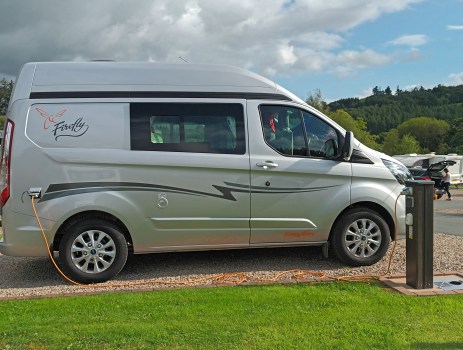
With over 600kms of coastline, it isn’t surprising that we spent a lot of time walking and driving along the coast east from Cherbourg to beyond Le Havre. However, after a few weeks of seaside, we drove inland. South of Caen we turned our silver-blue campervan in to the campsite in the small market town of Falaise. Following the instructions, we chose a free pitch by the river and I immediately knew I would like it here.
Falaise’s municipal site sits under the walls of the town and by the lively river L’Ante and from our pitch we had a view to the monumental castle perched on the crag. The river carves a cleft through the limestone here, with the castle crag to our left and Mont Myrrah rising to our right. With bright clean facilities, fresh bread delivered daily and sunshine, it was perfect.
Finding out Way around Falaise
On our first wander around the town we followed our noses along narrow cobbled roads that wound uphill between pretty houses to a lofty gate, Porte Philippe Jean. Inside the town walls we found the grandiose square leading to the castle. We were drawn to an unusual art work by Jef Aerosol, a renowned French artist. Called ‘War is Hell’ a tank is covered in black and white images of adults and children affected by the brutality of war and also peace symbols. Reconstructed from many tanks and with sections damaged by bullets and mines, the Sherman tank represents the loss of soldiers and civilians in all wars. Of course, Normandy is packed with Second World War history, but in Falaise and Caen we became aware of how this war was devastating for civilians.
The Porte des Cordeliers, Falaise
Falaise played an important role in the Second World War and the liberation of France. After the landings on the Normandy beaches about 50km away on 6 June 1944, driving the German army out of Normandy took weeks of brutal fighting. The battle for Caen was merciless and the Germans did not leave the city until 9 July 1944. We had driven from Caen to Falaise in just over half-an-hour, stopping at the Canadian war cemetery and passing the Polish war cemetery on the way. These places of rembrance were reminders of the remorceless fighting in 1944: it wasn’t until 16 August 1944 that the Allies entered Falaise. The liberation of this small town marked the beginning of the end of the German occupation of France.
On that first afternoon, after visiting the Église Saint-Gervais-Saint-Protais de Falaise, which has some elements from the original 11th century church remaining, we sat in a welcoming cafe in the square and drank creamy hot chocolate while lazily people watching.
Chateau de Falaise, the large castle where William the Conqueror was born dominates the town and is certainly worth a visit. The exhibitions in the keep show historical characters telling their story, with English subtitles. We were somewhat overwhelmed with history having heard from William, his wife Mathilda, his son Henry, Eleanor of Aquitaine and others. On the roof we left the exhibits and looked over the cliffs, understanding how the castle’s position helped it survive sieges.
By contrast, the Musee des Automates was window-to-window fun. There were displays concentrating on the mechanics of the figures and the history of creating engaging Christmas window displays in Parisien department stores, but mostly visitors wander between window displays of moving figures and smile. We spent a long time spotting all the action of a comical scene from the Tour de France, a boisterous and colourful dance marathon was lively and Santa’s doll workshop was absorbingly enchanting.
In the Église de la Trinité de Falaise, near the castle, we studied the photographs of Falaise after the 1944 bombing by the allies. I read the stories from local people, feeling a need to bear witness. Their hardship and suffering was heartbreaking.
Walks in the Falaise Countryside
Our favourite holiday activity is to set off for a hike of between four and six hours under a blue sky and with a rucksack packed with lunch. Surrounded by farmland and sleepy villages, rural Normandy around Falaise offered some unforgettable walking in rolling countryside.
Les Trois Chateaux walking route is 11.5km and begins at chateau number one, William the Conqueror’s chateau in Falaise. Descending from the castle we followed roads through a delightful area by the river that was once mills and tanneries before climbing up Mont Myrrha, an escarpment with a view across the cleft to the castle. We watched a peregrine flying above the towers before descending back towards the town and picking up a traffic-free winding and walled track, the Chemin des Oliviers, to the village of St Laurent. Here we admired the 11th century church with a wooden barrel roof and ornate side chapels.
A sunken path near Falaise
Crossing open fields above the valley a wind insisted we put jumpers on until we reached the shelter of the stone buildings of Versainville. We peered through gates at chateau number two, an elegant 18th century private building. A dark sunken path opened out to a flower-strewn track by a field of corn and a flock of swallows on the wing. Climbing out of the valley back to Falaise, we walked around Château de la Fresnaye (our third chateau), on the edge of the town.
A 13km walk took us through fields above L’Ante river, beginning on a former railwayline, now a walking and cycling route. Narrow lanes wound around vast fields of crops to the village of Eraines, where we were distracted by the village church. Crossing the river on quiet lanes and by desirable houses, we returned back through St Laurent and the delightful walled path, crossing the river by an old mill that led us back to the walls of Falaise.
Entering the village of St Laurent on the Chemin des Oliviers
Useful Information about Falaise
The Medieval walled town of Falaise has a population of under 10,000, but it has all the facilities visitors in a campervan need. In the evenings, we mostly cook in our campervan, splashing our cash on morning coffee and cake. Occasionally we do enjoy a meal in a restaurant and Falaise has a few to choose from. We ate in the creperie, surprisingly busy for a weekday evening in September. We began with a kir Normande aperitif, a local tipple we had happily discovered. With our galettes, made with buckwheat flour, we drank local cider and to finish we shared a crêpe with banana and flaming rum that was delicious.
Saturday is market day in Falaise and it seemed that everyone from the surrounding villages had descended on the usual sleepy streets and we had to shuffle and meander around the shoppers and stalls of vegetables, baskets and clothing. The rest of the week there are small grocers and supermarkets in the town centre and it isn’t far to the Carrefour on the edge of town. There is a larger E LeClerc about 30 minutes walk from the campsite.
A Day out to Caen from Falaise
The 118 bus takes a winding route from Falaise, stopping in every village, to reach the city of Caen. In Caen, the bus station is about 20 minutes walk from the city centre. We were here on market day [Friday] and the streets around Place Saint-Sauveur were lined with stalls. Buskers gave the city a lively soundtrack.
As you would expect there are plenty of restaurants and shops in a city the size of Caen. We had coffee and enjoyed an excellent lunch in L’Okara Cantine on a chic narrow street.
Inside the Abbaye aux Hommes in Caen
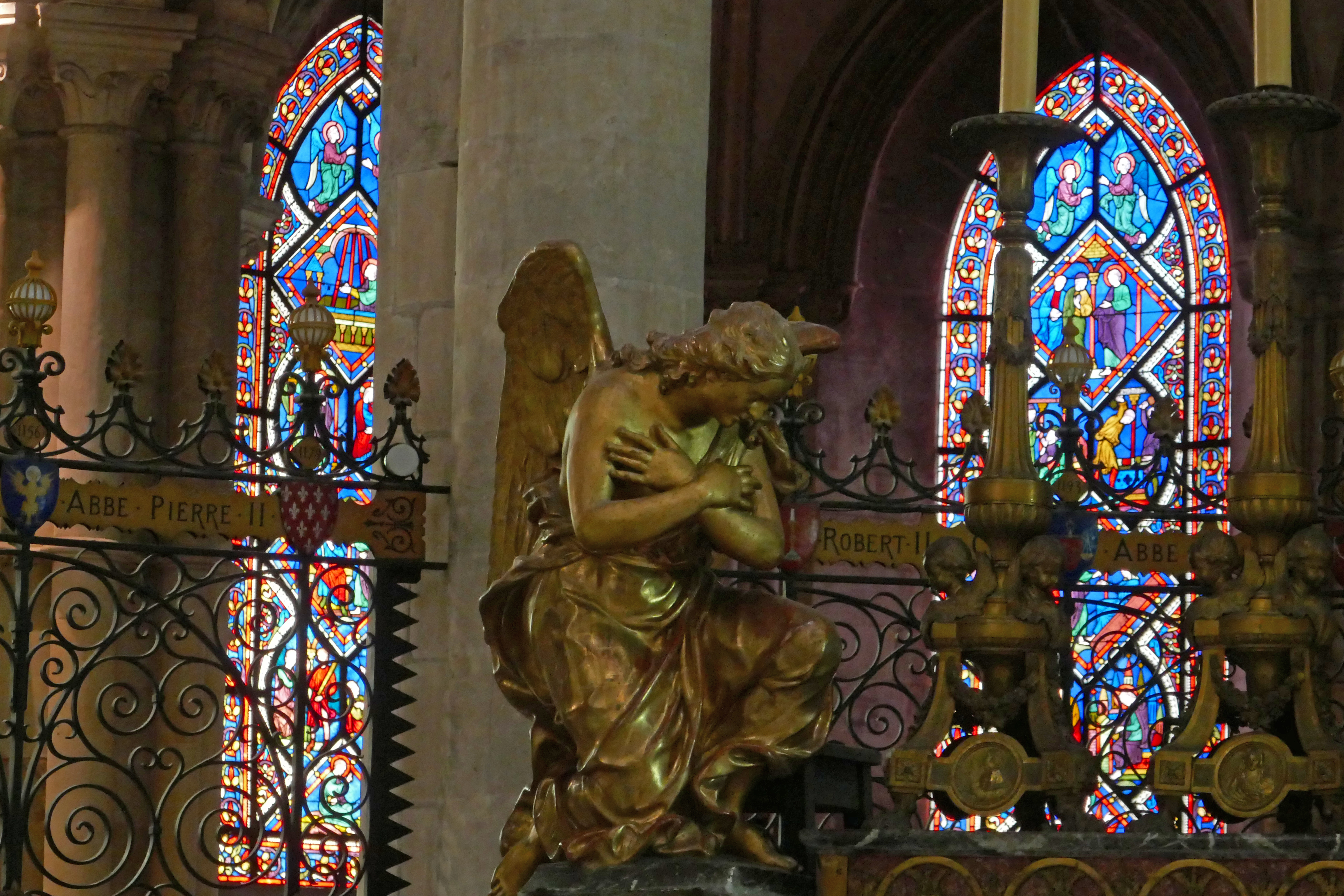
In the immense Abbaye aux Hommes, built by William the Conqueror and rebuilt in the 18th century, there are grand arches, stained glass windows, cloisters and elaborate wrought iron features. William was buried here but disentombed during the revolution and it is said that only a thigh bone now lies in his tomb. The exhibition about the destruction of Caen in the Second World War was sobering. The Abbaye’s role as a hospital meant it mostly survived the bombing.
Exploring on foot, we also found the castle ramparts and the breezy marina before catching our return bus that was packed with young people returning from college.
For more information about the campsite in Falaise and the town, click here.
It is that time of the year when once again I share the expenditure of a couple living in the northwest of England and reveal our spending in all its individualism and flaws.
Our finances had another injection of welcome income in 2024 as my partners state pension and final work place pension kicked in [hurrah to a bus pass and a Christmas bonus of £10 :)]. Near the end of 2025 my own state pension will begin and we will be fullon pensioners and have two bus passes! Even in 2024 93% of our spending came from income, rather than our savings, and this number makes a massive difference to how secure I feel about our finances.
Nevertheless, inflation continues and after spending £28,573 in 2023, we began 2024 with a budget of £30,000 but quickly revised this to £31,000 and added £3,000 for expensive [non-campervan] holidays. You can see how that additional income is going to my head. We managed to keep to this budget [just!]
Once again this year, as well as considering the budget, I also weigh up the environmental impact of our spending and I have highlighted this under each spending category.
Here is how our budget breaks down:
Essentials – total £11,753 [35% of total spending] [2023 £8,418 / 30%]
Food – £4,970 [2023 £4,535] – Averaging £414/month, this is an increase of around 10% on our food and alcohol. We continue to both be vegetarian and often vegan and shop mostly at Lidl, with the exception of wine which comes from our local wine shop, The Wine Society and France. Our shopping habits are mostly a win for the environment and our pocket.
Utilities, insurance & phones for a 2-bed 57.2 sq mtrs [615.7 sq feet] bungalow – £4,131 [2023 £3,584] – Our gas and electric has remained expensive this year averaging £70/month. We decided to enter a fixed price contract towards the end of 2024, which we hope was the right call. In winter we keep the house moderately warm but we do wrap up in layers too and always have cosy blankets to hand. Our water bills remain low [about £18/month] as we have a meter. When we are at home we use about 90 litres of water/day, which is less than the average for a single person household in the UK. United Utilities tell us a single household uses an average of 149 litres of water/day and a typical couple use 276 litres/day. We find it hard to imagine what people do with this much water. We continue to be careful with our gas, electric and water usage, aware that these are resources we should be conserving. Saving energy and water is a win for the environment and our pockets
Essential repairs and replacements – £1,916[not a separate category in 2023] – This is our spending on essential repairs to our property and the cost of replacing our elderly mattress and laptop. Repairing is better for the environment than replacing but we still have a gas boiler which contributes to climate change. We have begun to think about heat pumps.
Our health – £736 [2023 £299] – We replace our specs every three years at the moment and in 2024 it was my turn. Fortunately we only needed check-ups at the dentist and various over-the-counter medications.
The money we spend on the essentials above are, in theory, the minimum we need to survive. It does now include some repairs and replacements but not the costs of owning a campervan, stuff buying and holidays.
Stuff (electronics, books, newspapers and other kit) – £4,969 [15% of total spending] [2023 £5,832 / 21%]
Household spending [everything from glue, newspapers and books to bird food, gardening stuff and parts for the bikes] – £3,612, [ 2023 £4,979] I have separated out essential repairs and replacements from items that are truly more stuff, although this category will include smaller repairs. In 2024 we did more work on our garden, buying recycled bricks and building a raised bed which then needed plants and a new tree to fill it. We also purchased one new replacement mobile phone and new ladders. Buying reclaimed bricks and planting a tree are environmental wins and costs that we could bear.
Clothes & accessories – £1,357 [2023 £853] – Another expensive year for clothes! A good chunk of this spending was buying new waterproof jackets, which will hopefully last a few years. I had a spectacular fall in 2024 and ripped the knees of a pair of good walking trousers [not in a stylish way]. I did manage to replace these in a sale and we continue a one-in one-out policy on clothes. Where possible we have scoured charity shops for clothing, particularly for fancy dress parties. An environmental and spending thumbs down.
Experiences – £16,061 [47% of total spending] [2023 £13,619 / 47%]
Holidays [still our favourite spending line] – £7,358, [2023 £4,481] – This paid for around 17 weeks of holidays in 2024. We spent 86 nights in our campervan [including five weeks in France]. We also tried some non-campervan holidays including a couple of weeks self-catering in Scotland and a pushing-the-boat-out trip to Italy. This was our February visit to Turin and Florence for an unforgettable two-week trip by train that cost £3,000. We have also stayed in one of Manchester’s Premier Inns about half a dozen times when we are visiting for friend’s celebrations. Taking the train to Italy is at least 80% less in carbon dioxide emissions than flying and is much more fun!
Restaurants & cafes – £3,554, [2023 £2,687] – Wow! What can I say, we clearly love going out for coffee and food and watching the world go by!
Running the campervan [servicing & insurance etc] – £1,975 [2023 £3,475] – 2024 has been a much cheaper year for our campervan as it has required no major work, just the usual services, insurance and MOT. A campervan does burn fossil fuels, so a thumbs down for the environment but camping holidays are cheaper, so a plus for our pockets!
Diesel for the above ‘van – £1,076 [2023 £1,210 ] – We can’t save the planet single-handed but we can try. One way is to use our campervan [our only vehicle] as little as we can. For short journeys we walk or cycle and for longer trip we take the bus or the train if it is feasible.
Tickets for concerts, football & attractions – £1,081 [2023 £696] – We continued getting out to see good films at the cinema in 2024 (The Outrun was a favourite] but around 20% of this spending was during our holiday to Florence. We didn’t visit everything in the city but entrance fees are high in Italy.
Public transport costs – £1,017 [2023 £1,070] – A consequence of using our own vehicle less is using public transport more and this figure does not include our train travel to Florence, which comes under holiday spending. In 2024 my partner got his much anticipated bus pass and with the £2 capped bus fares we have used buses without a thought and made the most of it, travelling to the Lake District and out of Morecambe for linear walks. The increase to £3 in 2025 feels steep but by 2026 I will have my own bus pass! We have a Disabled Rail Card to reduce the cost of our train fares and this is our preferred method of getting to Manchester. A return to Manchester is around £30 for the two of us, although unreliability continues to be frustrating. Although rail travel is often more expensive than driving, we prefer to keep our environmental impact as low as we can.
Giving – £1,057 [3% of total spending] [2023 £704 / 2%]
Gifts & donations – £1,057 [2023 £704] – In 2024 we continued to support charities that we care about and an increase in our gifting to charities and family and friends reflects our greater security with more income. We have also both taken up some volunteering in 2024, giving our time and skills to local organisations. By focussing our giving on environmental charities we can be part of the change required.
TOTAL SPENDING FOR 2024 – £33,840
I am pleased that we just came in just under the £34,000 budget. Our actual spending is still much less than the £43,100 quoted in 2024 as the amount needed for a couple to achieve a moderate retirement but well above the minimum amount. I would suggest our retirement is much more than moderate!
2024 has been our highest spending year in retirement.In the last eight years ofretirement we have spent an average of £26,619 a year.
By the end of 2025 our pension income will be complete when I reach state pension age.We are currently expecting to spend around £35,500 in 2025 [including another splashing-out holiday]. This will be mostly, but not entirely, funded by income.
Here’s to 2025 when we hope to continue to live the life we want to lead and have the resilience to survive whatever 2024 brings us.
Let me know in the comments below how your budget matched your spending in 2024 and your hopes for 2025.
The walk uphill from the Jubilee Tower on the Trough of Bowland road isn’t steep but it can seem relentless. The call of red grouse accompanied my heavy breathing. The grouse fly low over the ground and as they land they appear to scold, ‘Get back, get back!’ A snipe rushed out of the longer rushes as we unknowingly disturbed it. This is the Forest of Bowland, almost tree-less high moorland that is managed for driven grouse shooting.
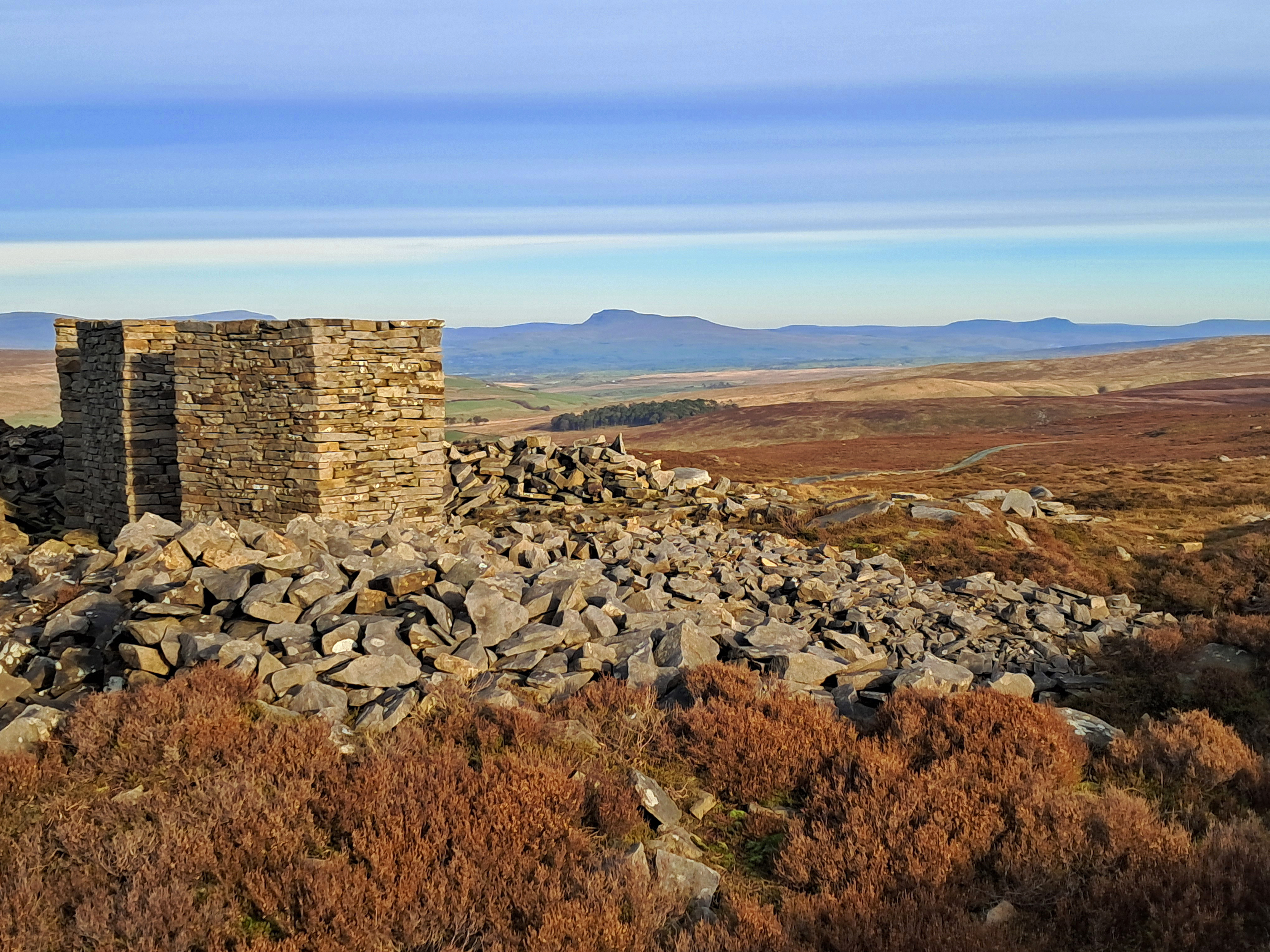
Reaching the bump of Grit Fell, we turned towards Clougha Pike and stomped across the flank of the fell, stepping over heather and bilberries towards the quarry. Here we stepped over broken stones, stopping when we reached the debris that has been organised into art.
The work of artist Andy Goldsworthy, three boxes of stone were built between 1999 and 2001. Each has an opening with pointed ends and inside Goldsworthy has created curving internal walls. The openings are the perfect size for an adult human to stand in and people often use the step by each shelter to do just that and pose for a photograph.
The temperature was just below zero and the boggy ground of the moors was irregularly frozen, the white ice highlighting the intricate details of green mosses. Black patches of un-walked peat were as hard as tarmac. From the quarry we were briefly blessed with an easy-to-walk track; this is how the wealthy arrive here to kill grouse. Elsewhere I watched where I placed my feet, constantly on the look out for thin coatings of ice over chilly water.
Around us was rolling heather-covered peat moorland, an occasional gritstone outcrop of broken stones creating an unexpected event in the landscape. We stood silently watching a pair of red grouse shambling among the heather nearby, staying close to each other and unpeturbed by us.
Walking towards an old wall on the horizon, I was reminded of the paper doilies my grandma used to serve my birthday cake on. Against the light, the crumbling wall appeared frilly around the edges and the low and feeble November sun glimmered through the many gaps in the stones. I wondered if the wall had been built with these holes and did they make for a stronger wall? Or is the wall gradually decaying from within and merely waiting for the next storm to tumble into a pile of stones?
The wind was coming from the south-west bringing slightly warmer weather. Returning from Clougha Pike in that direction, it blew into my face [the only part of me exposed] and my frozen blocked nose dripped as I concentrated on breathing through my mouth. We passed a small pool reflecting the blue sky in crackly ice.
The view took in the whole of Morecambe Bay, from Barrow, to Arnside over Morecambe and Heysham to Fleetwood. The expanse of this feature that we live alongside can really be appreciated from these high viewpoints. Blackpool tower punctuated the horizon, a white Isle of Man ferry was just reaching Heysham and the River Lune slithered to the sea at our feet.
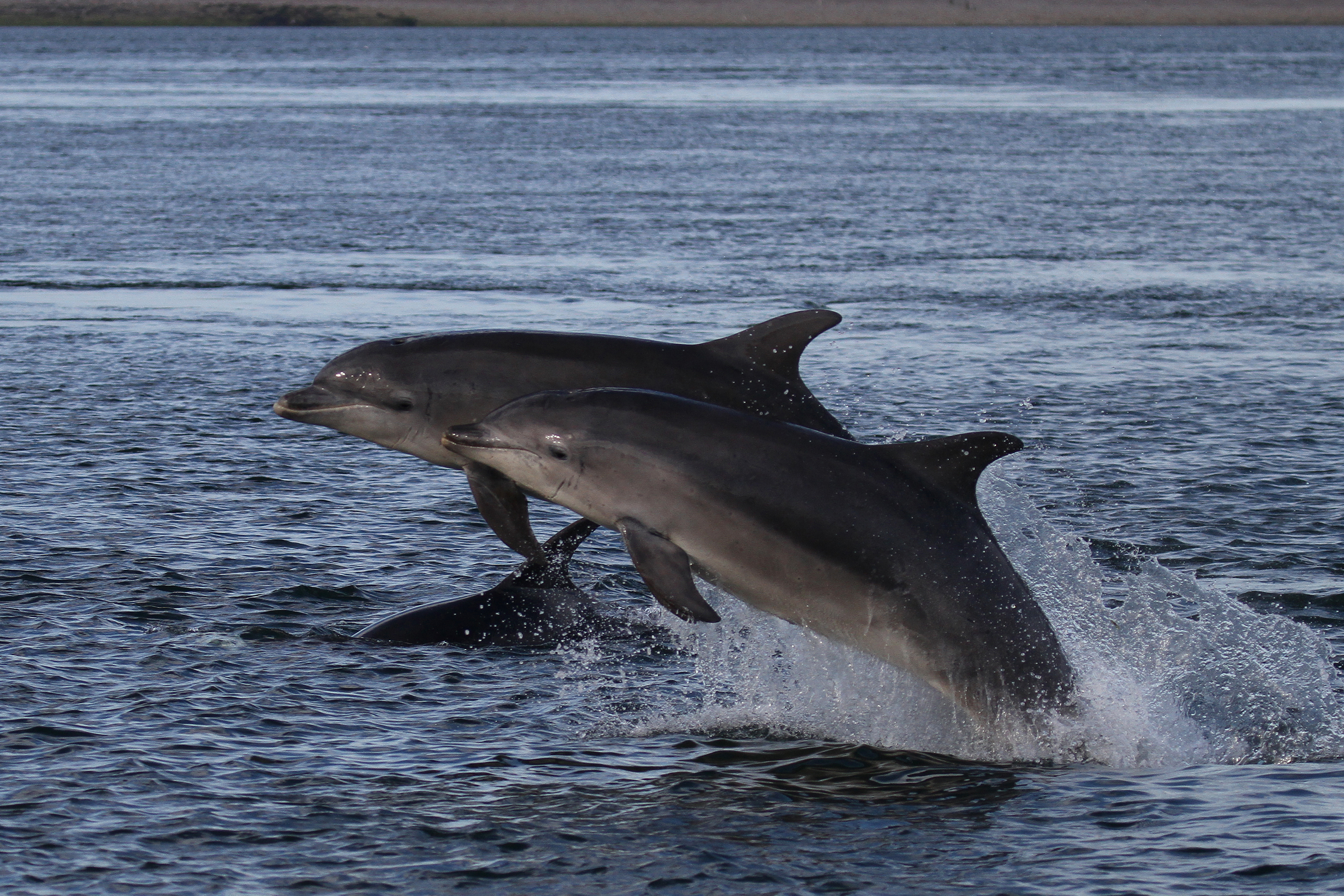
Fans of dolphins know the best time to see them at Chanonry Point near Inverness is an hour or so after low tide when the dolphins follow the current, chasing the fish up the Moray Firth. It therefore wasn’t surprising that even in arctic conditions (I was wrapped up like Nanook of the North) we found a small crowd on the pebbly beach below the lighthouse. Among them was the Whale and Dolphin Conservation’s Field Officer and, knowing him from previous visits, we caught up while we shivered in the bitingly cold wind, constantly looking hopefully across the choppy water. ‘You can say you’ve seen The Black Isle turn white,’ he quipped as we turned around to see the fields above Chanonry Point dusted in snow. Our bone-chilling patience was eventually rewarded with an acrobatic and cheering display from five dolphins.
Scottish Gaming
Our Scottish trip had started in much warmer temperatures in the pretty town of North Berwick on the Firth of the Forth. It felt like mid-summer not late March when we walked to Tantallon Castle that sits dramatically on the cliffs near North Berwick. Skylarks fluttered high in the blue sky, joyfully singing their hearts out and seabirds were already bagging their spots on the cliffs below the castle’s stone walls. Shimmering in the blue sea was the volcanic island lump of Bass Rock, home to gannets,
In North Berwick we had more fun than I expected in the Scottish Seabird Centre thanks to an array of interactive games that are popular with children and adults who haven’t quite grown up! The games were challenging for a non-gamer and I was soon a hungry seal and a dead fulmar chick! There are more traditional exhibits too and watching the close-up film of flying geese I was mesmerized, feeling part of the flock. Used to seeing these birds high in the sky, witnessing the power radiating from their necks and wings was remarkable.
Fog rolled in that evening ending the unseasonably warm weather and lingered into the next morning as we left North Berwick. Driving down a narrow lane, a hare raced towards us hugging a mossy stone wall. Knowing how devastating it would be to hit one of these mythical symbols of good fortune we pulled in and watched the beautiful animal gallop by.
Wildlife Havens
It was chilly at Loch Leven RSPB reserve and we walked briskly between the hides around the pools. Despite the cold the birds seemed to sense spring was on the horizon and pairs of lapwings twirled in the air, their swanee whistle call reminding me of Sooty’s fun and accident-prone friend, Sweep. The noisiest neighbours, the black-headed gulls, mixed up their own raucous mating dance with swooping attacks at the swans. Unperturbed the male swans, feathers impressively puffed up, powered through the water in pursuit of nonchalant females.
The woodland uphill trail not only warmed us up but showed that Loch Leven has more than birds. A couple of adorable red squirrels bounded around the trees, a roe deer raced up the hill when it spotted us and another lucky hare crossed our path. From the top we had a birds-eye view over the reserve.
Sometimes a campsite immediately feels like home and Silverburn Park near Leven was one such place. The tree-lined entrance road opens out to a camping area with views across the golf course to the sea. Run by a charity, campers receive a warm welcome and as well as the beach, have the run of a delightful walled garden. While I eyed up the cakes in their café a biscuit-coloured cat with a deep purr rubbed around my legs.
Looking out the next morning there was a colourful sunrise and a flurry of snow which soon melted. In fresh weather we walked along the sandy beach to the charming seaside village of Lower Largo. Here creative and colourful gates and sculptures adorned with local scenes and seafaring themes brightened up the streets. In the opposite direction the beach took us to Leven. Returning through golf courses we had views across the Firth of the Forth with Bass Rock highlighted by the sun.
Fine and Dandy
Shopping for some essentials in Dundee we admired The Discovery, one of Scott’s ships displayed on the quayside, and stumbled upon the amusing and energetic Desperate Dan statue. The publishers of The Dandy and Beano comics were based in Dundee and a life-size Dan struts confidently across a square dragging his sidekick Dawg on a lead while Minnie the Minx is ready with her catapult.
Before driving to the campsite at Stonehaven, a favourite of ours, we stopped at Fowlsheugh Cliffs. Even this early in spring this crinkly coastline was packed with noisy kittiwakes, the birds balancing on the narrow ledges of their high-rise accommodation. Stonehaven campsite has fabulous coastal cliff walking, a castle and a picturesque harbour on the doorstep. An added bonus are the quirky metal sculptures of boats, planes and lighthouses that line the bay, but don’t take my word for it, if you’ve never been add it to your list!
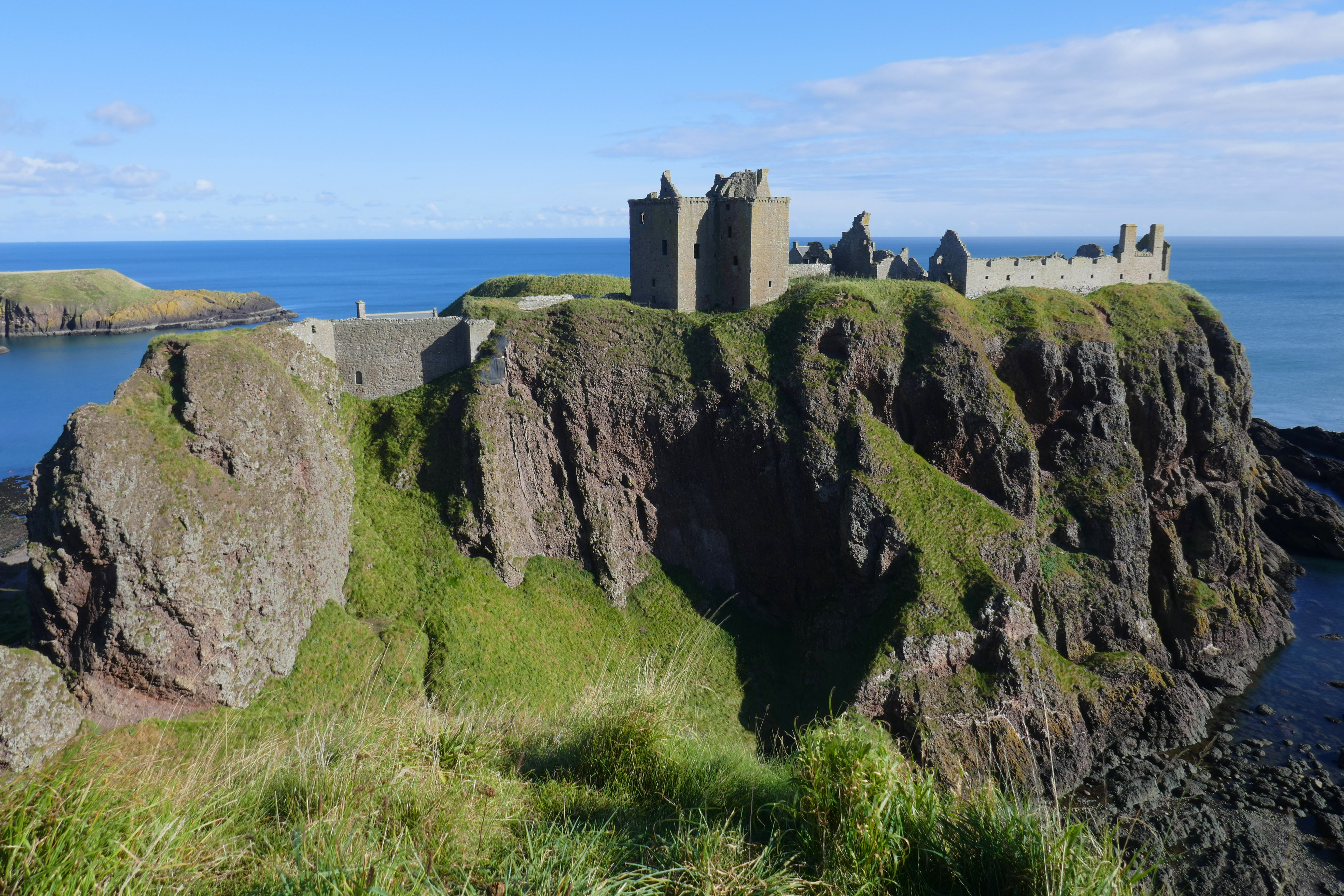
The cliff path to Dunnottar Castle is packed with breathtaking views, starting with Stonehaven and its harbour. Spring weather had blown in and we stopped at the temple-like war memorial to take in the panoramic views that now included the towers of Dunnottar Castle that perches on a rocky outcrop above the sea. We’ve visited the castle before so returned through Dunnottar Woods where, judging by the profusion of tiny doorways, the fairies hang out.
Happiness Comes in Waves
Heading north, we were treated to the magical sight of a marsh harrier at Loch of Strathbeg. Parking at the ruined Rattray Chapel that overlooks the loch we had lunch watching the birds. The narrow road deteriorates after the chapel so we hiked the mile or so to Rattray Head, a remote and striking stretch of coast. Sand dunes sculpted by the wind and sea to form mini-mountains covered in spiky grasses that whispered in the wind led us to the beach. The tide was high and water surrounded the small lighthouse. Walking along the beach watching the waves and the cormorants we felt so lucky to have this spot to ourselves.
The sea stayed close at the Fraserburgh campsite and as warming sun streamed through the ‘van windows I was comfy watching the tides, the surfers and some hardy swimmers in the bay. Anthony muttered about salt and mud and made the most of the good weather to clean the worst muck off the ‘van. Later we strolled around the harbour packed with boats of different sizes and colours and watched scores of herring gulls skilfully wheeling through the air, amazed you never see them collide.
To the Lighthouse
The next morning the weather reminded us it was still only March as dark clouds obscured the sun and hail bounced off the pavements while we sheltered in a doorway before running to a café for coffee. Once the sun returned we made for the Scottish Lighthouse Museum, the highlight of which was climbing the spiral staircase of the disused Kinnaird Head lighthouse where from the light and gallery we had blustery views over the sea and Fraserburgh.
Later we walked along Fraserburgh Bay, a sweep of golden sand where children paddled in a shallow stream and gleefully raced up and down the largest sand dune. At the end of the bay we headed inland by a serene river and returned on sheltered paths between the dunes.
Back on the road we pulled in to Cullykhan Beach car park for a short walk by a stream that tumbles through a gorge to a delightful sandy cove. Beyond we could see the row of white cottages of Pennan. We have explored this north-facing coast between Fraserburgh and Inverness many times and I have happy memories of the beaches, cliffs and picturesque villages but there are still new corners to explore.
Tweet of the Day
A bumpy farm track took us to the car park for Troup Head where RSPB signs directed us to the cliffs where gannets nest. Graceful gannets always take my breath away. About as big as a goose, gannets are experts in elegance as well as being accomplished fishers. Close up we could see their heads were the colour of thick clotted cream and their fearsome-looking beaks were baby-soft blue. Huge-winged gannets soared below us, their throaty call filling the air and we watched others gathering clumps of grass for nesting.
We had never visited Lossiemouth so, as the weather cranked up for an autumn-like wet and windy storm, we pulled into the East Beach car park hoping to explore. In a break in the heavy showers we strolled around the harbour and the grid pattern of streets before battening down for a windy night in the ‘van. Always looking for the bright side, Anthony hoped the torrential rain would clean off some of the mud we had picked up during the day.
Culbin Forest and Nairn’s East Beach are so vast, even though we have visited before we were soon on unfamiliar paths through the fragrant pine trees. There is plenty of space for everyone here and even though Nairn isn’t far away we easily found quiet corners. Leaving the trees and dunes we reached the sandy beach and I spotted handsome black and white oystercatchers with their long orange beaks that are perfectly designed for probing mud. As they deftly flew along the tideline we grinned at each other as we heard their exuberant sharp calls.
Dancing Dolphins
If you’re lucky at the Rosemarkie campsite you will bag one of the pitches with an uninterrupted sea view. We were fortunate perhaps because everyone else had seen the wintery weather forecast and stayed home. It was bitterly cold and the next morning we once again woke to sleet. Undeterred, after breakfast we walked along the shore to Chanonry Point, the best land-based place in Scotland to watch dolphins. After our amazing dolphin encounter we thawed out in the ‘van and spent a cosy afternoon relaxing, eating and drinking, occasionally glancing up to watch the birds on the shore.
Before leaving Scotland’s east coast we had a date with our favourite pizza place north of Gretna Green. The sleety-snow had ceased but it remained chilly as we parked in the village of Cromarty. Whatever the weather pizza has to be earned and before ordering at Sutor Creek Café we had a brisk walk around the harbour, seafront and pretty streets.
The bonny Cromarty Firth was dotted with a bizarre collection of rustic (or rusting) defunct oil platforms. These strangely beautiful structures loom like industrial dinosaurs and contrast sharply with the picturesque cottages and attractive streets of Cromarty. Striding out along The Links we came upon The Emigration Stone, a tall artwork that commemorates the ships packed with people that left these shores for the New World. It is inscribed with the description of one ship’s bittersweet departure.
While our pizza cooked in the wood-fired oven at Sutor Creek we enjoyed the warmth of the café and chatted to the chefs about the oil platforms. They told us some locals complain but others have become so accustomed to them they’re almost invisible! We ate our pizza back in the ‘van overlooking the firth and it was as delicious as expected (my mouth is watering just writing this).
We have been to Scotland more times than I have fingers and toes to count on so it is remarkable that we still find new and awesome sights to see, but then it is an outstanding country. As usual we experienced every season but there is no doubt we will be back again for pizza and dolphins and so much more.
North Ledaig Caravan Park north of Oban in Scotland is a popular campsite. For us it has good and bad points but we made the most of a couple of nights here, leaving our campervan onsite and walking from the site.
The Campsite
This is a large site with different areas for Caravan and Motorhome Club members and non-members. This isn’t a club site but it is affiliated. The site slopes down to the coast and many of the pitches have a sea view but you have to deal with the tilt, unless you carry large levelling blocks. There are some pitches that are level, often tucked away without a sea view. Pitches are allocated by the site, and, as we found, changing the pitch you have been given is more of a palaver than it really should be.
There are two facilities blocks, one in the centre of the site and one by reception and the shop. These are both kept clean and have modern showers that are okay.
As well as the sea view and colourful sunsets, the disused railwayline that is now a cycle path and runs through the site is the other big plus at North Ledaig. This is part of the Caledonia Way from Campbeltown to Inverness. It is a mixture of road and traffic-free cycling. Most of the 49-mile section between Oban and Fort William [the stretch this campsite sits on] is on this disused railwayline and it is a fairly level route with fantastic views.
A Walk around the Lanes – approx 8km
This is an almost completely flat walk. We turned right on the cycle path and walked down to North Connel on the traffic-free route. Crossing the main road, we took the lane through Black Crofts and around the shore of Loch Etie. We were walked around the Moss of Achnacree and caught glimpses of the heather moss occasionally through individual houses and we could gaze along Loch Etive. This is a residential road with houses of different ages and sizes and there is some traffic. It became quieter once we turned onto the straight road back to North Ledaig. A signed along here warned us about red squirrels and sure enough, one bounded up a lane towards us and scampered under a fence into the trees.
Walk up Beinn Lora – approx 9km
With a sunny day forecast, we decided to climb Beinn Lora, a small hill that overlooks the campsite. It is only 308m high but being on the coast it is a marvellous viewpoint. This time we turned left on the cycle path to Benderloch, which is only 1.5km from the campsite. We were disappointed that the lovely café here closed on Mondays and Tuesdays so we took a flask. From Benderloch we climbed steeply through the woodland on well-made paths with regular picnic benches and viewpoints. We could look down on the coast and see the rows of caravans and motorhomes at North Ledaig below us, as well as the runway of the hardly-used airport.
Stopping for coffee and an early lunch on the last picnic bench, we had views north over Benderloch to Morvern. Walk Highlands suggested the final push to the summit can be boggy but it was okay on our September walk. On the open hillside of rock and short wet sections, skeins of geese flew over honking enthusiastically. From the rounded trig point we could see Ben Cruachan and along Loch Etive and laid out below was the moss we had walked around the day before. It was clear enough to see over Lismore and across to Mull and in the distance were the Paps of Jura. For effort vs reward, Beinn Lora tips the scales very much towards reward. We returned to the campsite the same way.
Three days and five trains, plus one planned replacement bus, across Europe to Firenze [Florence] in Tuscany and not a hitch. Given our experiences of appalling train reliability in the northwest of England, this seemed remarkable.
Why Travel by Train?
We have been trying to save the planet for decades and choosing sustainable travel options is second nature. We first travelled across Europe by train in 1991 with our five-year old son. Strikes in France disrupted the ferries and the trains on that journey and our trip to Milan was memorable for a lot of waiting around, some thoughtful French train staff and not always having enough food. For some reason, we were not put off and continued to use public transport to Slovakia, Spain, Germany and Austria through the 90s and 2000s
Since buying a campervan, our train travel has been in the UK and from campsites. We wanted to travel on the rails across Europe once again.
Why Firenze?
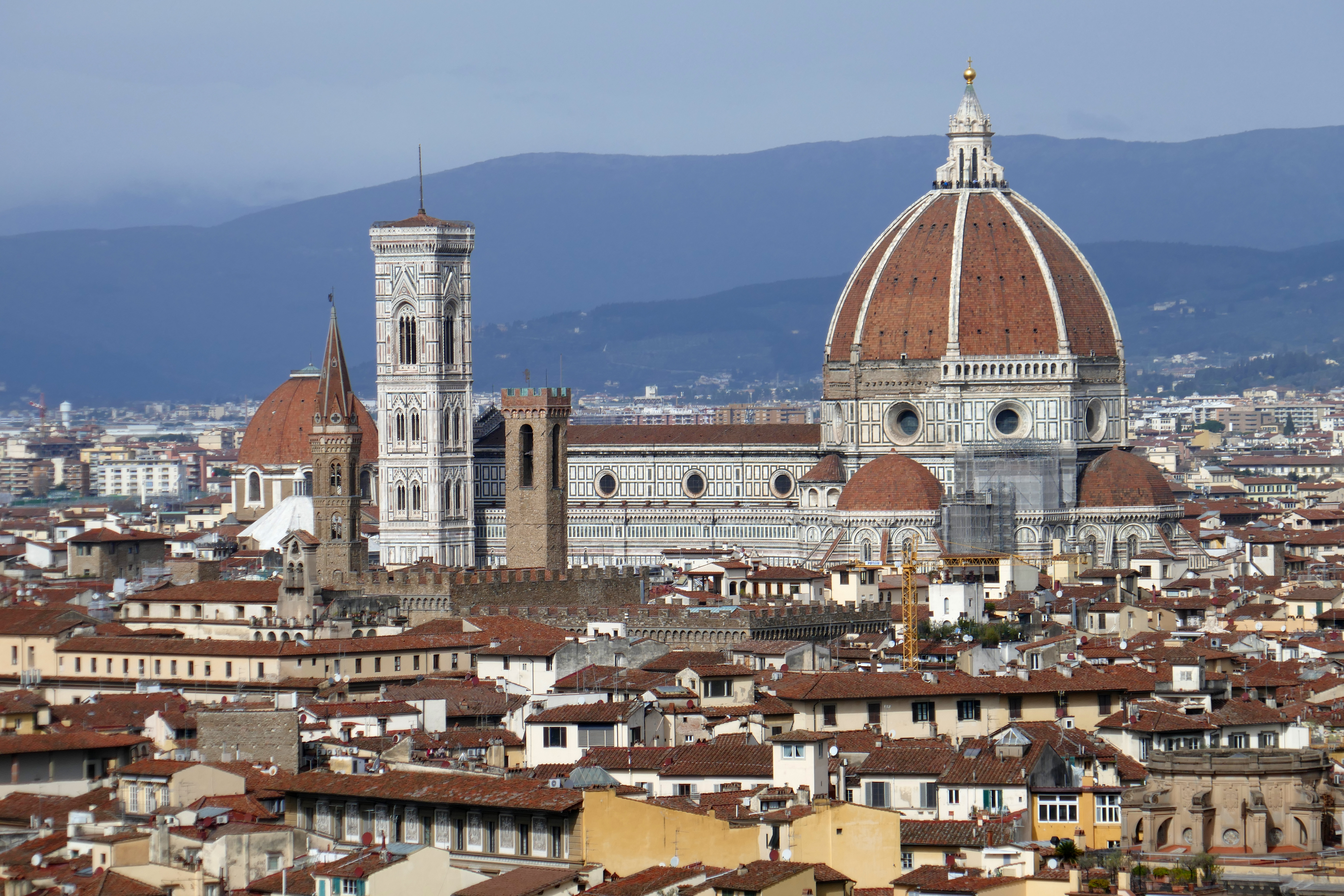
Somehow, we have travelled around Firenze and Tuscany plenty of times but never visited the city. Everytime, we thought about how busy it would be and how hot and bothered we would get and we stayed in the countryside. It was last winter’s jigsaw project that inspired us. The jigsaw showed the Duomo di Firenze and, as we worked on the pieces, a plan to visit began to emerge. Firenze is easy to reach by train, has plenty of accommodation, lots to see and do and the Duomo looked awesome! An out of season trip sounded perfect.
The Journey, Day One
The Lancaster to London Euston train was the part of the journey I was most nervous about but Avanti managed to run a service. We gave ourselves plenty of time for a leisurely walk to St Pancras via Camden. We had selected an evening Eurostar as this was cheaper and the journey was uneventful. A top tip was to buy Metro tickets on the Eurostar so that we could get straight to our hotel when we arrived. We stayed at the Novotel right outside the Gare de Lyon, which I highly recommend.
The Journey, Day Two
Leaving our bags at the hotel, we walked to the Cimetière du Père-Lachaise, as our Gare du Lyon train didn’t leave until mid-afternoon. This vast cemetery is crammed with monumental graves, arranged around rows of narrow paths that climb the hillside. There are so many famous people buried here, you will want to look out your own heroes. We firstly looked for the grave of the author Colette, finding a simple black granite stone adorned with flowers. Oscar Wilde’s grave was a modernist fanciful creation in concrete. Cobbled lanes and narrow earth paths wind around the hillside and we eventually found Jim Morrison’s grave. This American singer-songwriter and lead singer with the band The Doors is popular. His life was not without controversy and his actions not always exemplary but we came in respect of his music.
The 14.48 TGV from the Gare de Lyon to Milano hurtled through the French countryside faster than our campervan. We cruised through the snow-covered mountains in the dusk until we reached Saint Jean-de-Maurienne, where, thanks to a landslide, we had to leave the train for a replacement bus through the Frejus Tunnel to Oulx. We had about 40 minutes to wait in Oulx in the chilly mountain air before the train arrived for the last stretch. We arrived in Torino [Turin] at around 22.00 and walked briskly to The Turin Paradise Hotel.
Torino
Day Three in Torino
Torino has been on my must-visit list since I saw The Italian Job and the minis racing through all those arcades. Breaking our journey here for a couple of days was an easy thing to arrange when we booked our tickets with Rail Europe.
Everything about The Paradise Hotel was lavish, including the breakfast buffet. Served in a high ceilinged airy room there were cheeses, yoghurts, cereals, fruit and veg, different breads, four types of honey and a whole table stacked with various croissants, including charcoal ones! This was better than anything we could serve up in our campervan.
It was a sunny day and we had a ball exploring Torino. From the fascinating National Mountain Museum on Monte di Cappuccini, where they seemed to have some of our old camping gear to Café Fiori, one of Torino’s elegant and historic cafes. We tried the local beverage, bicerin, a chocolate-coffee combo that was confusingly sweet and bitter at the same time. We walked around the large outdoor market, under grand arcades, found some of the locations from The Italian Job and window shopped.
Vermouth rosso [rojo in Spain] is one of my passions and Torino is where this aperitif was first concocted. At the stylish hotel bar we ordered vermouth rosso and the bartender spotted two interested amateurs and organised an impromtu tasting. Having chosen our vermouth he poured glasses, added a curl of lemon and bought bowls of olives, crisps and peanuts. This felt such a luxurious start to our evening we needed bringing back down to earth and we ate in the nearby M**Bun, a slow fast-food restaurant.
The Journey, Day Four
Our final train to Firenze was just three hours. There was no buffet car, just a vending machine that dispensed nothing that resembled coffee! The appartment we had booked was about 25 minutes walk across the River Arno. We had a week in a flat that overlooked The Boboli Gardens and we felt in the centre of things. We dropped our bags and set off to explore.
Walking in and around Firenze
Over the next seven days, we walked around the city, getting our bearings and enjoying finding quiet corners as much as the big sights. We crossed the Ponte Vecchio many times, had evening aperitifs in the Piazza di Santo Spirito and were often drawn to the Duomo, just to enjoy its magnificence.
The dancing starlings in the evening sky in Piazza Santa Maria Novella was one of the unforgetable sights and sounds of Firenze. This grand piazza was also where we joined the rally to remember Ukraine on the second anniversary of the full-scale war and invasion by Russia and it became a special place for us.
Bellosguardo – Steep hilly lanes from Porta Romana in the southwest of Firenze took us along the Via San Carlo and to Bellosguardo. Dotted with grand villas, olive groves and vineyards the views over Florence were wide. Cimitero di Soffiano, a vast cemetery with burials on different levels and an art deco style was a highlight on this walk.
Fiesoleto Settignano – The number seven bus climbed high into the hills of northeast Firenze to Fiesole. After coffee, we visited the remains of a Roman theatre and baths and an Etruscan Temple. Setting off hiking, we followed narrow lanes and tracks to Monte Ceceri, a maze of trees and small quarries. The network of paths was confusing and online maps such as Lokus and Komoot were useful. At viewpoints we stopped to enjoy the panoramas over Firenze. It was a spring-like day, the birds were singing and breathing in we got a lungful of pine. We descended into Maiano and then doubled back, contouring around the hillside on paths through varied woodland and by terraced olive groves. This part of the walk was much quieter than Monte Ceceri. A damp path took us steeply down to a stream and then climbed up to the houses of Settignano that perched on the hillside. In this sleepy village we caught the next bus back to Firenze.
South of the River Arno along Via Colli to Piazzale Michelangelo – Skirting around the Boboli Gardens, lanes packed with villas took us to Forte Belvedere, which wasn’t yet open for the season. Following Via Colli we wound above Firenze, each turn opening up new views over the city. We turned off the main road, picking up paths to Chiesa di San Miniato al Monte. The church is surrounded by a crowded cemetery and has Firenze spread below. Piazzale Michelangelo thronged with visitors, even in February, but the views of the River Arno, the bridges and the magnificent Duomo are spectacular. We descended through a pretty garden with sculptures.
We visited some sights
The Boboli Gardens cost €10 per person and are perfect for strolling, although beyond green there is little colour from flowers. In February they close at 16.30 and for the last 20 minutes a continuous announcement that the garden is closing is broadcast. This reverberates around the, until then, peaceful gardens! We felt we were in a public announcement torture chamber!
The Galleria dell’Accademia for a dose of art and to see Michelangelo’s David. We had to queue for about 30 minutes, even in February!
The Duomo is a full day in itself. We booked Brunelleschi tickets that can be used over three days, although you still have to join queues. We climbed the cupola and the campanile [both 400+ steps] because we love getting above the roofs of a city. The views were astounding. We also visited the interior. Travel light as you will be searched over and over again!
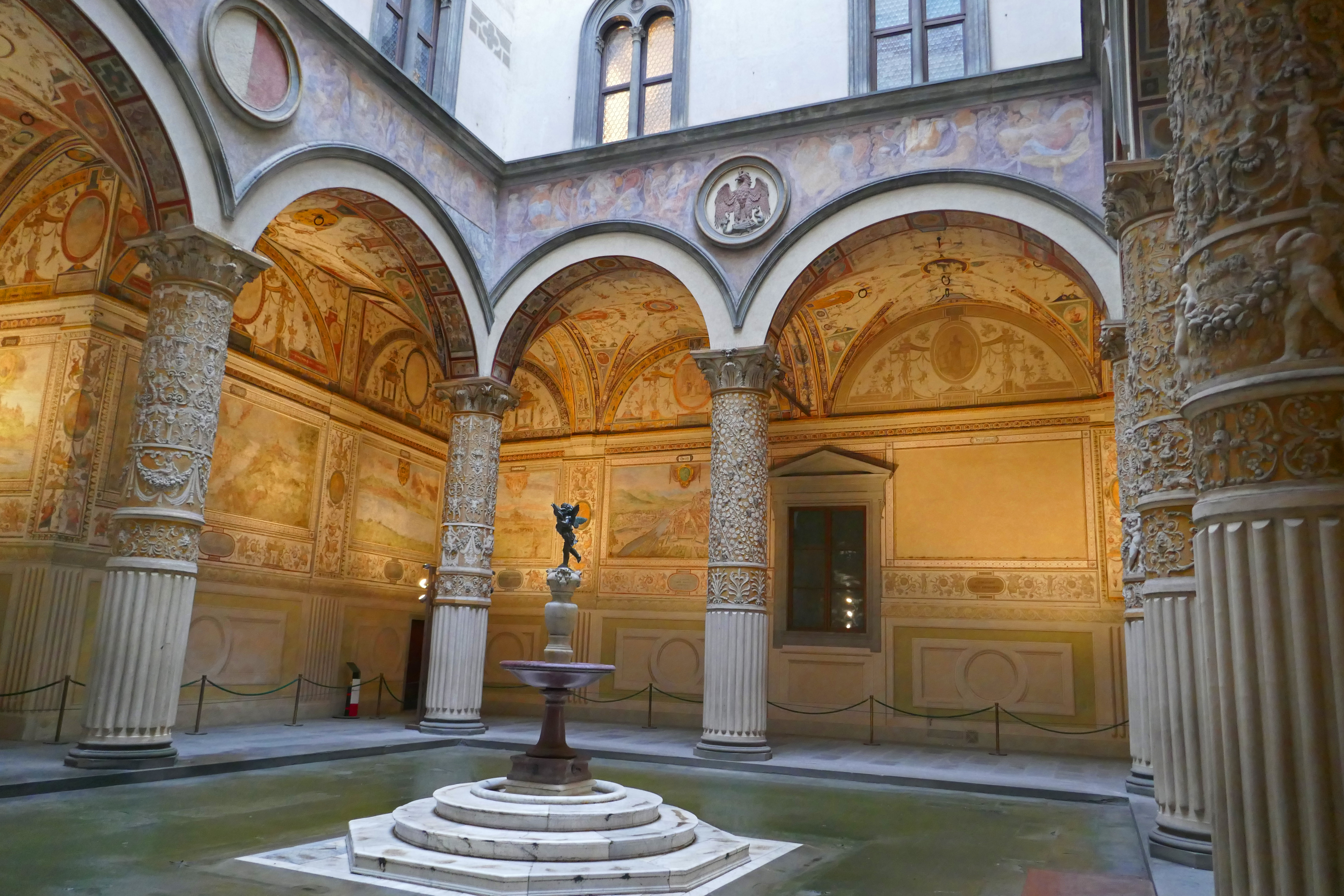
Palazzo Davanzati is a Firenze palazzo on four floors and arranged around a covered atrium with internal balconies. The rooms are all interesting and sumptuously decorated and at the top of the house is the kitchen. There are vases and paintings and ornate furniture from different centuries from the 14th to the 19th centuries. For €6 this was great value in a generally expensive city and interesting and I am suprised how few people seem to visit.
Museo Galileo – Seeing the actual telescopes that belonged to Galileo was astonishing and it was hard for other exhibits to compare to this. It is the place to help you appreciate intricate and shiny scientifi instruments as works of art. There is also an interactive room where we could play at being Galileo!
We visited a couple of churches – The Basilica di San Lorenzo had an austere air to it but the cloisters are light and airy. There are paintings and sculptures by Donatello. Santa Croce, a Franciscan Monastery in front of a handsome piazza, has many memorials and frescoes and double cloisters. There was some information about the 1966 flood that caused so much devastation.
Siena – It was a chilly grey day when we caught the train to Siena for the one hour and twenty minutes journey. Steps and escalators climb up to the city level inside the walls. The streets are narrow and hemmed in by stone buildings, that open up at Il Campo, an undulating public space used for horse racing twice a year. Santa Maria della Scala was the highlight of our Siena trip, this large building complex is a former hospital and is now a museum and art gallery on many floors. The 15th century frescoes showing life in the hospital delighted us with their colour and life, telling stories of the everyday. This warren-like building had other exhibitions, including works by 20th century artist Giuseppe Gavazzi.
A couple of notable places to eat
Caffe Scudieri near the Duomo was expensive but charming. The pinenut torta was tasty and not too sweet and the cappuccino was the best ever, the perfect combination of bitterness and creamy smoothness.
Brac, a bookshop and restaurant that is all veggie and all delicious. We ate surrounded by shelves of bottles of wine and cookery books and had a piatto unico each. This was three dishes, a salad, a pasta and a special dish. The food was elegantly presented and so tasty. The ginger sauce on my tortellini was exquisite. Anthony’s fennel salad was fresh and the pasta with a spicy sauce was excellent. My mouth is still watering thinking of this meal!
Return Journey
Day One – Firenze to Torino and Torino to Paris, with a replacement bus service in the opposite direction. We stayed at the same hotel in Paris.
Day Two – Paris to London and London to Lancaster.
Summing up
We were away for eleven nights, seven in a self-contained flat and four in hotels. The whole trip cost us around £3,000. It is more expensive than a campervan trip but the train was a more sustainable way to travel for such a distance.
Travelling by train still felt like the perfect way to cross long distances in Europe, meet people, experience different cultures and relax while the scenery passes the window. We used the expertise of The Man in Seat 61 in our planning and if you’re thinking of doing a similar trip, this is a good place to start.
Firenze in February seemed busy but I guess this is nothing compared to summer months there. I couldn’t describe it as peaceful and the backdrop in the city centre is the constant rumble of suitcase wheels. Those of us who fling a rucksack on our backs have no comprehension why these are so popular! The weather was mixed with some fine spring-like days and some wet and chilly days. The good thing about a city holiday is that the weather doesn’t really matter.
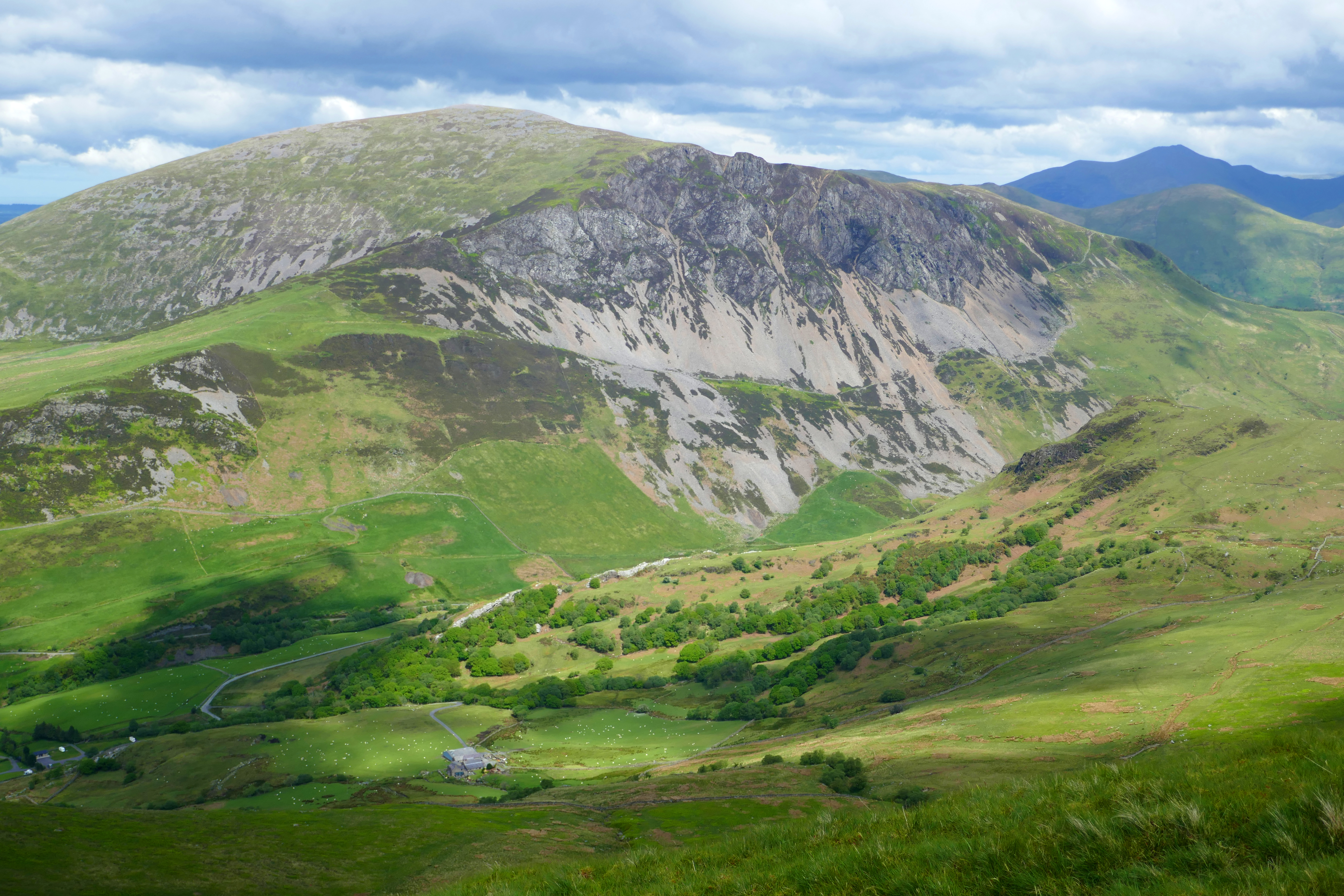
Tal-y-mignedd Campsite in the Nantlle Valley is a campsite that is made for the word nestling. Tucked away between steep hills on the edge of the Eryri National Park [Snowdonia] in North Wales, this is a place to find tranquility, fabulous hiking and, maybe surprisingly, good coffee.
The Campsite
Pitches – At Tal-y-mignedd, the camping is divided over a number of fields from large to small enough for just a few tents. These are all either totally level or mostly level and all have open views. For campervans there are a few hardstanding pitches with electric hook up and some grass pitches with electric too. There is also plenty of room for non-electric pitches for tents and ‘vans on grass.
Facilities – There is one facilities block with male and female showers and toilets, an accessible bathroom and a kitchen with sinks for washing up, a microwave, hob, kettle and fridge/freezer and washing machine and dryer. There is also a second campers kitchen which wasn’t open when we were there. There is a chemical toilet disposal point and fresh water taps. Everything was kept clean and tidy. A pleasant surprise in a valley that has little in the way of phone signal was good and free wi-fi.
Access – The B4418 between Rhyd-Ddu and Nantlle is single-track in places. You either have to drive three miles on this quiet narrow road from the Beddgelert to Caernarfon road or around two miles from the village of Nantlle.
The campsite wasn’t busy when we were staying there. It was mid-week and May and only three or four other pitches were in use. This didn’t put any strain on the facilities but a stay here would be a livelier experience during a busy summer weekend.
Reception is in the farmhouse and the family were always friendly and helpful. This is still a working farm and their vehicles drive up and down the track but this was never intrusive. Sheep sometimes find themselves on the camping field and the sound of birdsong is interupted by cattle!
We paid £27/night with electric hook up and it is £20/night without. This seemed good value for hot showers and fabulous views.
Things to do
The campsite sits on the Snowdonia Slate Trail. This 83-mile long circular route starts and ends in Bangor and visits sites associated with the slate industry of North Wales and takes walkers through forests, by lakes and into villages. The section along the Nantlle Valley is fairly level and reasonably well signed. From Tal-y-Mignedd we picked the trail up in both directions.
Walking East – Heading towards the peak of Yr Wyddfa [Snowdon], we joined the narrow lane for a short distance, through the hamlet of Drws y Coed where we left the road and followed an increasingly damp path past an unused dam towards woods. A cuckoo called from across the valley and making our way around the craggy Clogwyn Y Garreg we had views of Yr Wyddfa. You could extend this walk and make a day of it with a rest at the pub in Rhyd-Ddu.
Amazing sunsets – The valley is aligned pretty much east-west and watching the light soften as the sun goes down is special.
Walking West – We also followed the Snowdonia Slate Trail along the valley bottom into Nantlle village and walked back along the lane, making a circular walk. The farm track passes a lake, Llyn Nantlle Uchaf, before reaching the village. At one time there were 40 slate quarries in the Nantlle valley and the village developed at the end of the 18th century to serve this industry, many of the quarrymen coming from Ynys Môn [Anglesey] and Arfon [the mainland of Wales facing Ynys Môn. For more about the history of Nantlle see the Dyffryn Nantlle website.
Drinking good coffee – In Nantlle we visited Poblado Coffi. In a unit in the old quarrymen’s barracks, coffee experts roast and blend beans. All the beans are sourced from sustainable coffee growers and they have strong relationships with these growers and pay a fair price for the coffee. We sat in the courtyard tasting the delicious coffee of the day, along with a slice of ginger flapjack and left with a couple of bags of coffee in the rucksack. If you find yourself anywhere near this gem, take the time to visit.
Walking up – We couldn’t resist climbing the hill that the farm shares its name with. This is a relentless steep climb but worth it for the views over the mountains, including Yr Wyddfa and to the sea. The first section is on a zig-zag track that climbs through sweet-smelling bluebells in May. The hill is only 653m high but punches above its weight and the rocky summit has a tall obelisk that you can see from the valley. Once at the top, fit and experienced walkers will continue along the stunning Nantlle Ridge for a longer walk and in warmer weather we would probably have done the same.
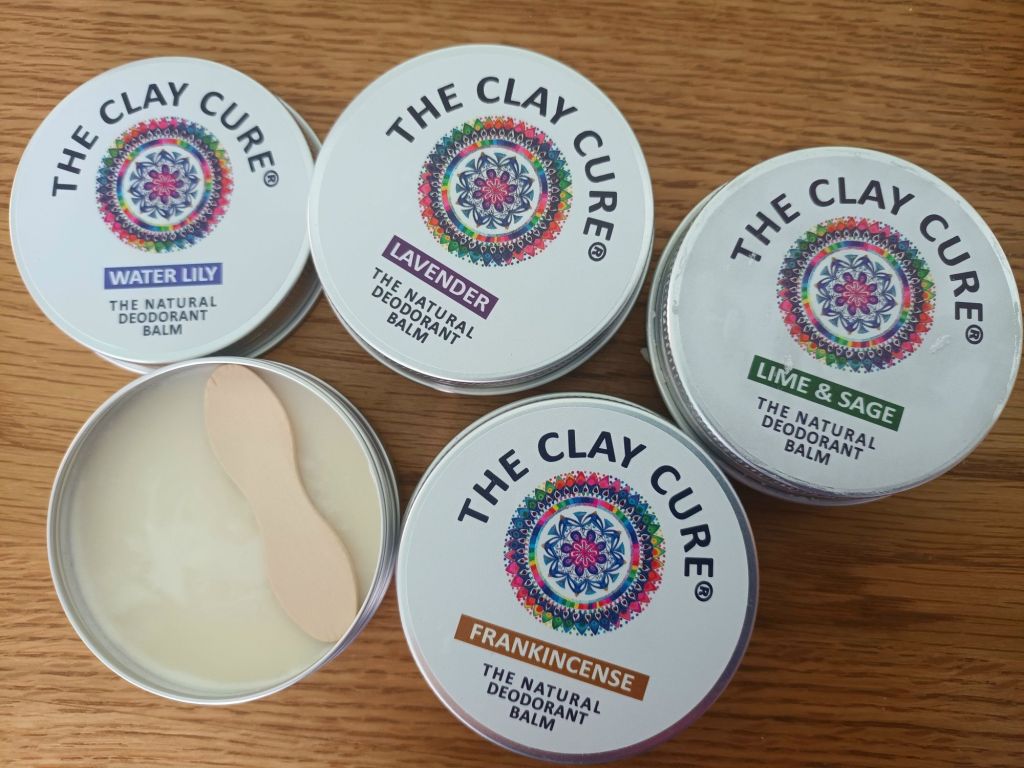
Reducing plastic is important to me but so is finding things that do what they say on the tin. The Clay Cure natural deodorant balm covers both these bases, it comes in a tin and does what the label says!
My search for a deodorant that is effective and easy to use is one that has lasted decades. I have tried rock-like crystal deoderants that had little impact; I have experimented with deodorant bars from Lush [one of my favourite companies] but found them messy and ineffective [but they do work for others] and I have tried doing without. The latter means I end up washing my clothes more often which uses more washing powder [in a cardboard box] and wears out my clothes more quickly, so isn’t a perfect solution.
So when I purchased a tin of The Clay Cure’s deodorant balm a couple of years ago, I wasn’t very hopeful that this would be the wonder product it is. Now I wouldn’t go anywhere without it.
For women and men, the deodorant balm comes in a small metal tin, not quite 7cm in diameter and around 2.5cm tall. It has a screw-on lid. Inside is a solid but soft deodorant, about the consistency of fridge-hardened butter [but it is vegan] [it is often softer in summer when the weather is warm]. The tin comes with a flat wooden spoon, familiar from tubs of ice-cream. You use this to scoop up a pea-size ball of the balm. Rolling this between your fingers warms and softens the balm and it is then easy to rub it in under your armpits. It disappears immediately, there is no waiting for it to dry, it isn’t greasy and it doesn’t stain your clothes.
I now buy in bulk from The Clay Cure website and, if you sign up for their newsletter, you will be notified when they have offers. There are currently eight different perfumes and a neutral deodorant. I like all of them, particularly the lavender and the lime and sage but you will have your favourite. You can find them on sale in other retailers such as wholefood shops and large farm shops.
If you buy two from their website, they are currently £8 each. I haven’t tracked how long they last but it spreads into months. There is no waste due to being packaged in a tin. This means you can get at every single bit of the balm. You are also left with a tin which is useful for storing all sorts of stuff from pins to peanuts or screws to sweets. Adding up all the plus points, this deodorant balm doesn’t feel like an extravagance.
Other easy wins in my aim to reduce our plastic footprint and stay reasonably clean and fresh smelling include solid shampoo, rather than bottles. We also always use bars of soap, rather than shower gel or liquid soap.
As usual, I have not been paid or even given any free products [I wish] to write this review. I share information about products I have found and enjoy using.
The Derbyshire market town of Buxton is famous for water; having the highest market place and its graciously curved Georgian crescent. We have visited many times and find it perfect for two campervanners who like hiking. Buxton has a number of campsites [see below] and does offer sights for those who don’t want to spend the day in the surrounding countryside. But if, like us, you enjoy a warm day in the great outdoors, below are five of my favourite walks for five days camping in Buxton.
The distances on the walks below are approximate and are based on walking from the Caravan and Motorhome Club’s Buxton site. I haven’t given step-by-step directions but the paths in this popular part of the country are well-walked and I hope that you can pick up our route [or make up your own] from an OS map.
Day One – Exploring Buxton [at least 7kms]
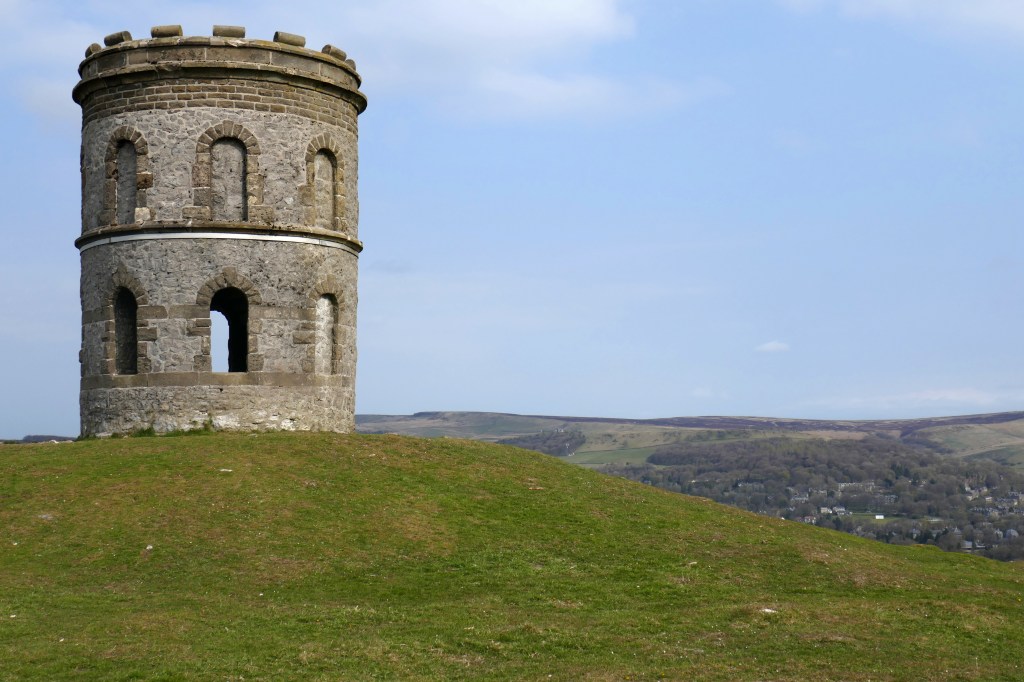
Buxton’s heritage trail leaflet will help you make the most of a stroll around the town. But first you have to walk to the town centre and leaving the campsite, you will immediately be distracted by the delightful paths through Grin Low Woods and to Solomon’s Temple.
Solomon’s Temple is a perfect introduction to Buxton. Climb the winding staircase of the hilltop tower and Buxton is laid before you, clustered around the dominating slate-grey Devonshire Dome.
Having taken in the view, we head downhill on the woodland paths with occasional wooden sculptures and reaching the streets by Poole’s Cavern. If you’ve never visited you might want to dally and explore this underground cavern.
We like to amble through the town’s restored Pavilion Gardens. There might be an art fair being held in the Octagon Hall or we will idly watch the ducks and look hopefully for chicks on the lake. I also like to admire the preserved tree trunk sculpted into figures and animals that stands in the park. The water-carrying figure of Arnemetia is a reminder that in Roman times Buxton was named Aquae Arnemetiae after this Romano-British goddess.
Our next stop is The Crescent, a Georgian grade one listed masterpiece and the pride of Buxton, recently restored as a luxury hotel. The gracious symmetrical curve of the stone building, the ground floor colonnade and fountains playing at the front are stunning. Opposite is St Anne’s Well which is decorated with flowers in the annual well dressing, a tradition followed in many Derbyshire villages and towns. The Pump Room has a tap and souvenir glass bottles, and I did once fill one with Buxton spa water to taste the lukewarm mineral-rich water. It is an aquired taste!
Buxton’s spring water emerges from the ground at around 28°C and has been exploited since the Romans, who built a bath and threw coins into the spring for luck. In the 16th century visitors took the water and in the Georgian era the Duke of Devonshire developed a spa resort. A ‘Well Woman’ was appointed to care for the well and tourists, a post that continued into the 20th century.
After all this strolling, we are ready to sit and there are plenty of cafes and tearooms in Buxton. Later we will walk over for a close-up of The Devonshire Dome. This building has an interesting history and has been used as stables, a hospital and is now a University. Finally, we will climb the paths up The Slopes to the upper part of Buxton, where the town’s oldest buildings surround England’s highest market place and from there head back to the campsite.
Day Two – Goyt Valley and Errwood Reservoir [about 14kms]
After the streets of Buxton, day two is a contrasting and challenging hike over moorland. A map will be essential to find your way around these moors but you will be rewarded with the sounds of lapwings and curlews and buckets of fresh air.
From the A53 near the campsite, we picked up Bishop’s Lane and climbed the hillside until a path took us to the disused railway line. Views over the two reservoirs in Goyt Valley will open out before you.
Reaching a lane, we descend to the shores of Errwood Reservoir. From here we chose paths that climb through the trees to the ruins of Errwood Hall. We are walking through what was once the grand ornamental garden where fountains played and the Grimshawe family, who lived here, relaxed on the lawns. Demolished in 1934 after the last of the Grimeshawes died, Errwood Hall was originally a dressed-stone building with a tower above an impressive entrance and rooms packed with fine furniture and art works. In those days the hall enjoyed views over the valley but is now surrounded by trees and rhododendrons. For me, the ruins have always retained a sense of romance tinged with loss but on our last visit it seemed particularly woebegone. The site deserves a little more care and I was disappointed there isn’t even an interpretation board to show what used to be here. However, there is an app and more information here.
From the hall we headed uphill finding the small circular St Joseph’s shrine that huddles in a hollow with pine trees. Dedicated to Dolores, a Spanish companion to Jessie Grimeshawe in 1889, the shrine has an elaborate altar of Spanish tiles and there are often fresh flowers. As we descended the moorland back to the reservoir a grey cloud threatened rain and we followed a circling buzzard towards the trees and shelter but the storm never arrived.
Walking south along the valley beyond Errwood Reservoir we crossed the old packhorse bridge and picked up a path over the moorland and back to Buxton. More walks in the Goyt Valley and its history can be found here.
Day Three – Three Shires Head [Around 17kms]
If you only have time for one day of hiking around Buxton, make it this one! The walk begins on the Dane Valley Way and you soon leave the traffic behind as you cross Axe Edge Moor, an expanse of moorland that holds the headwaters of four rivers, the Manifold, Dane, Wye and Goyt. Despite the warm weather, it was just us on this path enjoying the gurgling streams and passing a few isolated farms and old mine workings.
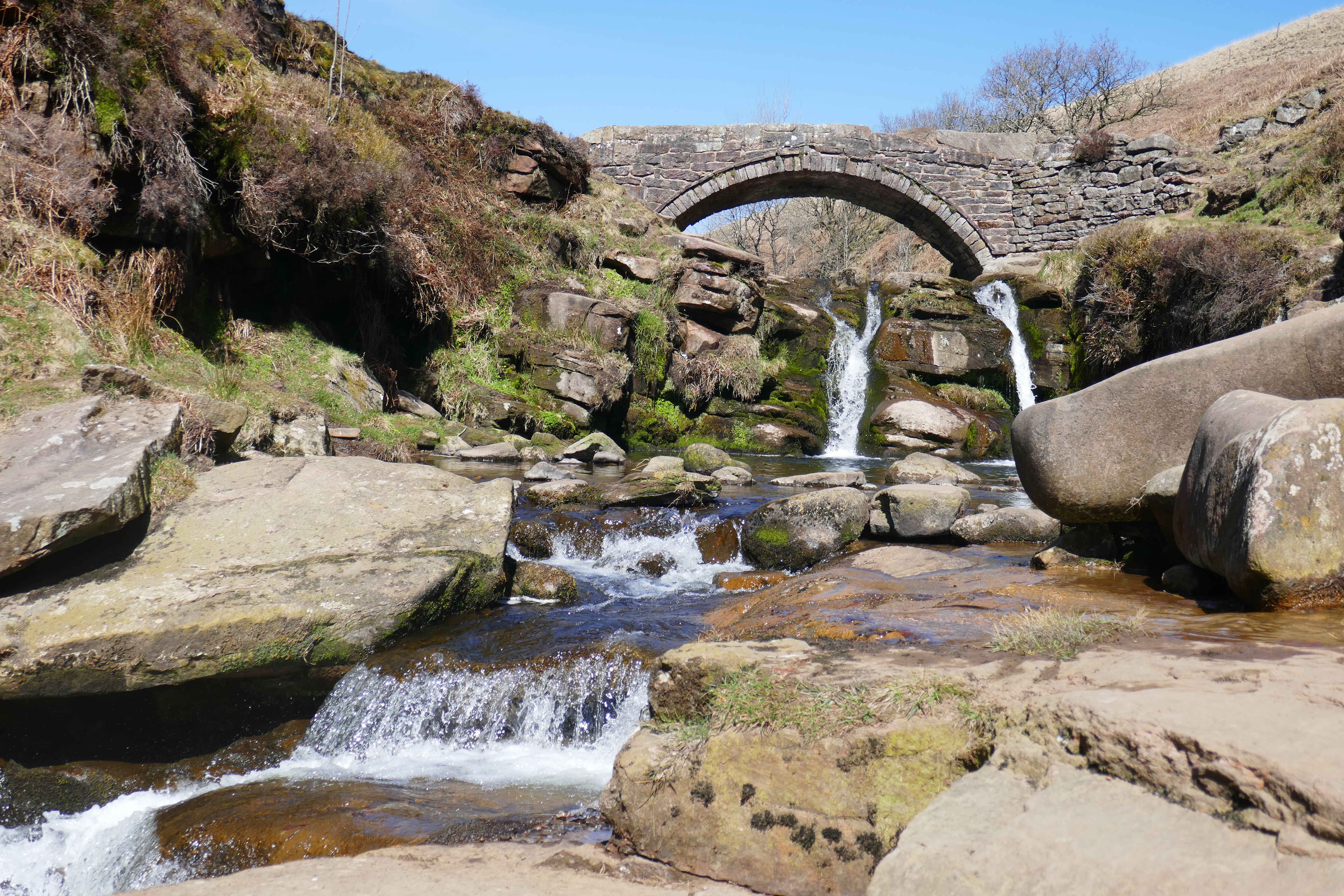
At Three Shires Head, where Staffordshire, Derbyshire and Cheshire meet, we joined the throng. These falls are a popular picnic and wild swimming spot. Sitting by the waterfalls I slipped off my shoes and dipped my toes in the gaspingly-cold water of the River Dane. As I dried my tingling feet I watched the hardy woman swimming in Pannier’s Pool in admiration.
Climbing up the hillside to Flash, a sheltered lane alive with butterflies took us to Flash Bar Stores where we devoured two of their delicious homemade vegetable pies at an outdoor table. A popular halt for cyclists, we chatted to a young man who was fuelling up having cycled from the West Midlands and was surprised how hilly the Peak District was!
Exuberant skylarks sang as we crossed the fields, criss-crossed by stone walls, below Flash. Multitudes of signs heralded the Health and Safety Executives huge Science and Research Centre. We skirted the buildings on the public footpath and picked up a lane that took us back to the road below the campsite.
Day Four – Five Dales from Tideswell [13kms]
On a perfect spring day we drove the short distance to the car park in Tideswell Dale. This perfect Derbyshire walk took us along, in and out of five dales.
We began in Tideswell Dale where a winding stream lined with bright yellow celandine wound beside us and rock cress hung from the limestone cliffs. Ash trees grow here but many have been chopped down due to ash dieback, a destructive fungal disease.
Miller’s Dale, not surprisingly, is home to many disused mills along the River Wye, often now converted to housing. I was concentrating on looking along the river for kingfishers. I didn’t see a kingfisher but a birdwatching couple pointed out a peregrine they had spotted on the skyline above us.
At Cressbrook we sat by the millpond watching the climbers on the crags and a pair of tufted ducks. The ducks dived into the shallow water to feed, stirring up the silt into billowing muddy streaks so that we could watch their underwater progress. Cressbrook Dale is thickly wooded with pungent wild garlic and carpets of soft green moss covering the dry stone walls.
The landscape opened out as we reached the short Tansley Dale where we found cowslips just coming into flower among the grasses. We climbed up to the patchwork of walled fields above the dales where lambs gambolled in the sunshine and the shallow Litton Dale led us back to the ‘van.
Day Five – Five Wells & Deep Dale walk (13kms)
In more sunshine, we walked through the wood to Buxton to catch a bus towards Bakewell. We hopped off near the village of Taddington and walked back to Buxton.
Our first stop was Five Wells Chambered Cairn. Here the stones that remain of a circular chambered cairn perch on high ground above the source of five springs. Although many of the stones have been taken, the two back-to-back chambers can be recognised. Descending to the village of Chelmorton we passed Bank Pit Spring, inexplicably and bizarrely known locally as Illy Willy Water.
The path into the wooded Deep Dale was steep but the sheltered dale was perfect for a lunch stop. As we ate, three sheep nose-to-tail went purposefully by on a lower path. When minutes later a fourth sheep appeared we assumed she was lagging behind and helpfully pointed in the right direction. Instead she came over and nudged my arm with her nose demanding food. We were eating more delicious pastries from Flash Bar and so there was no chance we would share!
The scenic uneven path along Deep Dale, over moss-covered stones and between trees, took us below the cave known as Thirst House before climbing up to King Sterndale and returning into Buxton under the 13 arches of Dukes Drive viaduct. Back in Grin Low Woods, we found a thick carpet of wood anemone and on the way back to the campsite picked up part of Buxton’s Ring of Trees Walk, a circular route through surrounding woodland.
Lime Tree Holiday Park – We have stayed here a few times. It is in a peaceful position just a short walk from Buxton.
Beech Croft Farm – this family-run site is between Buxton and Bakewell and in quiet countryside. Walk Five is near here.
Longnor Wood Camping – This adult-only site is near the village of Longnor. There is good hiking from the campsite and some cosy country pubs in the vicinity.