Doorways & windows around Europe: some ramblings


Looking through my photographs from recent trips in our campervan one theme stands out.  I have to acknowledge that I can’t help myself; I am always taking photographs of doors and windows.  You might ask how many photographs of doorways and windows one travel writer needs and the answer is clearly an infinite number.  Wherever I am, either at home in Salford and Manchester or in a new village or city, I look for the detail in doorways and check out buildings above the shops to see the windows and the details on the buildings.  This got me thinking, what is it about doors and windows that appeals to me.  I am certainly drawn to an unusual and beautiful doorway and window and I am a real sucker for shutters and stained glass.  But is it just the aesthetics of the doors and windows themselves or is it something more?  Windows and doors are portals to an inner world that is often private.  Am I secretly longing to know what is behind the openings or am I more interested in what might emerge from those doors and windows?

The Romans had a god for many things, including doorways.  Janus, usually shown as a two-faced god, looks to the future and the past and was also the god of beginnings endings and transitions; the Romans understood the lure and significance of the doorway.    Doors, although often beautiful, are closed; they act as the border between the open street and private space.  A closed door has potential but what is hidden beyond may be good and exciting or it may be evil.  The locked door is a familiar metaphor in many tales; we have to get beyond these closed doors to reach something we are seeking.  A locked door is both a temptation into the unknown and a barrier to access; knocking on an unfamiliar door is always daunting.   Doors have the duality of Janus, being closed and open, locked and unlocked, positive and negative and these contradictions are intriguing.

In contrast, windows are transparent, we can see inside and out through the glass.  Windows are also a public stage for beautiful objects; in our 80-year old flat we have wide windowsills and we use these to display favourite objects, a single ornament and an ancient inherited plant in a pot.  By placing these at the public face of the house we are sharing them with the wider world.  Windows are the eyes of the house and the items in the window give a glimpse behind those eyes.

Standing and staring out of a window is a way to travel to other places without moving from home.  Our flat has lots of windows that let the morning and evening sun flood in to the rooms and from these windows I watch the outside world, creating stories in my head.  Whenever we arrive somewhere new the first thing I do [before I check out the interior] is go to the windows and look at the view; I think this is me getting my bearings in a new place, finding out where the sun rises and who I can see and be seen by.  Looking up in a new city I like to imagine myself standing at some of the beautiful windows I see; I wonder how life in this street looks from above and what it would be like to live there.  For me windows only represent the positive; openings to different perspectives and portals for fresh air and sunlight.

The photographs in this post are really just a small selection from my collection of doorways and windows.  The evidence of my addiction is right before your eyes!


How can you afford holidays when you live on a low budget

1991 July Verona and Castel S Piedro.jpg
Verona in 1991

We all prioritise what we spend our money on to have the life we want.  You won’t be surprised to read that I have always prioritised holidays over pretty much all discretionary spending.  Despite living on an average or low income for 40-years we have always travelled.  Firstly, some background … when I first started work and living alone I had little money to spare so marriage to Mr BOTRA was a big plus financially [and in many other ways].  Even with below average salaries we were much better off living as a couple.  We had our son in the Thatcher years and so received only a few weeks maternity pay, had to fight for one week of paternity leave, received no Family Tax Credits and the only state help we received was Family Allowance that was frozen in the late 1980s.  And yet we managed to afford holidays, how did we do this?

Through all those years we prioritised holidays over living in expensive houses, buying new furniture and cars and posh frocks.  This was our choice and whereas we would probably be better off now if we had made different decisions no one can ever take all those holiday memories away from us.  We had a ‘big’ holiday every year and these were often adventurous holidays abroad.  After paying the mortgage and the utilities, holidays were our next priority and we saved a set amount every month that was earmarked specifically for holidays.  This amount was put in to a dedicated savings account and such was our determination to explore foreign places that we never dipped in to this money for other financial emergencies.

Our holidays were never expensive and luxurious trips, it was always the travelling that we were interested in.  We enjoyed camping and before our baby was born we bought a high quality tent and acclimatised him to camping from being a toddler.  We chose wisely, buying a Saunders Spacepacker lightweight back-packing tent, widely recognised as the best available in the 1980s and beyond.  We could carry this and our ‘gear’ for our trip in two big rucksacks.  When our son outgrew our shared Spacepacker we bought him his own.

Travelling and seeing new places was what mattered to us, taking walks costs nothing and our holidays were about hiking in the mountains and enjoying fresh air and new experiences.  The budget rarely ran to eating out; the exception was our trip to what was then Czechoslovakia and is now the Czech Republic and Slovakia in 1992.  Back then eating out was so cheap in those countries we could indulge.  We slipped up when we visited the Black Forest in Germany the following year, assuming the same budget as we had spent in Czechoslovakia and finding out that Germany was much more expensive than eastern Europe!  With no credit card to prop us up we had to stay within budget and it was a tight fortnight.  We discovered Germany’s budget supermarkets, spent the days walking, playing in the parks and visiting free museums and pitched up on a scruffy, anarchic and most importantly cheap campsite; it was an interesting trip.

It was 1991 when we first went abroad to Italy [see the photograph above] and this trip set the pattern.  We took the train to Verona, which had been on my list for many years and I thought I had arrived in heaven.  Camping Castel San Pietro above the town turned out to be the perfect place for two young parents and their five-year old child.  Set inside ancient walls this was a relaxed, welcoming and slightly quirky campsite.  From here we made our way on public transport to the Dolomites and spent our days walking in the dramatic and unbeatable mountain scenery.

As well as these train and backpacking holidays we would visit Scotland every Easter, sharing the cost of a large self-catering house with friends made it affordable and we would have numerous weekends away with the tent in the UK.  These were the days before Facebook but if we had been able to post about our holiday activity you would have thought we had loads of money!

These adventures and trips to all corners of Europe would not have been possible without that discipline of regular saving over twelve months.  We didn’t consider ourselves natural savers and we certainly didn’t save for anything else at this time, there was very little spare.  Our desire to travel gave us the motivation and we continued this monthly saving plan even as we became more financially comfortable.

Think Save Retire recently blogged about earmarking your money a well-timed post as I was drafting this.  Completing Steve’s statement clarified for me that holidays have always been our priority and made me realise how we continue to make sure that our money supports that priority.


Three more small steps to giving up plastic: Update #4

20180212_092534
A basket of cloths

1. Toilet rolls

We welcomed in 2018 by receiving a box of 48 toilet rolls from Who Gives A Crap.  This company are trying to make the world a better place one toilet roll at a time.  Their toilet paper comes wrapped in paper, not plastic and most importantly it does the job [we bought the premium 100% bamboo rolls].  Who Gives A Crap started four-years ago thanks to a crowd funding campaign and I heard about them thanks to blogs written by people who are way ahead of me in their pursuit of giving up plastic.  Who Gives A Crap’s toilet rolls are from recycled paper or from sustainable bamboo and they donate 50% of their profits to organisations such as WaterAid to help build toilets and improve sanitation in countries that don’t have access to a toilet.

2. Re-usable bags for fruit and vegetables

Apart from toilet rolls [and I just can’t go there] my current interest is in finding items we can re-use rather than use and bin, as much as it in finding items that are plastic-free.  We have invested in six  re-usable mesh bags for tomatoes, mushrooms, onions, small oranges and other fruit and vegetables we buy loose.  I keep three at home in the bike pannier that is used for shopping trips and three in the campervan.  I have come to the conclusion that re-using our own bags is preferable to even using paper bags and so bought these bags and keep them handy so there is no excuse to use anything else.  I found the mesh draw-string bags on Ebay [I think they are also sold for separating laundry items].  The staff in our local supermarket were happy to peer in them before weighing and they are light and easy to wash if you need to, so these are a big win.

3. Re-usable alternatives to kitchen roll

We are not big kitchen roll users, we always have a damp cloths [torn up clothes or towels] hanging around the kitchen for small spills.  But we always have a roll in the kitchen for things like mopping up bigger spills and drying aubergine that has been salted and rinsed.  To prevent even this small usage we now have a basket of dry cloths in the kitchen window [see top photo].  These are a combination of torn up old towels, old face cloths and some miscellaneous new reusable cloths we had in the cupboard.  This makes it really easy to grab a dry and clean cloth when ever it is needed and then throw them in the washing machine to be used again.

20180103_173651
The toilet rolls arrived wrapped in paper and in a cardboard box


You can’t get too much winter in the winter

2018 Feb Lowther Shap and Preston (20).JPG
Lowther Castle in Cumbria is a stunning ruin

Retirement has completely changed my experience of winter and given the season a different character that is new and refreshing.  I have always dreaded the winter and would become quite low in November as the days got shorter and colder.  But now we are retired and no longer tied to just two days of freedom we can take off for a day trip or camping tour as soon as sunshine is forecast.  This flexibility means that winter starts to feel like a succession of fantastic frosty and sunny days and is suddenly much more enjoyable and fun.  Last week we spotted another window of opportunity to make the most of the blue skies and we headed north.  After some mooching around the border city of Carlisle with its red sandstone castle and marvellous museum, we visited the dramatic ruin of Lowther Castle whose roof was removed in the 1950s to save the estate from crippling taxation.  The castle and gardens have been recently opened up and are a fantastic place for a day out at any time of year.

We returned south via another ruin, Shap Abbey.  Set in an idyllic and peaceful valley the remains of this ancient abbey are open to the public, although only one tower remains from the original buildings.  From the village of Shap we had views to the Lake District fells dusted in snow and in the sunshine the north-west of England showed off its most beautiful side.

We popped in to Preston for old times sake and were pleased to see the hot potato and parched peas stall [the original street food] was still doing business in the Flag Square.  Continuing south to the town of Ashbourne in Derbyshire we had a great day walking in more sunshine.  Then the weekend arrived and with it the drizzle.  We met friends for a pub lunch and a walk and had a lovely afternoon thanks to excellent waterproofs but it would have been better if the fine weather had blessed those working folk too.

PS the quote is from Robert Frost.


Sharing a marvellous vegan [and fat-free] fruit cake recipe

2018 Feb Lowther Shap and Preston (1).JPG
Vegan fruit cake

With a few days winter camping planned I thought we needed some wholesome sustenance to ward off the winter chill.  This delicious fruit cake is easy to make [although it does take a bit of pre-planning] and keeps well for around five days.  I first made this cake by soaking the fruit in tea but starting using whisky to use up some we had in the cupboard.  I found that the whisky gives the cake a real flavourful punch and it is going to be hard to go back to cold tea when the surplus whisky has gone.  Having a cake in the campervan is comforting and helps us to save money as it encourages us to have tea and cake in the ‘van rather than stopping at a tea shop [too often].

So here is my recipe for a vegan tea or whisky fruit cake

Ingredients

  • 225 grams of flour
  • 2 teaspoons baking powder
  • 70 grams of sugar
  • 1/2 mashed banana [60 grams] or you can use one egg if having a vegan cake isn’t important to you
  • 250 mls whisky or brewed black tea
  • 300 grams of your favourite mixed dried fruit [I like a mixture of cranberries and sultanas]
  • 60 mls of soya milk [you can use cow’s milk]
  • 1/2 teaspoon mixed spice
  • Pinch of salt

Method

  • The day before, put the dried fruit in a bowl, pour over the whisky or brewed black tea and leave overnight to soak.
  • The next day preheat the oven to 180C [gas mark 4] and line a baking loaf tin [the recipe has no oil so it needs the paper to stop it sticking].
  • In a mixing bowl sift in the flour, salt, baking powder and mixed spice.  Add the sugar and mix well, breaking any lumps.  Make a well in the centre and add the mashed banana and the milk.  Add the dried fruit and any remaining liquid.  Mix well.  You should have a soft mixture, add a little more milk if it feels too dry.
  • Pour the mixture in to the loaf tin and bake for 40 minutes to one hour and a skewer comes out clean.  Cool and leave a day before you eat it if you can.  The cake keeps well in a tin.


My journey through travel writing

P1070870
One of our campervan mottos

I don’t just write travel articles, I am also an enthusiastic reader of travel books.  As I read I am in awe of travel writers who can string together more than the 2,000 word limit of my articles and still hold my attention, be well-written, informative and entertaining; what stamina and discipline that must take.  I immerse myself in these armchair journeys to the familiar and the exotic through the pages of a good travel book and I have many favourites.  For me, good travel writing is not a guidebook [although I read these too] or a series of facts about a place; good travel writing is about stories and experiences, it is about how a place made someone feel, it is about tales told honestly and it is about personal journeys.  In the hands of a good travel writing I feel I am sitting on the author’s shoulder and I am along for ‘The glory of the ride.’

My reading of travel writing started as a young teenager.  With a passion for reading I soon exhausted the children’s section of the small town library near to my home and so [with some hesitation as I wasn’t sure if it was allowed] I furtively moved across the room to the adult books.  At the end of two tall rows of books by a large warm radiator I found a little-visited corner where I could browse unnoticed and here was the library’s small travel section.  Amazingly there were gems here and in particular I discovered two Ethel Mannin books; An Italian Journey from 1974 about her travels around northern Italy that captivated my imagination and started my love affair with Italy and her 1960s American Journey, telling tales from her travels by Greyhound around an America that was far from the glitzy American dream I saw on the TV.  I am sure I missed much of the subtlety of her writing, I knew nothing of Ethel Mannin and her politics and little of the world beyond Staffordshire and yet the travellers tales and adventures of a lone woman both touched me and inspired me.  It was some years later that I discovered Dervla Murphy and her individual style of travel writing and I have followed her on her numerous and exciting journeys ever since.  Dervla Murphy has an honest style that is never sentimental.  She is such a fantastic listener and gatherer of individual stories and she weaves historical information and personal narratives so well I feel I have been there with her every step of the way.

Some time ago World Hum compiled a list of their top 30 favourite travel books and I took a look to see if any of my own ‘must read’ books were on there and to look for ideas for new travel books to read.  Paul Theroux, Norman Lewis, Bill Bryson, Bruce Chatwin, Eric Newby, Jan Morris and Patrick Leigh Fermor all make the list and are excellent choices that I have loved reading.  Others such as Evelyn Waugh and John Steinbeck are writers I enjoy reading but think of as novelists rather than travel writers, so I added their books to my list.  There are other titles and authors I’ve not come across and I have been looking at these; up to now I have added Europe, Europe by Hans Magnus Enzensberger to my wish list.

That young teenager had ambitions to be a writer but, despite my reading, I only thought of novels as the way to earn money as a writer and I lacked the imagination for such an undertaking.  Forty-years later in my 50s I realised that ambition and became a published writer.  My first travel article was published in 2013 and the thrill each time I see my writing and photographs in print has never faded.  That said, there may be travel writers with glamorous lives but for me it is less razzle-dazzle and more about typing.  The time I spend travelling versus the time sat behind a desk researching, writing and editing [words and photographs] is about 1:10.

I will never be as accomplished a writer as my heroes but I try to tell readers a story that every motorhomer can relate to.  This narrative combined with the 2,000 word limit excludes many of my travel experiences and anecdotes and the editing process takes many hours.  In these articles I am balancing practical information with my desire to paint a comprehensive pictures of the places we visit by describing the sights, smells and sounds I have experienced.

These ten tips for writing travel articles are a good and useful start for anyone who is thinking of writing their own travel articles but firstly check out this article 15 signs you are born for travel writing to see if travel writing is for you.  The tips made me aware that I rarely include any direct dialogue in my travel articles.  I can see how this can strengthen the intimacy of my stories and my current resolution is to try and bring this in to as many future articles as I can!


Gnome Island, Salford Quays: #surprisingsalford #26

Ship Canal Nov 2017 (5).JPG
Gnome Island on the Manchester Ship Canal

I am not sure if technically Gnome Island is in Salford or Trafford.  It sits in the middle of the Ship Canal but it seems to me it is on the Salford side of the canal so I’ve claimed it and included it in my surprising Salford series.  You can see Gnome Island from the canalside but I got a superb view of Gnome Island on one of my birthday treats, a Water Taxi trip from Salford Quays to Spinningfields.  These cute yellow boats trundle the waterways from the city centre to Media City and to the Trafford Centre.  The Christmas Market was in town at the time and Gnome Island had its own festive Santa Claus visiting for a month or so.

Riding by on the water you get an uninterrupted view of the jolly gnomes waving and smiling and these diminutive figurines must brighten up the day of those commuters who use the Waxi on our dark winter mornings to get to work.  The gathering of gnomes appear to be both male and female and there are some child-gnomes on the island too, so who is to say their number won’t increase over time.

I see Gnome Island as a positive sign of the eccentric and fun side of life in the city.  Long may it continue to be there to delight locals and surprise visitors and let’s hope no official decides it doesn’t have planning permission!

If you want to find Gnome Island yourself, it is now on Google Maps.  It is just before the Trafford Road bridge on the Salford side of the quays.

In May 2020 Gnome Island had a brief flurry of activity on Facebook. There were posts about the history of this wonderful Salford attraction.  Read the story of Gnorman, the pioneer gnome, his partner Gnorma and their twins Gnoah and Gnatalie!

In November of 2020, visiting Salford Quays I noticed that it is now much easier to get a good view of Gnome Island from land. Since they put in the new tram line to the Trafford Centre you can see Gnome Island from the Wharfside metrolink station. What a big improvement to Salford Quays!

Winter sunshine & walking in the Peak District

2018 Jan Chatsworth trip (7).JPG
Near Birchen Edge above Baslow in Derbyshire

The forecast was for a cold and sunny few days and so with nothing in the diary we were able to hop in to the ‘van and take a couple of nights in the Peak District to make the most of the fine weather.  We stayed at the Caravan and Motorhome Club Chatsworth campsite which is in a peaceful walled area in Chatsworth Park.  We gave the stately home a miss and walked through the glorious countryside but if you did want to visit it is very near to the site.

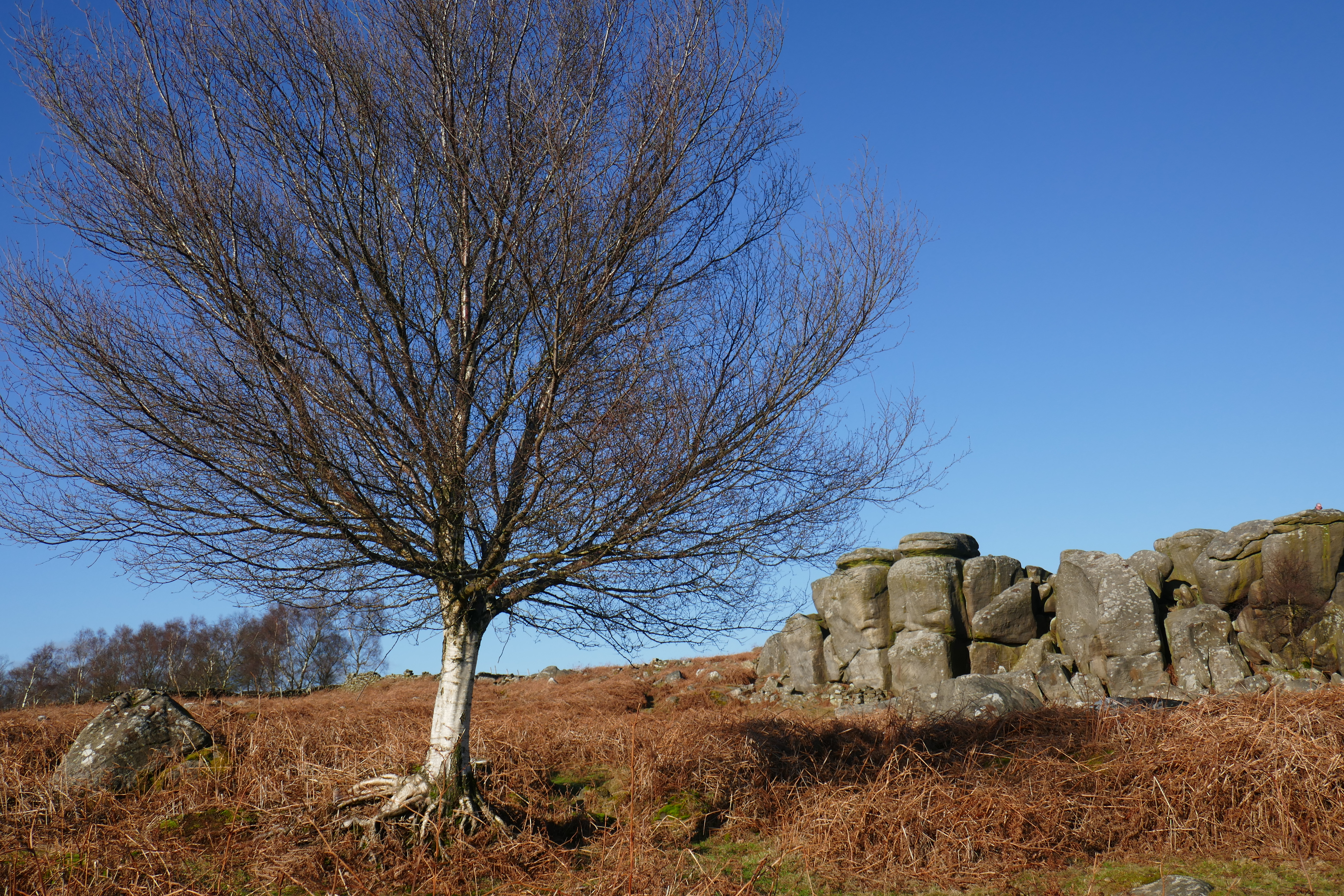
On a sunny and frosty morning we walked out of Chatsworth Estate to Baslow, where after a coffee, we climbed through woodland and out on to the open moorland behind the Robin Hood Pub on to Birchen Edge.  These Peak District edges are glorious places to walk, with views over the crags in to the valleys below, I always enjoy the lofty feeling of walking along these distinctive features.  On Birchen Edge we passed Nelson’s monument, a tall thin stone pillar on the rocks.  This was erected by a local business man thirty years before the more famous monument to Nelson in Trafalgar Square.  Our walk took in not one but two of these stunning Derbyshire edges.  After a boggy section of moorland we followed the track towards Baslow Edge, finding the Wellington Monument that celebrates the 1815 Waterloo victory.  We walked along the top of Baslow Edge and as the sun started to set we returned to our pitch via one of the many paths under the crags.

We also took in a lovely walk around Longstone Moor, a beautiful limestone ridge that is criss-crossed by paths.  This area was once a thriving lead mining area but is now a quiet and less visited spot among the bustle of the Peak District.  The area around Baslow is lovely but it does get plenty of visitors and finding space to yourself is near to impossible on a fine day.  On Longstone Moor we met no other walkers and we had a sense that the space and fresh air was just ours to enjoy.  We did find the crowds when we popped in to the Packhorse Inn for a swift half.  This charming pub in Little Longstone had welcoming warm fires and is happy to serve walkers with muddy boots.


Top tips for campsites and stop overs when you are abroad

09.14 Vila Praia de Ancora campsite
Idyllic Portuguese campsite

Updated November 2024

Prompted by a fellow Devon ‘van owner I have given some thought to the baffling array of guides out there for motorhomers to use, buy or download to help you find a campsite in mainland Europe.  Very few motorhomers have unlimited amounts of space to store numerous guides and unlimited amounts of money to purchase them so how do you choose what to spend your hard-earned on?  When travelling we generally plan on a day-by-day basis and out-of-season and in more remote areas you can’t always rely on just coming across somewhere suitable to stay [either a campsite or wild camping pitch] without a bit of planning.  Below is a guide to the resources we have found most useful when we travel abroad.  Each guide or app has its plus points as well as its limitations.

Guides, apps and websites

Since I wrote this post in 2018, finding a campsite has changed dramatically. We now use Search for Sites app and the ACSI Card books and app {see below], almost excusively.

ACSI Card – Available from Vicarious Books in the UK, this is great value for out-of-season touring (from September to June) and this is our first port of call when we are looking for a campsite so that we can get maximum value from it.  You pay for the card and books and campsites in the scheme charge a set fee for a pitch with electricity.  The number of sites in the scheme various by country. There are few in the UK but plenty in France.

Caravan and Motorhome Club Guides – We used to have these guides for our European trips.  The entries and campsite reviews are from members and can be quirky and brief.  We like to read between the lines of these reviews and do find these books of assistance, even though the information is not always up-to-date.

Aires and Camperstop Guides – We used to carry some of these guide books with us, relevant to the country we were travelling in. The books are fairly comprehensive and kept as up-to-date as a book can be and give an honest review of each aire, its facilities, its outlook and how comfortable it is. Nowadays we rely on apps and the internet.

In France we will look for municipal campsites in small towns as these are generally good value and near to the town centre for [the essential] bakeries and bars.

Home-based research & recommendations

In addition to the above we will research areas we are fairly certain we will be going to, particularly national parks and mountain areas where there are often few campsites and we are looking for the best situation for walking.  This might be Google searches, Rough Guide / Lonely Planet information, some Cicerone Guides include campsites and we sometimes ask a question about an area on a motorhome forum or Facebook page where there are generous well-travelled people with a wide range of knowledge.

You also can’t beat personal recommendations from other campers you meet on the way and these have sometimes taken us to interesting places that we never expected to visit when we set off.

To book or not & the one house rule

Until 2020, we generally never booked campsites when we were abroad as it was rarely necessary. Since 2020, owning a campervan has become more popular and campsites have become busier. Even in May, June and September we have come across full campsites in France, Germany and the Netherlands, particularly during public holidays. We now try and keep some flexibility and book sites a day or two in advance. In 2024 in France, we never managed to get a pitch on the popular campsite in Bayeux, despite turning up on a wet Sunday and then trying to book ahead online. If you really want to stay in a particular site, it may be worth booking.

Our house rule is to start looking for somewhere for the night by around 17.00.  This is just because we did get caught out in Mecklenburg in northern Germany on one trip.  There were plenty of campsites around the Mecklenburg lakes and none of them were full as it was only June.  The mistake we made was to be too busy enjoying a lovely sunny evening and leaving looking for a campsite until after 18.00 and German campsites don’t keep the evening hours that are common in southern Europe [and even Poland where we had just come from].  At each campsite we arrived at reception was closed and the barriers were down.  We eventually got a pitch on a site that we could drive in to but we didn’t have the key for the toilets and had to hang around for another camper to show up to use them, which was somewhat disconcerting for other campers!


Sculptures at Salford University: #surprisingsalford #25


Uni totem sculptures allerton building (2)
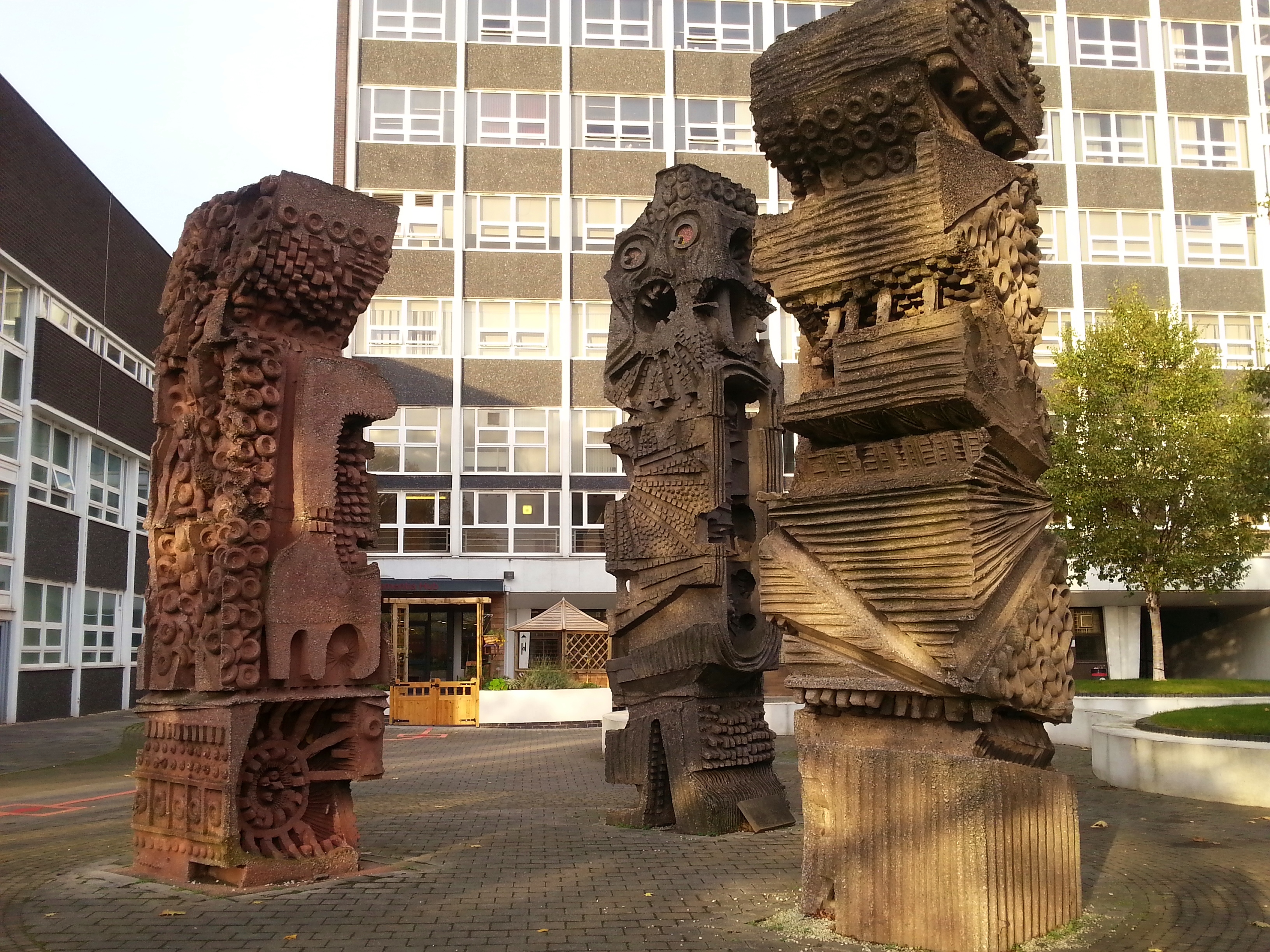
The three totem sculptures by William Mitchell

If you have time to wander around the Frederick Road Campus of Salford University or as you drive along the A6 you might come across these sculptures.  The three unusual sculptures are Grade II listed by Historic England.   Totem-like, these sculptures were built in 1966 by William Mitchell and stand in a courtyard in front of Allerton Building at what was then Salford Technical College and is now University of Salford.

These are bold concrete public art pieces, typical of the 1960s that make reference to engineering and to Central American art.  I dare anyone not to want to touch these tactile pieces as you walk around the three giant figures.  The sculptures change with the light and every time I visit I see new details I had missed before.  Almost six metres high these are imposing works, each made from four concrete blocks.

English Heritage note:

‘William Mitchell was a leading public artist in the post-war period who designed many pieces of art in the public realm, working to a high artistic quality in various materials but most notably concrete, a material in which he was highly skilled, using innovative and unusual casting techniques, as seen in this sculptural group. He has a number of listed pieces to his name, both individual designs and components of larger architectural commissions by leading architects of the day.’

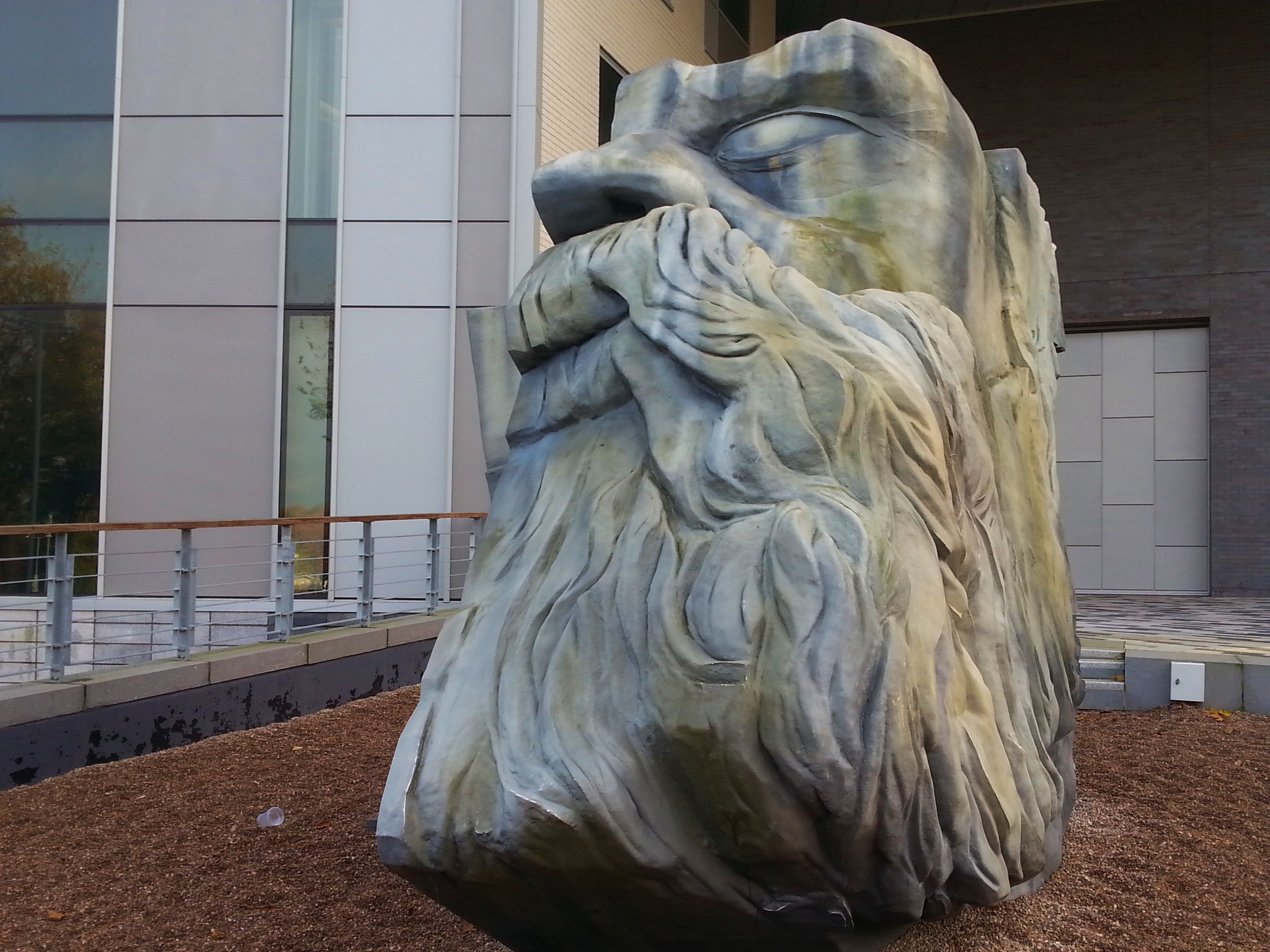
Salford University has other public art, including ‘Engels’ Beard’ [below] positioned by the Adelphi Building.  This five metre high fibreglass sculpture doubles as a climbing wall.  Greater Manchester now has two statues to Engels who spent more than twenty years here.  The poverty he observed influenced his writing of The Condition of the Working Class in England.

Uni Engels Beard
Engels’ Beard sculpture at Salford University