Alice asked the Cheshire Cat … ‘What road do I take?’

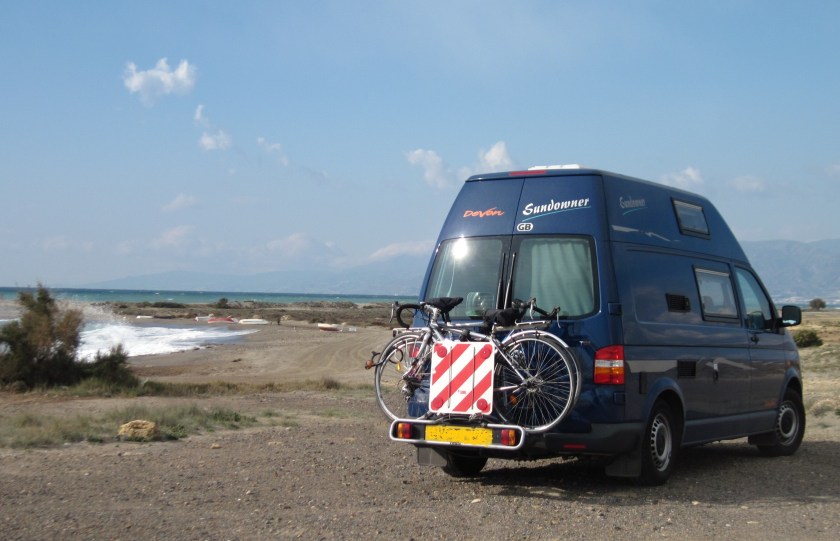
1412-near-balerma-almeria-005
The Blue Bus by the Spanish coast

Sometimes it comes up in conversation and I tell people we had a gap year, living in our campervan for twelve months and travelling around the southern parts of Europe.  Most people’s reaction is, ‘I would love to do that’ with a dreamy look in their eyes and I don’t deny that it was a fantastic experience.  I have noticed that lots of people buy in to the romantic idea of the freedom of the road in a campervan and want to be part of that.  I don’t wish to trample on anyone’s dreams but if our conversation continues I often add that although I understand that everyone has specific circumstances that might explain why they can’t drive off in to the sunset, if we can do it then lots of other people can.

If the gap-year enthusiast is still with me I might mention that the trip was at least three years in the planning, that we saved a lot of money, sold everything we didn’t need, downsized the house and gave up secure jobs to do it and that fortunately Mr BOTRA and I love each other very much and so don’t find sharing the [lack of] space in a small campervan a problem.  At this point many people start to lose enthusiasm and reconsider, realising they don’t really want to go to that much trouble just to travel around in a tin box.  If they stay with me I might refer to how much we missed our son and daughter-in-law and friends while we were away and a few more fall by the wayside.  The final nail in this conversation can be when I explain the amount of effort we had to put in to find new jobs when we returned.  Of course, lots of other people do get organised and plan and execute a similar / longer / more adventurous trip and I am happy to share any useful experience I have with these folk; they are not just dreamers but are people who make things happen.

No matter what personality test I take I have always come out as a doer.  I used to co-run workshops for community groups and organisations where we took them through a visioning exercise, thinking about their community or organisation in five or ten years time, mapping that vision and then supporting them in planning the multitude of steps required to make that dream a reality.  To me this sort of planning is second nature but it became clear that some people were good at the vision but hopeless with the planning and even more struggled to get beyond the first couple of steps on the path to their dream.  Staying true to an idea through the tiny steps of the planning stage can be a struggle and needs perseverance and strength, an ability to pick yourself up when you get knocked down and a willingness to be adaptable when circumstances change along the way.

There are as many different dreams out there as there are individuals and I would love to be able to congratulate everyone who has ever had a plan and made it real.  The Financial Independence and Early Retirement community is not dissimilar to the [later life] gap year in a campervan community; they are people who have a dream or a vision of a different life and make it happen, even though the planning and saving to achieve this dream might take many years.

Although when travelling I like to see where the road takes me, in terms of life I like to have a plan and so my favourite life quote is from the great story teller Lewis Carroll in Alice in Wonderland, when Alice met the Cheshire Cat:

“Alice asked the Cheshire Cat, who was sitting in a tree, “What road do I take?”
The cat asked, “Where do you want to go?”
“I don’t know,” Alice answered.
“Then,” said the cat, “it really doesn’t matter, does it?”


The truth is out there! Work know about my early retirement

2012-06-05 Cecina cycle ride 006.JPG
I am looking forward to time for more cycling trips in Italy and …

So I have done it!  My boss now knows that in three months time I will be retiring.  How did that go?  I work for a caring charity and my boss is a lovely person.  She trusts me, knows that I am reliable and understands that I don’t make decision lightly … she also understands my need for a good work-life balance to stay happy and healthy and respects my desire to work in admin, rather than as the manager I used to be … but when I told her my news it was clear that it wasn’t something she was expecting.

Mostly she was upset that she was losing a reliable member of staff.  She argued that I wasn’t anywhere near old enough to retire [I know].  I [possibly unrealistically] wanted her to be happy for me and so kept reminding her that my retirement is wonderful news and that perhaps she could be pleased for me.

We were meeting at our head office and later we went to tell other colleagues who were equally shocked and also envious.  This broadcasting of the announcement helped me to really absorb the reality of it in my heart, as well as my head [this might sound silly after so much planning] and the inner joy I felt was almost overwhelming.  I was able to fly the flag for the power of saving and how being frugal and strict with outgoings can pay off.  Of course, everyone wanted to know what our retirement plans are and became misty-eyed with envy at all those forthcoming long trips to sunny places in our campervan.

I was feeling happy and relieved to have got this conversation over and then the mood flipped.  As you might have read, the company has been through various re-organisations recently and just after I had given my news the information came through that the company is implementing an immediate recruitment freeze.  A stab of guilt pierced through my joyful state as I realised I was leaving at a time when they won’t be able to replace me, but honestly this only made a small chip in my elation.

Back in April I deliberated about when to get this conversation out of the way.  At that time leaving was eight months away and it was certainly too soon to tell.  But after the months of waiting I feel so relieved for a number of reasons; I was feeling very awkward having being part of a number of conversations recently regarding additional responsibilities and new projects that would continue beyond the festive period and so beyond my time with the company and I also prefer to be honest and open and I was uncomfortable not sharing my plans with colleagues.  Of course, that niggling guilt will keep returning because that is the person I am, but I know that I am not dispensable.  Now the company has three months to plan where my workload will sit from the New Year and I feel satisfied that I have treated them fairly.

I don’t expect a big fuss when I retire as working from home I won’t leave a desk-sized gap in anyone’s office.  There will be no surprise bunch of flowers, no card signed by everyone in the building, little joking about how lucky I am to be retiring and no cake baking for my last day at work.  I feel a mixture of gratefulness and sadness about this, I don’t like lots of fuss but I am someone who likes to mark occasions … I think I will need to find a way with family and friends to mark the ending of my office-bound working life, after all it is now over 40-years since I walked in to my first workplace [an opticians] as a young and naive 16-year old.

Buying second-hand makes sense to us

20160922_130237.jpg
The new-to-us sofa

Big changes are afoot at the BOTRA household.  As we move away from paid work it made sense to change the use of the second bedroom of our flat from office [and storage of stuff] to dining room [and storage of stuff].  This is a bit of a challenge, as although generally our dining room only needs enough space for two and up to six when we have visitors a couple of times a year it needs to stretch as we host our book group.  On these evenings we need space to sit ten people for a meal; a big ask for a small flat.

After much deliberating, measuring and scribbling of plans we figured we could fit the two dining tables needed for book group in to the room formerly known as the ‘office’ as well as some built in cupboards for the stuff and so the project started to take shape.

A bonus with this plan is that moving the dining table out of the living room gave us much more space in the living room.  More consideration and measurements later and we realised we could fit in another sofa.  Hurrah!  Not only would the ten book group members be able to sit and eat, they would now also have more space to relax in during the pre-eating and post-eating phase of our meetings.

But our excitement plummeted when we realised what an expensive business buying a new sofa is.  We don’t buy new furniture very often but we walked down to a local furniture store and sat on everything they had.  The cheap [ish] ones felt shoddy and although we are frugal, we don’t like shoddy, we expect things we buy to last for years and years.  The well-made sofas felt the business but would take a good chunk of our budget.

Somewhat disheartened I went to look in a local charity shop that specialises in furniture and found the sofa in the photo, just the right colour to compliment our other sofa, from a well-known and expensive brand and professionally cleaned by the charity before being put on sale.  At only £125 it was a good recycling bargain.

We feel good because we haven’t spent lots of money and our savings have stayed on track, our cash has gone to a charity, rather than a big business and we have helped to recycle a sofa and so reduced the amount going to landfill and no new resources have been used up.

Reducing our use of plastic one tiny step at a time

20160918_182631
Making hummus in our tiny food processor

We have a long way to go before we are anywhere near a Zero Waste Home.  But, as with everything, when the overall goal is so enormous I feel better if I at least start to make some small steps towards getting there.

Since the 1980s we have taken many tiny steps towards being a low waste house.  We already make our own bread; we don’t buy any sort of microwave meals [we don’t have a microwave] or convenience foods [with the exception of Linda McCartney’s sausages, which come sensibly packaged in just an easily recycled cardboard box].  We gave up laundry liquid for a cardboard box of powder earlier this year and buy as many fruit and vegetables that are both local and come without packaging as we can find.  We have recently moved on to Lush shampoo bars, rather than buying plastic bottles.  We keep leftovers in bowls and containers in the fridge [and then use them] and have a roll of clingfilm we have owned for decades and it just seems a shame to throw it away.

So, it has been a long time in coming but I finally got around to making our own hummus.  This is something I eat lots of and the plastic pots it comes in have been taunting me every time I bought it and spoiling my enjoyment of this wonderful food.

For me the crucial step was buying a jar of tahini [we always have garlic, olive oil and chickpeas in the cupboard] … every time I went shopping I prevaricated because it was just something else to make space for in to our tiny kitchen.  I know that making hummus is really easy to do and takes just a few minutes, after all I made my own back in the eighties when you couldn’t find it in a supermarket.  But last week I got a grip, bought the tahini and whipped up some delicious hummus.

So for a day or two I will enjoy the virtuous feeling of taking a step in the right direction until I read some more and come up with the next thing to tackle … if I can find room for a five litre container of white vinegar it might be cleaning products.

Following our hearts: does owning a campervan make financial sense?

p1010214
Our Devon Tempest campervan

This article in the Observer newspaper last week got Mr BOTRA and I thinking about whether owning our campervan saves or costs us money.  It shows how important owning the ‘van is to us that we have never given this much thought before.  As someone who has spreadsheets to plot our spending and savings to every penny, this seems like a huge omission and just goes to show that when it comes down to it our hearts rule over our heads.  We own the ‘van because we love the lifestyle, rather than to save money and even while we have been saving to retire we have never thought of not owning a campervan.

To investigate further I opened up all the spreadsheets and looked at the costs for our previous ‘van over eight camping seasons from 2007 to 2014

Insurance, services, road tax, MOT, tracker & club membership cost around £1,200 each year.  Before we had a campervan we didn’t own a car but we did spend money on hiring cars every month.

Over the years the ‘van didn’t need a lot of maintenance [it was a VW] but it did travel 70,000 miles and we had to buy the following, a new exhaust, tyres, new covers for the front seats, two replacement windows.  The cost of these averages out at £161 a year.

Our regular camping holiday in Europe for over three weeks, and including a ferry, costs around £1,350 each year [note, I haven’t counted food bought in supermarkets in this total as we would eat if we were at home].

In those years we spent an average of 25 other nights camping in the UK [from 18 to 48 nights].  These nights were mostly on campsites with some wild camping and cost an average of £17.63 / night, giving an average of £581 each year.

I haven’t calculated diesel costs in this rough and ready estimate, as we would still want to go to places …yes, I do know the ‘van is not as economical as a car but neither have I accounted for car hire and taxis in my calculations.  It is all getting complicated and I hope these things just cancel each other out.

Motorhomes don’t depreciate in the same way as cars.  When we traded in the ‘van we only lost £8,500 on the price we had paid for it, this works out at £1,062 per year.

Total cost each year has been £4,354 per year for an average of 52 nights holiday each year.

It is hard to estimate what we would have spent on holidays if we hadn’t had the ‘van but based on what we used to do I can estimate a figure.  We used to have a three week organised cycling holiday using hotels in mainland Europe [£3,000], a week in Scotland [£700], a short break in Germany [£700] and a UK short break [£400].

This gives a grand total of £4,800 on around 37 nights of holiday.

So owning the ‘van saves us £446 / year and we get 15 nights more holiday a year.  But hang on … Interest rates were considerably higher between 2007 and 2014 [5.5% in 2007].  If we had invested the £32,000 we had spent on the ‘van we could have received at least £2,000 a year in interest and would be quids in; however, with today’s low interest rates the sums add up very differently, as the article suggests.  Do we regret buying the ‘van when we did – absolutely not!

Tents & rucksacks are now part of our past

1995 July wild camping near Sgurr a Chaorachain
Wild camping in Scotland

It has been an emotional recently in the BOTRA household, with lots of reminiscing and a few tears.  All because Mr BOTRA and I have faced the truth that we are [probably] never going to sleep under canvas or take a backpacking trip again.

I don’t think we are the only motorhomers who started our camping holidays with a tent, although we might be the only ones who, when we got married, didn’t own a fridge or a washing machine but did both bring a Vango Force 10 tent to the marital home.  Given our lack of white goods and possession of two tents, an extravagant purchase early in our marriage was a lightweight Saunders Spacepacker.  This beautiful and practical tent served us well over the years as we backpacked all over Europe, firstly just the two of us and later fitting our son into its womb-like interior.  Although the Spacepacker was sold on eBay years ago (another emotional time) as part of our money saving project to buy a brand new campervan, we had hung on to the larger tent and the possibility of camping.  In reality, since we bought our first campervan in 2005, the tent has only been used by friends and relatives.

During a recent clear out of the stuff among the dust under our bed, I pulled out the tent and our two large Karrimor rucksacks and dared to suggest it was time to offer them out to the world via eBay.

Mr BOTRA, the sentimental one, became misty-eyed, remembering all the places he had carried his rucksack and a trip down memory lane, accompanied by photographs took up the afternoon.  I was the practical one, reminding him how much we enjoy the comfort and freedom of the ‘van and pointing out how else we could use the valuable storage space in our small flat.

Amazingly there is a market for old camping gear, thanks to the British passion for festivals where inexpensive gear makes common sense.  So the old, but still waterproof, tent was collected by a local man who was optimistic enough to think that a British festival might not be as muddy as we knew it would be, and our old trusty rucksacks were bought by two similar music-loving individuals.  Our savings got a small boost and the tent and rucksacks were recycled and given a new life.


Saving money on the lovely island of Anglesey

P1010184.JPG
The beautiful Llanddwyn Island on the Isle of Anglesey

Spending a few days visiting some of the wonderful nature reserves and wildlife sites on the Isle of Anglesey proved to be a very frugal holiday.  With no admission fees to pay, our only costs were small amounts for parking, leaving enough to buy the occasional [okay daily] ice-cream.

Anglesey has designated its 125 miles of coastline as an Area of Outstanding Natural Beauty and rightly so, as the coastline is beautiful and varied.  We stood in the fresh breeze on the top of Holyhead Mountain and walked around the expanse of Red Wharf Bay, spotting egrets, curlew and oyster catchers feeding on the rich feeding grounds.  On the way to Amlwch, with its fascinating [and free] museum about the geology of Anglesey, we visited the old copper mine at Parys Mountain [again no charge] and were stunned by the vibrant purple and orange colours and the huge open cast mine.  We walked around Rhoscolyn Head to find the perfect white sea arch; this is just as impressive as Durdle Door but is kept a secret, as on a sunny day we had this idyllic spot to ourselves.  I have struggled to decide which photograph to use from this trip as there are so many but opted for this view of Llanddwyn Island, a tidal island accessed from Newborough Forest [we were just sorry we didn’t spot a red squirrel but with such an expanse of trees the squirrels were no doubt having fun out of sight].

Anglesey also has international recognition for its important geological heritage as it is one of the 120 areas that are part of the UNESCO Global Geoparks network.  Travelling across Anglesey is a journey across twelve Geological periods and 100 rock types.  The colour and variety of the rocks on Anglesey are there for every visitor to discover and of course this rocky diversity results in a range of different plants too.

We stayed on a small Caravan Club Certified Location [CL] site for £13 a night called Tyddyn Osgar in the village of Brynteg.  Mr BOTRA and I don’t understand the pricing policy of these small sites and it seems to be completely arbitrary with some charging over £15 a night for nothing more than a hook-up.  This one provided a friendly welcome, one of the best campsite showers we have ever found, well-cut grass, wide-open views across to the Snowdonia mountains, a pub nearby, great cycling from the site and an offer of a lift for linear walks if we needed it … all hard to beat and ensured our trip didn’t eat in to the savings.

Finding some perfect parking spots

2011 July on Rees Jeffreys Road Fund car park at Rhaedr y cwm above Llan Festiniog
Rees Jeffreys Road Fund car park above Llan Festiniog

My introduction to William Rees Jeffreys was quite by accident one sunny Sunday a few years ago.  Travelling home after a weekend camping in Dolgellau and keen to extend the carefree holiday feeling as long as possible, my partner and I took the B4391 over the hills from Llan Festiniog.  Spotting a car park with extensive views, we couldn’t resist stopping for a brew and a stroll down the lane to pick bilberries and sit by the babbling brook.  The splendidly positioned car park had a plaque and I learnt that it was funded by the Rees Jeffreys Road Fund.

Like many brief encounters, I didn’t give Rees Jeffreys another thought until twelve months later I had another chance meeting with this enigmatic fellow.  Once again on the lookout for a good place to pull in for a drink, we turned off the M6 at Tebay and followed the road towards Kendal.  Spotting a lay-by with a view towards the Howgill Fells we pulled in and realised we were parking next to a familiar plaque.  The kettle went on and I climbed out to read that here was another car park funded by the Rees Jeffreys Road Fund.  Over my cup of tea I starting wondering what the story was behind this man, why he felt the need to pay for car parks as far apart as Wales and Cumbria and why he deserved a plaque.

Back home, an internet search revealed some information about William Rees Jeffreys; born in 1872, before Karl Benz had patented his internal combustion engine for a Motorwagen in 1886, William Rees Jeffreys was a keen cyclist and was initially motivated in his campaigning to improve roads for cyclist.  As cars became more widespread, William Rees Jeffreys held positions with the Road Board (the precursor of the Department of Transport), the RAC, the Roads Improvement Association and the Institute of Automobile Engineers.  From 1919 he was a leading light in the classification and numbering of the roads in Britain to aid the assignment of the money from the Road Fund and to help drivers navigate; the final list was completed in 1926.  Following his death in 1954 his estate provided the endowment for the Rees Jeffreys Road Fund; this gives financial support every year for education and research related to road transport and also for physical road transport projects, hence all the lovely road side parking areas.

As frugal campervan owners we always need car parks and lay-bys and those next to roads often suit our purpose of a rest stop on a long drive.  These halts give us a chance to have a hot drink at little cost and stretch our legs without going out of our way and here was an organisation providing just the facilities the motorhoming community needs; I’ve not found a WRJ funded car park yet that has a height barrier.

Interesting as the Rees Jeffreys Road Fund website  was, it lacked a list of the road side rest areas the Rees Jeffreys Road Fund had supported and I wanted to know more.  An email to the Secretary quickly led to the arrival of a list in the post a few days later which showed 68 funded rest stops; these spread from Wester Ross in Scotland to Cornwall in the south-west.  With the list, I was now able to plan holiday routes to include a Rees Jeffreys Road Fund road side rest areas.

My next opportunity to use the list was on a Spring trip to Pembrokeshire.  The delight of a following a quest is that you never know exactly where it will take you and we found ourselves in some idyllic spots just because they were Rees Jeffreys Road Fund rest stops.  Our first find was a small parking area on the B4582 near Cardigan, alongside the Crugiau Cemmaes bronze age barrow, which has stunning views over the Welsh countryside.  At Wood near Newgale we enjoyed further views over Newgale Sands and St Brides Bay from the dramatically situated sloping car park.

Our final stop on this trip showed up the limitations of the list; with no grid references or even road numbers, even with the help of online maps and street view, there were some rest stops that were very difficult, if not impossible, to locate [you will notice my list is annotated with notes].  I think we found the road side rest stop at Pont Marteg on the A470 north of Rhayader in the stunning river Wye or Afon Gwy valley.  The red kites circling above I stretched my legs, searching for the now familiar Rees Jeffreys Road Fund plaque; I never found it and so wasn’t completely sure we were in the right place.

The Rees Jeffreys Road Fund uses the interest earned on their investments each year to fund research projects and educational bursaries as well as road side rests and are happy to consider applications from any source, so if you think your local beauty spot needs a small car park let your council know about this opportunity.

Having visited Rees Jeffrey Road Fund rest stops in England and Wales, I got the opportunity to seek one out in Scotland.  Just north of Glasgow, the car park at Queen’s View between Mingavie and Drymen was funded by my old friend WRJ.  This car park enables the locals and visitors to park up and enjoy some fresh air and exercise; a quick five minute pounding of the legs will take you to the view point where it is said Queen Victoria stopped to take in the view of Loch Lomond, the more energetic can spend two or three hours walking up to the crags of the strangely named hill, the Whangie.  The car park was busy on a bank holiday weekend and needed a good litter pick to make it a really pleasant place to rest.


Most recently we visited the rest stop at Iron Gate car park, perfect for the wonderful walk up Moel Famau in Flintshire.  Mr BOTRA and I have ticked off only a few of the WRJ road side rests but the list travels with us in the glove compartment of the van and I have no doubt that my acquaintance with William Rees Jeffreys will be maintained and I will continue to be grateful for his generosity to motorhomers and other road users.

Walking through local history in Salford

20160724_102946
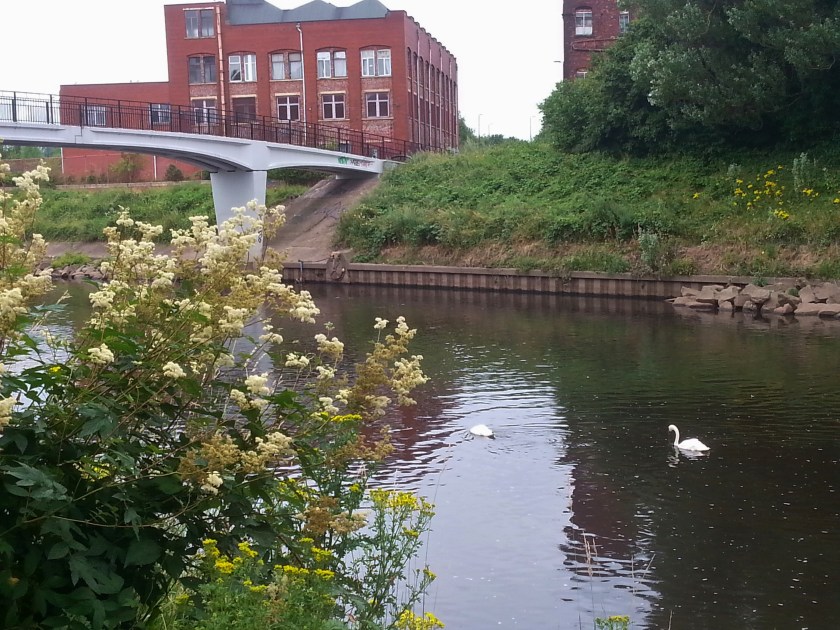
The river Irwell in Salford

We had a weekend at home and this gave me the chance to do some local walking.  I can’t pretend we live in the most beautiful part of the UK, Salford is as urban as it gets and developed as an industrial city in the 19th century.  The cotton and brewing industry that lead to the growth of Salford came because of the rivers and it is the river Irwell that winds its way in to Salford and along the Salford-Manchester border.  Nearby we also have two canals, the massive Manchester Ship Canal and the Bridgewater Canal.

Walking along rivers and canals is always interesting and enjoyable.  In Greater Manchester this is where you find plenty of industrial heritage and history but it is also where you can find wildlife.  On my walk along the Irwell, the Bridgewater Canal and the Ship Canal this weekend I saw groups of squabbling black-headed gulls, flocks of Canada geese, a diving cormorant, a languidly flapping heron and a few elegant swans.  Of course, there is no shortage of litter along the river and canal paths but on my walk I chose to seek out the beautiful, rather than the squalid.

To get to the river Irwell from our flat I walk through Peel Park.  This is one of the oldest parks in England and is currently undergoing renovation thanks to Heritage Lottery money and is slowly becoming the splendid place for a Sunday stroll and a green space for city wildlife it was designed to be.  More work is planned over the next twelve months and I look forward to seeing the park become beautiful once again.

Exploring our local area is on my list of things to do when I am no longer tied to paid work.  Of course, we will travel further afield too but we are both looking forward to finding more of the many gems across Greater Manchester, maybe buying a day ticket on the bus or the tram to a country park, spending a day in one of our many museums or following a route on foot or by bicycle to just see what we find.


A wet weekend in the Lake District gave us chance to face our fears

P1000079.JPG

Rannerdale near Buttermere in the Lake District

It takes really bad weather to keep us ‘van bound on a camping trip.  We have good waterproof gear and our map reading skills can deal with low cloud and showers.  But the recent weekend was as bad as it gets in the Lake District.  Of course, we did get out for a walk on both days but Saturday was that atrocious combination of high winds and heavy rain that makes walking more of a chore than an enjoyable past time.  We walked from the campsite for about an hour and a half and then filled the site drying room with our dripping gear.

Spending time reading and playing cards in the ‘van did give us chance to talk over some things in depth; we talked about work and no longer working and we shared our worst fears for our forthcoming retirement.  What was interesting is that for two people who have been planning this retirement for at least the last six years [and actually for the last 30-years] our anxieties are very different.

My worries are all about our health.  I fret that one of us will either not even live long enough to enjoy our retirement or only survive for a year or two in to retirement before dying.  My alternative nightmare has one of us becoming too ill or infirm to take part in all the walking and cycling we want to spend our long retirement doing.  I am optimistic [or naive] about our finances, sure that the sums are robust and that we’ll deal with any problems as they arise.

Mr BOTRA’s worries are mostly related to money; he is the more cautious one of the team.  He is concerned that we haven’t budgeted correctly and we will run out of money before all our pensions kick in [not until 2026] and he worries that by finishing work he is closing off options to earn a few thousand extra that could be kept in the bank in case we want to move house, buy a new campervan or have some other emergency [of course we have a small contingency fund].  Having worked full-time for all his working life [apart from our gap year] he also has concerns about how his days will be filled without work, although he has no shortage of interests and ideas for things he wants to do.

While Mr BOTRA assures me that we will probably live a long and healthy retirement, I equally reassure him that he will soon wonder where he fitted in the time to go to work and that the spreadsheet doesn’t lie.  These reassurances are important but equally important is to recognise and face the fears of your partner honestly so that you can work as a team to put things in place and [hopefully] stop these fears becoming reality.