15 years in the campervan community

Lock Down Two gave me a bit of time to look back on our happy campervan years. I would describe myself as a campervan enthusiast rather than expert, so I was surprised when we realised that we had now owned a campervan for 15 years. We still have plenty to learn about the art of owning a house on wheels but, after so long, we must know more than we did back in 2005 when we were campervan virgins. In that 15 years three different campervans have captured my heart and joined us on our holidays. Each one has been blue and each one slightly longer in length than the last. In those 15 years we have put 1,319 camping nights under our belts, staying on over 700 different campsites and other overnight spots.

Owning a campervan was a dream for me from being a young teenager. It remained on my wish list for many years, as even second-hand they are an expensive purchase. I was in my 40s before we were in a secure enough financial position to buy our first campervan and even then we had to re-mortgage the house to buy a second-hand six year old ‘van! This first campervan was blue and somehow that felt right and set the trend for the following two.

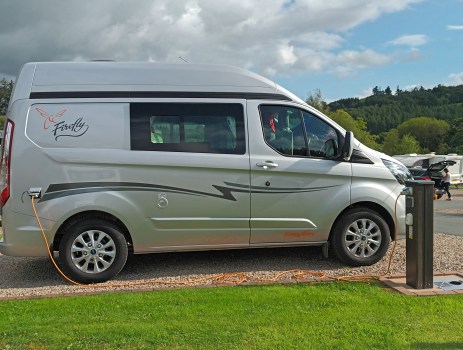
We were nervous choosing that first ‘van, not really having a clue what we were doing. We spent many fun-filled hours looking around motorhome sales areas in the north-west before eventually buying from Todds, near our home in Preston. The discreet expertise of the Todd’s staff reassured us as we took a deep breath and parted with our cash. After viewing campervans with a variety of layouts and lengths, some with bathrooms, some without, we decided to keep it simple and chose a reliable Volkswagen with a straightforward layout. It was a short-wheel base VW T4 with a high top and a traditional rock ‘n’ roll bed and side kitchen. We knew this first ‘van was a testing-the-water sort of purchase, rather than a forever campervan and it gave us the chance to see if vanlife would live up to our expectations.

We took this first ‘van to Scotland, of course, around England and to Germany. Quite quickly we bought a driveaway awning to give us a bit more space and the ‘van transformed our festival experience when we spent the weekend at the Hurricane Festival in northern Germany. Having our very own home on wheels to escape to and relax in, away from the bustle of the festival, was heavenly.

We learnt a lot owning that first ‘van and never regretted starting with a simple conversion. We didn’t have to get into the intricacies of water heaters, refillable gas cylinders and complex bed making. All these things would have obscured the pure excitement of being campervan owners. The VW allowed us to make mistakes, read more about owning a ‘van and talk to other campers, learning at our own pace.

We returned from a trip to Salisbury in Blue Bus One with a more practical understanding of campervan electrics. It was February and we didn’t have a hook-up. With temperatures below zero the blown air heating was keeping us warm and toasty as we played cards into the evening. Everything was fine until the leisure battery ran out of juice! Even wearing layers and cuddling under the duvet we had a cold night. This particular mistake taught us that for winter camping we needed a diesel or gas heater, we also learnt that the hassle of putting an awning up and down wasn’t for us and that the freedom to travel where we wanted suited us very well.

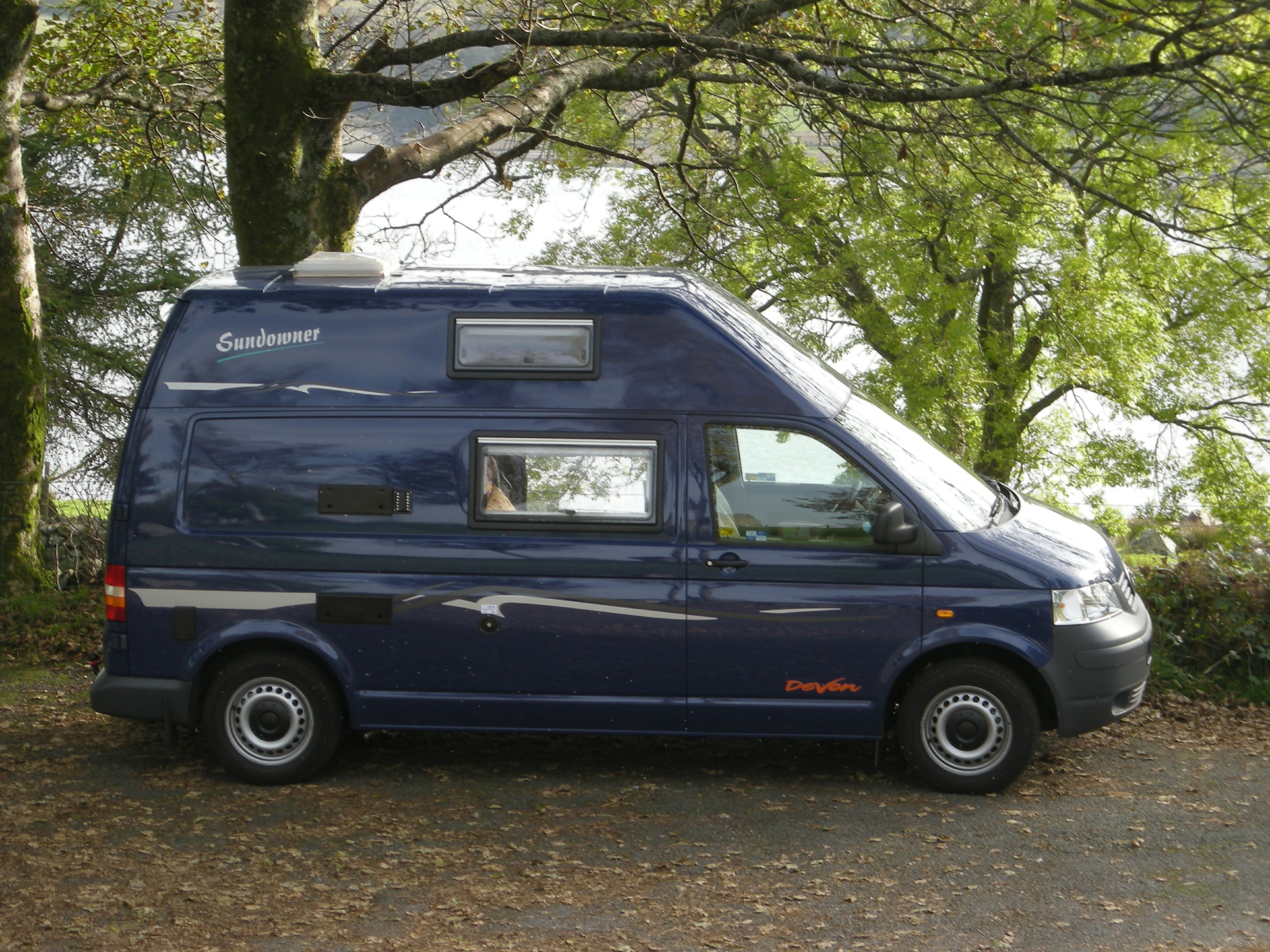
Despite the lessons learnt, we were still really campervan rookies when just 18 months later we were buying a brand new Sundowner direct from Devon Conversion. Our knowledge had moved on, we were clearer about what we wanted and had a spreadsheet of essentials and nice-to-have features. We stayed with the reliable VW but this time picked a long-wheel base, needing a bigger loan on our mortgage! By now our plan for travelling for 12 months around Europe had begun to hatch and this ‘van was purchased with that trip in mind.

Our first trip in Blue Bus Two was a tour around Poland and the following year a campsite owner in France said, ‘You are the people in the Blue Bus,’ and the name stuck. We travelled 80,000 in our second campervan, from Poland to Portugal and Slovenia to Spain and we spent 678 nights sleeping in its comfy beds and living under its roof. So many memories are tied up with that ‘van, it is no surprise I wept the day we said goodbye to it! I hope whoever owns it now showers it with even half as much affection.

The Sundowner was only 5.3m long but its clever layout made great use of the small space, with no bathroom but a toilet. At the time having four travel seats was essential as our son and daughter-in-law often needed a lift and this limited our choice of layout. By the time we bought our third ‘van they were more independent meaning this wasn’t an issue and we could upgrade to a ‘proper’ ‘van with a bathroom.

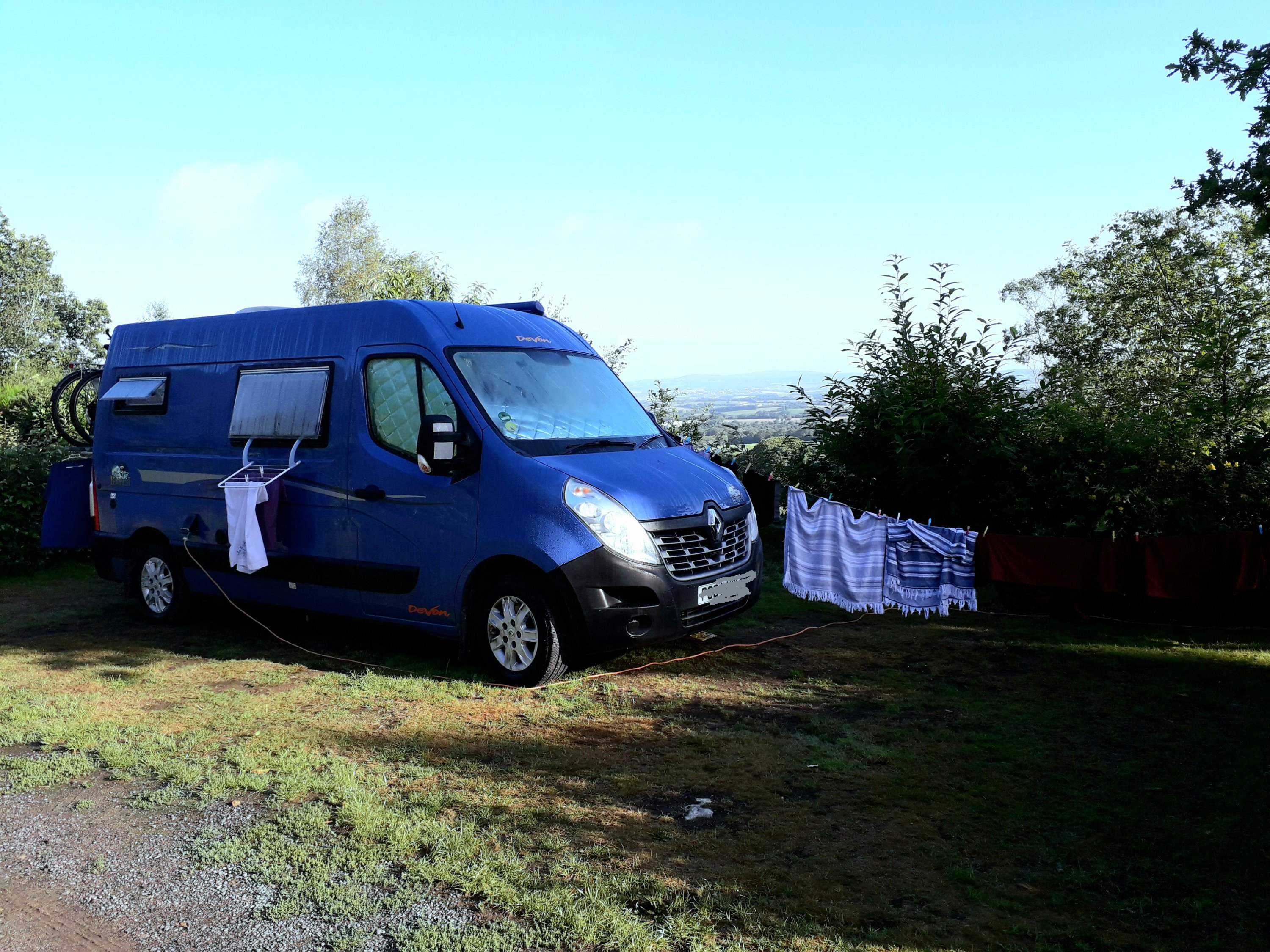
We had taken the VW T5 as large as we could, so we had to look for a different base van for Blue Bus Three. Both of our VW campervans are still on the road somewhere, a testament to the reliability of the T4 and T5 and we always look out for them when we are on the road in the hope that we will have a reunion one day. The elegant shape of the VW limits what can be fitted inside, although there are conversions with bathrooms. After plenty of consideration and more lists we decided to move onto a French classic, the Renault Master.

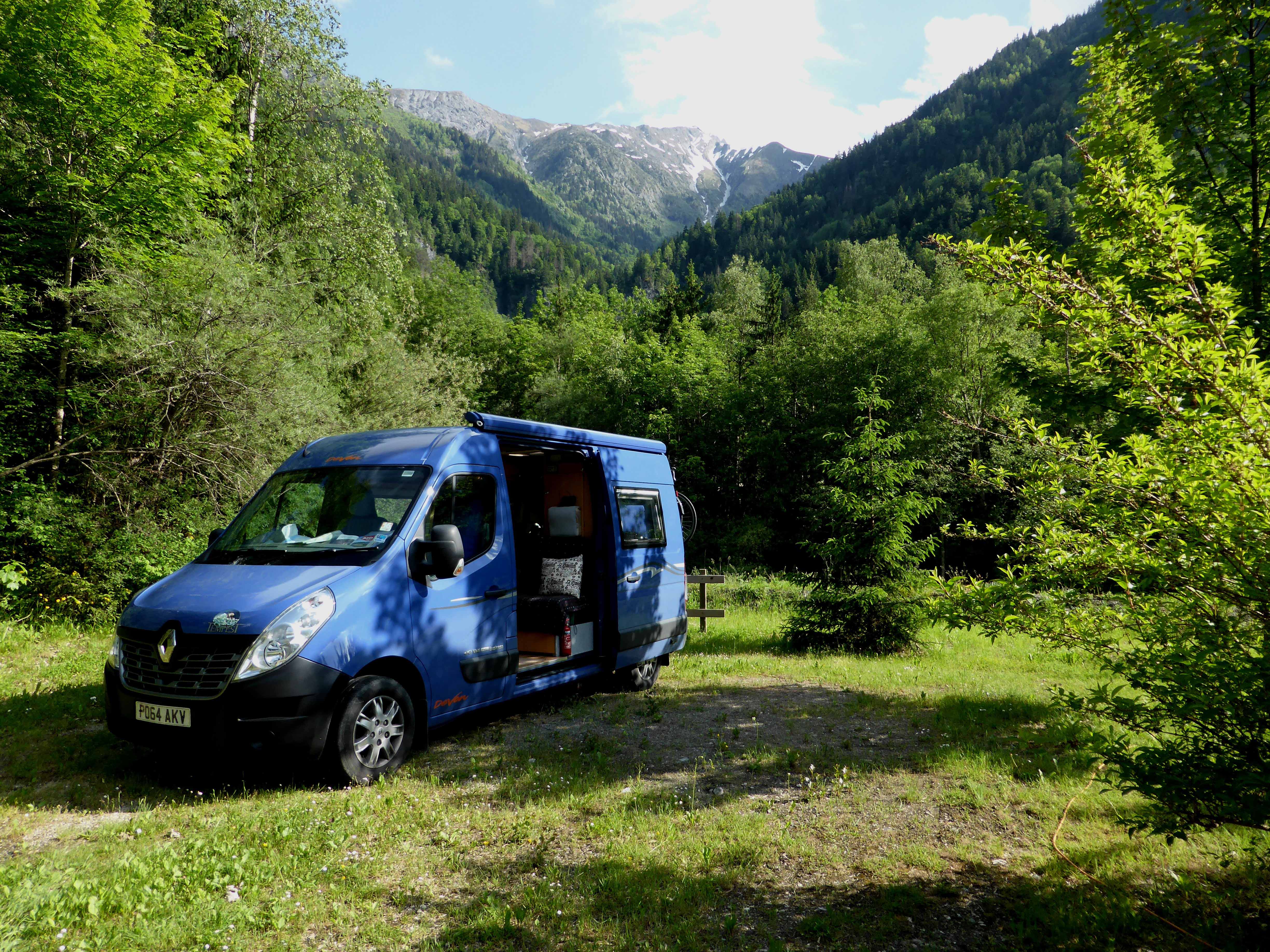
By now, with ten years of living the campervanning dream under our belt we thought we knew what we were doing. We have nothing but praise for the conversions Devon produce at a reasonable price and we like dealing with a small converter that is willing to offer some flexibility on their standard layouts. Other converters were considered and we spent an exhausting day at one of the motorhome shows, climbing in and out of different ‘vans, sitting in them and talking to the sales people. We spent evenings pouring over a spreadsheet, considering the pros and cons of different options before deciding on a Devon Tempest. We were certain we didn’t want to go large and the Devon Tempest gave us a 5.4 m long ‘van with a layout we were confident we could live in.

Our Renault Master seems enormous to us. We have now owned it for five years and have been regularly grateful for the bathroom, but in 2020 it really came into its own. The Tempest was also our first experience of a side sofa with a view out of the sliding door, a feature that we really love. The big Renault sliding door lets the sun in and even on cooler days we can sit in the shelter of the ‘van and be cosy on the sofa.

A big part of the joy of owning a campervan is the people you meet on the road. During our year travelling around Europe we met many fantastic people, some of which have remained friends. Having owned two Devon Conversions campervans we have been a part of the Devon Motorhomes Owners Group on Facebook [and initially on Yahoo Groups] from the beginning. If you have a negative opinion of Facebook I don’t blame you, even the most harmless posts can unexpectedly veer off into a negative direction very quickly, but the Devon Owners group is a refreshing exception. Everyone is friendly, polite, helpful and the group makes having a Facebook account worthwhile. As well as virtual conversations, the Devon Owners generally have two or three meet ups a year, always sociable and fun occasions and thanks to our campervan we have made some good friends.

We have now spent over 600 nights in Blue Bus Three. It has had its problems but has taken us to Greece and Germany, Croatia and Shetland and we have no plans to change it. With the proposals to phase out diesel and petrol engines I wonder if Blue Bus Four will be all electric.

Walking & Camping in the Écrins Mountains of France

A hill walker’s paradise, the Écrins Mountains has an abundance of wildflowers, charming mountain villages and traditional houses, beautiful wall-painted sundials and so much more.  It is fair to say it is one of my favourite parts of France.  The mountains of the Écrins National Park top 4,000 m and, with no roads crossing the central peaks, accessing the unsurpassed mountain walking, the prettiest villages and flower-rich Alpine meadows often involves driving on minor roads that wind steeply up deep-cut valleys.

Below are some of my favourite walks in the Écrins, although I hope to return and discover more soon.  The walks follow an anti-clockwise route around the central mountains, starting with the western valleys.  The campsites we stayed at are listed at the end of the post.

La-Chapellle-en-Valgaudemar

La Chapelle-en-Valgaudemar is a small attractive village  that nestles among the mountains and is reached from the N85 north of Gap.  We stayed overnight at the campsite and woke to low cloud shrouding the mountains but it was dry as we set off walking from the village up the hillside to Les Portes.

The steep narrow path isn’t long [we were walking for about 45 minutes] but it crams in everything you would expect from a mountain walk into that short space.  You will walk through green Alpine meadows, lush woodland and areas of rocky scree, see plenty of colourful wild flowers and have views across the valley and to higher mountains.  It was early June when we visited and we identified many varieties of orchids as well as cranesbill, cowslips, globe flowers, tiny pansies and tall erect white asphodels.

At Portes des Oules we stood on the bridge looking down on the gushing waterfall as it rushed down a narrow gorge.  The pretty hamlet at Portes des Oules has some houses with thatched roofs, their tall chimneys jutting into the sky, apparently to help prevent fires.

Embrun and The Foret Domaniale de Mont Guillaume

Turning left in Gap we took the road towards Embrun and found a pitch at Camping la Vieille Ferme which is conveniently located for the impressive rock-perched town.  As dark descended, scops owls flew through the warm air, the quiet broken by their haunting calls.

We enjoyed a wonderful 14 km walk from here.  After walking into the town and enjoying the views, admiring the old town and having coffee in one of the many cafes, we climbed the hillside along a narrow road and track towards Calayère.  As we walked swallowtail butterflies followed us from flower to flower and a cuckoo called from the woodland.  We climbed higher on the minor road to Le Chateau de Calayère where we rested and watched a couple of donkeys in a field and drank in the mountain panorama.

A delightful green lane surrounded by flower meadows took us into the La forêt domaniale de Mont-Guillaume where we picked up a steep narrow path back down the hill.  In the afternoon heat the shady woodland was welcome as we followed the stream back to Embrun.

Mont Dauphin and the Marmots

Between Embrun and Briançon and below Mont Dauphin there is a marmot community and whenever we pass this way we stop to see these charming animals.  Although being so accessible they are willing to tolerate humans to some extent, we try and treat them with respect and not cause alarm.

After dawdling along the short trail around the marmot area we drove up to the fortified town of Mont Dauphin which sits above the gorge with craggy escarpments on three sides.  We crossed two moats and walked through the immense and complex defensive walls into the walled village.  Built by Vauban at the end of the 17th century this is a remarkably well preserved group of buildings.  The grid of streets are lined with pretty houses and from the walls the views along the valley are spectacular.

On a previous visit to Mont Dauphin we were camping near Guillestre and enjoyed a memorable walk from there that followed a stunning and airy path below the fortified village but high above the river.

Vallouise

Turn off the main road between Embrun and Briançon at L’Argentière-la-Bessée and follow the valley road for about 10 km to Vallouise.  We have fond memories of the campsite at Vallouise when it was a municipal site.  Now part of a chain it has lost some of the rustic charm it had but the village of Vallouise, with gorgeous houses, many decorated with ornate sundials and a central square, is still delightful.  The village is named in homage to Louis XI, remembering that in the 15th century he briefly stopped the persecution of local people.  There are lovely walks from the village but you might want to drive further up the valley for some spectacular mountain walking.

Pre de Madame Carle and the Glacier Noir path

It is a further 22 km or so from Vallouise to the end of the road and the large car park at Pre de Madame Carle but well worth the drive.  From here there are a number of fantastic walks including the Glacier Noir.  If you are looking for isolation, a bit of excitement and stunning scenery then this is your path.

At first the path zig-zags uphill but eventually you reach the narrow lateral moraine ridge that climbs steadily upwards on the north side of the glacier.  We felt privileged to have this fantastic and airy route to ourselves.  The path varies in width but is never more than a metre wide and sometimes narrower and the rock and gravel moraine slopes steeply down to the glacier on one side, while the other slope is grassier and less steep; this latter direction is the way to fall!

We walked among a dramatic landscape with dark crags around us and plenty of snow.  The tranquility was only broken by the sound of occasional falling rocks.  As we climbed higher we could hear the waterfalls at the head of the glacier.  These thundered loudly periodically as if a sluice gate was being opened and closed.  At first glance this appears to be a bleak and desolate landscape, but look closely and you will see tiny flowers surviving in the rocky moraine.  I found a cluster of tiny forget-me-nots, bright pink primula and azaleas bushes which were not yet in flower.  Marmots pottered confidently on the path in front of us, flicking their tails and moving quickly and easily on the steep terrain.  Chamois crossed our paths and sat watching us from the banks of snow.  This was heavenly.

Col du Lauteret

We have driven over the Col du Lauteret [2,057 m] on the splendid road among snow-capped mountains a number of times but only once stopped for a walk.  From the col, the well-marked Sentier des Crevasses takes walkers straight into the high mountains as it traverses the valley side.  This path is abundant with wild flowers, alpine choughs circle overhead and vultures soar.  On the hillsides we heard the piercing alarm call of marmots and stopping to look we eventually spotted them on the hillside.  The views from the narrow but easy to follow path across to the immense La Meije are spectacular.

Walking as far as the Belvedere viewpoint is easy.  Beyond here the hillside becomes steeper and the rock more unstable.

Les Terraces, Chazelet, the Combe de Martignare and Notre Dame de la Roche chapel

Some of my favourite walks in the Écrins were completed from La Grave.  This attractive village, beyond the Col du Lauteret, huddles along the steep-sided valley below La Meije.  Its stone buildings and steep narrow streets ooze character.  The Romanche river runs along the valley below the village and it is surrounded by stunning Alpine scenery.  In the winter this is a popular skiing area.

A 12 km walk took us from La Grave to Les Terraces on a steep uphill path.  Les Terraces is a quiet village perched high on the mountainside, where stone houses with balconies have an enviable view.  Continuing on towards another sleepy village, Chazelet, we stopped to take in the views at the Oratoire de Chazelet, a stone shrine.  The summit of La Meije was peeking out of the cloud, below us was to La Grave and I looked up at the circling griffon vultures knowing I wasn’t brave enough to walk far along the ‘walk of faith’ or Le Perchoir that has been built like a gang-plank from the sheer rock face.  Chazelet is another picturesque village whose busiest season is winter.  From the village we carried on to Les Plagnes and the Combe de Martignare that was a stunning sea of white with narcissi.  Picking up a path back to Chazelet we descended the mountainside to the valley on a steep zig-zag path via the precariously sited Notre Dame de la Roche chapel.

Through mountain villages to L’Aiguillon at 2095m

The mountain villages of the Écrins are beautiful places to explore.  Once again from La Grave we set off for Ventelon and on to Les Hieres.  Beyond these villages the road became a track and we had excellent views looking up the valley.  We reached the stone houses of Hameau de Valfoide where nothing disturbed the tranquility except a hare that lolloped across the lane in front of us.

After passing the Torrent le Maurian we were on a path that was initially steep until it reached grassland full of pheasant’s eyes daffodils and butterflies.  It wasn’t far from here to the bench at L’Aiguillon at 2,095 m.  We sat enjoying the views to La Meije, high enough to still be in the clouds, and below us in the valley was La Grave.  We descended through more flower-rich meadows full of bird song, giving a wide berth to the large dog guarding the sheep [there are lots of signs about how to deal with these dogs].  Joining a road we walked back up hill to Lac du Pontet, a small mountain lake and followed a stream down to Villar d’Arene that is just off the main road.  Here we found a cafe and enjoyed beers and ice-cream in a sunny square before crossing the Romanche and walking through lovely fragrant larch forest where the ground was soft underfoot with a carpet of pine needles.  The path took us over a shoulder and then onto a track back to the campsite.

Le Bourg d’Arud, Venosc and Lac Lauvitel

Below the skiing resort of Les Deux Alpes and in the north of the Écrins is the village of Venosc.  From the nearby campsite we spent a lovely day on another perfect Alpine walk.

It is worth taking time to explore Venosc, a delightful village that has a cable car up to Les Deux Alpes and is packed with shops selling crafts and bijou cafes.

From Venosc, we took a path that followed a clear river through woodland to the hamlet of La Danchère.  Here we took the right-hand path up to Lac Lauvitel and into a floral paradise; there were so many wild flowers it was impossible to stop at them all.  The stony path was relentlessly steep and at one cascade we had to scramble over a plug of snow.  In the hot weather this was tiring work but worth it for the reward when we emerged at the blue lake surrounded by craggy mountains.  Around us was an amazing natural rock garden that we wandered through to a meadow and the lakeside.

We descended on what would have been the left-hand path from La Danchère.  This was equally steep!

Well done if you have kept reading this far, as I have saved my favourite walk to the last!

La Berarde and Refuge du Chatelleret at 2,232 m

The mountain village of La Berarde is about 20 km further along the narrow road from Venosc and is the end of the road.  La Berarde is a small village with a couple of cafes and shops.  We parked the Blue Bus here and under a cloudless sky walked 11 km to the Refuge du Chatelleret at 2,232 m and back.

The route starts steeply with zig-zags rising gently up the valley on a sandy path through low shrubs.  As we climbed higher the path became stonier and there was less vegetation.  We encountered lots of marmots, a few groups of chamois and so many butterflies.

Climbing steadily it took some time to reach the refuge, high in the valley and huddled underneath the massive of La Meije.  In early June the refuge wasn’t open but the guardian was busy getting it ready for the summer season.  The beauty of this valley is breathtaking.  We sat in solitude, surrounded by craggy mountains and with magnificent views down the u-shaped valley to the twin peaks above La Berarde.  Sitting in the sunshine we noticed a strange rainbow streak in the sky above one of these peaks.  This was a cloud iridescence that lasted for about 30 minutes, moving and changing shape and fragmenting.  An amazing phenomena I have never seen before.  The descent was the same way and just as lovely the other way round.  We stopped to refresh our feet in the cold water of the river on the way.  What a fantastic hike and a great end to our time in the Écrins.

Although many walks are well-marked, we took walking maps and the Cicerone guide to Écrins National Park to help with planning and completing our walks.

Campsites in the Écrins

Les Melezes Municipal Camping, La Chapelle-en-Valgaudemar This grassy site has some trees and the ground is fairly hard.  The facilities are clean & the water hot.  The village is small with some shops but no bakery.  Lovely walks from the site.
Camping Vieille Ferme, Embrun A Dutch-run site near to a lovely town.  Some trees for shade but mostly sunny and marked grassy pitches.  Clean facilities and warm water.
Camping La Meije, La Grave A steep walk from the beautiful village & by the river,  this is a grassy site with trees, clean facilities and flowers.  The site is well maintained & has good views.  The showers are roomy with very hot water, the wash up undercover.  An all round excellent site.
Huttopia Vallouise Campsite This large rambling site has great views.  It is dotted with permanent erected tents & chalets.  The new toilet blocks are good and it has a pleasant reception area.  There are bakeries in the village.
Le Champ du Moulin Camping, Le Bourg d-Arud near Venosc The site has marked pitches, good views, a friendly welcome and a small shop where they sell morning bread.  Facilities are in the basement & are clean and warm & the showers are hot & roomy.  There is also a drying room.

The Motoring Ombudsman made our Campervan happy!

Until fairly recently I hadn’t heard of The Motor Ombudsman (TMO), an organisation that is there to sort out disputes between customers and the automotive sector. In the past I have expressed a bit of scepticism about how effective these service ombudsmen are, but I have to hold my hand up and say they did [eventually] come up with the goods when we had an issue with Renault.

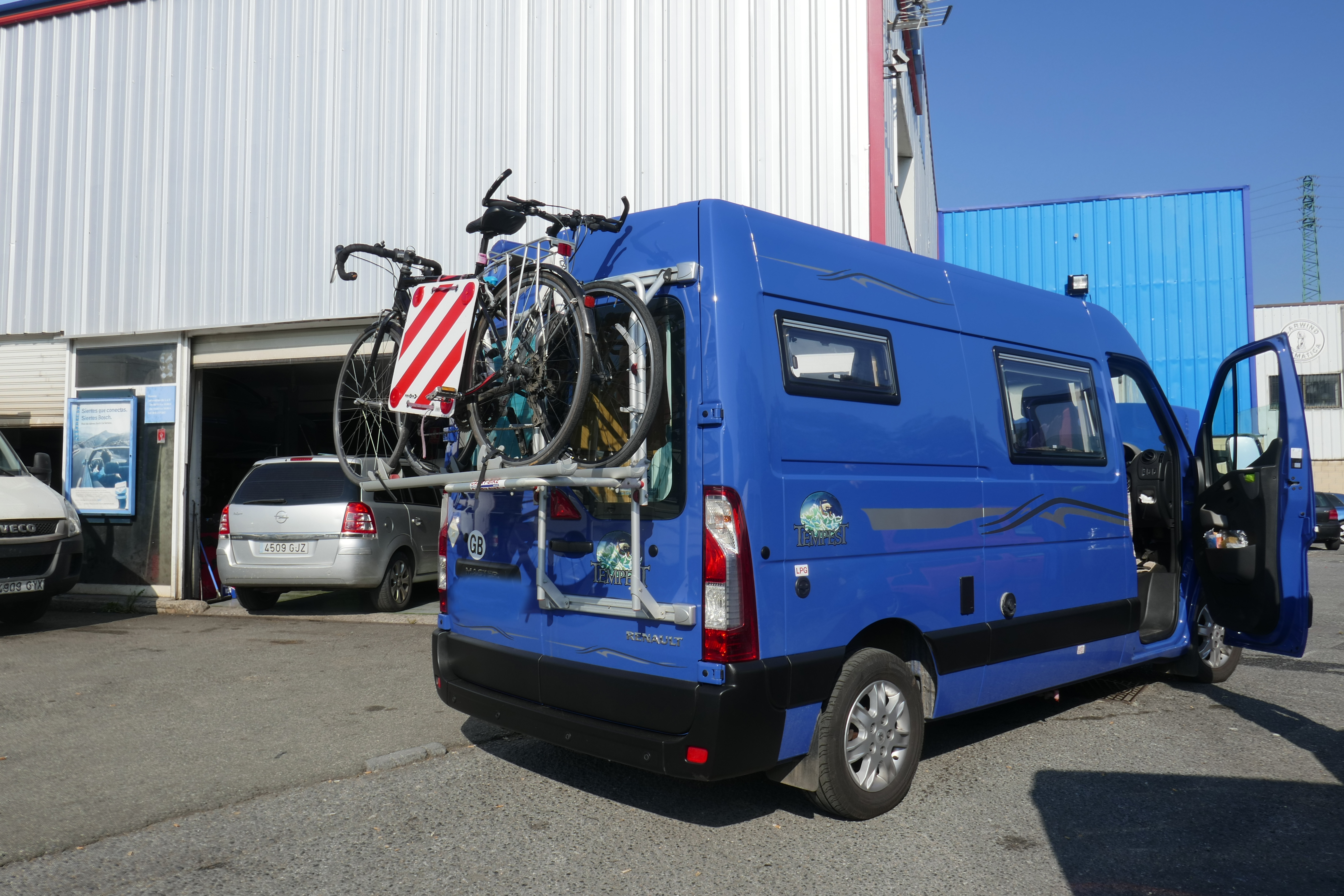
Our campervan conversion is on a Renault Master, a reliable work-horse sort of van that it would be reasonable to expect would keep chugging on for many miles. And yet, on our last trip to Spain ours let us down dramatically when the power steering suddenly failed in a Lidl car park in Guernica, having driven only 30 km from the ferry at Bilbao.  It turns out that without power steering it is a herculean effort to wrestle a Renault Master into a parking space! One telephone call and our breakdown kicked in and after a wait of a few hours in the mid-day sunshine we were taken on the back of a large lorry to a friendly garage [in the photograph] in a town near Bilbao. None of the mechanics spoke English, we hadn’t even got into the swing of Spanish after being in the country a few hours, but everyone smiled a lot.

At the time our van was only four years old and power steering was still covered under the warranty. We informed our breakdown about this but they weren’t keen to move us onto a Renault garage as they thought this could prolong the repair and our need for alternative accommodation. This was possibly true and we were eager to be back on the road.

After a nail-biting day and night, when we didn’t know if it was a big or a small issue, the problem with the power steering turned out to be a relatively simple electrical fault and the local garage had our campervan up and running by the afternoon of the next day. We were relieved to only have to stay one night in a hotel and there was a lot more smiling all round.

In the meantime we had spoken to our Manchester Renault garage who suggested that Renault UK might just reimburse the £130 the repair cost us as it was covered by the warranty in the UK.  When we returned home we contacted Renault, pointing out what good customers we had been at Renault Manchester, that the power steering should never have failed and how inconvenient this was on holiday. We hoped for an apology for the disruption and, knowing they had no obligation to pay us anything, a contribution to the cost we had incurred as a gesture of good will.  Instead Renault responded very curtly, stating that they were not required to pay for a repair carried out by a non-Renault garage.

We would have been happy with just a few quid to shut us up but Renault’s response was so dismissive and thoughtless we were pushed into standing up to the might of an international corporation, a bit like David fighting Goliath, and call in The Motoring Ombudsman.  The TMO took up our case and at first got the same uppity response from Renault. The TMO came back to us shrugging their shoulders in a Gallic way, saying there was no more they could do.

We were a trifle despondent to be beaten but didn’t think we had anywhere else to go. Then a few months later, quite mysteriously, TMO emailed us again to say they had reviewed our case [?] and were contacting Renault once more.  We didn’t hold our breath but this time, again mysteriously, they either caught Renault on a good day or maybe gave the case to someone more experienced. On this occasion Renault reacted in a more customer-focused manner and offered to fully meet the cost of the repair and added a little something for our inconvenience. Of course, we accepted!

It isn’t quite the victory of David over Goliath but we were grateful to be listened to and did say a big thank you to The Motor Ombudsman and to Renault!

Briarfields Touring Park & Cheltenham & Gloucester

Cheltenham 1

An adult-only campsite on a regular bus route to Cheltenham and Gloucester is a great place for a couple wanting an urban break full of historical interest, entertainment and stunning places to eat.  Briarfields is on the edge of Cheltenham and is open all year round so, like us, you can visit out of season.  The site is enclosed by trees and has good-sized pitches and clean facilities.  With buses from the entrance, the background road noise is a small price to pay for the convenience of being able to easily visit the historic town of Cheltenham and the city of Gloucester.

Gloucester 2

Cheltenham

You get off the bus in Cheltenham near to the brilliant white Regency buildings of The Royal Crescent.  I had a copy of David Elder’s Cheltenham Heritage Walks guide book with me and we set off on some of the nine themed walks in this book.

If it is a fine day then the perfect thing to do in Cheltenham is to walk to some of its parks and gardens.  A highlight of your tour will be Pittville Park, about 15 minutes walk from the town centre that gives you chance to admire the large Regency houses and green squares you will pass on the way.  With a duck pond, a boating lake, a playground and cafe and on the hill the stately Pump Rooms, Pittville is an lovely park.  The elegant columned Pump Rooms has a domed roof and inside there is a tap where you can still sample Cheltenham’s water.

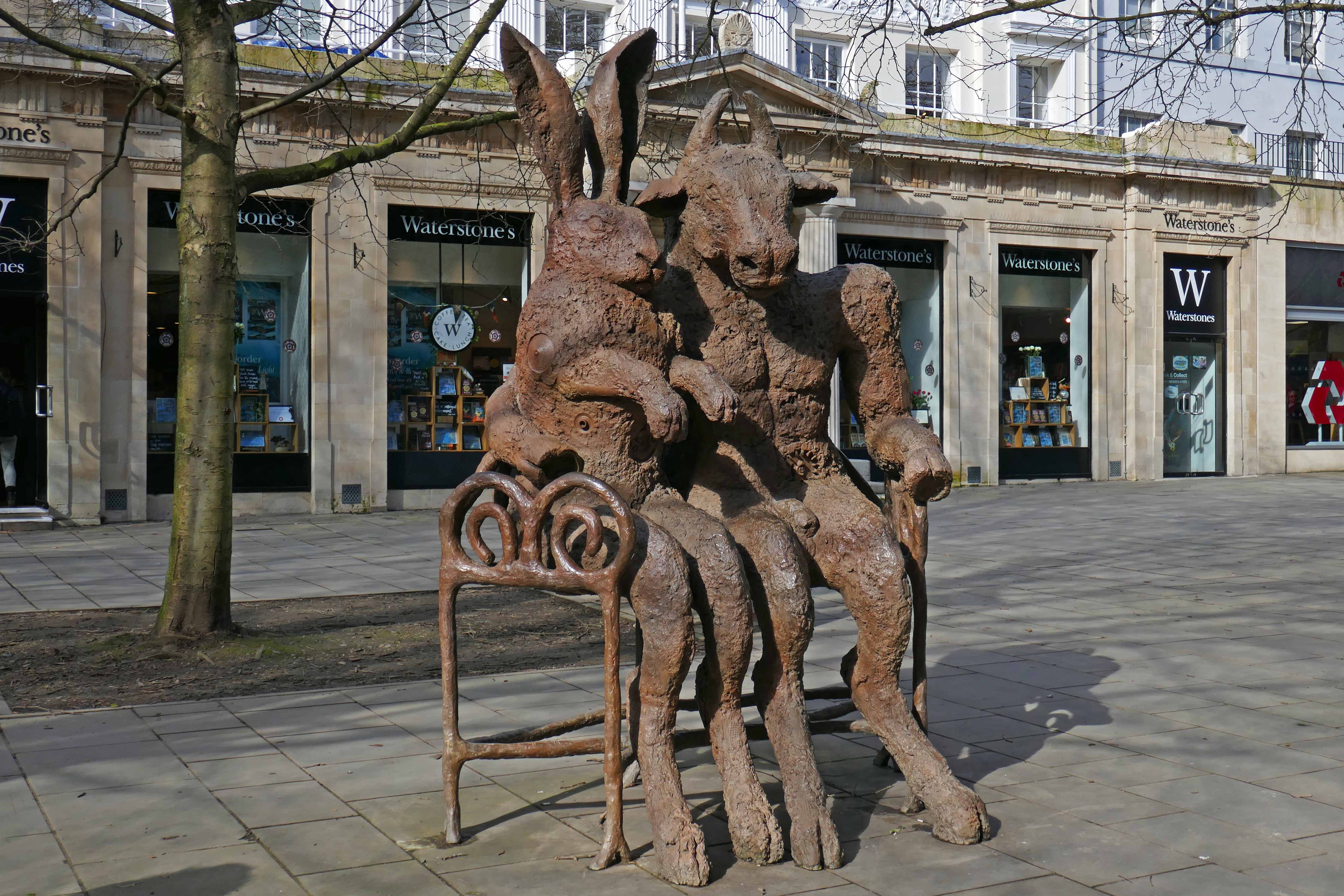
It isn’t my favourite thing to do, unless I actually need something, but even I can recognise that Cheltenham has a great shopping centre.  Whether you are like me and don’t get beyond window shopping or do the real thing it is worth keeping an eye out for some of the statues among the shops  and follow Cheltenham’s story through its art.  The Minotaur and The Hare [in the photo at the top] is easy to find but look carefully and you might spot some of the small pigeon statues too.  These remember the role of this humble bird in Cheltenham’s history when a local farmer spotted pigeons pecking at salt deposits at the mineral spring on his land.  In the Regent Arcade you will want to check the time and watch The Wishing Fish Clock on the hour or half hour.  This colourful and fun tall clock with a goose, golden eggs and other animals, has a fish hanging below the clock that blows bubbles to the tune, ‘I’m forever blowing bubbles.’  The Imperial Gardens near to the centre are where you will find the statue to Gustav Holst and Cheltenham also has a museum to this composer who was born in the town.

Walking further, on the edge of the town we found Sandford Park.  This has none of the grandeur of Pittville Park but offers a respite from the bustle of the town and has a pretty stream running through it and more statues.

We visited The Wilson to find out more about Edward Wilson, the local polar explorer and artist who took part in two Antarctic expeditions with Scott.  Wilson, Scott and Henry Robertson Bowers died in a blizzard around 29 March 1912 still 148 miles from their base camp and just eleven miles from a food stash.  As well as the room to Edward Wilson the gallery has paintings, and some stunning and elegant arts and crafts furniture that I would certainly buy if I had lots of money.

Cheltenham 2

Gloucester

Taking the bus in the opposite direction our first stop in Gloucester was the Cathedral and this is surely a must-do for anyone in the city.  We took one of the tours the cathedral offers and found it was a great way to get much more out of our visit and understand the layers of history in this beautiful building.  As well as Edward II’s tomb, you will gaze in awe at the medieval east window that is the size of a tennis court and enjoy the elegant cloisters that are popular film and TV locations.  If these tours are running when you are there I would recommend you join in.  Afterwards we climbed the steps to the Tribune Gallery to get a whole new perspective on the building.

Walking to Gloucester Docks we had coffee and croissants in an Italian cafe where the chocolate croissant came not just with a chocolate filling but also a chocolate topping.  Outside a group of Vespa owners were congregating by the water and comparing their scooters.  With the sun shining we could have been in Italy!

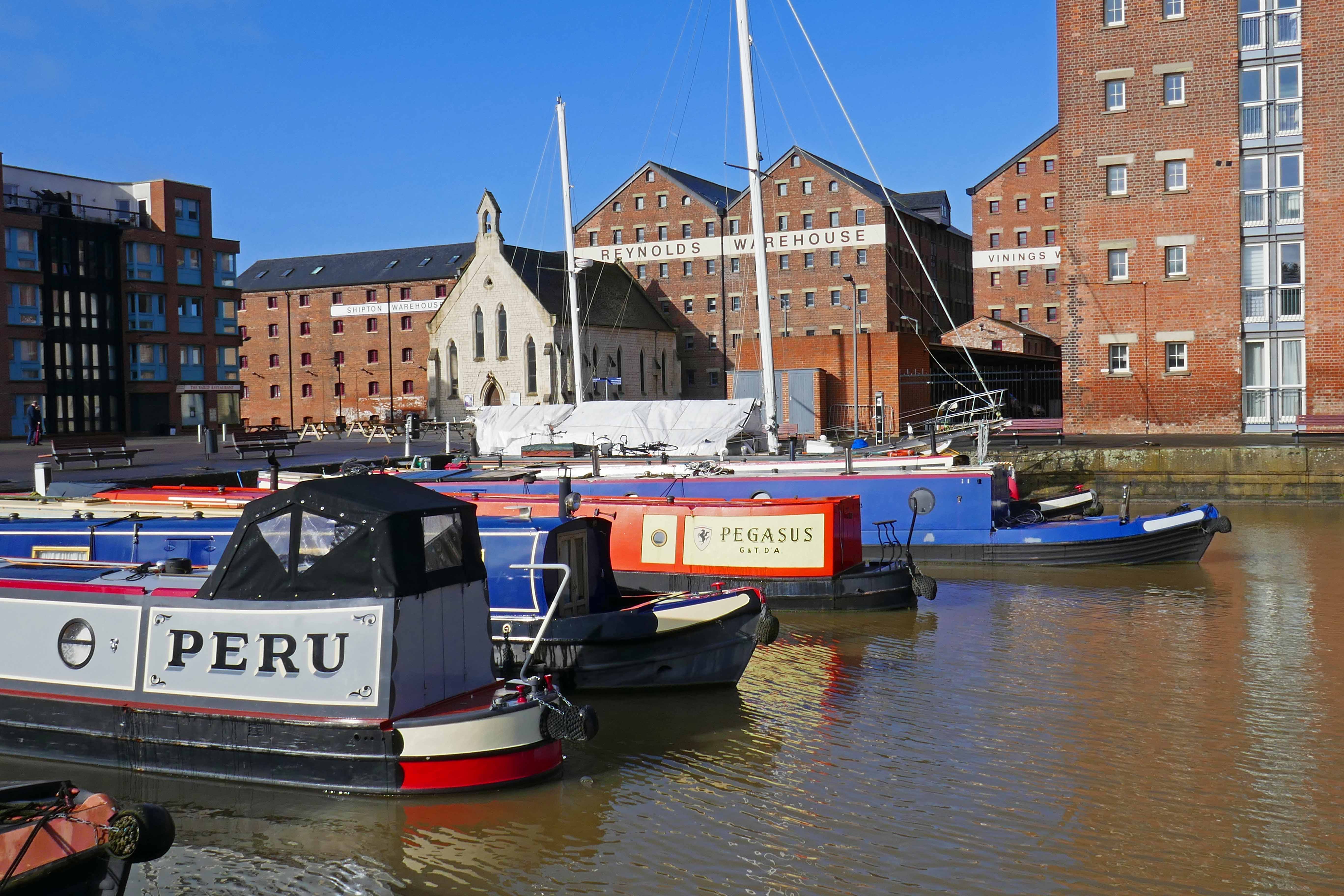
The Victorian warehouses at Gloucester Docks have been restored and this is a watery area of cafes and restaurants that is so pleasant to walk around.  The National Waterways Museum is inside one of the huge warehouses on the Docks.  Each floor has low ceilings and small windows and was designed to store cargoes that arrived here along the canal from Avonmouth and the River Severn.  The oral history exhibits bring to life the hard work in all weathers of the workers on the barges.

The Jet Age Museum

Also accessible by bus from Briarfields, the Jet Age Museum has a mostly indoor collection of Gloster Aviation Company (GAC) planes, apparently the company changed its name from Gloucester as anyone outside England struggled to pronounce it!  GAC built the Meteor, the RAFs first jet that saw service in the Second World War.  GAC started life in Cheltenham and worked with Frank Whittle to build The Meteor, testing it in 1941 and flying with the RAF by 1943.

The museum is run by enthusiastic volunteers and is packed with information.  You can concentrate on the planes or dig deeper into a particular aspect of aviation.  Visitors can have a bit of a hands-on adventure climbing two ladders in and out of the cockpit of a Vulcan bomber, a cramped and stuffy place that isn’t for the claustrophobic.  The five of us each had a crew member’s seat and our guide described what each of us would have been responsible for on a flight.  Easier to get into and more comfortable was the BAE Trident, the first passenger aircraft with an automatic landing system, built by a local firm.  There are smaller simulators for children too.

Gloucester 1


If you want to read more my travel article about this area that was published in MMM in November 2020 can be found in the list of MMM published articles.

Nine Campsites for a perfect campervan tour of Brittany

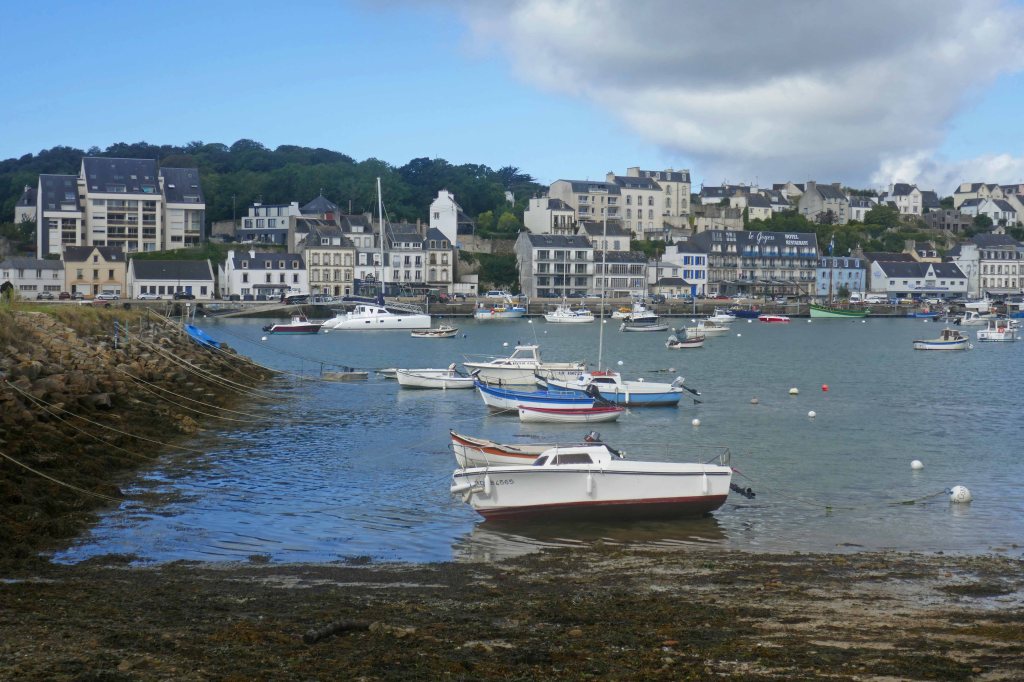
The pretty harbour in Audierne

We spent three weeks touring Brittany in north-west France in August this year.  We wouldn’t normally choose to travel during school holidays and August but, of course, nothing is normal in 2020.  I’m kicking myself that we didn’t travel to France in early July but at that time we thought we could continue with our plan to go in September for the autumn.  As it became increasingly clear that the situation was only going to get worse we bought our ferry date forward and we are so glad we did.

We opted to stay at campsites, rather than aires, on this trip.  All but two of the sites listed below are around the beautiful coast and I think all of them were three star sites.  Including local tourist taxes, the sites cost from €18 [ACSI discount rate as the season ended equivalent to £16.03] to €27.17 [£24.20] a night for high season and compared to the UK campsites these prices seemed reasonable.  We didn’t go swimming but most of the campsites had a swimming pool, the sanitary blocks were open at all of them, hand sanitiser was widely available but not all the sites had soap for good hand washing.

The coast of Brittany is spectacular and we enjoyed walking and cycling along its cliffs and coves.  Inland Brittany is a rural idyll dotted with pretty walled towns that are perfect for exploring.

Here is the list of where we stayed with my comments.  You will notice I appreciate a good hot shower!

Campsite nameCommentsCost per night
Camping de L’Esperance, TrebeurdenLevel grassy site by a road, reasonable pitches but long cable needed.  Facilities kept very clean, showers only warm but roomy and a good flow.  Bread available and there is a lovely 8 km walk around the nearby island.€24.80
Camping Tourony, TregastelLarge pine trees for shade over pitches of various sizes that are not necessarily level and some hedging.  Showers are jets of hot water and a little cramped.  Short walk to lovely beach, pretty bay and harbour and other longer walks.€25.60
Camping du Vougot, Plouguerneau, FinisterePeaceful site with very large pitches marked by trees and hedges.  A friendly and helpful welcome and maps for walks and local cycle routes.  Only 4 showers, so sometimes there was an evening queue but hot water & clean.  Lovely beach nearby and indoor pool on the site. €23.50
Les Bruyeres Camping, CrozonAmong trees and good size pitches, large pool but slightly unkempt air, showers standard and okay.€26.60
Camping LocronanTerraced site with views on the edge of the old beautiful town of Locronan where there are bars, cafes and shops.  Modern facilities block with hot and roomy showers and older block, both kept clean.  A friendly welcome and information on local walks around the town and to the nearby woods.  Indoor pool on the site.€27.17
Camping Kersiny Plage near AudiernTerraced site with some sea views, on a fantastic coastal cycle route in both directions.  The facilities are dated, basic and fairly open to the elements but the showers are hot.  Bread available at the friendly reception.€21.30
Camping Le Kervastard, Beg Meil, FouesnantSmall site with ACSI low season discount. Close to the town, beaches and a nature reserve. Pitches are hedged and large, the clean facilities have hot showers only spoilt by the short burst of water between button presses.  Friendly welcome at reception, bread available and small grocery shop and bars and restaurants nearby. â‚¬18.00
Camping Domaine du Roc, Le Roc St Andre near PloermelSmall cramped site by the canal and small village, no bread on site but bakery and shop nearby.  The facilities are scruffy and showers only lukewarm.  The site has a swimming pool and is popular with groups. Great flat cycling along the canal to pretty towns.€19.50
Camping Des Chevrets, St Coulomb near St MaloLarge site with good-sized marked grassy pitches.  Two beaches and headlands a short walk away and some sea views.  The showers were roomy but the temperature of the water varied somewhat and I wouldn’t call them super-clean. Pizzas available from the snack bar and a pleasant beach-side bar and restaurant. Plenty of walks from the site in all directions. This site is expensive in high season but great value with the ACSI card.€18.00

Just zip it: Zip [cable] ties are essential campervan kit

Does everyone carry zip ties in their campervan? Certainly without these handy plastic ties in our campervan spares cupboard we would sometimes struggle to stay on the road. I am old enough to remember the days before zip ties but still find it hard to think how we managed without these small bits of nylon in the past. We have used zip ties to hold lights onto bikes when the mount has broken; they have replaced broken handles on bags, held together rolled up blankets and more recently were essential for a makeshift [but solid] repair on our Renault Master.

According to Wikipedia, Cable ties were the invention of Maurus C Logan of the electrical company Thomas & Betts. Appearing in 1958 under the brand name Ty-Rap they were initially designed to organise and keep tidy the multiple lengths of cabling in aeroplanes and Logan spent a few years working out the design. They are, of course, still really useful for that original purpose as we now have multiple lengths of cabling that needs organising in our home.

I like to get our van serviced and checked regularly, so before we set off on our trip to France we took our campervan into the local garage. We needed some new front brake pads and oil changes were due. It seemed worth getting these things sorted before travelling so that we could be sure the Blue Bus would have a trouble-free trip. Unfortunately, this forethought had the opposite result as the garage didn’t quite put our Renault back together in the way they had found it.

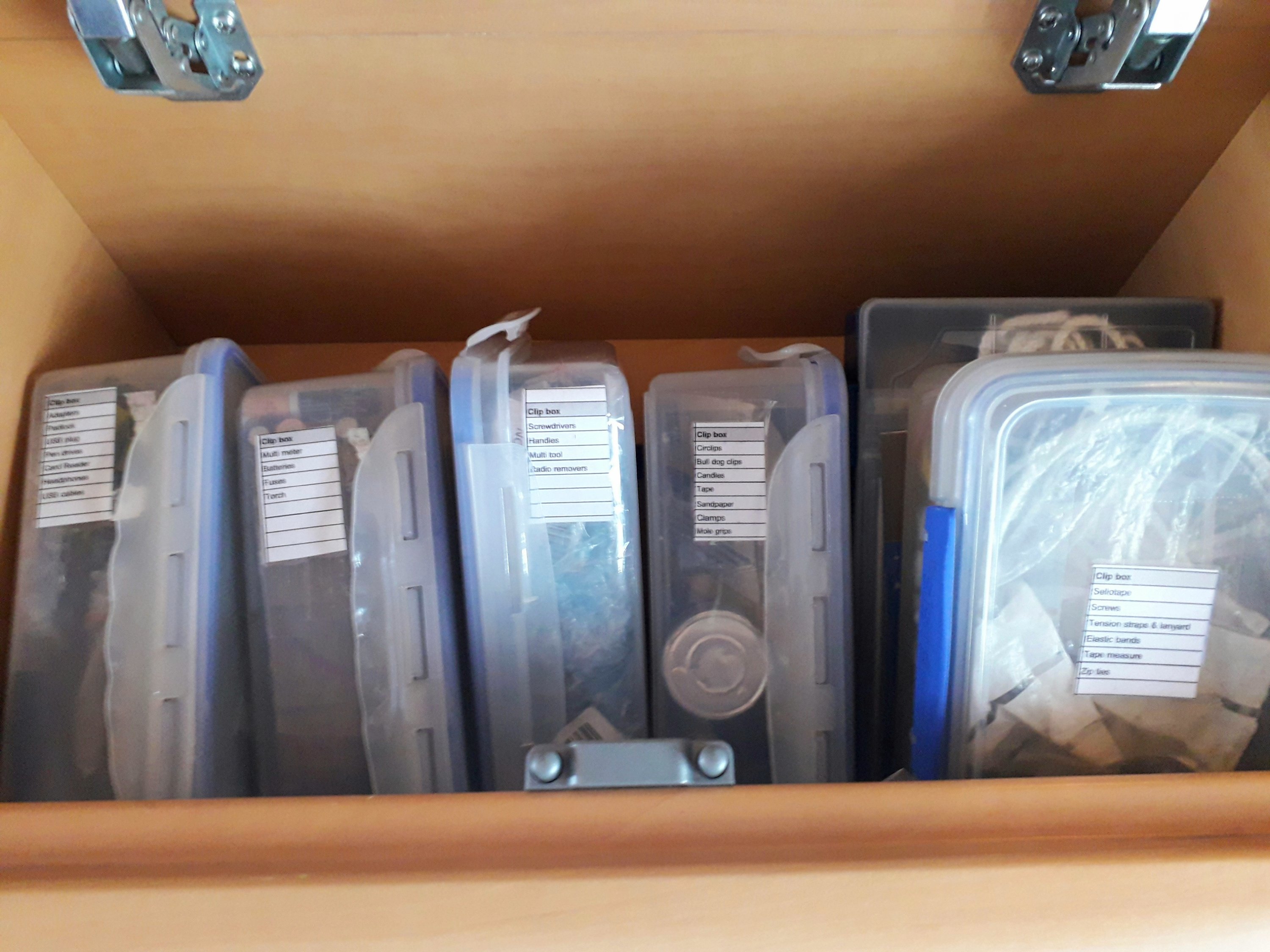
Driving down to Portsmouth for the St Malo ferry there was an alarming banging noise from the front wheel at between 65 and 70 mph. We slowed down and pottered into the next services to stop and take a look. It seemed the cover over one of the wheel arches was flapping as the bolts that hold it in place had come loose. In our campervan we have one cupboard devoted to things that are useful for repairs. Here we keep various kinds of tape, spare handles, superglue, waterproof clothing repair kits, needles and thread, tools and of course zip ties. In this instance the reel of strong tape held the flapping plastic still and the rest of our journey to Portsmouth was uneventful apart from the three hour traffic jam that almost made us miss the boat!

We thought that was the end of the matter but should have known better.  A few days later I was doing some stretching exercises on the ground beside the ‘van, glancing underneath I noticed something hanging down that shouldn’t be.  Further investigation revealed that when the garage had carried out the service they hadn’t fixed the plastic cowling under the engine [the under-engine undertray] back in properly and it was now hanging down low just waiting to be caught on an unsuspecting speed bump.

We do have breakdown cover but decided to have a go at fixing it ourselves and so lying on the outdoor mat I had been exercising on, Mr BOTRA lay under the confines of our campervan while I handed the appropriate sized zip tie to him. He fixed three of these in the holes where the missing bolts should be. We checked the repair regular but this temporary fix saw us around the rest of Brittany and back home from Portsmouth. They worked so well I wonder if Renault should consider using cheap zip ties instead of the bolts that the garage had failed to fix properly.

Our quarantine is almost over and after the excitement of the dentist trip on day one of freedom, day two will involve a trip to the garage to give them the chance to put right their mistake.

Before coronavirus, even uncertainties seemed more certain: Still trying to co-operate with the inevitable

10.28.2018 Morata and Chinchon (24)

I have a mixed relationship with uncertainty.  While it can be a marvellous travelling companion, bringing us unexpected pleasures such as finding a pretty village on a fantastic walk or stumbling across a fair when we only stopped in the town for coffee.  The uncertainty I experience when there is a problem or after something goes wrong is less enjoyable.  Problems with our campervan, such as our little Greek incident, send my anxiety levels sky high.  These days I am struggling to stop my brain from descending into a worried spiral as our plans to travel in our campervan are regularly disrupted overnight.

I have written before about the travelling plans we had made for the spring BC [before coronavirus] and how these were ditched during lock down.  As restrictions relaxed and then campsites re-opened DC [during coronavirus] I tentatively began to pencil in some trips away in our Blue Bus.  We decided to stay local and we enjoyed some wonderful active and safe holidays in the Lake District through July, knowing we could get home in an hour or so if we needed.

I understand that we are still in DC and that this virus has not gone away.  We continue to socially distance, we wash our hands thoroughly as often as possible and we wear our masks when we need to.  Looking forwards in June, I imagined that life in the UK would have settled into a management stage by now as we learned to live with the virus.  I thought this would lead to a bit more certainty and our future travel plans could be more concrete into the autumn.  Apparently not!  Although I had accepted that we would be unable to visit the wonderful country of Portugal this year, I had started to get hopeful that we would be able to travel around beautiful Spain in September and October, using the ferry booking we had made in those carefree January days.  My cautious optimism was dashed on the 25th July when it was announced that the Foreign Office no longer recommended travel to Spain.

I like to think of myself as adaptable but this skill has been severely tried this year.  I find I dare not even write about what our plans are now, firstly because they change so often and secondly because putting it in black and white might jinx things.  What is certain is that we will not be packing until the day before our next trip [having to unpack without going away is too depressing] and if we do get away we won’t have any activities even pencilled in.  Perhaps I am being too pessimistic and cautious but in these ever uncertain times it is hard to dream that anything will have a positive outcome.

Does it help to keep up-to-date with the news, or is that just another source of anxiety?  Sorting the rumours from the truth is important but takes time and these days my own careful assessment of risk means nothing if the Government decides to show their resolve by stamping down on what I can do.

I don’t have a crystal ball, I don’t know what tomorrow will bring but I do know that even the uncertainties seemed more certain in my BC world!  I could worry about illness or mechanical problems almost carelessly, confident that the risk of those things happening was small.  My over active imagination never conjured up anything like the constantly changing restrictions and rules we have been living with DC in the UK.

Uncertainty and certainty are both part of life and I know I can’t control everything but at the moment all I can really try and control are my thoughts.  I could disappear into a pool of my own despondency.  Instead I make myself sit with my  uncertainties and anxieties and write about them.  This does help.  I feel all the emotions and then send them on their way, leaving me to focus on staying in the present, co-operating with the inevitable and accepting that this new super-charged uncertainty is here to stay.


Camping & walking in Arnside & Silverdale

Silverdale and Arnside
At Jenny Brown’s Point on a perfect winter day

Many of us want somewhere to take our campervan that is away from the crowds, has plenty of footpaths, lovely views and a few attractions.  If this is what you are looking for then the Arnside and Silverdale Area of Outstanding Natural Beauty on the north Lancashire south Cumbria border is a great choice.  This small area bounded by the stunning Morecambe Bay and the River Kent has been a favourite destination of ours for the last 30-plus years.  When we lived in Preston and were enjoying a car-free existence it was a lovely area that was accessible by train for walks.  Once we had a campervan it became a go-to destination for a few days away on our own and with friends.  Although only a small area it is packed with variety.

The area’s big draw for wildlife lovers is the RSPB’s reserve at Leighton Moss but there are also historic and heritage attractions and some marvellous and varied walking.  Where else can you be pottering along a craggy coast in the morning and after lunch be sauntering through pretty woodland or following the shores of a small lake to a limestone pavement?  This is truly a diverse landscape, with so much to offer.

I have lost count of the number of holidays we have had in this area, in good and bad weather but I always return home loving it more.  If you’ve never been to Arnside and Silverdale think about planning a few days or even a week or so in this wonderful area.

Here are some ideas to help you make the most of a camping trip to this area:

Campsites

Most recently we stayed at Hawes Villa Camping, a small reasonably priced site with some basic facilities and great walking right from the step of your campervan with Hawes Water just ten minutes away.

If you want a site with full facilities then the more expensive Holgates Silverdale site might suit you.  The large site has a pool, bar/restaurant, shop and play area.  It is also in a beautiful position on the edge of the village.  Holgates Hollins Farm site is nearer to Arnside Crag and is quieter but still has an excellent sanitary block.

We have walked by Gibraltar Farm campsite many times but never camped here.  I do know it has plenty of fans and as it sells its own ice-cream I will get there soon!

You can find a few quiet wild camping spots too.

Walking is the best way to get to know this area

To get the most out of walks an OS map or the Cicerone walking guide are both helpful.

The Fairy Steps – You can walk to this limestone escarpment either from Arnside or from Hawes Villa Camping.  Climbing up the path through the woodland from Hazelslack you will come to a limestone escarpment that at first glance is impregnable.  Look carefully and you will find a narrow gash through the limestone and a series of steps to the top.  Popping out onto a grassy ledge you have a splendid view over to the Kent estuary.  As you squeeze up the gash in the steps you can try and climb without touching the sides so that the fairies will grant you a wish.  Good luck with that!

Arnside Knott – Arnside nestles on the slopes of Arnside Knott, a limestone hill with tree-covered slopes that reveals stunning views over the Kent Estuary and Morecambe Bay.  It is a straightforward but steep walk, either from Arnside or from either of the Holgates campsites.

The coast – There are footpaths around pretty much all of the coast here.  Highlights include the old tall chimney at Jenny Brown’s Point and the lime kiln near to Gibraltar Farm campsite, the pretty and sheltered cove at Silverdale, the stunning mixture of craggy coast, bays and woodland around Arnside Knott and the dyke and salt marshes from Arnside to Storth.

Eaves Wood – Meander through this lovely wood and climb to the viewpoint where you will find the Pepperpot,  a monument built to commemorate the Jubilee of Queen Victoria.  The Silverdale Holgates campsite is on the edge of Eaves Wood and the paths can be easily accessed from the site.

Gait Barrows National Nature Reserve and limestone pavement – From Hawes Villa Camping walk by Hawes Water and you come to Gait Barrow, an expanse of grey limestone pavement cut with grykes and dotted with low-growing trees.  No dogs are allowed on the pavement.

Dallam Tower Deer Park and Beetham – A longer walk from Hawes Villa Camping could take you to the pretty village of Beetham.  The path from Heron Mill at Beetham takes you uphill over pasture.  As you walk look out for the herd of fallow deer that are kept here.  Walking down the hill, with the stately Georgian Dallam Tower on your left, you reach a pretty section of the River Bela before it runs into the Kent.  Cross the river and you will be in Milnthorpe.

Things to see and do

RSPB Leighton Moss – Open all year, the expansive reed bed is home to a wide range of wildlife; as well as fantastic wildfowl and marsh harriers there are otters and red deer.  There are trails to walk, hides and amazing views from the Sky Tower.

Leighton Hall – Open limited days from the beginning of May to the end of September, this historic house has links with the Gillow furniture makers.

Heron Mill, Beetham – This restored and working corn mill in normal times [BC] is open Wednesday to Sunday for most of the year.  There are tours when you can see the waterwheel working.

The train from Arnside or Silverdale to Grange-over-Sands – On the railway line from Arnside you cross the 505 m long viaduct over the River Kent.  Grange-over-Sands has a lovely railway station, a pleasant park and a selection of good cafes and interesting shops.

Carnforth – The black and white film, Brief Encounter was filmed in Carnforth.  Take the train or drive to Carnforth Station Heritage Centre and The Brief Encounter tea room.  Afterwards spend some time browsing the rambling bookshop across the road; I have never walked out of this wonderful shop without at least one great book.

Warton Old Rectory – This ruined 14th century house is in the pleasant village of Warton and is free to explore.  Afterwards visit the church and find out why this small village has links to George Washington, the US President.  From the village you can also walk over Warton Crag.

An Arnside teashop – Everyone has their favourites; the Old Bakehouse is justifiably popular, Posh Sardine is recommended, there is a chip shop and on a sunny day you can enjoy a pint with a view at The Albion.

A cross bay walk – Check out the Guide Over the Sands events page for dates of the planned cross bay walks.  In the summer this is an exceptional way to enjoy the beauty of Morecambe Bay.  Led across the sands and mudflats by the Queen’s Official Guide, the walk is about eight miles, takes three to four hours and will involve wading through water that is at least knee deep.  During the coronavirus pandemic these guided walks have been cancelled but they will hopefully return in the future.


Me & my campervan: Back on the Road Again

Camping Indigo Vallouise
Camping in the Ecrins National Park in France

I thought I was one of those people that plans for the unexpected, always thinking about the worst that could happen but even I never imagined there would be a life I would have to live where we couldn’t take our campervan away on a camping holiday.  I had thought ill health might stop us travelling, or money, or a breakdown or maybe a ferry strike would keep us in the UK but not being able to stay overnight anywhere for over three months!  That scenario was never on my radar until March 2020.

We were at home, where else, when the confirmation that campsites could open on 4 July 2020 was announced.  Like all these political proclamations, everyone had expected it for days but to get the news was a relief … you would think.  After the initial elation, I found that new anxieties floated to the surface.  My head fretted that something would go wrong.  Covid 19 certainly hasn’t gone away and is here for a long time if not forever.  This means that any number of things could happen that could lead to a loss of freedom once again if we aren’t managing it sensibly.  Covid 19 cases could increase again and even if there is no evidence that camping is the culprit, someone could decide it has to stop.  I worried that this could even happen before 4 July arrived.  I wanted to get out camping that night, not have to wait eleven long days!

Many people are still wary about going away from home and I understand this but I almost feel that if we don’t go straight away we may stay at home and never travel again.  Travelling is an important part of me and I dislike being confined to home, but even I have felt my expectations falling and my horizons lowering over the months at home and I am aware that there is a hint of apprehension about getting on the road again.

This week I have been checking the cupboards in the ‘van, filling them with what we need and anticipating being away camping again with a combination of joy and a bit of a tear in my eye.  On the eve of the 4th July, I feel a mixture of trembling excitement and sick anxiety and it feels important to work through this.  I need to crack on and get out into the big world again.

All being well, we will be camping, along with plenty of other people, on July 4th and I expect we will get back into the swing of it and after a week or so feel like we have never been away.  I don’t think I will ever take the freedom to travel for granted again.  We are starting slowly, camping not far from home and mostly on sites with no facilities.

I know we are lucky to have some amazing places nearby, to be alive and healthy, to have each other and to own a campervan.  I will be so happy to be back out in our Blue Bus and once again smiling to myself when I wake up as I remember I am in our campervan.  I can’t wait to have days when I have no idea what will happen and where we will end up.  Tomorrow I will be back on the road again!

Kinlochewe: Our last camping trip before lock down

20.03.2020 Kinlochewe and Lochs Clair and Coulin (23)
Beautiful Loch Clair

Will life become divided into BC [Before coronavirus} and AC [After coronavirus]?  And I think I need a category DC (During coronavirus] as this pandemic is likely to be with us for a year or two.  Looking back on camping trips we made before lock down they have a happy-go-lucky almost dreamlike quality that I don’t see returning for some time.  We took stopping at a cafe, visiting a museum and, of course, camping, not exactly for granted but certainly something we had the freedom to do when we wanted.  All this changed in the UK on 23 March 2020 and although things have begun to re-open, as I spend DC standing on a 2 metre line to queue and video calling friends I can’t say the experience is like it was in BC.

Our last BC camping trip was to Torridon in Scotland.  We set off in March expecting to be touring this wonderful country for a month and hiking through some of its glorious countryside.  Even though our trip was cut short by the virus, we had a wonderful few days before we had to return all the way home.

We have stayed in Torridon, on the west coast of Scotland, before but the last time we were there together on a walking holiday the UK was at war with Argentina over the Falklands Islands.  We were looking forward to a much delayed revisit.

Walks from Kinlochewe

You couldn’t ask for better weather the day we followed the tracks and paths around Loch Clair and Loch Coulin.  With blue sky and snow still lying on the mountains, the views over the lochs to the distinctive peaks of Liathach and Beinn Eighe took my breath away.  The walk is mostly flat and easy to follow for 9 km / 5.5 miles.  More details on the Walk Highlands website.

From the Kinlochewe campsite we walked to Loch Maree and along Gleann Bianasdail.  This is the approach to Slioch, the craggy high mountain by the loch, but on a cloudy day we stayed low, walking about 16 km / 10 miles.  The walk along the river to the loch is a pleasant and easy 10 km return and takes you by the old cemetery and through beautiful gnarled trees covered in lichen.  The footbridge over the roaring waterfall might be where some would turn back but we continued up Gleann Bianasdail.  Keep a look out for the wild goats that scamper up the steep hillsides here and are delightful to see, we also spotted some red deer.  The views back to Loch Maree as you climb higher are worth the longer walk and the river gorge has some vibrant green Scots pine trees huddled along its banks.

Walking there and back the same way when the views are so varied and awe-inspiring is no hardship and I have no hesitation in recommending the 13 km / 8 mile return trip to Loch Grobaig, a tiny loch in the trough between the mountains of Liathach and Beinn Eighe.  Starting at the small car park above Torridon House, the path follows the river, through woodland that soon opens out to moorland and a stony and occasionally boggy path.  Beinn Alligin looms to your left, the snowy slopes of Beinn Eighe pop up ahead and to your right are the steep slopes and crenellated ridge of Liathach.  Following the river, a dipper bobbed along the rushing water between the rocks.  As we gained height we looked back for the views of Upper Loch Torridon.  We had Loch Grobaig to ourselves and as we ate our lunch I felt embraced by isolation and magnificence.

In the evening sunshine we stopped to recreate photographs we had taken all those years ago at the viewpoint above Upper Loch Torridon.  Our trip was cut short but the memories remain.  As I type we can’t return to Scotland yet but we hope it will be sooner than 30+ years [maybe even DC] when we are back there again.

22.03.2020 Over Loch Torridon and campsite (2)
The view across Upper Loch Torridon

We stayed at two campsites

Ardtower Caravan Park is a top-notch independent campsite with views over the Moray Firth from the higher hard-standing pitches.  We have stayed a couple of times and the owners are always friendly and welcoming.

Kinlochewe Caravan and Motorhome Club Site is a beautifully positioned site at the foot of Beinn Eighe and in the small village.  At night the skies are dark and during the daytime the views and local walking are amazing.