An award winning travel writer

P1140693
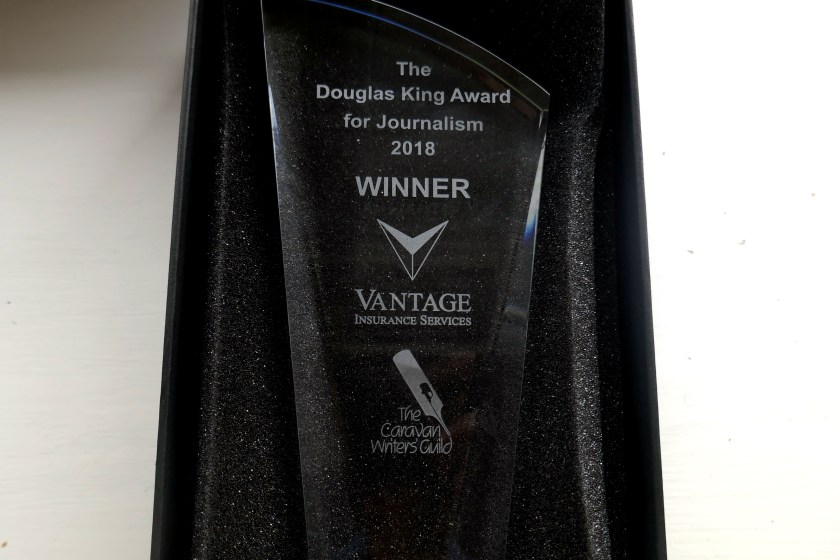
The Caravan Writers’ Guild Douglas King Award crystal glass trophy

‘How did you get into journalism,’ Terry Owen, the former Secretary of the Caravan Writers’ Guild asked me.   I was visiting Terry and Alison to collect the crystal glass trophy I had won for the Douglas King Award for written journalism.  Terry’s question was a good one that deserved a better answer than the waffle I came up with on the hoof.  What I did say is that I have been practising and improving my writing for a long time.  The night school class I took in English Literature in the 1980s got my fingers itching and I learnt from others while I worked on an alternative local magazine, Preston Other Paper.  Studying for a degree in Geography and Environmental Management and a higher degree in Applied Public Health and keeping my first blog from 2009 helped to hone my writing skills so that in 2011 I was ready to dip my toe in to being paid for writing about life in a campervan.  My journey to winning the Douglas King Award has been a long one and I continue to strive to ensure that my travel articles are entertaining, accurate and informative.

I  write travel articles because my friends don’t always want to listen to my stories of my travels and the need to share the beautiful places I visit is strong.  These travel articles are not aimed at my friends, my audience, the campervan and motorhome owner [or potential owner], is always at the forefront of my mind.  In practice this means that my travel articles are not only the story of tours we have completed in our own ‘van, they include practical information about places you can park a long vehicle, where campsites or wild camping spots are and the state of the roads.

As well as improving my craft and remembering my audience I thoroughly research the area I am exploring.  Typically, I always learn more snippets of information than I can fit in to one travel article but part of the art of a writer is knowing what fits the story you are telling and what might be fascinating but is a digression and needs to be ditched.

I like to weave a thread through my stories as this helps them to hang together so that they are more than a list of places we visited.  This thread might be something personal such as a childhood memory or a visit to an area that has long been on my wish list.  For other articles I might concentrate on the weather or the local food.  Sometimes the narrative emerges from the research and I might link together literary connections or historical sites.

I am chuffed to bits when people I meet or on social media tell me how much they like a particular travel article I have written but winning an award for my journalism is a different level of recognition that has blown me away.  It is such an honour to have my writing appreciated and judged to be award winning by other professionals and I still have an inner glow from having won.

I entered the Douglas King Award for the first time a few years ago and in August this year I thought i would give it another go.  Checking through my articles that had been published in the preceding twelve months I chose to submit the article about a tour of Scotland’s beautiful west coast, published in MMM in January 2018 and a piece I was proud of.  You can find the article in the list of my MMM articles if you want to have a read.

In September we had just arrived in Spain and I got a call to tell me that I was short-listed for the award; I was over the moon at receiving this recognition for my writing but certainly didn’t expect to hear anything more.  So imagine my elation when the following month I heard that the judges had decided that my article was good enough to be declared the winner!  The judges thought the piece was a, ‘Beautiful descriptive feature’ which certainly goes to prove that you don’t need perfect weather to write a good travel article, which must be a comfort to many UK based journalists.  We were in the lovely Spanish coastal town of Peñíscola when I received this news and so I unfortunately missed the glittering presentation evening.  I was both delighted and astounded to win and only Mr BOTRA got to see my blushes.

The Caravan Writers Guild covered the award on their website and MMM published a news story.  It was a particularly big night for MMM as the magazine scooped two awards at the October presentation evening with their Road Test Editor also winning the John Wickersham Award for Video.

Both the Caravan Writers’ Guild’s awards are open to non-members and they manage these awards efficiently and courteously with the aim of encouraging excellence within the sector.  Membership is available to those who have been writing and published for at least a year, so if you’re a motorhome or caravan journalist writing in print, on a blog or producing a vlog then give joining the Guild a thought and maybe enter a piece yourself in 2019.

IMGP5856ct2
Receiving the Douglas King Award from Alison Owen [photograph taken by Terry Owen]


Arran: My first encounter with this lovely island

P1120252
The dramatic landscape of Goat Fell on Arran

The internet suggests there are up to 5,000 islands around Great Britain, although the exact number seems to be hard to be sure of and there are certainly plenty of these I have never heard of, let alone visited.  Another source gave a figure of 82 islands that measure more than 5 sq km.  This is still a higher number than I might have guessed at and one that made me ashamed of how few of our islands I have taken the trouble to get to.  It was time to visit an island and an autumn trip to Arran, off the south-west coast of Scotland was planned.

Goodness knows why I have never been before as we found so much that delighted us on Arran.  The craggy mountains around Goat Fell are perfect walking country; Glen Sannox is simply stunning; the stone circles at Machrie Moor are impressive and fascinating; the coastline near Blackwaterfoot  and the walk through boulders to the basalt cliffs of The Doon is stunning and the sheltered bay at Lochranza is picture perfect.  I loved pretty much everything about the island.

Thanks to the Road Equivalent Tariff (RET) on Scottish ferries, getting to Arran is now more affordable and it was just over £45 return for our 5.4 metre long campervan.  We needed to have a frugal holiday due to our expensive year but also like to support campsites and so we stayed on three of the islands campsites [see below] and did a few nights wild camping too.  Wild camping is popular on Arran and some places can get busy at weekends as Arran is a perfect place to visit in a campervan.

We didn’t visit any tea shops, although I am told they are excellent, but we did support the Arran economy and bought excellent local cheese in the cheese shop, local beer at the brewery, good local oatcakes and delicious local bread in the Blackwaterfoot Bakery.  These all went very well together and didn’t last long.

Arran was a great start to my plan to visit more of the islands around Great Britain.  The big question is where to go to next?

Campsites we used on Arran

Lochranza Campsite – a beautifully situated site that is well kept.  The site is grassy with some hard-standing pitches if it is wet and there are open views.

Seal Shore Camping  – this site at Kildonan has lovely views out to sea and clean facilities.  The site is sloping but while we were there they were building some more level pitches.  The site is next door to a bar.

Middleton’s Caravan and Camping Park – This level grassy site at Lamlash is handy for the shops, places to eat and shoreline in Lamlash.  The facilities are clean and it has good hot showers.


Go the extra mile it is never crowded

P1070396.JPG
A quiet corner of the Lake District

You might laugh [please do] but when I came across this saying recently my literal mind skipped it’s metaphorical intention and took its meaning to the letter [I often do this].  My thoughts wandered to when we have walked an extra mile or so on a beach or in the hills or cycled just that bit further and felt smug as we left the crowds behind.  The saying is spot on; going that extra mile often takes us to a quiet corner and to somewhere special that we can embrace as our own for a short time.  By just taking a bit more effort I can enjoy an undisturbed experience of a location with the space and tranquillity to really see, smell and feel the place.

The quote attributed to Wayne Dyer, author and self-development guru, is, ‘It’s never crowded along the extra mile.’  After thinking about all those idyllic places we have found it eventually dawned on me that this quote isn’t to be read literally and instead encourages everyone to believe that by putting in the extra effort you can reach the top.  My mind turned to those times when I have gone the extra mile on a task.  Doing just the minimum required can be an easy option and I have times when I need to cruise through jobs because my mind is preoccupied with other stuff.  But I feel much better about myself when I put the extra effort in and give my absolute best.  And yet, the number of people who will reach the heights of the elite in any field is limited [or never crowded] and unfortunately not everyone can be outstanding otherwise outstanding becomes the average.  For myself, I don’t expect to be award winning, I go the extra mile to compete against myself, stretching my performance and improving my skills.

I consider myself a slow writer; certainly each time I write a travel article or blog post I spend hours rigorously writing, editing and re-editing.  I do this for two reasons; I am certainly terrified of the shame of making a mistake that makes it in to print [although they do and I have to deal with it] but I also want to produce work I can feel proud of.  I constantly review, learn new techniques and apply these and I feel that my writing has improved over the years.  I don’t go the extra mile for promotion or a higher salary, my editor is not pushing me to write differently, I am self-motivated to do better and throwing together a piece of writing with the minimum effort has never been an option.  By going the extra mile I might not reach the top but I do maintain my self-respect.


Helly Hansen Watersport Centre: #surprisingsalford #33

Ordsall and water sports centre July 2017 (9)
Water-based fun in Salford

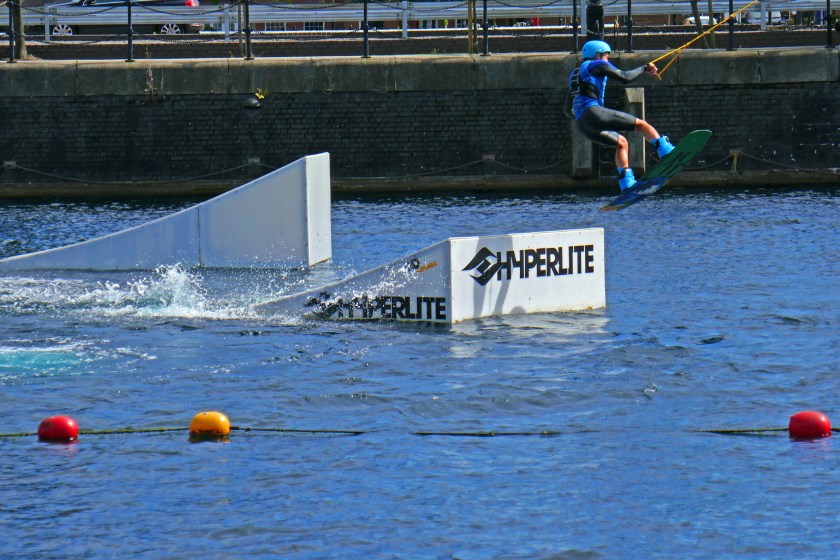
We like to get out and stretch our legs and get the heart pumping after writing at the laptop for much of the day.  Salford Quays is the place we take one of our favourite regular walks and we often swing by the Watersports Centre as there is usually something going on there which gives us an excuse to linger and lean on the railings and watch.  Sometimes there are groups of young people learning how to manage a kayak, on other occasions there are acrobatic wakeboarding sessions.  Those of us not taking part in these water-focused activities [and we are never alone here] can idly enjoy the spectacle.

I am always pleased to see the Manchester Ship Canal at Salford Quays being used.  When I used to cycle to work over the canal I would often see groups rowing along the canal in the early morning.  In winter it would be barely dawn and the sun would be coming up over Manchester, the rowers were out on the water and wrapped up against the cold.  On other trips around Salford Quays we have stumbled upon open water swimming events when the noise from splashing arms and legs echoes around the blocks of flats.

My first experience of the Watersport Centre was when our son took part in the Salford Dragon Boat Festival.  His workplace had a team in the race and we came along to watch the fun.  The dragon boats themselves are stunning, each decorated boat is 40-foot long and holds 18 people.  One of these is a qualified helm, 16 people row and one person is the drummer beating time.  We cheered our son’s team on and for novices they did pretty well, getting through a number of the heats but the main thing was that they enjoyed taking part.  This event is a great spectacle if you can get to Salford Quays next time it is on.


Trekmates Poncho: A Review

P1120052a
Modelling the Trekmate poncho

 Updated April 2025

Okay, so this won’t be the most trendsetting and smart bit of gear you will ever see me wearing but it is certainly proving to be practical.  We both own cagoules, waterproof jackets that are perfect for when the heaven’s open.  We live in the north-west of England and have been bought up to carry these cagoules on every walk, even if there isn’t a cloud in the sky, as in our unpredictable climate you just never know.

Cagoules are fantastic in winter but even when made of Gore-tex they can get hot and sticky in a summer shower.  Last year at the Upton Blues Festival I noticed lots of people were wearing ponchos in the rain and these looked both practical and comfortable.  We don’t buy anything on the spur of the moment but started the process of thinking and researching ponchos.

It seemed the poncho market is broad and we could buy expensive or cheap.  Generally with hiking gear I will opt for quality over budget options but as this was a new bit of kit that we were not completely sure would ever be useful we decided to be cautious and frugal.  Dipping our toes in to the waterproof poncho market we bought these Trekmates ponchos for £20 each in 2018. [2025 update: Trekmates now do a range of ponchos from £35-£55.]

After even a short time these ponchos are proving to be perfect for those short sharp summer shower that we often get in the Alps and in UK.  In this sort of weather the temperature doesn’t plummet too much and putting on a cagoule, even a breathable one, can be a sweaty experience.  We prefer to stay dry and walking in the countryside there isn’t always a bus stop or hut nearby to shelter in.  As well as being perfect at a festival these ponchos are now our go-to option on those hiking days when there isn’t a cloud in the sky and but we want to pack a just-in-case waterproof.  As the ponchos are lighter and less bulky than our cagoules I am sure we will use them often in our trips to southern Europe.  This will mean that our expensive Gore-tex cagoules will last that bit longer.

The Trekmate poncho has a number of other plus points over a cagoule:

  • They come in one size so if you are as short as me [162 cms] the poncho is long enough to cover your shorts and keep them dry.  Mr BOTRA is a bit taller but the poncho would still cover his short shorts!
  • The poncho’s are big enough to go over your rucksack as well as you and keep that dry
  • The poncho’s come with a stuff bag so they pack away neatly
  • This is a light piece of kit that doesn’t take up much room in your pack

These ponchos only come in black and the design is very simple.  At the front there is a large pocket that might be useful to keep any map dry during the shower.  There is a zip at the neck and a flap and the hood is a generous size.  In the body of the poncho there are two holes with Velcro to stick your hands and arms out of if you need to.

The only downside we have found is that if it gets windy the ponchos can billow.  I think if it is that windy it will most probably also be cold and we would be carrying cagoules and waterproof trousers anyway.

We decided to buy at the cheaper end of the poncho market for our first purchase in case these proved to be something that we never actually used.  We have now owned these ponchos a almost seven years and they have more than proved themselves. Other than one of the press studs at the neck breaking off, they continue to keep us dry in short summer storms and light rain and are perfect to carry just-in-case.

I am now a convert to a different way of keeping dry on the hills, even if I don’t look like the most stylish walker.  If you see me please don’t laugh too much!


Wing mirror jousting!

09.23.2018 Visit to Artajona (9)
The Blue Bus parked at Artajona in northern Spain – a perfect place for jousting!

The mishap came as a bit of a surprise.  The road from Torla to Aínsa in Aragon is a secondary road but a good one and we were pottering along in the sunshine, enjoying the views over the Rio Ara and of the villages perched on hilltops.  The road has a white line down the centre but the carriageways are on the narrow side and the light traffic was driving considerately giving enough space to oncoming traffic.

Coming towards us were two massive white motorhomes in convoy.  The leading motorhome was taking up more than his fair share of the road and we moved over to the edge of the road to ensure everyone could pass by safely.  We assumed the big guy would do the same but it seemed he too had been watching Game of Thrones and fancied a bit of wing mirror jousting with our Blue Bus.  Bang!  We both cursed him as our passenger side wing mirror was slammed inwards and the glass broke.

We know this isn’t a tragedy, it is really just one of those things that will happen to lots of people in campervans.  Those big wing mirrors are a perfect target after all and this is the first time we have broken a wing mirror in our 13 years of having a ‘van.  The idiot in the motorhome didn’t stop – to be honest there wasn’t really anywhere safe to stop – and we limped along for a couple of kilometres until we found a lay-by to pull in to.  Shaken we gave each other a hug and investigated the damage.  The glass of the main mirror was shattered but fortunately the small blind spot mirror at the bottom was still intact.  The mirror no longer responded to being moved.  Our only consolation was that the big white motorhome would most likely have the same damage to his wing mirror and we hoped his replacement mirror was even more expensive than ours.

Our Renault has no internal central mirror, so the wing mirrors are essential.  We had a go at fixing a shaving mirror we carry in to the housing of the wing mirror to help the driver see behind but we couldn’t get this to work.  We have since found that you can buy temporary ‘mirrors’ and may invest in one or two of these.  After some thought and consideration we felt it was safe to drive using just the blind spot mirror for the remaining 25 kms to Aínsa.  Although this mirror is small it functioned pretty well.

A call to our breakdown sorted out a garage that was expecting us and the mechanics there spent some time ensuring they were ordering the correct mirror for our Renault.  The next day it took them 15 minutes to fit the new wing mirror and it cost us around £200!  An expensive jousting session.

2018 Oct Carol Kubicki wing mirror (1)
Fixing the mirror in the garage

Lightoaks Park: #surprisingsalford #32

Lightoak Park July 2017 (1)
Dappled sunshine on the pond at Lightoaks Park

Always keen to explore other parts of Salford further from my home I found myself walking north from the familiar Buile Hill Park and in to the unfamiliar Claremont and Irlams O th’ Height areas of Salford.  Here I found Lightoaks Park and was delighted by what a lovely and pleasant park it is.  Lightoaks Park is one of Salford’s larger parks and it offers a varied landscape that is worth an hour or two of anyone’s time.

The park was officially opened in 1925 and as it rapidly approaches its centenary it has an active friends group that helps to take care of the park and organises events and activities throughout the year.

I walked through the park to the pond with Mr BOTRA and leaning on the fence we chatted to a local who was also out enjoying the park.  He told us he was a regular to this park and shared his love of the park, expressing with his smile how important his local green space was to him.  We meandering around the paths through woodland and lawns and found the outdoor gym to play on for a short while.  We stumbled upon a section of wall set with old carved stones, presumably from a mansion that was on the site previously.

Maps from around 1940 show that the pond was a feature in the new park and that in those days Lightoaks Park had a pavillion, tennis courts and a shelter with a lodge at the Claremont Road entrance.  In the higher part of the park was Crimble Lodge and Claremont Farm.

Irlams O th’ Height is a former village and is a tough name for locals and visitors to spell.  I hope I have got it right!


Sedan: Add it to your wish list

Sedan (3)
The massive fortification in Sedan

For anyone with a campervan, motorhome or a caravan there are two good reasons for visiting Sedan in northern France.  Firstly for around €9 a night you can stay at the municipal campsite.  This municipal site is easy to find and is pleasantly placed by the river Meuse, with moorings for boats alongside the site and an open aspect that helps it feel more rural than urban.  We were greeted warmly by the member of staff who gave us a map of the town and told us enthusiastically about the castle and told us we could pitch where we liked on the grassy site.  The ground is a little uneven but nothing the levelling blocks couldn’t deal with.  The sanitary facilities were not the most up-to-date but were clean and the showers were good and hot and we don’t need much more than that and you can’t expect much more for the price.

Sedan is handily placed for us to reach our ferry at Zeebrugge but we arrived with enough time to visit the second reason to visit Sedan.  It has what is claimed to be the largest medieval fortified castle in Europe.

It is about a 15 minutes’ walk to the castle from the campsite and it is as magnificent and immense as you could hope, with an impressive curtain wall around the castle and courtyard and lovely views over the town from the corner bastions and the ramparts.  We explored the dark corners, alleys and stairwells that were designed to confuse the enemy and from the information boards learnt how the castle had grown over time.  I was particularly fascinated by the view into the interior of a round tower that had been enlarged over the years and seeing the interactive scale model of the castle in 1870 during the Franco-Prussian First Battle of Sedan.  The Second Battle of Sedan was in May 1940 during the German invasion of France.

After exploring the castle, we strolled around the town that has a history of cloth-making; some think that upholstery from Sedan gave the Sedan chair its name.  We found narrow streets and charming shops, lovely botanical gardens and bridges over the river Meuse.  Sedan also has an open and covered market on Wednesday and Saturday mornings.


Ordsall Chord: #surprisingsalford #31

Ship Canal Nov 2017 (12)
The Ordsall Chord bridge from below

It isn’t often that Ordsall in Salford is mentioned in the Chancellors budget!  In 2011 I was only half listening to the Chancellors statement on the radio but my ears pricked up when he proposed funding the construction of the Ordsall Chord.  What was the Ordsall Chord and what sort of musical instrument would need government support?  As we live near to Ordsall in Salford I investigated further and discovered this was a much needed railway project joining two Manchester railway stations; Manchester Piccadilly and Manchester Victoria.  The Ordsall Chord takes a curved route around the city centre, skirting the boundary of Ordsall, hence its name.

As with many railway projects nothing happened for a long time but eventually construction work started.  I watched the new line taking shape through 2016 and was excited to see the bridge over the Irwell erected [watch the video] and the completion of the project at the end of 2017.  This arched bridge is a stunning addition to the local skyline and is a thing of beauty.  The weathering steel of the bridge over the River Irwell gives it an attractive rusty appearance as well as being practical.

In December 2017 the Ordsall Chord opened for trains, providing that much needed direct link between the two stations.  On my Waxi trip along the canal we sailed under the bridge but I couldn’t wait to take my own trip on this new bit of railway line.  In January this year we used a trip to Bradford as an excuse to take a trip along the Ordsall Chord.

This work has also revealed the historic stone bridge or viaduct built by George Stephenson in 1830 for the Liverpool to Manchester railwayline.  This elegant bridge is being restored and will be part of the public space around the Ordsall Chord.  I for one am looking forward to this part of the project being completed.

2018 Jan Salford Chord (2)
Crossing the Ordsall Chord from a moving train

Hope the voyage is a long one


06.11.2018 Saillans (5)
I can’t resist cats, pretty tea-towels and net curtains

I heard the author Louis de Bernieres talking on the radio and {as so often happens with radio programmes] he took me to a new place – Ithaka by Constantine Cavafy.  He was sharing a poem that had changed his life and it resonated with me too.  The Greek island of Ithaca or Ithaka identifies with Homer’s Ithaca, home of Odysseus and his odyssey to return there.  Ithaka is our goal, the thing we get up for every morning or our own quest.  But like Odysseus, it is the adventures and discoveries along the way to our quest that are important and there are good reasons why we shouldn’t rush the journey just to get to the end of our odyssey.  Constantine Cavafy speaks of the importance of enjoying the road to our own Ithaka, pausing to appreciate the route but keeping ‘Ithaka always in your mind’.  We can then hope to arrive at our Ithaka older and wiser after years of learning on the way.  ‘Without her you wouldn’t have set out’, Constantine Cavafy reminds us.

Louis de Bernieres interprets Ithaka and ‘what you’re destined for’ as every human’s inevitable journey to death.  We take the first steps on this journey as soon as we are born and we all hope that this is a long and interesting journey.  ‘Ithaka’ and Louis de Bernieres’ response, ‘When the Time Comes,’ are poems that intimate that we would do best to enjoy whatever life throws at us and hope that we don’t reach the end of our journey until we are old.  Louis de Bernieres poem has become popular as a reading at funerals and I can see why.

To someone who adores to travel those words, ‘And if you wish, let there be Spanish music, Greek seas, And French sun, the hills of Ireland if you loved them’, make me smile.  Even if my own Ithaka comes tomorrow, I have been lucky enough to have found those and other treasured places … but hopefully my journey will continue a little longer. 

Ithaka, Constantine Cavafy
As you set out for Ithaka 
hope your road is a long one, 
full of adventure, full of discovery. 
Laistrygonians, Cyclops, 
angry Poseidon—don’t be afraid of them: 
you’ll never find things like that on your way 
as long as you keep your thoughts raised high, 
as long as a rare excitement 
stirs your spirit and your body. 
Laistrygonians, Cyclops, 
wild Poseidon—you won’t encounter them 
unless you bring them along inside your soul, 
unless your soul sets them up in front of you. 

Hope your road is a long one. 
May there be many summer mornings when, 
with what pleasure, what joy, 
you enter harbors you’re seeing for the first time;
may you stop at Phoenician trading stations 
to buy fine things, 
mother of pearl and coral, amber and ebony, 
sensual perfume of every kind—
as many sensual perfumes as you can; and may you visit many Egyptian cities 
to learn and go on learning from their scholars. 

Keep Ithaka always in your mind.
Arriving there is what you’re destined for. 
But don’t hurry the journey at all. 
Better if it lasts for years, 
so you’re old by the time you reach the island, 
wealthy with all you’ve gained on the way, 
not expecting Ithaka to make you rich. 
 
Ithaka gave you the marvelous journey. 
Without her you wouldn’t have set out. 
She has nothing left to give you now. 

And if you find her poor, Ithaka won’t have fooled you. 
Wise as you will have become, so full of experience, 
you’ll have understood by then what these Ithakas mean. 

When the Time Comes, Louis de Bernieres

When the time comes, it is better that death be welcome,
As an old friend who embraces and forgives.
Sieze advantage of what little time is left,
And if imagination serves, if strength endures, if memory lives,
Ponder on those vanished loves, those jesting faces.
Take once more their hands and press them to your cheek,
Think of you and them as young again, and running in the fields,
As drinking wine and laughing.
And if you wish, let there be Spanish music, Greek seas
And French sun, the hills of Ireland if you loved them,
Some other place if that should please, some other music
More suited to your taste.
Consider, if you can, that
Soon you’ll shed this weariness, this pain,
The heaped-upon indignities, and afterwards — who knows? —
Perhaps you’ll walk with angels, should angels be ,
By fresher meadows, unfamiliar streams.
You may find that those who did not love you do so now,
That those who loved you did so more than you believed.
You may go on to better lives and other worlds.
You may meet God, directly or disguised.
You may, on the other hand — who knows? — just wander off
To sleep that seamless, darkest, dreamless, unimaginable sleep.
Do not be bitter, no world lasts forever.
You who travelled like Odysseus,
This is Ithaca, this is your destination.
This is your last adventure. Here is my hand,
The living to the dying;
Yours will grow cold in mine, when the time comes.