Books: portable and joyful

2013 May Wolfgagesee cycle ride 2013-05-28 001

According to Neil Gaiman, ‘Physical books are tough, hard to destroy, bath resistant, solar operated, feel good in your hand: they are good at being books, and there will always be a place for them.’  And I think he is right.

It feels that ink and paper is being replaced by e-Books, potentially saving thousands of trees, although sales have been falling.  This got me thinking, will this mean the end of the campsite book swap, a feature of most good sites?  These range from a dusty shelf in a corner of a room with half a dozen novels from the last century to a tidy book case bulging with a range of current novels.  How much longer will I be able to browse the rows of dog-eared paperbacks on the off-chance that something will take my eye?

To say I like reading is an understatement, I always have a novel on the go; with a book I am never bored, trains can be delayed, dentists can make me wait and I am entertained.  On trips away in our campervan I always have a few books tucked away in case I get through my current book; we might have a wet day and be van-bound or I might want to soak up some sunshine, either way I will want to also spend the time travelling in my head through the pages of a novel.

In 2009 my partner and I took a late gap year and travelled around southern Europe in our camper van.  One of my concerns was how to ensure I had enough reading material as I knew it was not possible to carry the 75 books I needed during the twelve months on the road in our small VW.  Think back to those days; e-Books had started to appear on the scene but were not so ubiquitous and paperbacks seemed the only way to go.  Using every space I could in the van, I found room for about 20 books of various sizes and genres, left parcels of others for our lovely son to mail out or bring in his suitcase when feasible and hoped to buy, borrow or swap the rest along the way.  With this simple plan I unwittingly opened myself up to interesting and fun experiences that I will always treasure.

Memorable swaps during our time away include the Fay Weldon I was persuaded to try by a Dutch gentleman who, in to his tidy ‘van, describing himself as a story teller with regular ‘gigs’ in different countries.  A motorcyclist gave me the fantastic Robert Harris’ Pompeii on an Austrian site not long after we had visited that beautiful area.  Another campsite swap re-kindled my interest in Graham Greene’s novels with a well thumbed copy of The Human Factor and an exciting Val McDermid crime novel set in Manchester and found on a well-stocked and English-owned camp site in southern France bought back memories of home.

My modus operandi was to wander over to an unsuspecting UK motorhome on a campsite with the handful of books I had to offer.  When the book swapping went well we would chat about books we had enjoyed for a while and I would leave with a couple of interesting novels to read.  However, these productive encounters were rare and I was astonished to find there is a non-reading community out there.  I remember one lovely couple we met in France who ransacked their caravan to find me a book to read and eventually unearthed an exceptionally tatty copy of Denis Wheatley’s The Devil Rides Out that had not seen the light of day since around 1966; I didn’t want to offend such helpful people and so took the novel off their hands.

Books were also often a good starting point for wider conversations; we met a cyclist from the Netherlands who came over to chat because I was reading Geert Mak’s In Europe: Travels Through the Twentieth Century.  Apparently this marvellous collection of travel and history writing is a best seller in the Netherlands and the evening ended up with us sharing a bottle of homemade schnapps (from another friendly camper) and putting the world to rights.  In Slovenia, I noticed the young receptionist at a camp site was reading an English novel; I was so impressed with his command of a second language and talked to him about English novels, giving him a couple of books I had finished with when we left.  Another lively conversation with a lovely couple in southern Spain who were living permanently in their RV, started when they put a pile of books out on their pitch with a sign saying help yourself.

When we reached Spain on our 12-month trip, the book swapping became much easier, as campsites which had plenty of ‘winter migrants’ from the UK would often have a shelf of books available to swap and I would be able to leave the novels I had read and take away something new to read.  These book swap shelves are generally a relaxed places on a camp site; I could spend as long as I wanted browsing the choices to find something to my taste.

Not so on one camp site in southern Spain that will remain nameless, as we may still be on their wanted list.  This site had taken the provision of reading material to another level.  They had a library room, full of books in English and many other European languages that was strictly run by a retired librarian from Scandinavia, who spent her winters on the site.  She used a computer to monitor the borrowing and returning of the extensive selection of books and relaxed swapping of books was forbidden.  This worked fine for those who were spending months on the site but didn’t work well for me as we didn’t intend to stay long enough to finish a novel.  I gave a false name and vehicle registration and we left the camp site with one stolen novel, although in my defence I did donate two books in exchange to their library.

Choosing to take an e-Book on our long-term trip might have meant I read the books I wanted to read but I would have missed the opportunity to interact with new people, try some authors I would never have considered and experience the unexpected.  Not to mention what would have happened when I spilt my coffee over my e-Book!
 

How we stay within budget while on holiday in our campervan

2011 August van pictures 014
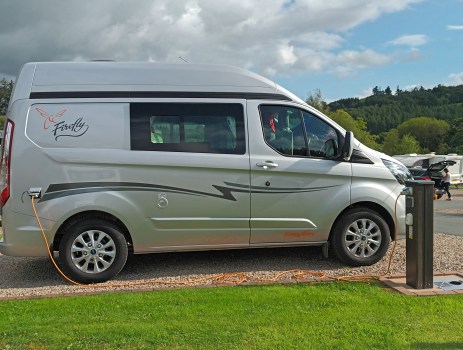
Cups of tea in the ‘van are cheaper than a cafe

How we all spend our money is a personal thing and holidays is no different; we all have our different priorities.  It is hard to argue that a campervan or motorhome that cost just over £40,000 is a budget option and I know that we only have our newish ‘van thanks to an inheritance that meant our savings for retirement could stay on track while we also funded a new ‘van which we expect to last us at least ten-years and many miles.

All that said, we do try and make the trips in our ‘van as frugal as possible by following these tips.

Campsites – the cost of an overnight on a campsite can be very high and, if you use campsits, is a major cost for ‘van owners.  We reduce our costs by wild camping and using Britstops when this makes sense and seeking out cheaper sites with fewer facilities at other times.  We also make use of the Caravan Club and Camping and Caravanning Club small farm sites, although we do think these can sometimes be over-priced.  Most of our camping is out of season when sites are cheaper and we can make good use of the ACSI card scheme in Europe, paying between €11 and €19 for a site.

Liquid Petroleum Gas – Our ‘van has a LPG refillable bottle that makes using gas for cooking and heating very cheap.  At around 50p / litre LPG is much better value than using replaceable gas bottles.

Cooking in the ‘van – this is where a campervan really comes in to its own and makes our trips affordable.  Eating out is expensive and we only do this as a treat.  The ‘van has a two burner hob and an oven that run on LPG and we have an electric hotplate to use when we are paying for a hook-up so cooking in the ‘van is both enjoyable and easy.

Planning meals – when we are travelling we plan meals for three or four days in advance and shop in supermarkets.  Our fridge will hold enough food for this long and we always have some tins in the cupboard if we don’t get to a supermarket when the fresh food has run out.  This way we are not tempted to eat out, we’re not tied to shopping everyday and we make sure we don’t waste and throw away food.

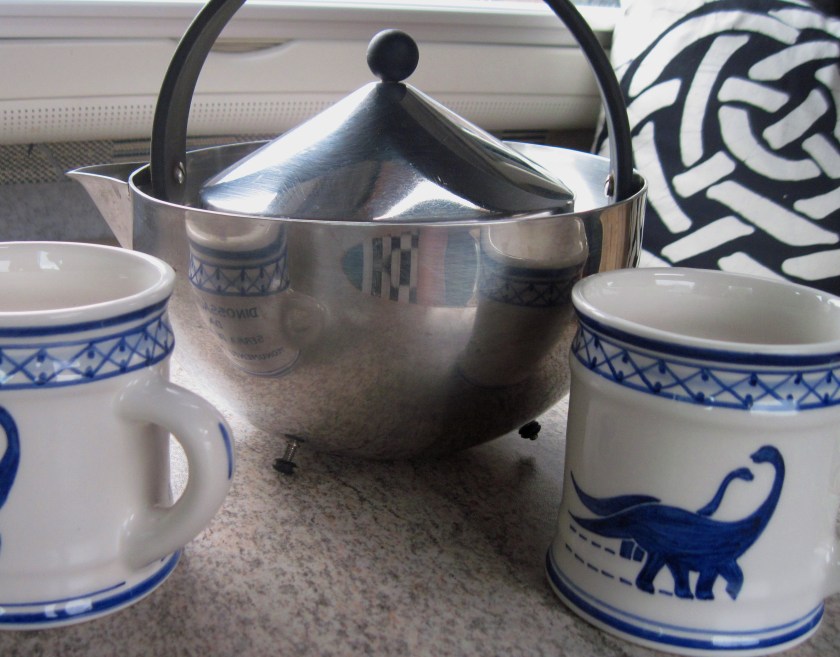
Onboard brews – unless we are in Italy, when having coffee in a cafe is part of the holiday experience, we will often make our morning coffee in the ‘van and always make cups of tea.  We carry good quality ground coffee and have a double-walled insulated cafetiere and a beautiful enamel milk-warmer so that we can make good coffee anywhere and we use a teapot to make a decent cuppa.

Cheap or free activities – Fortunately we are still two reasonably fit individuals who enjoy walking and cycling; both free activities (although the gear can be expensive).  We do visit attractions occasionally but this is often because I am writing a travel article.  I’ve just looked to see how this looks in practice and on our year travelling we spent just 5% of our expenditure on entrance fees and cable cars (just over £1,000).

Diesel – we own a 5.6 metre long campervan, rather than a large motorhome and we bought the most economical model of the Renault Master available so that our diesel bill isn’t too high.

Fixing things – when things break in the ‘van we don’t immediately buy new, we see if we can fix it.  We always carry some basic tools and equipment for fixing things on the ‘van and it is amazing what you can fix with a zip tie and a roll of duct tape.

Mr BOTRA the bicycle mechanic – self-taught, Mr BOTRA can fix most things on the bikes and this has saved us hundreds of pounds over the years.  From experience, we now always travel with the tools to fix the bikes and some basic spares after needing to replace my pedals on a trip to Germany; we hadn’t packed the pedal spanner and had to pay a local bike shop to do the job.

Buying second-hand – whenever we can we like to buy the gear we need second-hand.  Not only is this cheaper but we feel we have given something a new lease of life and we have helped the environment by recycling.  Outdoor gear is well-made and lots of people buy walking clothes that they either grow out of or hardly use and there are lots of bargains out there on Ebay.


Working at home reviewed

P1000439

I have now been working at home for over a month, so I thought it was a good time to review and look at the things I was worried about and the questions I was mulling over when I was still based in the office.

Do I miss other people and have I lost all my social skills?  What I have learnt is just how comfortable I am with my own company.  I do miss my previous co-workers and wonder how they are doing but I find it is quite enough to communicate with colleagues by email and phone and occasionally attend meetings.

Do I miss the office banter?  It is quite hard to laugh on your own [unless it is to cat antics on FB] .  I have the radio for company and occasionally this makes me laugh, although just at the moment the news is mostly distressing or annoying.  Perhaps I am losing those social skills.

Do I sit in a local cafe using their WiFi?  I thought I would do this but up to now I haven’t felt the need to get out and be with people.  Maybe the winter will encourage me out of the flat.

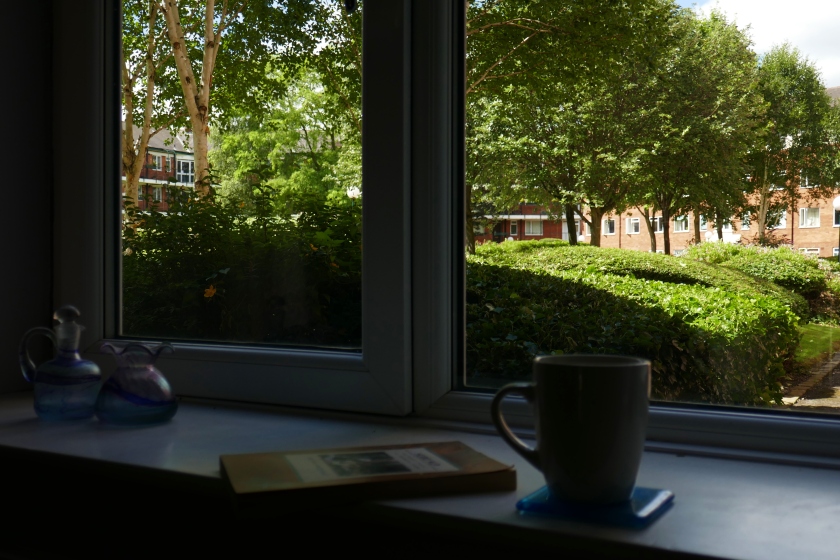
Do I enjoy the freedom?  Absolutely!  I was used to structuring my own day but working at home is so much more relaxed.   I do try and give my day some sort of structure, with brews at particular times and a regular lunch break, otherwise I get to the late afternoon and realise I haven’t eaten or even got up from my desk.  I use my breaks to do some quick household chores or exercises while the kettle boils; I am here when parcels arrive and I can wear what ever I like.  In the office we didn’t have space to have a room for eating lunch and we all ate at our desks; now I can sit with a view of the gardens and my book (and I never have to worry about forgetting to bring my packed lunch to work).  And shoes … now I spend my days padding around in bare feet I wonder when I will wear so many of those work shoes, it might be time to have a clear out.

Am I more productive?  Most definitely! I am getting so much more done without those interruptions.

Do I enjoy the view?  Yes!  Every day.

I am truly grateful to have been allowed to work from home and even after this short time, I am not sure I could go back to the constraints of working in an office, as is often the case, it was only when I was out of a situation that I realised how oppressive it was.  I even find that having to attend meetings (something I thought I would enjoy to maintain contact with co-workers) is feeling a bit of a hassle.

The only thing I miss is my brisk walk to and from the office and I do find I often need to get out of the flat to stretch my legs as soon as I have packed away the work laptop at the end of my working day.


Walking through local history in Salford

20160724_102946
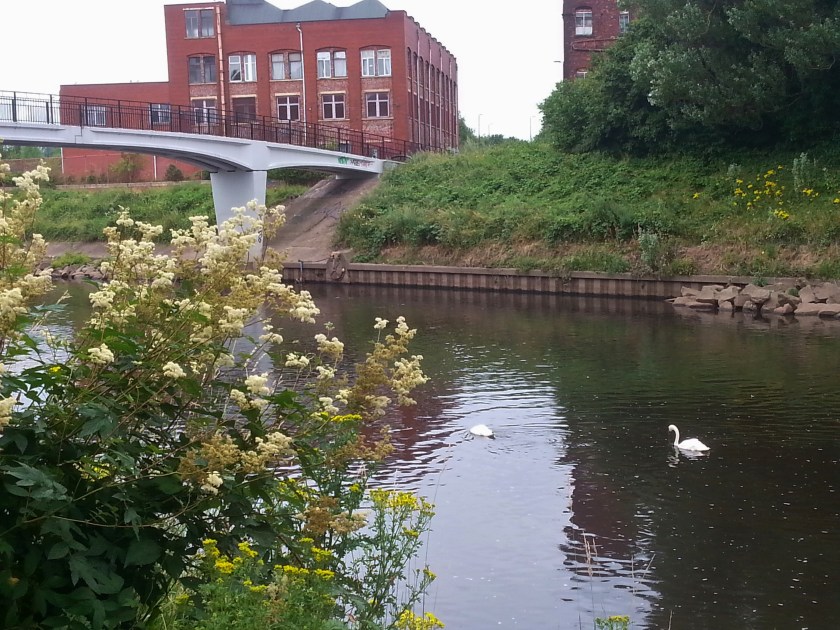
The river Irwell in Salford

We had a weekend at home and this gave me the chance to do some local walking.  I can’t pretend we live in the most beautiful part of the UK, Salford is as urban as it gets and developed as an industrial city in the 19th century.  The cotton and brewing industry that lead to the growth of Salford came because of the rivers and it is the river Irwell that winds its way in to Salford and along the Salford-Manchester border.  Nearby we also have two canals, the massive Manchester Ship Canal and the Bridgewater Canal.

Walking along rivers and canals is always interesting and enjoyable.  In Greater Manchester this is where you find plenty of industrial heritage and history but it is also where you can find wildlife.  On my walk along the Irwell, the Bridgewater Canal and the Ship Canal this weekend I saw groups of squabbling black-headed gulls, flocks of Canada geese, a diving cormorant, a languidly flapping heron and a few elegant swans.  Of course, there is no shortage of litter along the river and canal paths but on my walk I chose to seek out the beautiful, rather than the squalid.

To get to the river Irwell from our flat I walk through Peel Park.  This is one of the oldest parks in England and is currently undergoing renovation thanks to Heritage Lottery money and is slowly becoming the splendid place for a Sunday stroll and a green space for city wildlife it was designed to be.  More work is planned over the next twelve months and I look forward to seeing the park become beautiful once again.

Exploring our local area is on my list of things to do when I am no longer tied to paid work.  Of course, we will travel further afield too but we are both looking forward to finding more of the many gems across Greater Manchester, maybe buying a day ticket on the bus or the tram to a country park, spending a day in one of our many museums or following a route on foot or by bicycle to just see what we find.


I knew when I met you an adventure was going to happen

20150403_121239
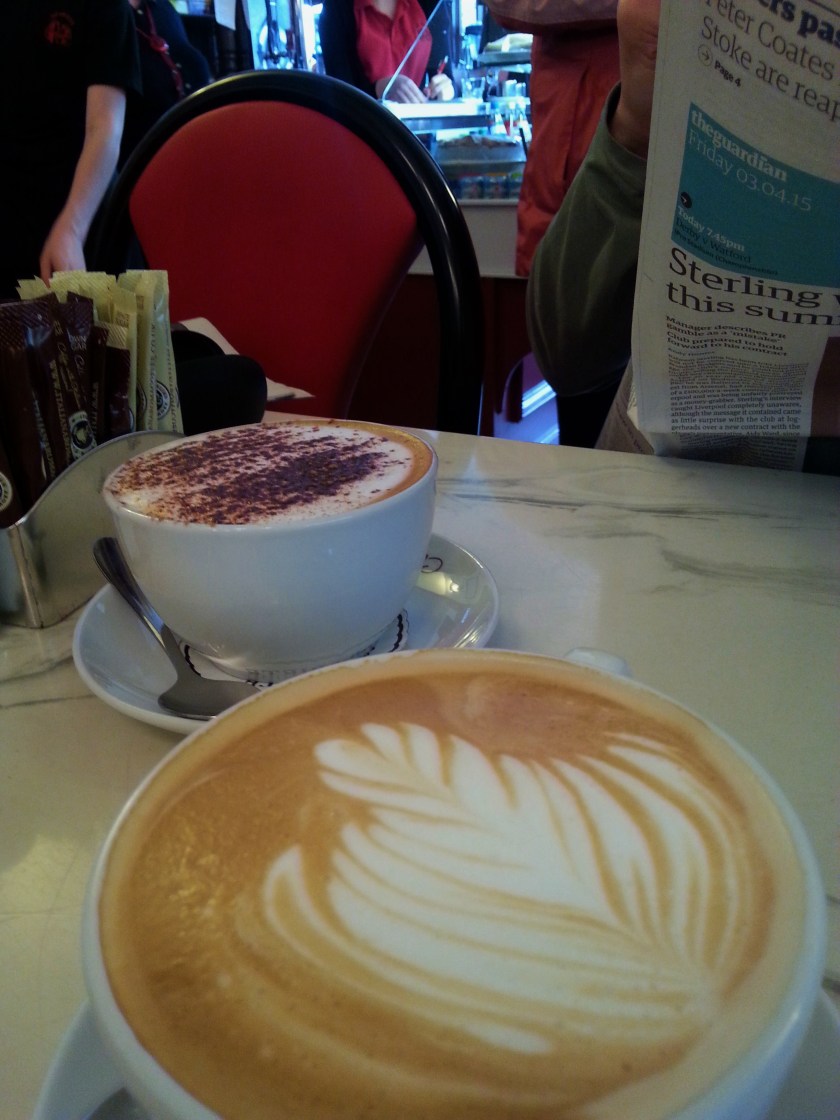
Good coffee is great to relax with

I have been working through The Real Good Writer’s DNA lately, exploring what I can do to improve my writing skills. Having been ‘to the deep, dark places of [my] brain’ one of the themes that has emerged is how much joy I get from being with my friends and I have been following the exercises through and reflecting on these friendships.

I’m not ashamed to say that I need my friends and in many respects the Real Good Writer’s DNA exercise didn’t tell me anything I didn’t know.  Times with friends are lots of fun, they make me laugh, they introduce me to new experiences and perspectives, they keep my feet on the ground and my friends have gifted me with a large bundle of happy memories.  However clever and resourceful I occasionally think I am, friends have helped me get through tough times, put things in to perspective when I have lost the plot and when I put myself down my friends will point out my strengths.

I was aware of how much I enjoy being with my friends but I hadn’t realised how deep this went and I was surprised how strongly this came out of the Real Good Writer’s DNA exercise.  I am not a woman who has lots of friends; my ‘best friend’ is certainly Mr BOTRA and I am comfortable with my own company but the friends I have I truly value.  The workbook encourages deeper reflection on themes and I also started to explore how and why I always keep something back from my friends and try not to smother them and make too many demands on their time and energy.

That said, I don’t hang on to friends no matter what and I have no time for ‘toxic’ friends.  We all know who these are and we sometimes hang on to them for commendably loyal or sentimental reasons.  These might be judgemental (rather than critical) friends, negative friends and friends I cannot trust.  These sort of ‘friends’ sap my energy and I have learnt it is best to let go of them.

As a child I learnt about friendship through books, including AA Milne’s Winnie the Pooh [a firm favourite] and what better place to learn about love and friendship than in those beautiful stories:

‘I knew when I met you an adventure was going to happen.’ AA Milne


Heading to the hills on the hottest day of the year [so far]

P1000412.JPG
Looking up to Cautley Spout in the Howgills

Perhaps to make up for the wet weekend in the Lakes just 10-days before, we were lucky enough to be camping in the beautiful Howgills for the ‘hottest day of the year’.  With temperatures of 30°C forecast in the valleys we obviously headed for the hills to catch any breeze.  The Howgills are to the east of the Lake District fells and are grassy rounded hills of grit stone and  slates.  We had a splendid day, walking up Cautley Spout, a high tumbling waterfall, to The Calf, the highest point of the fells at 676 metres above sea level.

While, no doubt, parts of the Lake District were busy with visitors on such a lovely day, the Howgills are always quieter and we only met a couple of other groups walking during the day.  Once we were off the main route and the gravel path of the Dales High Way we had the place to ourselves and could enjoy the airy views over Cautley Crag without interruption.

Over the few days we were there we explored all corners of this rural area; we ate delicious chocolates from Kennedys in Orton, to the north of the fells, had fun trying our hand at weaving at the historic Fairfield Mill near Sedbergh [Mr BOTRA thought he could definitely enjoy doing more of this] and found orchids and butterflies in the beautiful Smardale Gill nature reserve.

Of course, it was just luck that we were on holiday on such a lovely day; we can’t wait until next year when we’ll be free and easy and able to set off camping as soon as we spot a good weather forecast.


You’ll miss the best things if you keep your eyes shut

26 Aug Lillaz walk 006 edelweiss with Fleabane
Edelweiss in the Italian Alps

I have been writing travel articles about noticing the small things recently and so when I came across this quote from Dr Seuss it hit the right note.  As much as I love the mountains and the big wide skies and far-reaching views that walking in the mountains and fells provide, I do get as much enjoyment from those harder to see things and you are just as likely to find me searching the ground when I am walking, as well as admiring the view.

My eye sight has never been very good and I have worn specs all my life [apart from a few years as a teenager when I was too vain to wear them and missed a lot].  Consequently, bird watching isn’t a hobby I am very good at on my own; however, my hearing is still almost perfect.  Fortunately, Mr BOTRA has eagle eyes [but poor hearing] and so together we make a great bird watching team as we have the senses required to spot birds and animals [learning to recognise more bird calls beyond the easy ones is on my list of skills to learn when paid work ends].

Fortunately flowers don’t move as much as birds and animals and so I get a lot of pleasure from finding beautiful flowers wherever we travel.  I try to identify them, photograph them and occasionally very badly sketch them.  The process of identification forces me to stop and really look at the detail of the plant I am interested in; the colour and number of petals, the shape of the leaves and check for any fragrance or hairs.

I have looked at apps for identification of plants but find these wanting and continue to use a book to identify plants, although I am still looking for a good wild flower key for southern Europe.  I find sketches and diagrams easier to use for identification than photographs.  Any recommendations would be welcome!


A wet weekend in the Lake District gave us chance to face our fears

P1000079.JPG

Rannerdale near Buttermere in the Lake District

It takes really bad weather to keep us ‘van bound on a camping trip.  We have good waterproof gear and our map reading skills can deal with low cloud and showers.  But the recent weekend was as bad as it gets in the Lake District.  Of course, we did get out for a walk on both days but Saturday was that atrocious combination of high winds and heavy rain that makes walking more of a chore than an enjoyable past time.  We walked from the campsite for about an hour and a half and then filled the site drying room with our dripping gear.

Spending time reading and playing cards in the ‘van did give us chance to talk over some things in depth; we talked about work and no longer working and we shared our worst fears for our forthcoming retirement.  What was interesting is that for two people who have been planning this retirement for at least the last six years [and actually for the last 30-years] our anxieties are very different.

My worries are all about our health.  I fret that one of us will either not even live long enough to enjoy our retirement or only survive for a year or two in to retirement before dying.  My alternative nightmare has one of us becoming too ill or infirm to take part in all the walking and cycling we want to spend our long retirement doing.  I am optimistic [or naive] about our finances, sure that the sums are robust and that we’ll deal with any problems as they arise.

Mr BOTRA’s worries are mostly related to money; he is the more cautious one of the team.  He is concerned that we haven’t budgeted correctly and we will run out of money before all our pensions kick in [not until 2026] and he worries that by finishing work he is closing off options to earn a few thousand extra that could be kept in the bank in case we want to move house, buy a new campervan or have some other emergency [of course we have a small contingency fund].  Having worked full-time for all his working life [apart from our gap year] he also has concerns about how his days will be filled without work, although he has no shortage of interests and ideas for things he wants to do.

While Mr BOTRA assures me that we will probably live a long and healthy retirement, I equally reassure him that he will soon wonder where he fitted in the time to go to work and that the spreadsheet doesn’t lie.  These reassurances are important but equally important is to recognise and face the fears of your partner honestly so that you can work as a team to put things in place and [hopefully] stop these fears becoming reality.


Out of order: some thoughts on sanitary facilities at campsites

2014-06-20 2014 June Lourdes cycle ride 045
The unbeatable sanitary facilities of Les Trois Vallées site near Lourdes

‘The sanitary facilities will be closed between 11.00 and 12.00 for cleaning’ is a familiar sign to anyone who has used a club campsite in the UK and this can be very irritating.   Of course, I would be the first to complain if the toilets and showers were not in a spit-spot condition and [as a former Youth Hostel warden] I do understand how much easier the task of sanitising the conveniences is if there are no campers wandering in and out while you mop the floor.  But, I am on holiday and don’t want to get up at the crack of dawn; after a leisurely breakfast it can often be 11.00 when I am hoping to use the ladies one last time before setting off on a walk and confronting one of these signs on the door is maddening.

All I am asking for is a little consideration for the paying guests, who, let us remember, keep the campsite in business.  Good club sites will leave the disabled toilet open while they clean the main facilities and this is a welcome compromise; however, not all camp sites are run with this amount of thoughtfulness and I have stayed on at least one club site that has two sanitary blocks but will still close both for the full hour.

Away from club sites, there are many different approaches to how to get the toilets and showers clean after they have been used and abused by hot and sweaty campers.  One solution, of course, is to not bother carrying out any cleaning at all, but these are few and far between and are not camp sites we stay at for more than one night, or return to for another holiday.

A lovely site on the Gargano peninsular in Italy used an industrial size hose pipe to vigorously sluice out the showers and toilets once a day.  They did not close the facilities during this process, but you only used them at your own risk.

In Mediterranean countries, you also often see signs telling you that the facilities are closed between 04.00 and 05.00 and on one level this seems a good plan; the toilets can be cleaned while the campers are all fast asleep in their tents and campervans.  However, I always feel concerned for the cleaners who have to work such unsociable hours.  Presumably this works well in warmer climes as it enables the cleaning to take place before it gets too hot to care about polishing chrome and scrubbing tiles.

Another popular way for campsite owners to ensure their facilities are immaculate is to work around the campers, cleaning the sanitary blocks while they are in use.  This can work satisfactorily, so long as either the site is not busy or they opt to get the mop and bucket out during a quieter period.  One Polish campsite [charmingly called Camping 51] stands out for the impeccable state of its toilet and shower blocks, as the elderly female owner could be found cloth in one hand, bleach in the other at every hour of every day, dedicating her life to ensuring a germ-free environment.  Her constant presence somewhere in the sanitary blocks caused Mr BOTRA to take up joyful whistling during his ablutions, to be sure that she knew he was there and avoid any possible embarrassing encounters.

One of the many reasons touring campsites in our campervan is fun is that every site is unique and has its own way of doing things but we do sometimes have to ask why.  One beautiful campsite on Luneburg Heath in Northern Germany had spotless facilities that were open at all times, with one important exception; they closed and locked the dish-washing area at 20.00 each evening, not re-opening it until 07.00 the next day.   As we don’t eat our evening meal until around 19.30 or later on holiday [and we are not alone in this] the choice was to either stack up the dishes for the next morning or rush to start the washing up as soon as the last forkful had been eaten.  Not surprisingly, this often resulted in a very busy washing up area at 19.55 every evening, as everyone tried to beat the imposed curfew.

Restricted access with key pads and locks for the sanitary facilities is becoming more and more common at campsites in England.  These provide endless opportunities for irritating the camper; with so many pin numbers to remember, keeping in mind the random selection of numbers and letters for the toilets has no chance of sticking in my mind and forgetting to take the key on a trip to the shower is an entertaining game we play..

Limiting access to the toilets can be understandable on a site with a footpath running through it or one that is next to an attraction or park.  On other sites there is no excuse for keeping the toilets and showers under lock and key, I have stayed at sites with locked facilities where there is not even have a house within 500 metres and no passing pedestrians who might decide to spend a penny.

Some camp sites provide very specialist facilities and my favourite sign is one generally found on coastal and riverside sites in southern Europe, where they have a sink marked for fish washing only.   Although I’ve never witnessed any actual fish washing, I am grateful to a site for providing these specific facilities; no one wants to wash their laundry in a sink where gutting and boning of the days catch has recently occurred.

Finally, I am sure there are two camps regarding the provision of piped music in campsite facilities and I am generally in the pro-camp.  However, there are times when the melodies seem incongruous; I’m thinking now of a favourite camp site in Cortina in the peace of quiet of the Italian Dolomites which inexplicably played  pan pipe music from South America on a continuous loop.


Sleep: a very important part of my day

20150307_145620
Our campervan has comfy beds

This article on sleep and how important it is for our well being and good health caught my eye recently.  Sleep has been in the forefront of my mind recently as I haven’t been getting enough of it [of course, when we are getting enough sleep we don’t give it a thought].  Every night since we returned from our holiday has been notable for the dark hours I have been awake.

When we were travelling in our motorhome for twelve months we basked in the luxury of waking up when we were ready, rather than relying on an alarm.  One friend had joked that we would gain years on our life expectancy just from taking a year away from the call of the alarm clock and she might have been right.  I always sleep really well in the campervan and find our weekends away help me to catch up on my sleep.

Fortunately, it isn’t anxiety that is keeping me awake, just hormones.  I have had menopausal hot flushes since 2008; these have varied in intensity over those eight years but it is always the night when they are worst.  HRT bought on migraines that were too regular and painful to make it worth taking but I found that Gabapentin helped.  No one ever told me this menopause-malarkey could go on for eight years but earlier this year I was optimistic enough to feel ready to be drug-free as the symptoms appeared to be easing; however, this last few weeks have been trying.  I currently sleep for about three hours and then wake up feeling so hot I can’t bear to have the duvet touching me as I fear either me or the duvet will combust.  I throw off the duvet and [not surprisingly] then get cold, pull the duvet back on and eventually drift off back into dreamland until the cycle starts again; this happens about three times a night.

We always have the bedroom window opening and its not even that warm in the UK at the moment!  Alcohol doesn’t seem to make much difference and eating spicy food [many websites suggest you avoid this] has no impact at all.

In the scheme of things, of course, this isn’t so bad but I am a person that struggles without sleep and a lack of it can make me a little irritable.  I am remaining happy and contented as I am grateful that I don’t have to work shifts or start work very early in the morning and working from home is much more relaxed than being in the office.  Goodness knows how others cope; it is often those low paid staff who get the worst deal when it comes to getting enough sleep; early morning cleaning rotas, night shifts and disturbed sleep patterns will have a negative impact on health.  But I am impatient for either this eight-year long phase to end or retirement to allow me to sleep until I have had my full quota of shut-eye.