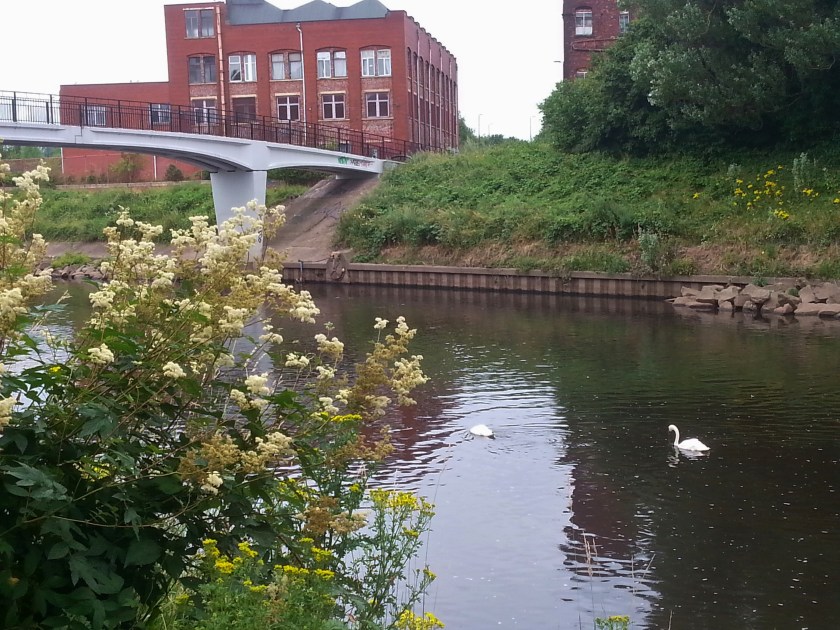
We had a weekend at home and this gave me the chance to do some local walking. I can’t pretend we live in the most beautiful part of the UK, Salford is as urban as it gets and developed as an industrial city in the 19th century. The cotton and brewing industry that lead to the growth of Salford came because of the rivers and it is the river Irwell that winds its way in to Salford and along the Salford-Manchester border. Nearby we also have two canals, the massive Manchester Ship Canal and the Bridgewater Canal.
Walking along rivers and canals is always interesting and enjoyable. In Greater Manchester this is where you find plenty of industrial heritage and history but it is also where you can find wildlife. On my walk along the Irwell, the Bridgewater Canal and the Ship Canal this weekend I saw groups of squabbling black-headed gulls, flocks of Canada geese, a diving cormorant, a languidly flapping heron and a few elegant swans. Of course, there is no shortage of litter along the river and canal paths but on my walk I chose to seek out the beautiful, rather than the squalid.
To get to the river Irwell from our flat I walk through Peel Park. This is one of the oldest parks in England and is currently undergoing renovation thanks to Heritage Lottery money and is slowly becoming the splendid place for a Sunday stroll and a green space for city wildlife it was designed to be. More work is planned over the next twelve months and I look forward to seeing the park become beautiful once again.
Exploring our local area is on my list of things to do when I am no longer tied to paid work. Of course, we will travel further afield too but we are both looking forward to finding more of the many gems across Greater Manchester, maybe buying a day ticket on the bus or the tram to a country park, spending a day in one of our many museums or following a route on foot or by bicycle to just see what we find.
I have been working through The Real Good Writer’s DNA lately, exploring what I can do to improve my writing skills. Having been ‘to the deep, dark places of [my] brain’ one of the themes that has emerged is how much joy I get from being with my friends and I have been following the exercises through and reflecting on these friendships.
I’m not ashamed to say that I need my friends and in many respects the Real Good Writer’s DNA exercise didn’t tell me anything I didn’t know. Times with friends are lots of fun, they make me laugh, they introduce me to new experiences and perspectives, they keep my feet on the ground and my friends have gifted me with a large bundle of happy memories. However clever and resourceful I occasionally think I am, friends have helped me get through tough times, put things in to perspective when I have lost the plot and when I put myself down my friends will point out my strengths.
I was aware of how much I enjoy being with my friends but I hadn’t realised how deep this went and I was surprised how strongly this came out of the Real Good Writer’s DNA exercise. I am not a woman who has lots of friends; my ‘best friend’ is certainly Mr BOTRA and I am comfortable with my own company but the friends I have I truly value. The workbook encourages deeper reflection on themes and I also started to explore how and why I always keep something back from my friends and try not to smother them and make too many demands on their time and energy.
That said, I don’t hang on to friends no matter what and I have no time for ‘toxic’ friends. We all know who these are and we sometimes hang on to them for commendably loyal or sentimental reasons. These might be judgemental (rather than critical) friends, negative friends and friends I cannot trust. These sort of ‘friends’ sap my energy and I have learnt it is best to let go of them.
As a child I learnt about friendship through books, including AA Milne’s Winnie the Pooh [a firm favourite] and what better place to learn about love and friendship than in those beautiful stories:
‘I knew when I met you an adventure was going to happen.’ AA Milne
Perhaps to make up for the wet weekend in the Lakes just 10-days before, we were lucky enough to be camping in the beautiful Howgills for the ‘hottest day of the year’. With temperatures of 30°C forecast in the valleys we obviously headed for the hills to catch any breeze. The Howgills are to the east of the Lake District fells and are grassy rounded hills of grit stone and slates. We had a splendid day, walking up Cautley Spout, a high tumbling waterfall, to The Calf, the highest point of the fells at 676 metres above sea level.
While, no doubt, parts of the Lake District were busy with visitors on such a lovely day, the Howgills are always quieter and we only met a couple of other groups walking during the day. Once we were off the main route and the gravel path of the Dales High Way we had the place to ourselves and could enjoy the airy views over Cautley Crag without interruption.
Over the few days we were there we explored all corners of this rural area; we ate delicious chocolates from Kennedys in Orton, to the north of the fells, had fun trying our hand at weaving at the historic Fairfield Mill near Sedbergh [Mr BOTRA thought he could definitely enjoy doing more of this] and found orchids and butterflies in the beautiful Smardale Gill nature reserve.
Of course, it was just luck that we were on holiday on such a lovely day; we can’t wait until next year when we’ll be free and easy and able to set off camping as soon as we spot a good weather forecast.
I have been writing travel articles about noticing the small things recently and so when I came across this quote from Dr Seuss it hit the right note. As much as I love the mountains and the big wide skies and far-reaching views that walking in the mountains and fells provide, I do get as much enjoyment from those harder to see things and you are just as likely to find me searching the ground when I am walking, as well as admiring the view.
My eye sight has never been very good and I have worn specs all my life [apart from a few years as a teenager when I was too vain to wear them and missed a lot]. Consequently, bird watching isn’t a hobby I am very good at on my own; however, my hearing is still almost perfect. Fortunately, Mr BOTRA has eagle eyes [but poor hearing] and so together we make a great bird watching team as we have the senses required to spot birds and animals [learning to recognise more bird calls beyond the easy ones is on my list of skills to learn when paid work ends].
Fortunately flowers don’t move as much as birds and animals and so I get a lot of pleasure from finding beautiful flowers wherever we travel. I try to identify them, photograph them and occasionally very badly sketch them. The process of identification forces me to stop and really look at the detail of the plant I am interested in; the colour and number of petals, the shape of the leaves and check for any fragrance or hairs.
I have looked at apps for identification of plants but find these wanting and continue to use a book to identify plants, although I am still looking for a good wild flower key for southern Europe. I find sketches and diagrams easier to use for identification than photographs. Any recommendations would be welcome!
It takes really bad weather to keep us ‘van bound on a camping trip. We have good waterproof gear and our map reading skills can deal with low cloud and showers. But the recent weekend was as bad as it gets in the Lake District. Of course, we did get out for a walk on both days but Saturday was that atrocious combination of high winds and heavy rain that makes walking more of a chore than an enjoyable past time. We walked from the campsite for about an hour and a half and then filled the site drying room with our dripping gear.
Spending time reading and playing cards in the ‘van did give us chance to talk over some things in depth; we talked about work and no longer working and we shared our worst fears for our forthcoming retirement. What was interesting is that for two people who have been planning this retirement for at least the last six years [and actually for the last 30-years] our anxieties are very different.
My worries are all about our health. I fret that one of us will either not even live long enough to enjoy our retirement or only survive for a year or two in to retirement before dying. My alternative nightmare has one of us becoming too ill or infirm to take part in all the walking and cycling we want to spend our long retirement doing. I am optimistic [or naive] about our finances, sure that the sums are robust and that we’ll deal with any problems as they arise.
Mr BOTRA’s worries are mostly related to money; he is the more cautious one of the team. He is concerned that we haven’t budgeted correctly and we will run out of money before all our pensions kick in [not until 2026] and he worries that by finishing work he is closing off options to earn a few thousand extra that could be kept in the bank in case we want to move house, buy a new campervan or have some other emergency [of course we have a small contingency fund]. Having worked full-time for all his working life [apart from our gap year] he also has concerns about how his days will be filled without work, although he has no shortage of interests and ideas for things he wants to do.
While Mr BOTRA assures me that we will probably live a long and healthy retirement, I equally reassure him that he will soon wonder where he fitted in the time to go to work and that the spreadsheet doesn’t lie. These reassurances are important but equally important is to recognise and face the fears of your partner honestly so that you can work as a team to put things in place and [hopefully] stop these fears becoming reality.
The unbeatable sanitary facilities of Les Trois Vallées site near Lourdes
‘The sanitary facilities will be closed between 11.00 and 12.00 for cleaning’ is a familiar sign to anyone who has used a club campsite in the UK and this can be very irritating. Of course, I would be the first to complain if the toilets and showers were not in a spit-spot condition and [as a former Youth Hostel warden] I do understand how much easier the task of sanitising the conveniences is if there are no campers wandering in and out while you mop the floor. But, I am on holiday and don’t want to get up at the crack of dawn; after a leisurely breakfast it can often be 11.00 when I am hoping to use the ladies one last time before setting off on a walk and confronting one of these signs on the door is maddening.
All I am asking for is a little consideration for the paying guests, who, let us remember, keep the campsite in business. Good club sites will leave the disabled toilet open while they clean the main facilities and this is a welcome compromise; however, not all camp sites are run with this amount of thoughtfulness and I have stayed on at least one club site that has two sanitary blocks but will still close both for the full hour.
Away from club sites, there are many different approaches to how to get the toilets and showers clean after they have been used and abused by hot and sweaty campers. One solution, of course, is to not bother carrying out any cleaning at all, but these are few and far between and are not camp sites we stay at for more than one night, or return to for another holiday.
A lovely site on the Gargano peninsular in Italy used an industrial size hose pipe to vigorously sluice out the showers and toilets once a day. They did not close the facilities during this process, but you only used them at your own risk.
In Mediterranean countries, you also often see signs telling you that the facilities are closed between 04.00 and 05.00 and on one level this seems a good plan; the toilets can be cleaned while the campers are all fast asleep in their tents and campervans. However, I always feel concerned for the cleaners who have to work such unsociable hours. Presumably this works well in warmer climes as it enables the cleaning to take place before it gets too hot to care about polishing chrome and scrubbing tiles.
Another popular way for campsite owners to ensure their facilities are immaculate is to work around the campers, cleaning the sanitary blocks while they are in use. This can work satisfactorily, so long as either the site is not busy or they opt to get the mop and bucket out during a quieter period. One Polish campsite [charmingly called Camping 51] stands out for the impeccable state of its toilet and shower blocks, as the elderly female owner could be found cloth in one hand, bleach in the other at every hour of every day, dedicating her life to ensuring a germ-free environment. Her constant presence somewhere in the sanitary blocks caused Mr BOTRA to take up joyful whistling during his ablutions, to be sure that she knew he was there and avoid any possible embarrassing encounters.
One of the many reasons touring campsites in our campervan is fun is that every site is unique and has its own way of doing things but we do sometimes have to ask why. One beautiful campsite on Luneburg Heath in Northern Germany had spotless facilities that were open at all times, with one important exception; they closed and locked the dish-washing area at 20.00 each evening, not re-opening it until 07.00 the next day. As we don’t eat our evening meal until around 19.30 or later on holiday [and we are not alone in this] the choice was to either stack up the dishes for the next morning or rush to start the washing up as soon as the last forkful had been eaten. Not surprisingly, this often resulted in a very busy washing up area at 19.55 every evening, as everyone tried to beat the imposed curfew.
Restricted access with key pads and locks for the sanitary facilities is becoming more and more common at campsites in England. These provide endless opportunities for irritating the camper; with so many pin numbers to remember, keeping in mind the random selection of numbers and letters for the toilets has no chance of sticking in my mind and forgetting to take the key on a trip to the shower is an entertaining game we play..
Limiting access to the toilets can be understandable on a site with a footpath running through it or one that is next to an attraction or park. On other sites there is no excuse for keeping the toilets and showers under lock and key, I have stayed at sites with locked facilities where there is not even have a house within 500 metres and no passing pedestrians who might decide to spend a penny.
Some camp sites provide very specialist facilities and my favourite sign is one generally found on coastal and riverside sites in southern Europe, where they have a sink marked for fish washing only. Although I’ve never witnessed any actual fish washing, I am grateful to a site for providing these specific facilities; no one wants to wash their laundry in a sink where gutting and boning of the days catch has recently occurred.
Finally, I am sure there are two camps regarding the provision of piped music in campsite facilities and I am generally in the pro-camp. However, there are times when the melodies seem incongruous; I’m thinking now of a favourite camp site in Cortina in the peace of quiet of the Italian Dolomites which inexplicably played pan pipe music from South America on a continuous loop.
This article on sleep and how important it is for our well being and good health caught my eye recently. Sleep has been in the forefront of my mind recently as I haven’t been getting enough of it [of course, when we are getting enough sleep we don’t give it a thought]. Every night since we returned from our holiday has been notable for the dark hours I have been awake.
When we were travelling in our motorhome for twelve months we basked in the luxury of waking up when we were ready, rather than relying on an alarm. One friend had joked that we would gain years on our life expectancy just from taking a year away from the call of the alarm clock and she might have been right. I always sleep really well in the campervan and find our weekends away help me to catch up on my sleep.
Fortunately, it isn’t anxiety that is keeping me awake, just hormones. I have had menopausal hot flushes since 2008; these have varied in intensity over those eight years but it is always the night when they are worst. HRT bought on migraines that were too regular and painful to make it worth taking but I found that Gabapentin helped. No one ever told me this menopause-malarkey could go on for eight years but earlier this year I was optimistic enough to feel ready to be drug-free as the symptoms appeared to be easing; however, this last few weeks have been trying. I currently sleep for about three hours and then wake up feeling so hot I can’t bear to have the duvet touching me as I fear either me or the duvet will combust. I throw off the duvet and [not surprisingly] then get cold, pull the duvet back on and eventually drift off back into dreamland until the cycle starts again; this happens about three times a night.
We always have the bedroom window opening and its not even that warm in the UK at the moment! Alcohol doesn’t seem to make much difference and eating spicy food [many websites suggest you avoid this] has no impact at all.
In the scheme of things, of course, this isn’t so bad but I am a person that struggles without sleep and a lack of it can make me a little irritable. I am remaining happy and contented as I am grateful that I don’t have to work shifts or start work very early in the morning and working from home is much more relaxed than being in the office. Goodness knows how others cope; it is often those low paid staff who get the worst deal when it comes to getting enough sleep; early morning cleaning rotas, night shifts and disturbed sleep patterns will have a negative impact on health. But I am impatient for either this eight-year long phase to end or retirement to allow me to sleep until I have had my full quota of shut-eye.
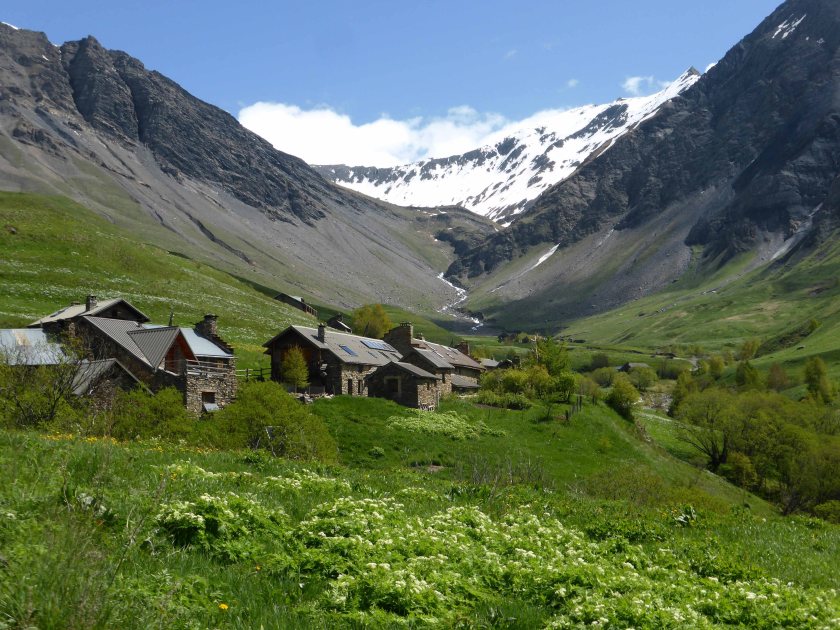
In the mountainous Ecrins the houses in the villages huddle together for warmth and companionship around a winding road, joined by steep narrow cobbled lanes and steps. The houses are built from rough stone with steep roofs and small windows. Typically, the windows have shutters and the traditional stone houses have a sort of wooden balcony for storing logs.
Above the village of La Grave the villages cling to the hillside, looking as if they could slide down at any time. Around the villages the pattern of the old farmed terraces can still be seen in the meadows. Each village has a church in a similar style and there are also stone wayside shrines on the roads between the villages, you might also find the communal oven and you will always find a water tap of fresh mountain water. As you climb higher the houses in these villages are less likely to be occupied all year round. In Le Grave we stayed at the wonderful Camping de la Meije just a few minutes from the village.
In Vallouise and Venosc we admired the sundials, including the beautiful 19th century Zarbula sundial on a magnificent villa in Vallouise. You can follow the Sundial trail through the region to find more.
We toured around the Ecrins National Park in an anti-clockwise direction over a couple of weeks and camped in five different valleys, each one having its own personality and each offering spectacular mountain walking. We used the Cicerone guide to the area for walks which has ideas for each valley.
We enjoyed all the walking but there are a couple of favourites worth mentioning. From Venosc we drove to the mountain village of La Berarde, walking 11 km to the Refuge du Chatelleret at 2,232 m and back with 520m of climbing. The route starts steeply and becomes more gentle along the valley on a pleasant sandy path with juniper and birch trees and plenty of flowers. Higher up the landscape become more rugged and with waterfalls and fewer shrubs adn the occasional snow field.
From Vallouise we drove to the large car park at Pre de Madame Carle and walked up the stunning and dramatic Glacier Noir path. More details about our trip are in my MMM article here.
You might enjoy my second post about where to see marmots in the Ecrins.
There was no one at reception & only one other camper so we left money in an envelope. This grassy site has some trees, the ground fairly hard, facilities clean & water hot. Small village with some shops but no bakery. Walks from the site.
Near the beautiful village & by the river, grassy site with trees, clean facilities, flowers & well maintained & good views. Roomy showers & very hot water, wash up undercover. An excellent site.
This large rambling site has great views. It is dotted with permanent erected tents & chalets. The new toilet blocks are good and pleasant reception area.
Le Champ du Moulin Camping, Le Bourg d-Arud near Venosc
Marked pitches, good views, friendly welcome, small shop & bread. Facilities are in basement & clean, warm & showers are hot & roomy. There is also a drying room.
We are back from our annual fix of European culture, weather and food. As well as enjoying excellent and unbeatable mountain walking in the Ecrins National Park in south-east France [don’t worry no one seems to know where this is – find Grenoble and go slightly to the south and east], we found some adorable wildlife.
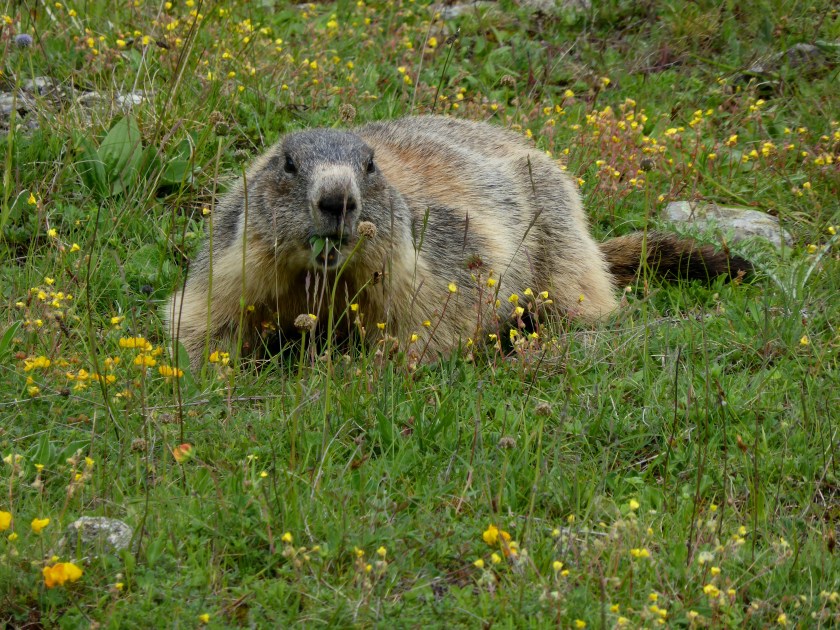
The Alpine marmots were abundant in the Ecrins and we saw at least one or two every time we were out walking. Sometimes we firstly heard a marmot, calling out a warning high-pitched whistle and searching the rocky landscape we would spot the look-out marmot on a rock, sitting up on its hind legs apparently warning the other marmots of our presence but really drawing attention to the presence of marmots. At other times we would spot them scampering low across a meadow or moving easily down steep craggy hillsides, twitching their stubby tails as they move and then disappearing down a handy burrow. At Pré de Madame Carle the marmots were pottering around the car park and finding shade under the cars.
If you don’t want to climb the steep paths of the Ecrins to see marmots, there are a group that are easy to find at Mont-Dauphin, south of Briançon. Since we last visited here in 2009 [Mr BOTRA had lots of fun making the video embedded in the blog post at the time] the humans have been managed so that the marmots can now run in and out of their burrows freely and avoid the humans if they wish to. Marmots hibernate for more months than they are out and about so you need to be around in summer to see them.
There are places that mean a lot to me and this meaning comes from a combination of things; the experiences and memories I have of the place, the stories and folklore of that area, the scenery and the vistas and the history of the area.




 Back on the road again