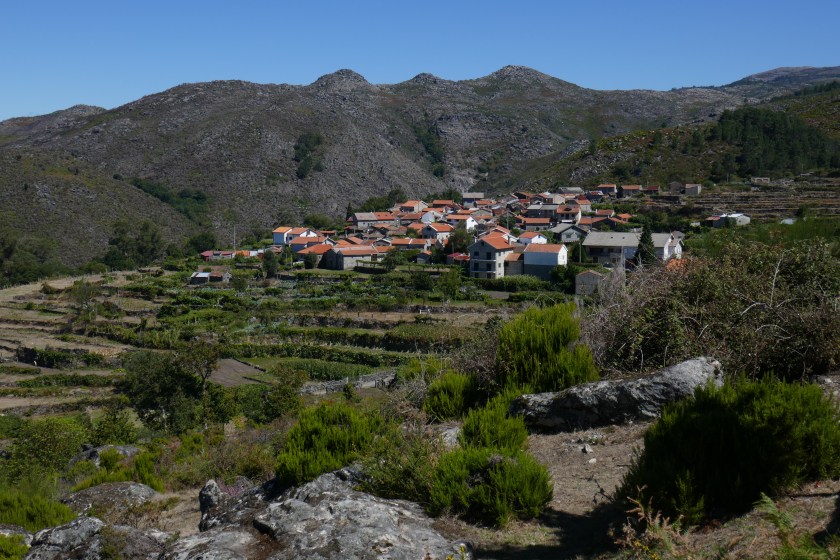
We started our tour of Portugal in the north with an intention to gradually move south. The Peneda-Geres National Park is in the north-western corner of Portugal and offers plenty of opportunities for outdoor pursuits. We based ourselves in two places in the national park; firstly in Entre Ambos-os-Rios at Lima Escape, a shaded informal campsite by the river that was €13 a night and later in Parque Cerdeira in Campo de Geres, which at €23 a night was a tad expensive for us and much more regimented. Both had good walks from the campsite and we also did some uphill cycling from Entre Ambos-os-Rios. Lima Escape had good information about walking at reception.
On our walks we visited the granite villages of Sobredo, Germil and Ermida and we also travelled up to the picturesque hillside village of Sistelo. In all of these villages the streets are narrow winding paved lanes and the old grey granite houses have small windows and often have steps up to the first floor with the newer houses built around the edges of the village hub. These are agricultural villages and grapes and corn are the main crops grown on terraces lined with stone walls, the grapes often grown along pergolas over the road or around the field edges. The corn cobs are dried in espigueiros, sheds sitting on stone legs to keep animals away, and the corn stalks are dried in stacks for animal feed. The local horned caramel-coloured cows wander the lanes along with dogs and cats and small flocks of sheep. We cycled to Ermida, only 8 kms along the road but the ride involves over 400 metres of ascent and some of this over 10%. Weary and thirsty we searched out the village cafe finding it only because we noticed a couple of men chatting outside an open door. There was no cafe name or sign, no tables with umbrellas, nothing to give it away as a cafe until we got inside and spotted the crates of beer and coffee machine.
From Campo de Geres we used a leaflet bought from the information centre for 10 cents and followed a 9 kms way-marked trail through the mountains and down to the reservoir where we had spectacular views and the route followed a Roman road that was busy with butterflies. The information centre at Campo de Geres is well worth a visit as it has a number of self-guided walking leaflets available.
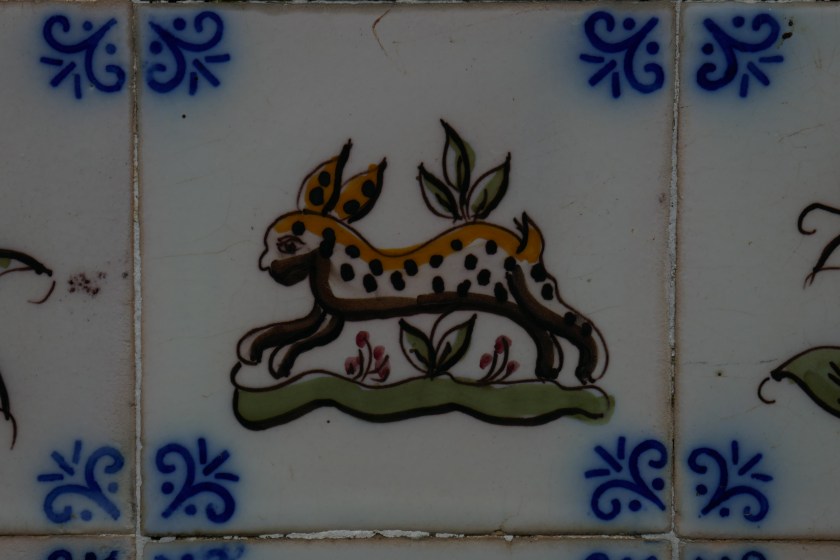
Away from the national park we stayed in the small town of Arco de Baulhe. The campsite overlooks the river and terraces of vines and the work-a-day Portuguese town [that is no less pleasant for that] is just five minutes walk away. For cyclists Arco de Baulhe is at the end of 40 kms long cycle route along an old railway line which provides excellent and scenic cycling along the river Tamega. The tile below is one that decorates the public toilets next to the old railway station. All of the old railway stations along the route have beautiful tiling and I had to stop and admire every one.
Portuguese tiles are always worth stopping to look at
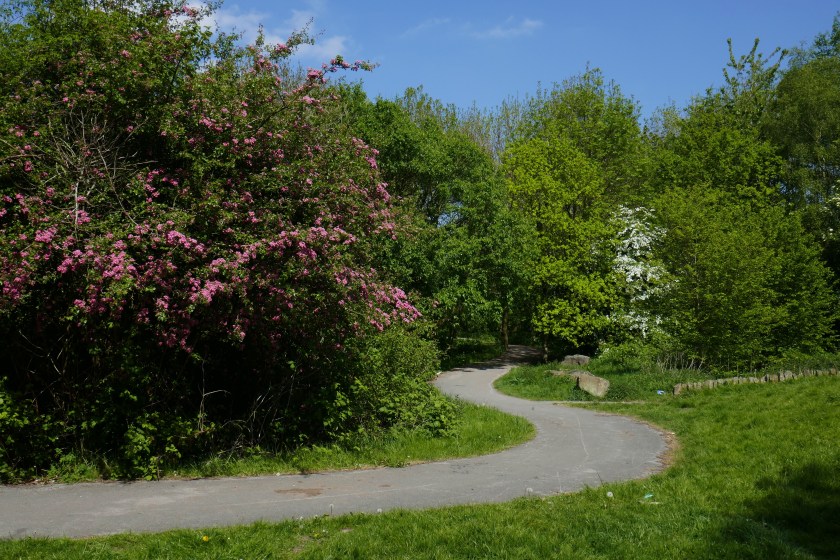
In 2007 the Manchester Evening News reported that Salford was getting its own version of Central Park. I have never been to Central Park in New York but it must be a point to debate whether the regeneration of this former brown field site quite managed to meet this extravagant aspiration. That said, the Lower Irwell Valley Improvement Area [Livia] is an improvement on the previous derelict site, joining together a number of smaller green spaces that give wildlife the green corridors that allow them to move around in.
Livia is in Pendlebury and lies between the railway line and Bolton Road and is surrounded by housing. The 1950s map shows the land was previously Newton Colliery with some farms surviving at that time. There is a public art memorial to the colliery on a grassy corner of Bolton Road and Queensway.
The regeneration created woodland and wild flower areas and the whole park is criss-crossed by a network of winding footpaths. There are some sculptures and structures that are now overgrown and it seemed to me that there is currently little management of the area ongoing. The green space seems to be mostly used as a route away from the traffic between home and the main road for local people. Even on a sunny day it was quiet here and the wildlife are probably all the happier for that.
After arriving in Bilbao on the ferry we immediately drove inland to explore parts of Spain we hadn’t reached before. We were heading for the Canyon of the Rio Lobos Nature Park but took some detours along the way, driving through the vineyards of Rioja and seeking out the fascinating dinosaur footprints north of Soria near the village of Enciso, where over 1,400 footprints have been recorded [obviously some more impressive than others].
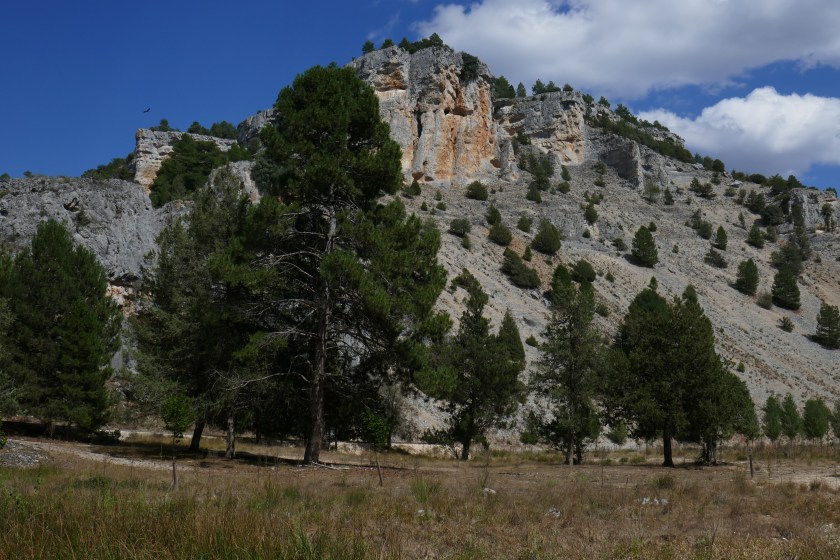
At the visitors centre of the Canyon of the Rio Lobos our Spanish was tested to beyond its limits as we discussed options for walking with a member of staff. As far as we could tell he seemed to be insistent in talking us out of taking the Gullurias footpath, as he said this just went through lots of woodland and was not worth following, but maybe we lost something in translation. The circular path does take a route through varied woodland at first before reaching a stunning view point over the limestone cliffs of the canyon. The path then descends in to the canyon and follows the river back to the visitors centre. It is a fantastic walk and if you find yourself here just go for it. We camped near Ucero and also walked up to the spectacular castle overlooking the village and on another day cycled in to the canyon beyond the hermitage where the paths are quieter and the canyon is narrower and greener.
Many of you will have heard our plans to visit the three cities of Segovia, Salamanca and Toledo on this trip. Segovia came first and it was stunning but it also helped us recognise that we didn’t want to spend all our time sightseeing in cities and Toledo soon got dropped from the list for this trip. Instead we spend a few blissful days in the Sierra de Gredos regional reserve. In the sunshine we cycled along the old drove roads and walked up to a glacial lake. Leaving the high ground, we drove along the river Jerte through fields of cherry trees and as the altitude decreased the weather got hotter. With temperatures in the mid-30s we only spent a day in the Monfrague National Park, known for the variety and numbers of birds, before heading north again.
Salamanca stayed in the plan and we couldn’t have timed it better [absolute chance], arriving at the start of the Festival of Santa Maria de la Vega, the patron saint of Salamanca who intervened to save the city from ransacking in 1706 during the war of the Spanish succession. On our first evening we joined the throng, many in the elaborate national costume, at a flower-based ceremony outside the cathedral and then to watch fireworks over the river. The campsite is an easy 6 kms cycle ride away from the city centre allowing us to go back and forth and visit the city over a number of relaxing days. We enjoyed the peaceful setting of the two-storey and five-sided cloisters in the Convento de las Duenas, where we also bought a box of cakes the nuns bake. Mostly we wandered around the city awestruck at the elegance of the sandstone buildings and dreamed of living in a flat with shutters at the window and a balcony overlooking one of the city’s plaza.
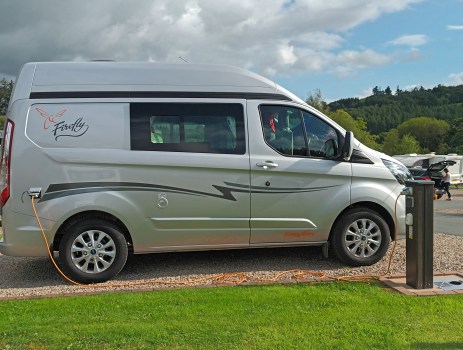
Parked at the lovely harbour at Burwick on South Ronaldsay Orkney
I am obsessed with my campervan and the vanlife and it is my fourth love [after Mr BOTRA, son and daughter-in-law] what I am trying to avoid is an obsession that leads to anxiety every time we park up the ‘van. It isn’t surprising really that in the seven-weeks since we had our campervan returned to us I still get that sick feeling of panic in my stomach regularly when I remember seeing our lovely campervan roll down the Greek slope and hit a wall. Even though we fortunately were not in the ‘van when the incident happened, these feelings of panic are worse when I am in the camper and we are parked on a bit of a gradient, in my head I can start to feel that the ‘van is moving and I am gripped by anxiety. On our trip to Scotland I kept waking in the night [everything is worse in the dark] and eventually I would have to get up and check that we had left the van securely in gear.
We have thought about buying chocks to hold the ‘van but these would take up space and I know in my rational mind that when the handbrake is fully on and the Renault is in gear it won’t go anywhere.
Clearly being in the ‘van should be relaxing rather than anxiety-creating and we needed to come up with a way to stop this pattern of behaviour. We have now developed a routine to follow every time we park up that we hope will ease the anxiety. The handbrake will be engaged and the van will be put in gear and then we chorus, ‘reverse gear engaged’ or ‘first gear engaged,’ depending on the direction of the slope, no matter how slight this slope is. We laugh as we do this as we feel pretty stupid but hope that by voicing the procedure we will remember that it is done and we can then both either leave the ‘van confidently or relax while we sit in it, certain that we have made the van safe.
What we want to avoid is sleepless nights [for me, Mr BOTRA is anxiety-free] or finding ourselves a mile or two in to a walk and starting to have doubts as we ask each other if we can remember putting the ‘van in gear. This self-imposed torture would end up with the absurd situation of us running back to the ‘van just to check and we would never be relaxed.
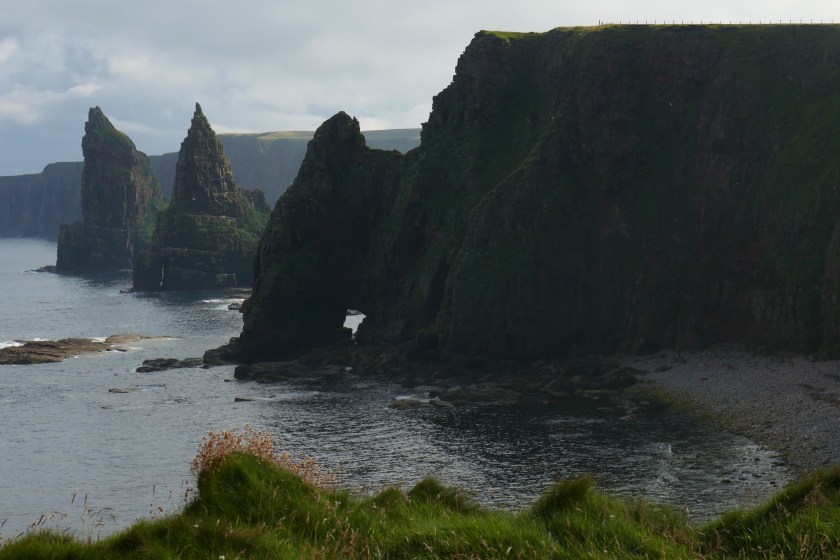
We had raced through Caithness on our way up to Orkney and we were determined to linger on the return leg of our trip as there were so many things we wanted to stop and see along the way. Of course, we climbed up Morven, the highest point in Caithness, and that was certainly a fantastic day but we did plenty of things that required less exertion. The coastal scenery of Caithness is hard to beat. The sea stacks at Duncansby Head on the north-easterly tip of Scotland are dramatic and worth the mile or two of walking from the lighthouse to see them. We also visited Dunnet Head, mainland Britain’s most northerly point, where after a wet morning the sun started to emerge and sea mist flowed over the cliffs; the beauty of it was mesmerising.
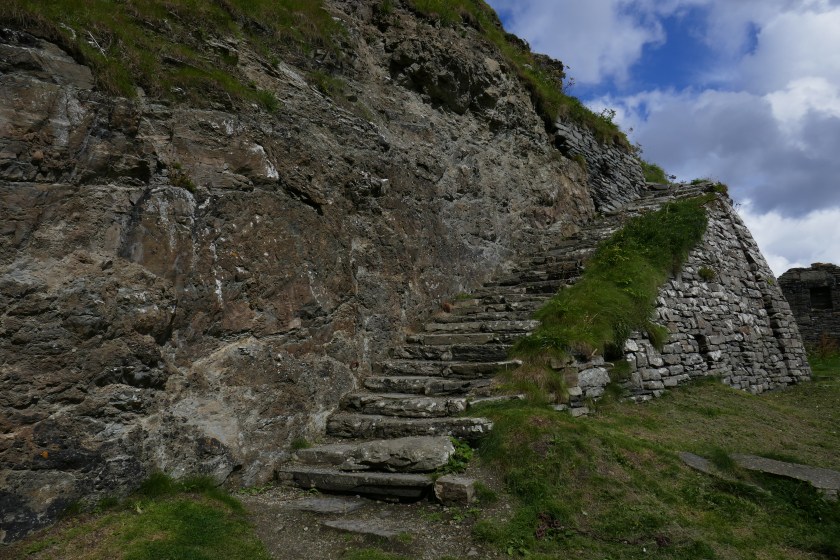
Following the coast we sought out some of the historical sights of Caithness. In the cliffs south of Wick are Whaligoe Steps, 330 flagged steps that zig-zag down to a rocky harbour inlet. The climb up and down the steps is beautiful in summer, surrounded by wild flowers and with views down to the harbour. The steps date back to the late 18th century and the harbour was used until the 1960s.
Inland we took the single-track road to the remote Loch of Yarrows Archaelogical Trail, which was a bit damp under-foot after the rain and where there are ruins of burial cairns and a broch. I learnt that stones in Caithness are not arranged in circles, they have rows and U-shaped arrangements. We wandered around the 22 rows of short stones [less than one metre high] of the Mid Clyth stone row and at Loch Stemster we walked the U of the isolated Achavanich Standing Stones.
We explored more recent history at Badbea, north of Helmsdale. The stones that mark the houses of the former village are perched on rough and steep hillside above the cliffs. Why would anyone choose to live in this spot that has no shelter from the north sea winds you wonder? The interpretation boards told me that this wasn’t a choice. In 1840 the people were cleared from their farms in the valleys to make way for sheep and this inhospitable land was all that was available. The people tried to scratch a living but within 60 years they had all left and the ruined buildings are now a reminder of how rich landowners exploit and mis-treat the people.
Since those awful photographs of the beach at Henderson Island covered in millions of pieces of plastic and the news that a dead whale was found off the coast of Norway with 30 plastic bags in its stomach, reducing your use of plastic has become more news worthy and a variety of papers and magazines are giving tips on how to reduce your plastic footprint.
These tips vary from refusing drinking straws in a bar to buying a wooden toothbrush and are all valid and help the planet and got me thinking about toiletries and single-use plastic. I have been aware for some time that this is a major use of plastic in our household. While moving on to solid shampoo has been fairly pain-free, I have failed to persuade Mr BOTRA to use a bar of soap for his shaving and instead he is trialling Lush’s shaving cream which still comes in a plastic tub which they will take back for recycling. We have never used liquid soap, preferring a simple bar of soap at the bathroom sink and have now moved on to a bar of soap, rather than a plastic bottle of shower gel, in the shower.
Spurred on by the top tips, I bought bamboo toothbrushes from an Ebay store and also a wooden wash-up brush. I don’t use much in the way of cosmetics, just lip salve which Lush package in metal tins and body lotion / moisturiser. My favourite body lotion is Le Petit Marseillais olive and amande cream that comes in a metal tin. It isn’t expensive and is available in French supermarkets and I stock up on this every time we are in France.
So far so painless. Reducing our use of single-use plastic is a slow process with small steps.
Moving on to tackling our cleaning products, we were at Port Sunlight on the Wirral recently and came away, as many do, with a cardboard pack of two bars of Sunlight soap. This has proved to be a great soap for all types of cleaning, including general cleaning of work surfaces and laundry.
One of my weaknesses is mints. I can’t really contemplate a journey in our campervan without having mints on hand to suck. These have always been tic-tacs; these tiny mints are perfect for a small treat but they are packaged in a plastic box. This had to change and I began the search for suitable vegetarian replacements. In Treasure Island Sweets I found tins of Barkley’s Mints. The mints taste great, come in a handy tin, wrapped in paper, so far so good but unfortunately each tin arrived wrapped in plastic! The small steps continue.
Hill walking in Scotland can be a serious business, you can spend hours planning your routes, fork out a fortune for gear and tick off Munros or Corbetts, Grahams or Marilyns. You can tackle long ridge walks, seek out those tucked away mountains where you won’t see another person all day and you can join others on some of the [rightly] more popular routes up dramatic mountains. In winter these mountains are often covered in snow that makes the walking much tougher. I enjoy walking in Scotland when the weather and the views are good far too much to be interested in ticking off tops. From my limited experience, although Scottish mountains vary enormously, there are a few experiences that many share and our trip up Morven, the distinctive and yet diminutive mountain in Caithness gives a flavour of the summer hill walking experience. Morven is just 706 m above sea level, making it a Graham, that is a mountain between 610 and 762 metres high.
It is true that not every Scottish mountain requires a long drive along a single-track road, there are some you can climb from the A9, but neither is Morven untypical in requiring almost 6 miles of driving along a narrow lane before you start walking. Owning a campervan adds to the excitement of the start of any Scottish walk as we are often unsure if we will fit in to the car park. I am often amazed at the inconsiderate parking of others in small car parks, when tidier parking would have meant that more cars [or a small campervan] could have fitted in. We set off early on our Morven day and so we got first dips on the parking area that will fit just three cars [if tidily parked].
In the ‘van we often have a brew at this point but eventually we have to put on our gear and venture out on the next stage of the walk; that is reaching the base of the mountain. The walk-in for Morven will be familiar to many hill walkers; the land rover track takes walkers over two and a half miles in to the moorland, ending at an abandoned cottage. At least this track is easy going and good progress can be made as the next section of a typical Scottish mountain walk is the bog trot. The soggy Caithness moorland had grassy tussocks, each one trying to turn over my ankle, and black peaty sections that might look stable but linger for more than a second and your boots are soon covered in dark mud.
Already we have walked for about four miles but haven’t really gained much height and the toughest part is yet to come. Eventually you reach the climb and in Scotland this means a steep, almost vertical hillside. I am the slowest hill-walker in Scotland and it is on this section that I will be over-taken by other walkers. I plod up the hill, desperately trying not to look up, as each time I do the top seems to be no nearer than it was the last time I looked. There is a rule on Scottish mountains that there will be at least one false summit, these catch out the inexperienced walker who will get excited that the top is within reach and will start looking forward to resting. These false summits no longer catch me out, I never expect that what I can actually see will be the summit until I am standing on a point where the only way is downhill. We had Morven more or less to ourselves so there were no other walkers to rush past me, highlighting how snail-like I am. The bonus with my slow pace is that I spot the wildlife. On Morven there was a mountain hare silhouetted on the skyline, a large group of hinds in the distance, a lizard, plenty of frogs, a water vole and a grouse that terrified me as its frantic wing beats broke the silence. There were also flowers; bright cloud berries on the summit, bog asphodel and the heather was in glorious flower.
During this slow ascent of a Scottish mountain the weather will change a number of times, either getting worse or better, the only rule is it will change. Sometimes you have a great view from the summit, sometimes you just miss it, sometimes you are lucky enough to walk through low cloud in to sunshine on the summit and at other times the cloud just stays with you. The uncertainty of the weather means layers are the only way to walk and these will be on and off throughout the day. On Morven we set off on a glorious day that slowly got cloudier. With the cloud came a breeze that was welcome, as when we were sheltered from the wind on the ascent this bought the midges out and I was grateful to reach the blustery and midge-free summit ridge.
Eventually I reach the top, feeling exhilarated and exhausted. The exhilaration is short-lived because I know that, although the climb up seemed interminable and tough-going, the descent is worse. By this point I don’t really care where I put each foot I am so tired but the walking now gets more technical; descending a steep-sided Scottish mountain is tricky and puts lots of weight on the knees. The only way to get through it is to take my time, grit my teeth and once again try to avoid looking at the vast distance I have to cover, concentrating only on securely placing each foot.
On our Scottish holiday, as well as climbing Morven, we walked up two other hills. Ben Rinnes, at 841 metres high is a popular Corbett in Banffshire where the parking is also limited. The summit gives great views and with a well-marked path and only 500 metres of ascent it is achievable in a short day. We also climbed Lochnagar, a splendid and popular mountain above Loch Muick that has plenty of parking. We took the direct route up the mountain, pausing to enjoy the fantastic viewpoint over the corrie before climbing steeply up above the crags. We descended down the lovely path by Glas Allt that is quieter and easier on the knees. After a tiring day of around 12 miles the walk back along Loch Muick seemed to go on forever and if I hadn’t started a game of i-spy-meets-name-that-tune [try and think of a song title that includes something you can see around you, eg River Deep Mountain High] I may never have made it back.
The tidal island of Birsay in the north-west of the mainland
There are not too many places I return to over and over again [aside from local favourites] but the islands of Orkney off the north coast of Scotland is one such place. Our recent holiday was my sixth trip to Orkney but the first in a campervan and what a difference having the ‘van meant. On previous visits we have been based in one place, all trips radiating out from that base. With the ‘van we travelled across the Churchill Barriers from South Ronaldsay to the north of the mainland, staying in a different place every night and getting a different feel for these wonderful islands. In truth the journey from the wonderful Skerries Bistro and Tomb of the Otters in the south to Birsay in the north is only 40 miles but then why rush around Orkney, there is so much to see, so many different bays to explore and despite repeated visits there are still parts of even the East and West Orkney Mainland that we haven’t yet visited, never mind the other islands.
Orkney stone buildings at Wind Wick
You can expect weather on Orkney and it is always colder than I remember. We have been here when the winds are relentless, on one visit we had a week of constant fog and we have had days of rain as well as fine and sunny weather. This trip was blessed with days of sunshine and what I noticed most was the sky. Orkney lies low and nothing gets in the way of the views of the sky, it is vast and hard to miss and the blue sky appears infinite. On this trip I got used to the feeling of space that those enormous skies give and I found myself missing it as we returned south. During the day we walked and drove under these skies and every evening we sat on a shore or a cliff enjoying a different view to watch the sun go down over the Atlantic, the red sky promising another fine day.
Houses on the sea front at Stromness
Orkney is always a great place to visit for wildlife and despite it being early August we saw plenty of birds, including puffins, black guillemots and gannets from the boat. On the cliffs we saw fulmars and kittiwakes. We watched seals bobbing in the sea and sitting on the rocks at Birsay. We searched for elusive otters and short-eared owls [we had to wait until the Scottish mainland before we spotted the latter]. Many come to Orkney for the incredible archaeological sites and we had timed this visit to see the dig at the Ness of Brodgar. I found the excellent guided tour very interesting, the site is so intriguing, and we contributed by adopting a square of the dig. We also made our first visit to the Banks Chambered Tomb, where our guide was a natural story teller who bought the site to life. We watched boats in Kirkwall and Stromness, we beach-combed at Birsay and at the lovely bay by Kirkhouse Point, we explored the cemeteries at Burwick and at Kirkhouse Point and we walked up Marwick Head to the Kitchener and HMS Hampshire Memorial and thought about the 737 people who lost their lives off the coast here in 1916. Of course we ate Orkney ice-cream and drank Orkney beer whenever we could.
It isn’t just the range of things you can do in Orkney that make it possibly the best place for a holiday, it is the tranquility and calmness of the islands. Even though I am a relaxed retiree these days I still enjoy slowing down our lives for a while on these beautiful islands.
One of my aims for retirement was to be helpful and do some good. It is now over six months since I packed up my work laptop and phone and gave up my salary and it seemed a good time to review how I have got on with this aim. Although I never think I have done enough and know that I could almost certainly do more if I wasn’t so busy enjoying myself, I have done a few helpful things. Below is a flavour of how the retired can still be useful members of society:
We have spent a couple of days working in the garden for our son and daughter-in-law [not sure if this really counts as a good deed as we would do anything for these two]
I spent an afternoon helping a neighbour organising her work files on her laptop
I am the volunteer Treasurer for DIY Theatre Company, an established company of learning disabled performers and I provide support to the Artistic Director
I voluntarily take the minutes for the Board of Directors that runs the development we live in
I visit an elderly house-bound neighbour and have helped her with online shopping
We helped another neighbour clear his storage unit and fitted some furniture in to our van and took them to the auction rooms for him
We have collected litter locally to try and keep the streets a little tidier
It certainly feels good to have the time to do all these things but I think I could try harder.
We are lucky at Salford Quays that the Manchester Ship Canal is orientated east-west. Every year on the shortest day we walk down to Salford Quays to see the sunrise. Unfortunately, this day of celebration has yet to coincide with one of the beautiful sunrises that we do occasionally have over the quays but we remain hopeful. When I used to cycle to work along the canal I would often enjoy amazing sunrises in spring and autumn during my commute to work.
Not being early birds these days, what we do manage to see more often is the sunset and these are worth walking down to the Quays to see. We are always joined by other people, both locals and visitors and the bridges will be lined with photographers and those who are just enjoying the natural spectacle as the sun goes below the horizon.
Standing on the bridge by Media City you are looking across the two Mode Wheel Locks on the Manchester Ship Canal. This unusual name is a corruption of Maud’s Wheel, the name of the wheel at the corn mill that was previously at this spot. These locks were the final lock on the Ship Canal before the expanse of the docks.
The boat in the photograph is one of the boats that takes parties on short canal cruises from Castlefield in Manchester city centre and beyond are the factories of Trafford Park.