The beautiful Chanonry Point on the Moray Firth in Scotland
One of my travel articles from this year included a visit to the pretty village of the Devon village of Clovelly, Charles Kingley’s [the author of the Water-Babies] childhood home. While researching his life and work I found this quote from him:
‘All we need to make us really happy is something to be enthusiastic about’.
This got me thinking about my own enthusiasms and how these contribute to my happiness. I have a fairly wide range of things I am enthusiastic about including walking, being in our campervan, cycling, travelling, reading, spending time with Mr BOTRA and with friends, cooking good [veggie] food, eating excellent ice-cream and drinking red wine, listening to loud rock music, writing, laughing and comedy, foreign TV thrillers, tai chi and learning. Taking part in all these [and other stuff] enhance my energy levels and feed my spirit.
I am drawn to people who have their own enthusiasms; they might not be enthusiastic about the same things as I am but I admire people who enjoy doing something and clearly get a lot of pleasure from it. I have friends with enthusiasm for gardening, visiting Iceland [the country], ballet and Shakespeare; none of these are things that fire me up but I love to hear them talk about their own enjoyment of these activities.
I enjoy taking part in some of the above activities with others and I find that enthusiasms shared can more than double the pleasure. We are part of a book group and the discussion always enhances my understanding of the book; camping trips with friends and walking with other people are sociable occasions that create shared experiences we can all look back on. Our son and daughter-in-law have an enthusiasm for whale and dolphin watching and the photograph of Chanonry Point reminds me of lovely times when we have joined them on this beautiful beach watching the dolphins.
Considering the force of enthusiasm took me to Patti Smith who considers enthusiasm as a state of radiance:
‘If we walk the victim, we’re perceived as the victim. And if we enter … glowing and receptive … if we maintain our radiance and enter a situation with radiance, often radiance will come our way.’
She goes on to relate this to William Blake’s life. He was a creative genius who was not appreciated in his lifetime but who held on to his vision and radiance or enthusiasm. We all have knock backs and stumble and I certainly constantly let myself down; my cooking is often not as perfect as my vision when I start out with the raw ingredients; my writing is never good enough and I often fail to learn to the extent I aim to but I try and stay enthusiastic and carry out activities with love and joy while seeking self-improvement.
PS Iceland looks beautiful and I would love to visit this country but I am waiting for them to discontinue commercial whaling.
I am much more of a spring person than an autumn-lover; I like the optimism of the beginnings of things more than the sadness I feel at endings. Finishing a novel can be either a disappointment or bring about a feeling of loss if I have got totally immersed with the characters, but at the start I am excited and looking forward to the ups and downs of the story. I certainly prefer the excitement of the beginning of a holiday when all that free time is laid out before me, compared to the melancholy I fall in to on the last day, even with all those good times to look back on. The early days when I am getting to grips with a new project before the realisation of the challenges or my own inadequacies set in are the best days. In the past a gloom has set over me as the nights get longer but I have learnt to deal with this, always remembering that spring and those light evenings will return. But this autumn a long weekend in the Lake District bought a glow to my cheeks and plenty of happiness to my heart.
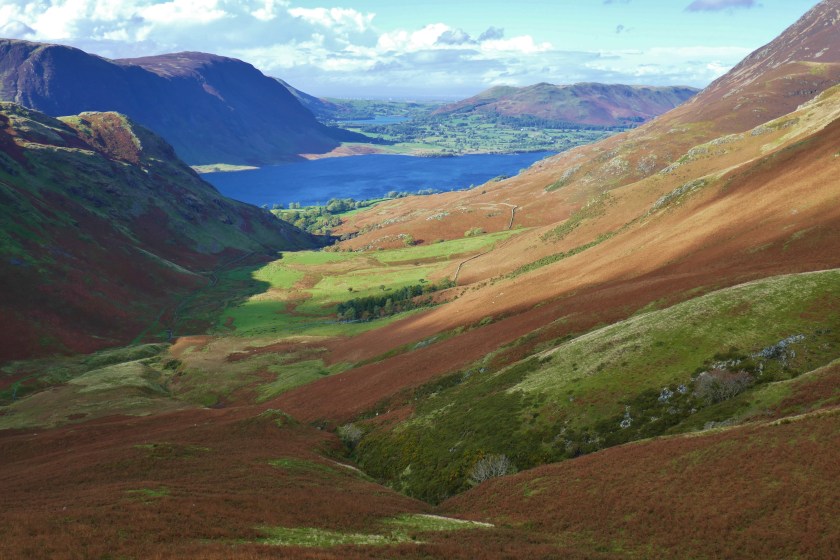
In the October sunshine last weekend the Lake District was steeped in the deep burnt-orange glow of the autumnal bracken and the leaves on the trees were turning to browns, yellows and reds. I couldn’t be gloomy surrounded by such colourful scenery.
We had time for a short walk up Sale Fell above Bassenthwaite Lake on the Friday afternoon and sat on a handy bench and gazed over the splendid view over the lake. We spent the next day pottering along the river Cocker to the lovely town of Cockermouth, toured the Jennings brewery and climbing up Whin Fell above Lorton to see the sunset. Sunday, after some heavy showers, the sun shone again and we had a splendid day climbing up the steep hillsides of Wandope above Crummock Water, via Whiteless Pike.
You can’t swing a Bratwurst without hitting an art gallery in Berlin and so it was only right that some of our time in Berlin was spent visiting just a couple of the many galleries in the city. The art scene in Berlin is diverse and vibrant; apparently there are 440 galleries across the city so perhaps there is something for everyone. We picked out just two places to visit on our long weekend and the two we visited couldn’t have been more different.
The Gemäldegalerie has a collection of European painting ranging from the 13th to 18th century on permanent display; including paintings by Jan van Eyck, Pieter Bruegel, Albrecht Dürer, Raphael, Titian, Caravaggio, Peter Paul Rubens and Rembrandt. Housed in a 1980s building in the Kulturforum, the building is a simple design and the purpose designed galleries are well proportioned and light, laid out in a slightly confusing but entertaining pattern that visitors can weave around. We spent an enjoyable few hours in the hushed and academic atmosphere of this amazing gallery.
The painting that made the biggest impression on me was Pieter Bruegel’s Netherlandish Proverbs. This is an illustration of about 112 different 16th century Flemish proverbs and idioms. The painting is lively and human, in contrast to much of the religious art in the gallery, and this is perhaps why it spoke to me. It is also humorous and reveals something of the past with illustrations of sayings such as, ‘one shears sheep, the other shears pigs’ [meaning one has advantages, the other has none] and proverbs I want to introduce to my vocabulary such as, ‘the herring does not fry here’ [it’s not going according to plan]. There are others we still use modified versions of today, such as ‘to sit between two stools in the ashes’ [to be indecisive] and ‘to try to kill two flies with one stroke’ [to be efficient].
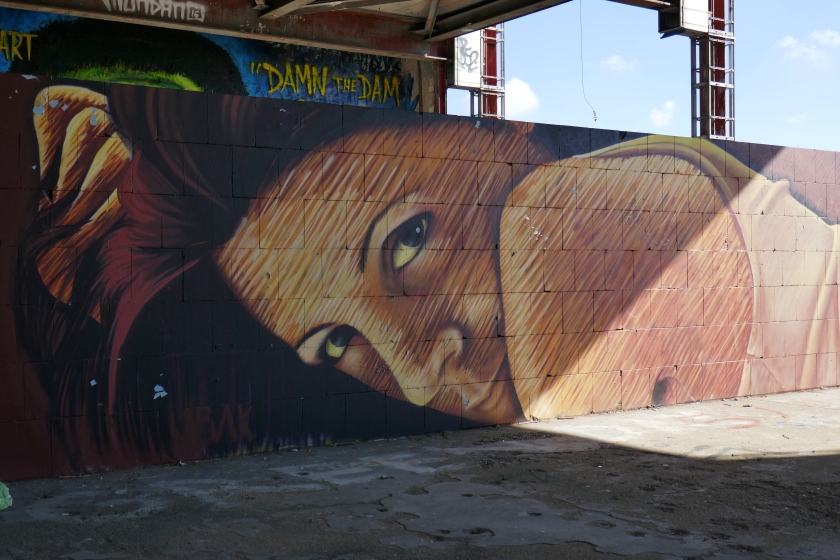
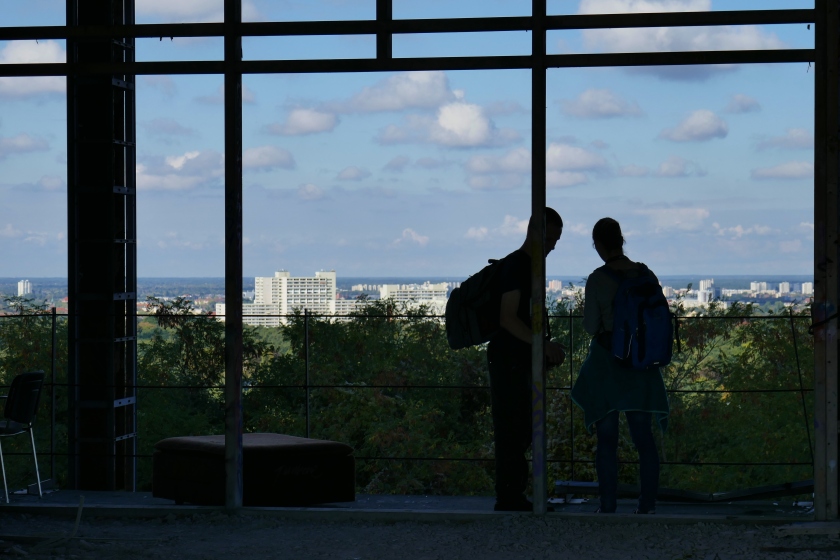
Almost everything in Berlin reveals many layers of history as soon as you scratch the surface. Our second gallery was on top of a hill in the Grunewald [green forest] that lies around Berlin. This is no ordinary hill; Teufelsberg is a 80 metre high mound that was created from the rubble removed from the bomb sites of Berlin after the second world war. The hill was in what was the British sector of Berlin after the war and in the 1960s it became the site of an Anglo-American listening station topped with radomes. After almost 30-years of listening to the DDR the station fell in to disuse after the fall of the Berlin wall. The hill was bought by a developer but planning permission for the hotels and apartments was not forthcoming and the abandoned buildings of the listening station remain and can be visited to see the graffiti art that uses the inside and outside walls of the crumbling buildings as a canvas. For a €7 entrance fee visitors can wander freely around the jumble of buildings [at their own risk] and admire the huge art works and stand at gaping holes in the buildings to enjoy the view over Berlin and the forest.
After spending a few hours at Teufelsberg we followed the maze of footpaths through the Grunewald to the banks of the lake, as no trip to Germany is complete without a woodland walk. With no signposts or compass we had to resort to using the sun and asking for help to navigate our way through the dense forest.
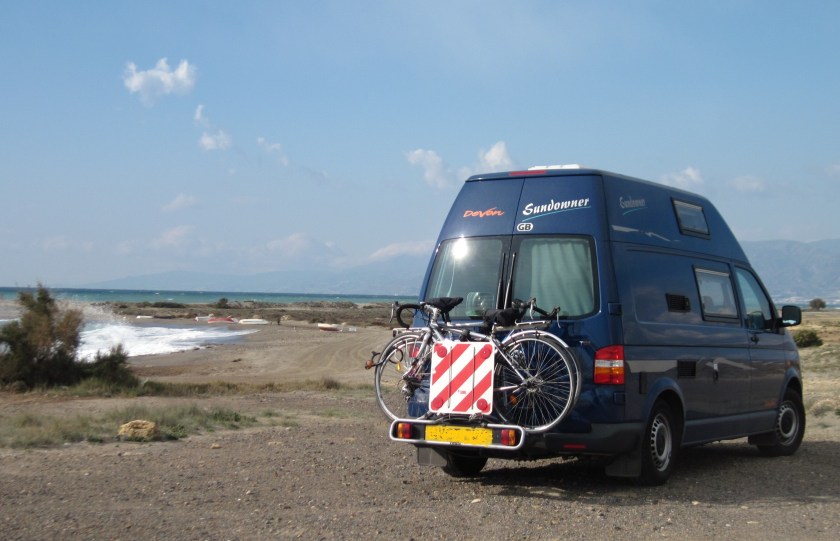
Sometimes it comes up in conversation and I tell people we had a gap year, living in our campervan for twelve months and travelling around the southern parts of Europe. Most people’s reaction is, ‘I would love to do that’ with a dreamy look in their eyes and I don’t deny that it was a fantastic experience. I have noticed that lots of people buy in to the romantic idea of the freedom of the road in a campervan and want to be part of that. I don’t wish to trample on anyone’s dreams but if our conversation continues I often add that although I understand that everyone has specific circumstances that might explain why they can’t drive off in to the sunset, if we can do it then lots of other people can.
If the gap-year enthusiast is still with me I might mention that the trip was at least three years in the planning, that we saved a lot of money, sold everything we didn’t need, downsized the house and gave up secure jobs to do it and that fortunately Mr BOTRA and I love each other very much and so don’t find sharing the [lack of] space in a small campervan a problem. At this point many people start to lose enthusiasm and reconsider, realising they don’t really want to go to that much trouble just to travel around in a tin box. If they stay with me I might refer to how much we missed our son and daughter-in-law and friends while we were away and a few more fall by the wayside. The final nail in this conversation can be when I explain the amount of effort we had to put in to find new jobs when we returned. Of course, lots of other people do get organised and plan and execute a similar / longer / more adventurous trip and I am happy to share any useful experience I have with these folk; they are not just dreamers but are people who make things happen.
No matter what personality test I take I have always come out as a doer. I used to co-run workshops for community groups and organisations where we took them through a visioning exercise, thinking about their community or organisation in five or ten years time, mapping that vision and then supporting them in planning the multitude of steps required to make that dream a reality. To me this sort of planning is second nature but it became clear that some people were good at the vision but hopeless with the planning and even more struggled to get beyond the first couple of steps on the path to their dream. Staying true to an idea through the tiny steps of the planning stage can be a struggle and needs perseverance and strength, an ability to pick yourself up when you get knocked down and a willingness to be adaptable when circumstances change along the way.
There are as many different dreams out there as there are individuals and I would love to be able to congratulate everyone who has ever had a plan and made it real. The Financial Independence and Early Retirement community is not dissimilar to the [later life] gap year in a campervan community; they are people who have a dream or a vision of a different life and make it happen, even though the planning and saving to achieve this dream might take many years.
Although when travelling I like to see where the road takes me, in terms of life I like to have a plan and so my favourite life quote is from the great story teller Lewis Carroll in Alice in Wonderland, when Alice met the Cheshire Cat:
“Alice asked the Cheshire Cat, who was sitting in a tree, “What road do I take?” The cat asked, “Where do you want to go?” “I don’t know,” Alice answered. “Then,” said the cat, “it really doesn’t matter, does it?”
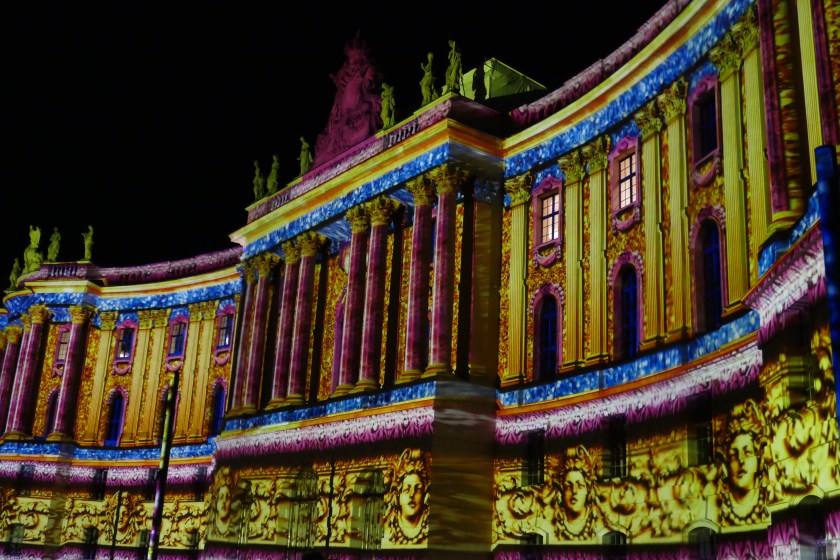
Bebelplatz in central Berlin brilliant with lights
Wow! We have just enjoyed a few fun-packed days in Berlin with friends. We walked miles, exploring the wonderful city and the surrounding forests, finding new sights, revisiting old favourites and marvelling at the changes in the city since our last visit eleven years ago. We found culture [more of this in a later post], multiple layers of history and good food and beer.
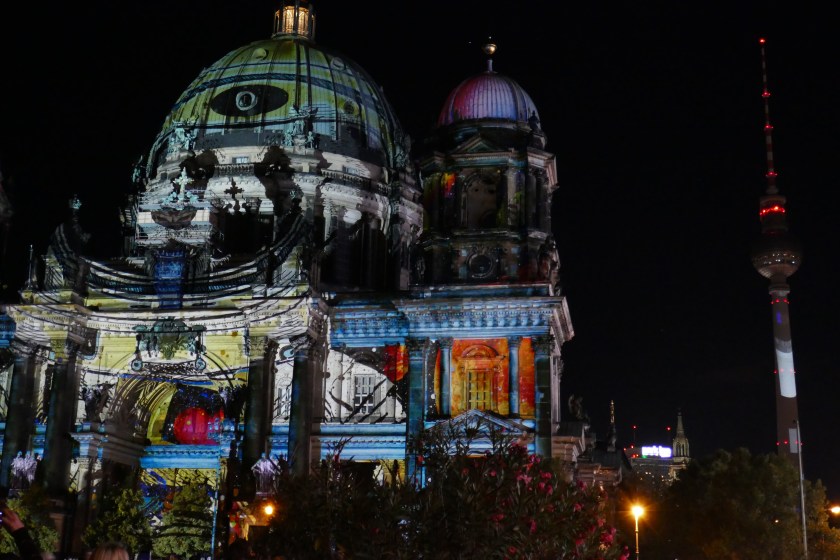
We had timed our visit to coincide with the Reunification Day celebrations and public holiday. We were also there during the Festival of Lights which is held over ten-days in October and uses some of Berlin’s spectacular landmarks and buildings as a canvas for light and video films. As well as the buildings, there are boats that are decked with lights making circuits around the river. The festival makes wandering the streets on a fine evening even more awesome; we stood in the Pariser Platz and watched the key events in Berlin’s history drawn across the magnificent facade of the Brandenburg Gate and joined the crowds to watch an amazing and ever-changing selection of colourful pictures projected on to the cathedral.
I hadn’t taken a tripod as we were travelling with hand luggage only and so my photographs of the light show are not perfect but give an impression of the vibrant and imaginative lighting that transforms a building into something quite distinct. The building is both a canvas for the light-art and enhances the images, while the light show alters the relationship between the people and the buildings, making people stop and look up, the bustle of the daytime stilled.
This link will take you to stunning photographs of previous years [the festival is in its eleventh year], as well as tips for taking great pics of the night-time scenes.
The Berliner Dom alongside the Fernsehturm in Alexanderplatz during the Festival of Lights
We are happy with any excuse to visit Teesdale and explore this lovely valley a little bit more and so set off for Cotherstone (pronounced to rhyme with fun not phone) in a cheerful mood, looking forward to meeting up with old friends and making new ones. Yes, this was the autumn get together of the Devon Owners group.
We were staying at the lovely and welcoming Doe Park Caravan Site just a ten minute walk from Cotherstone. For someone so hopeless remembering names there were so many Devon ‘vans [and their owners] at this meet it was hard to keep up with who was who, we kept the attendance list close by all weekend and apologise to everyone whose name we got wrong.
Our welcome was warm and very genial. Normally when we arrive on a campsite the first thing we do [being addicted to a cuppa] is put the kettle on and have a cup of tea. Parking on our pitch on Friday afternoon we managed to get the kettle on, but it was over an hour before we had a long enough break in neighbours popping over to say hello and could actually make that brew.
Of course, we did some walking and while many people walked or cycled into the delightful Barnard Castle, we decided to go the other way to Eggleston, which has a lovely hall and gardens, with a tea shop and a pretty garden trail that passes colourful borders, a ruined chapel and fruit trees laden with apples and plums. Autumn is settling in now and we walked high above the river, finding huge puffball mushrooms and picked blackberries from the hedgerows. We returned along the Tees Railway Path from Romaldkirk which is perfect for walking or cycling.
On the way home we stopped in Kirkby Stephen on the edge of the lovely Howgill Fells and walked up Smardale Fell. We were walking in blustery sunshine and could see showers flitting across the Pennines and watched rainbows briefly arching over the hills.
Well … Mr BOTRA and I do know that life is rushing by us at an alarming rate but we really couldn’t believe it had been two years since we had visited the gorgeous Wharfedale in the Yorkshire Dales. What were we thinking of? Why had we neglected this beautiful valley for so long? Had other beautiful parts of the UK been distracting us? [The answer is yes to the last question].
We made up for it this last weekend and were rewarded for our return with beautiful weather for a couple of days that was perfect for walking trips.
On day one we followed a favourite walk from the campsite near Grassington, following grassy paths over Malham Moor and stopping to admire the wide open views. We crossed the lovely Wharfe at Conistone and here decided to head for Kettlewell and pick up the bus back down the dale. This took us to the wonderful dry limestone valley known as Conistone Dib. The path winds upwards through a rocky gorge that would once have been a lively stream and we enjoyed climbing up the steps of old waterfalls and along the gravel stream bed. Along the way we met a group of National Park volunteers clearing stone cairns and we stopped to chat. As we walked away we were both thinking the same thing … how lovely it will be to have the time to volunteer in this beautiful area.
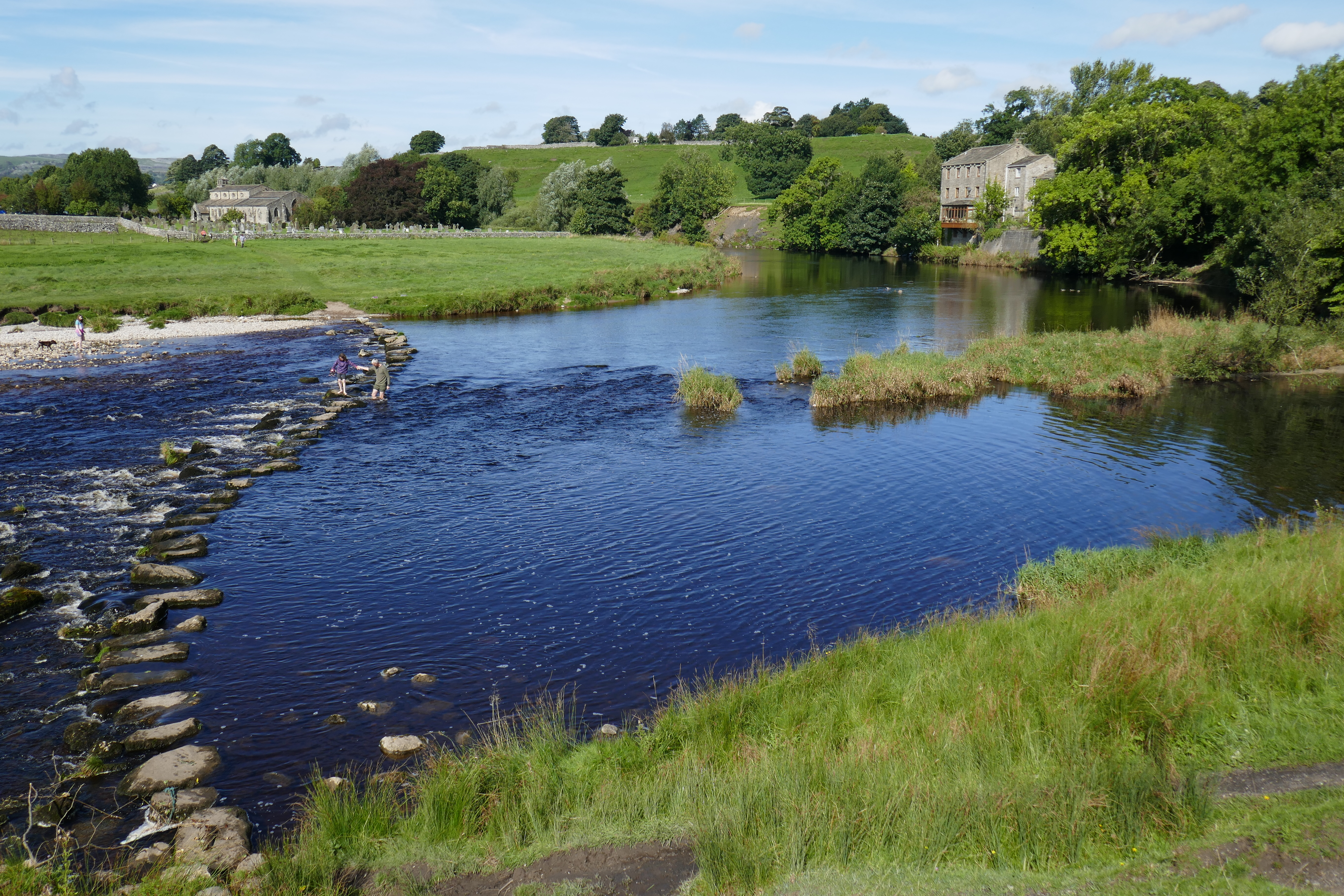
The next day was still sunny and we walked from Grassington along the river Wharfe to the pretty village of Burnsall. Thanks to rain a couple of days before the river was full and this made crossing by the stepping stones at Linton and Burnsall entertaining for everyone who was watching. We watched dad wading across, the river up to his thighs; he held the hand of his young daughter who was then able to jump across the stones. Later we marvelled at the daring of a walker who ran across so fast his feet hardly touched the stones. We returned through the valley-side village of Hebden and as we came through Grassington Park Estate Meadows we promised ourselves we would visit next July to see the flowering meadows in their full glory.
The summer of 2016 might not be memorable in England for being wall-to-wall sunshine and yet we have managed to be lucky enough to have some excellent weekends away. Although we have visited our much loved Lake District a couple of times, it has been a memorable summer for exploring some new areas [yes even in our small country we can still find places to discover]. Our trips to the Howgill Fells and Knaresborough were very pleasurable and we explored some beautiful places and enjoyed some good walking.
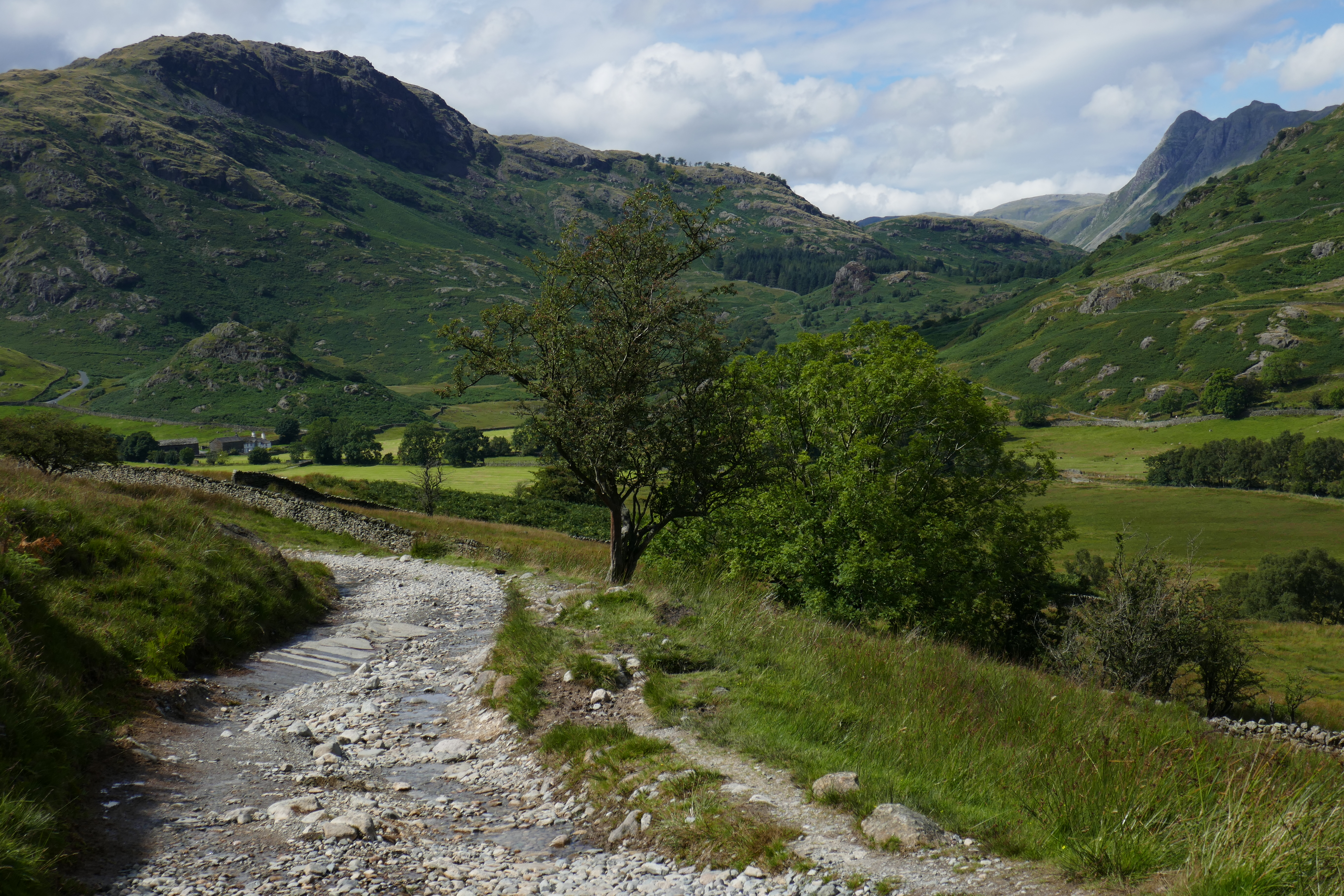
I was reminded how beautiful Great Langdale is in the Lake District on our August trip. Time flies so quickly and I am often amazed how many years it is since we have visited favourite places. As we drove in to the lovely glaciated valley and got our first glimpse of the distinctive hills bathed in the evening sunshine, the steep-sided hills seemed to give me a big comforting hug. After a pint of Old Peculier in the Old Dungeon Ghyll, listening to the chatter of other walkers talking about routes and studying maps for the next day I was even happier. The sound of the stream lulled me to sleep that first night.
The Howgills trip was one of discovery and I think it will become a favourite as the walking is good and the area is less popular than its neighbours. In North Yorkshire, we walked about 20 kilometres in to the lovely town of Knaresborough and back. This wasn’t mountain walking but it was beautiful through the Nidd Gorge and we enjoyed spotting the blue-green of the kingfishers flying fast over the river. There is also more to discover on the moors between Knaresborough and Skipton and so I hope we will be back [although as I said above, years might fly before this actually happens]. It hasn’t all been walking and we also spent some time in the fascinating and packed Nidderdale Museum in Pateley Bridge. Run by volunteers, there is something for everyone in this lovely local collection.
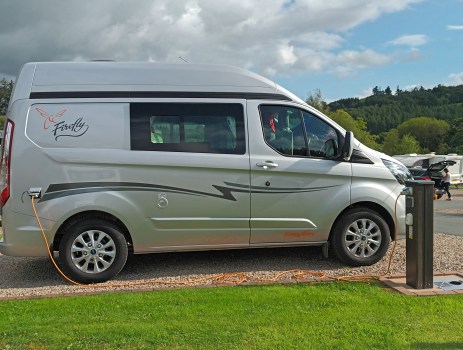
Meeting up with what we call ‘Our Australian Friends’ earlier this year on one of their trips to the UK set me off reminiscing about all the people we have met thanks to our motorhome and how much having the ‘van enriches our lives.
We met ‘Our Australian Friends’ one cold and wet January day on the campsite in Ronda in southern Spain six-years ago, when they knocked on the steamed up window of our ‘van and in true blunt Aussie style asked, ‘do you want to come over to our ‘van for a drink before we kill each other’. We agreed with some trepidation; fortunately they turned out not to be serial killers and we have been pals ever since.
Also on our ‘gap year’ we found someone who shared our outlook when we met a lovely Italian woman in El Rocio. She was camped next door and lubricated by red wine, we sorted out the world in a mixture of English, Italian and Spanish. A couple of years ago we drove to Italy to see her again and reinforced the feeling we had that here was a kindred spirit. Since that trip she has moved house and we are sad that for the time being we seem to have lost touch.
We have also found some new people we really like spending time with from attending the regular Devon Conversions Owners Club rallies and contributing to the group’s online forum. The happy accident of buying the same make of motorhome doesn’t necessarily lead to a flourishing friendship but it turns out it is a good step on the way. Once the conversations meanders away from why you picked your particular model and you find other common ground, a friendship can start to unfold.
Two other motorhome acquaintances introduced themselves by getting in touch via my blog. They were a like-minded couple and motorhomers who took the trouble to make a comment, this developed in to an email conversation, escalated into face-to-face meetings over the last few years which adds joy to our lives.
None of this is to forget our wonderful long-standing and much valued friends, some of whom have their own campervan or tent and are prepared to spend some of their holiday time with us. These are people we have decades of history with and who suffer our imperfections without judgement [although not necessarily without comment]. We have a bucket full of good memories from these weekends and these shared experiences consolidate and sustain these friendships.
Finally, through writing this blog I have made many online connections with the Financial Independence and Retiring Early (FIRE) community. I have learnt so much about being frugal and staying optimistic from these positive, knowledgeable and well organised folk.
By happy coincidence, I was editing this blog post when my weekly Brain Pickings email arrived in my inbox. The wonderful article on reclaiming friendship says much better than I can how I feel about this aspect of my life. I do hope that, thanks to our campervan and my blogs, Mr BOTRA and I will make new connections with people we like, our friendships will be strengthened and, who knows, maybe news ones will start to develop.
Rees Jeffreys Road Fund car park above Llan Festiniog
My introduction to William Rees Jeffreys was quite by accident one sunny Sunday a few years ago. Travelling home after a weekend camping in Dolgellau and keen to extend the carefree holiday feeling as long as possible, my partner and I took the B4391 over the hills from Llan Festiniog. Spotting a car park with extensive views, we couldn’t resist stopping for a brew and a stroll down the lane to pick bilberries and sit by the babbling brook. The splendidly positioned car park had a plaque and I learnt that it was funded by the Rees Jeffreys Road Fund.
Like many brief encounters, I didn’t give Rees Jeffreys another thought until twelve months later I had another chance meeting with this enigmatic fellow. Once again on the lookout for a good place to pull in for a drink, we turned off the M6 at Tebay and followed the road towards Kendal. Spotting a lay-by with a view towards the Howgill Fells we pulled in and realised we were parking next to a familiar plaque. The kettle went on and I climbed out to read that here was another car park funded by the Rees Jeffreys Road Fund. Over my cup of tea I starting wondering what the story was behind this man, why he felt the need to pay for car parks as far apart as Wales and Cumbria and why he deserved a plaque.
Back home, an internet search revealed some information about William Rees Jeffreys; born in 1872, before Karl Benz had patented his internal combustion engine for a Motorwagen in 1886, William Rees Jeffreys was a keen cyclist and was initially motivated in his campaigning to improve roads for cyclist. As cars became more widespread, William Rees Jeffreys held positions with the Road Board (the precursor of the Department of Transport), the RAC, the Roads Improvement Association and the Institute of Automobile Engineers. From 1919 he was a leading light in the classification and numbering of the roads in Britain to aid the assignment of the money from the Road Fund and to help drivers navigate; the final list was completed in 1926. Following his death in 1954 his estate provided the endowment for the Rees Jeffreys Road Fund; this gives financial support every year for education and research related to road transport and also for physical road transport projects, hence all the lovely road side parking areas.
As frugal campervan owners we always need car parks and lay-bys and those next to roads often suit our purpose of a rest stop on a long drive. These halts give us a chance to have a hot drink at little cost and stretch our legs without going out of our way and here was an organisation providing just the facilities the motorhoming community needs; I’ve not found a WRJ funded car park yet that has a height barrier.
Interesting as the Rees Jeffreys Road Fund website was, it lacked a list of the road side rest areas the Rees Jeffreys Road Fund had supported and I wanted to know more. An email to the Secretary quickly led to the arrival of a list in the post a few days later which showed 68 funded rest stops; these spread from Wester Ross in Scotland to Cornwall in the south-west. With the list, I was now able to plan holiday routes to include a Rees Jeffreys Road Fund road side rest areas.
My next opportunity to use the list was on a Spring trip to Pembrokeshire. The delight of a following a quest is that you never know exactly where it will take you and we found ourselves in some idyllic spots just because they were Rees Jeffreys Road Fund rest stops. Our first find was a small parking area on the B4582 near Cardigan, alongside the Crugiau Cemmaes bronze age barrow, which has stunning views over the Welsh countryside. At Wood near Newgale we enjoyed further views over Newgale Sands and St Brides Bay from the dramatically situated sloping car park.
Our final stop on this trip showed up the limitations of the list; with no grid references or even road numbers, even with the help of online maps and street view, there were some rest stops that were very difficult, if not impossible, to locate [you will notice my list is annotated with notes]. I think we found the road side rest stop at Pont Marteg on the A470 north of Rhayader in the stunning river Wye or Afon Gwy valley. The red kites circling above I stretched my legs, searching for the now familiar Rees Jeffreys Road Fund plaque; I never found it and so wasn’t completely sure we were in the right place.
The Rees Jeffreys Road Fund uses the interest earned on their investments each year to fund research projects and educational bursaries as well as road side rests and are happy to consider applications from any source, so if you think your local beauty spot needs a small car park let your council know about this opportunity.
Having visited Rees Jeffrey Road Fund rest stops in England and Wales, I got the opportunity to seek one out in Scotland. Just north of Glasgow, the car park at Queen’s View between Mingavie and Drymen was funded by my old friend WRJ. This car park enables the locals and visitors to park up and enjoy some fresh air and exercise; a quick five minute pounding of the legs will take you to the view point where it is said Queen Victoria stopped to take in the view of Loch Lomond, the more energetic can spend two or three hours walking up to the crags of the strangely named hill, the Whangie. The car park was busy on a bank holiday weekend and needed a good litter pick to make it a really pleasant place to rest.
Most recently we visited the rest stop at Iron Gate car park, perfect for the wonderful walk up Moel Famau in Flintshire. Mr BOTRA and I have ticked off only a few of the WRJ road side rests but the list travels with us in the glove compartment of the van and I have no doubt that my acquaintance with William Rees Jeffreys will be maintained and I will continue to be grateful for his generosity to motorhomers and other road users.


 Back on the road again