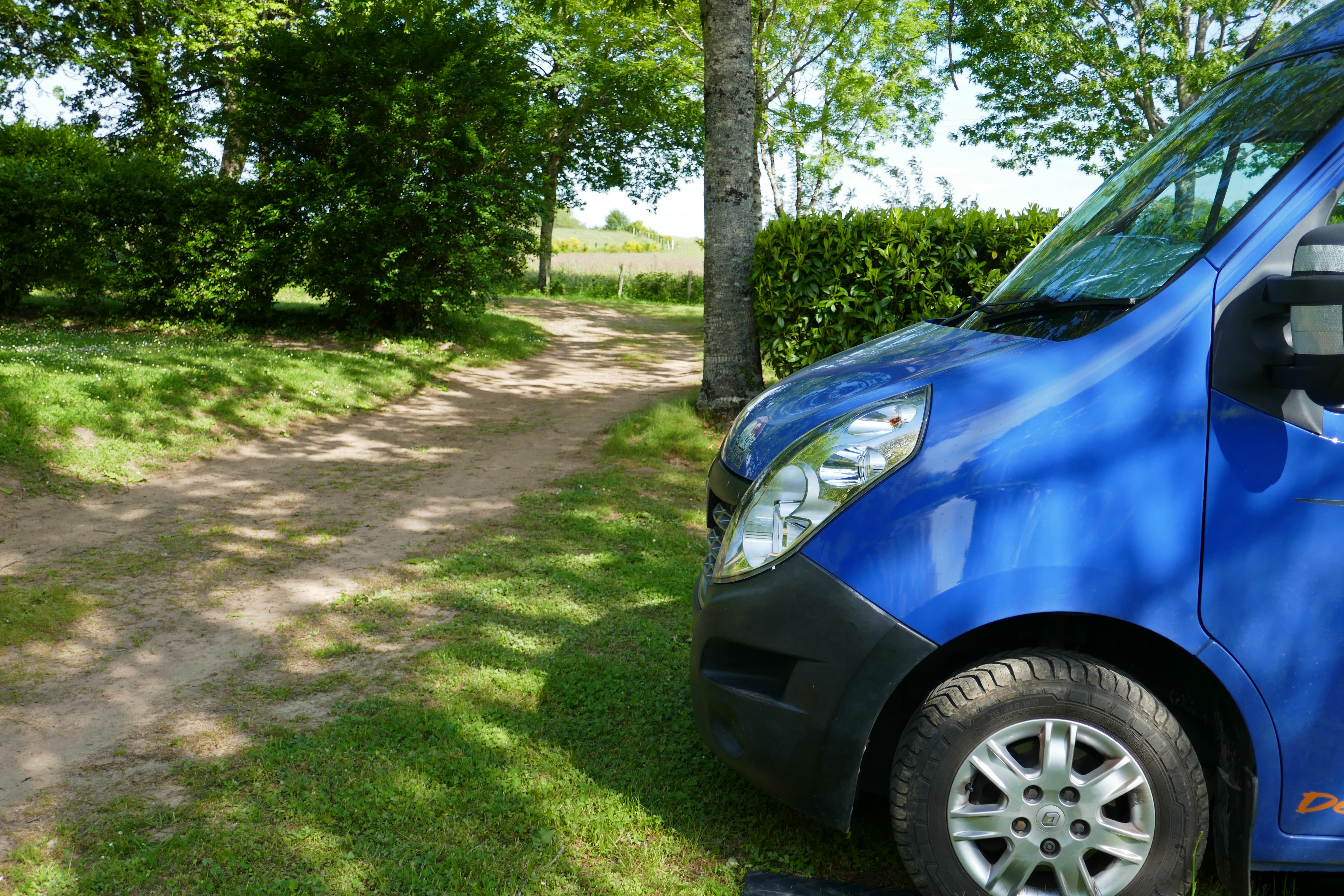
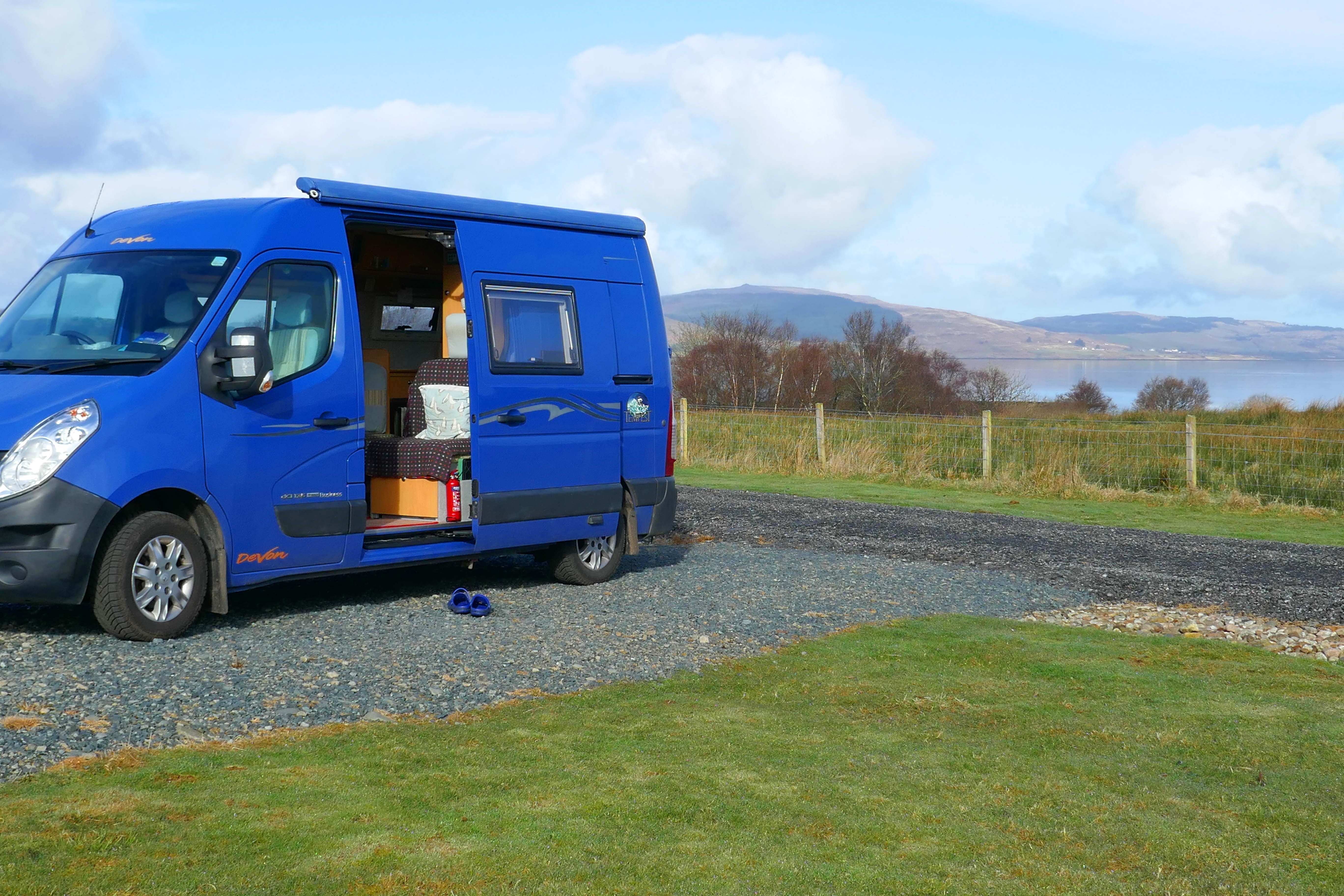
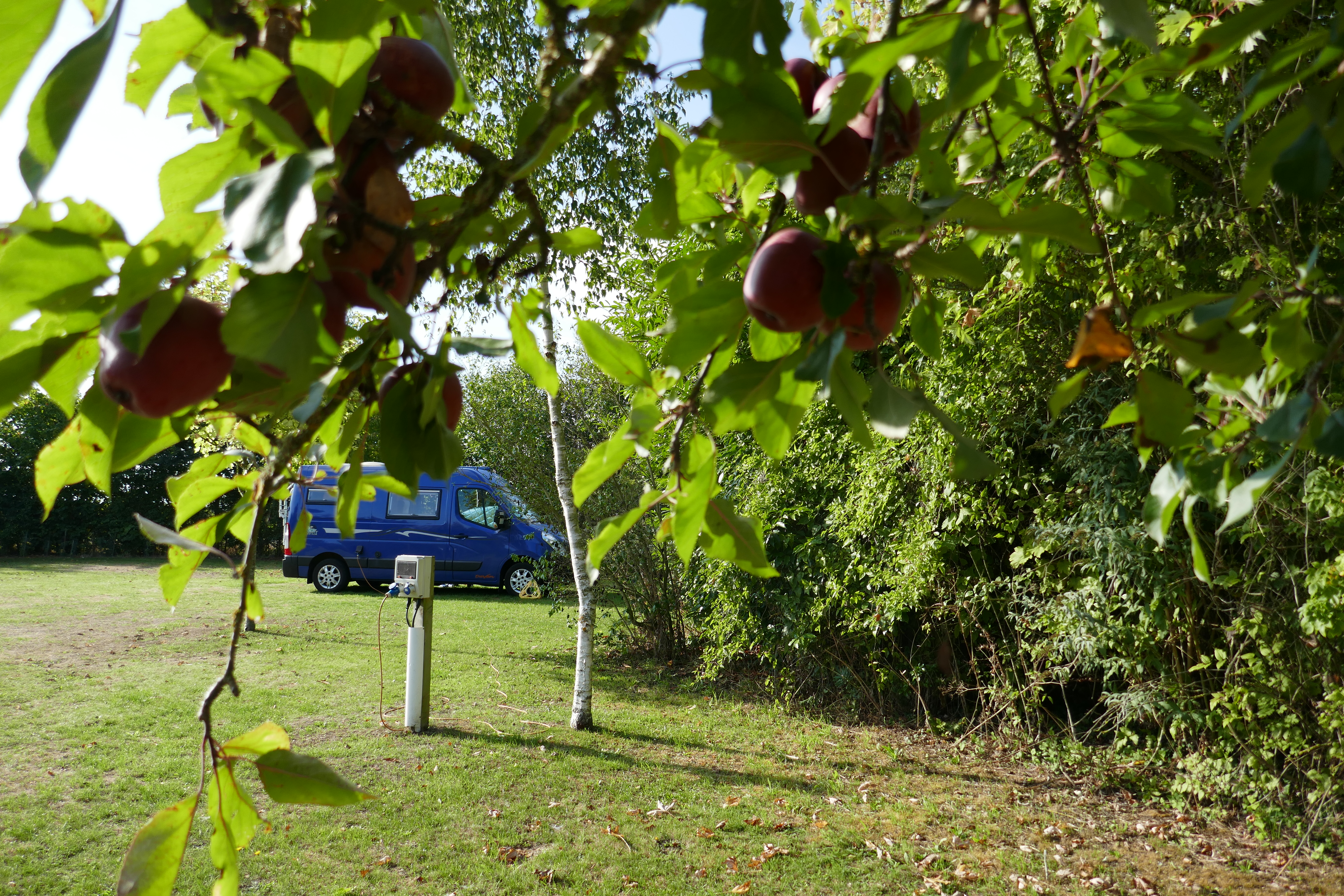
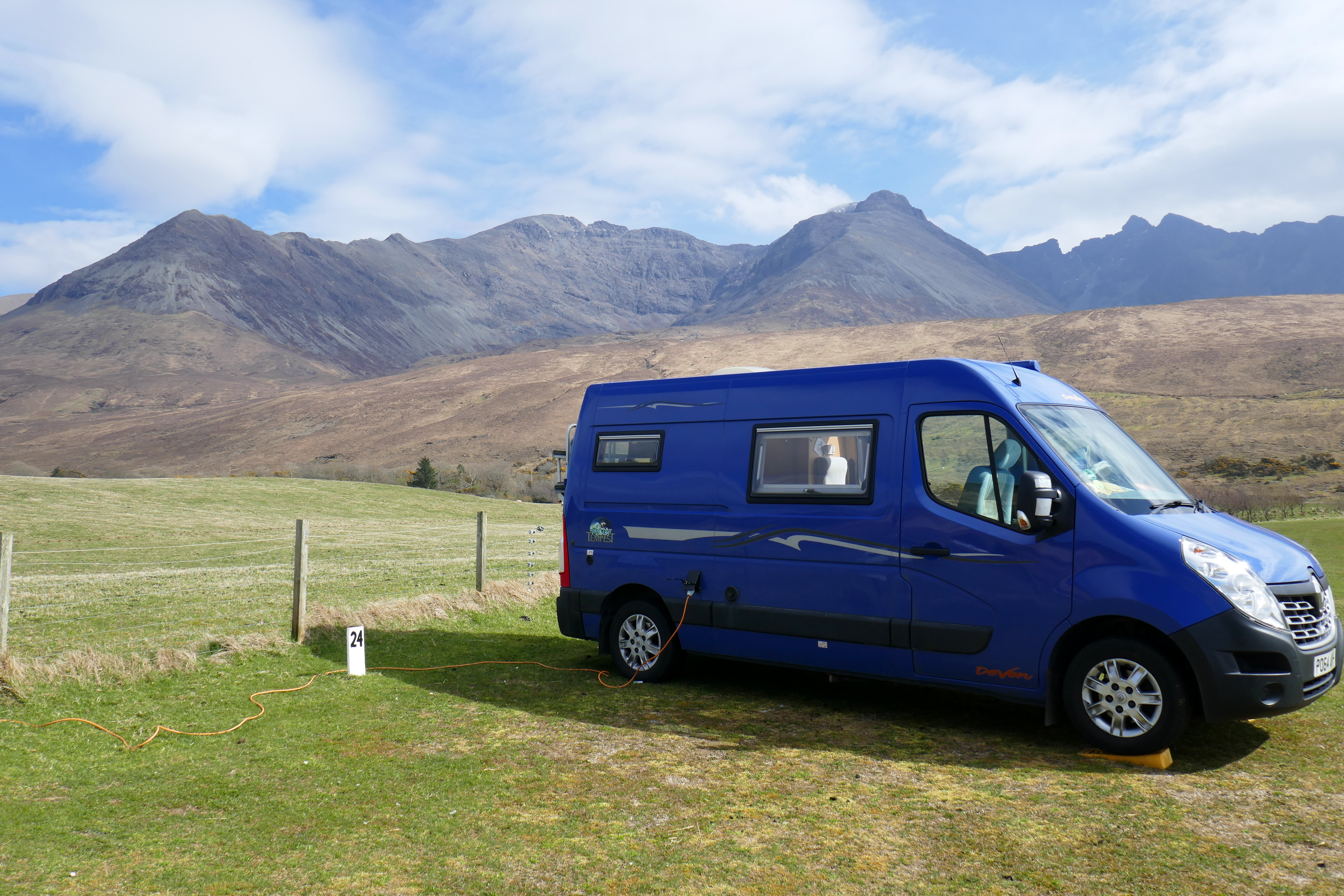
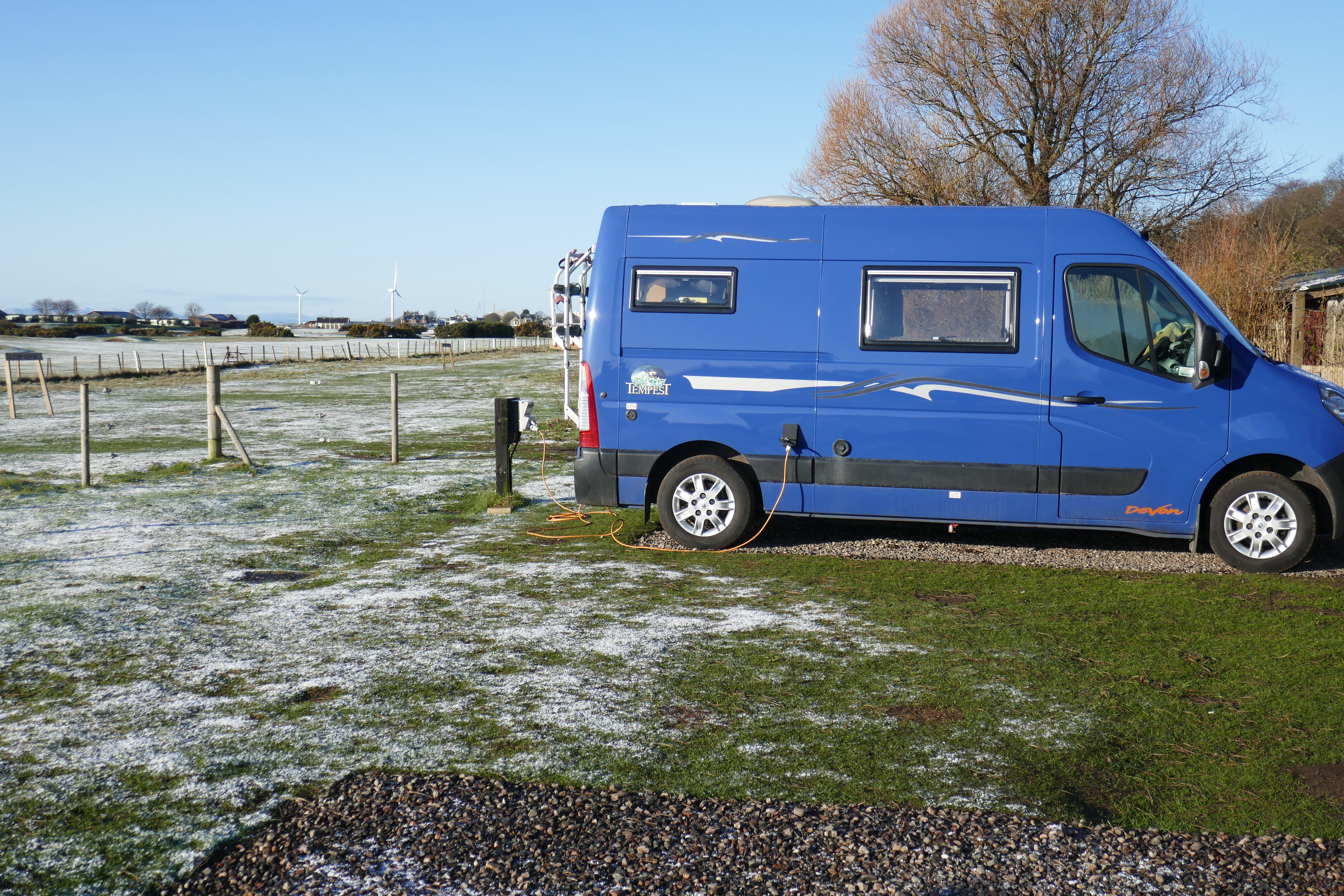
We started the conversation during our campervan trip around France. Was it time to change our campervan? We adored our Devon Conversions Tempest on a chic blue Renault, it had everything we needed. After eight-and-a-half years, over 900 nights and around 80,000 miles it had been the workhorse campervan you expect from a Renault Master. Sitting in the French sun with a bottle of wine we mulled over options. Not owning a campervan at all was one we needed to consider but my tears at even the thought answered that question! We are a good team and generally get the best solutions when we put our two heads together and eventually we realised that what we wanted was a smaller ‘van.
When we bought our Devon Tempest we were keen to try the luxury of a travelling with a bathroom and didn’t want the faff of turning the front seats around. We had enjoyed what we think of as our enormous 5.4 metre long Blue Bus but both now felt ready to return to a simpler way of camping. We also felt uncomfortable owning a diesel ‘van with a Euro Five engine, we wanted something less polluting.
The research began with electric ‘vans but it soon became apparent that although there are a few out there they are still a rare beast and would cost almost as much as our Lancashire bungalow! A second-hand but newer campervan with a Euro Six engine was a cleaner option that wouldn’t leave us destitute. Visiting campervan dealers it quickly became clear that what we wanted was difficult to find. Campervans have become so popular they fly off the forecourt and those on offer were unsuitable in so many ways.
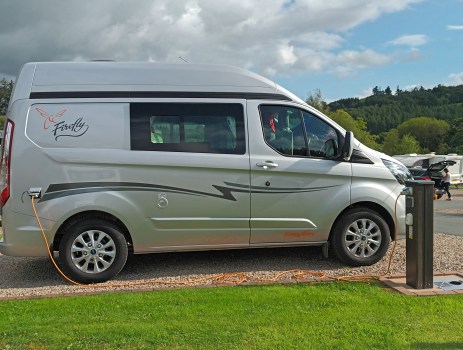
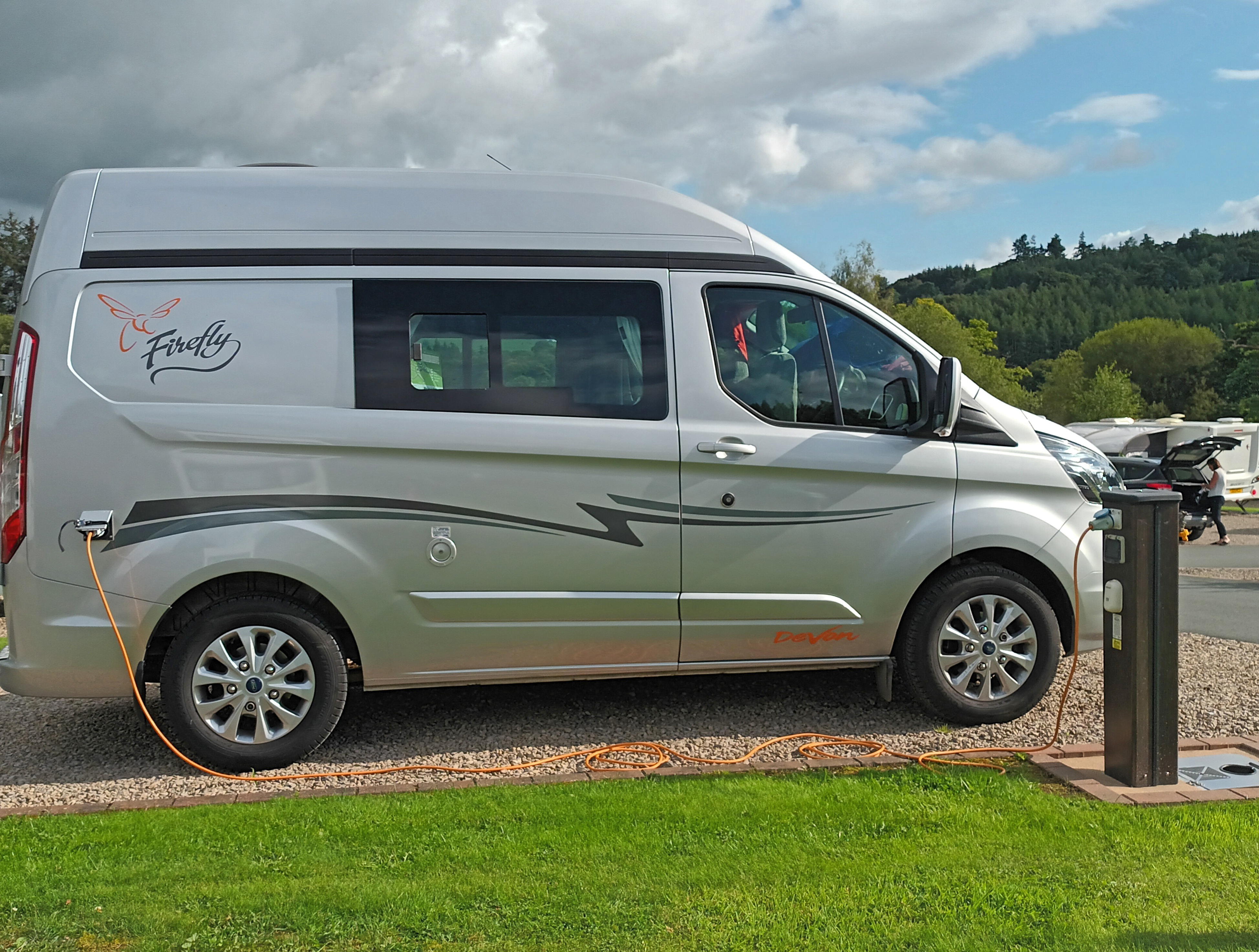
Then we had a piece of luck. A chance conversation alerted us to a short wheel base Devon Firefly on a Ford Custom Transit coming up for sale. We like the Devon Conversions campervans and had owned two previously so we were beyond excited while we waited. The Firefly is a similar layout to our previous Devon Conversions campervan, the Sundowner, although that was on a VW. It was a layout we prefered as it includes a toilet tucked away at the back, so we could downsize without losing all the facilities we had been used to.
Seeing the Firefly, the only thing wrong with it was its colour! Our first three campervans have all been blue and we were looking at a silver campervan. I quietly started to wonder how much a re-spray would cost! Eventually I came to accept that silver is on the blue scale and we were buying a ‘van that identifies as blue!
Buying second-hand is so different from buying new. As well as not being able to pick the colour we couldn’t pick and choose from the menu of expensive extras and the ‘van came with someone else’s choices. We had the electric water heater they had fitted taken out, as it took up space and, with no shower, was no more use than a kettle. We also had a diesel heater fitted. I am mystified to know why someone wouldn’t put a heater in their campervan as in the UK this really only leaves about three months of the year when you can comfortably go camping. This was also our first experience of owning a conversion with a compression fridge rather than a three-way fridge.
Emptying our Tempest took a week as we considered each item, trying to decide what was essential and what wasn’t ready for down-sizing. The essentials still seemed a very large pile to fit into a small five-metre-long campervan. At the dealers I said a tearful goodbye to our Blue Bus and wished it a happy second life. Back home we thankfully found a place for all our stuff in the Firefly and set off on our first camping trip to Small Batch campsite near Church Stretton in Shropshire.
Our shakedown trip only had a few mishaps. After so many years with our Tempest and knowing all its quirks and corners, we felt like beginner campers again with this new machine. Most embarrasingly and publicly, we were that ‘van that set off the alarm at bed time, disturbing the whole campsite! We had never had an alarm before and some learning was required. The compression fridge had more space than our previous fridge and I had packed it with food, including garlic bread for our evening meal, forgetting we no longer had an oven! Fortunately, we were away with friends with a larger ‘van and an oven so we didn’t have to try cooking garlic bread in the RidgeMonkey. We learnt to switch the compression fridge off during the night as it is very noisy! And we got back into the habit of turning those front seats. After six nights away we were settling down and getting used to living in a campervan that was just underfive metres long. We also had a long list of modifications we wanted to make.
A kind friend, watching us struggling to figure out locking the Firefly so that the alarm wouldn’t go off, suggested that changing ‘vans was good for our brain health as we were having to re-learn so many things. I hung on to her positivity as we muddled through all the new-ness of the Firefly.
It seems that our Tempest has sold to new owners so we hope we meet it on the road one day and that whoever purchased it has lots of fun travels and enjoys all that space.
We don’t buy gadgets! But this one has been so useful in our campervan I had to share it with you. Wet clothes and shoes draped around our small campervan make me stressed. They get in the way and make the ‘van feel damp. Some ‘vans have luxurious bathrooms with heating and you can hang up clothes there, shut the door and forget about it but this isn’t an option for us. Now, providing we have a hook up, the Aerative shoe and clothes drier takes the strain out of rainy days and laundry.
At £69 this has to be good, so what do get for your money? The Aerative comes in a draw string bag and takes up about the space of a small pair of shoes. Folded up it sits in your shoes but the drier also has a hook that unfastens so you can easily hang it up. It then opens out into a coat hanger shape, with air ducts along the arms. You simply plug it in and press go. It also comes with pegs for items that don’t hang up so easily, such as socks. Another advantage is that it only uses around one amp so won’t blow the campsite electric system or cost you a fortune if you’re on a meter.
To dry a shirt we hang the Aerative from a hook or from a cupboard door handle near to a plug, open the Aerative out fully, hang the shirt on the Aerative and switch on. It does dry fast but this will depend on the fabric of your shirt. We find that often the very bottom of a shirt remains damp and we will turn it upside down and peg it around the hanger to finish it off.
Drying boots and shoes is easy and there is no need to extend the arms into a hanger. In the folded position shown in the photograph above you can place each ‘arm’ in a shoe and switch it on. It takes a long time to completely dry a pair of soaked through boots but this and air drying overnight should mean you have dry boots the next day which is luxury.
The only downside to this useful piece of kit is the noise. It hums like a low-powered hair dryer so is fine while we are sitting reading or cooking but you wouldn’t want it on all the time. If you have a bathroom and can pop it in there and shut the door this will be less of an issue.
Twelve months on, I wouldn’t be without this piece of kit. It still fits in our downsized campervan and feels essential for drying wet gear and washing. If more campsites had a drying room [or it never rained] we probably wouldn’t need an aerative but in the real world …
I haven’t been paid to write this review or received a free piece of kit I merely wanted to share with readers something we have found that has made our camping experiences better.
In May and June this year [2023] we travelled through France for around just over six weeks. We moved around the west [Atlantic] coast in a fairly adhoc way, deciding where to go next as we went along and booking nothing. To help anyone planning their own trip to France I have listed where we stayed by departments below, rather than in the order we visited them.
Every campsite we stayed on was offering a discount with an ACSI card. In France this discount is generally available out of season until the beginning of July and again from the end of August or the beginning of September. The amount we saved varied from just a couple of Euros a night to more and we recovered the cost of the card in around a week. Over a six week trip the ACSI card more than paid for itself.
With a couple of exceptions, the sites all had unisex facilities, most provided toilet paper but not all of them and some provided soap at the sinks in the sanitary blocks. Many of the sites had swimming pools too. We also always paid a tourist tax of around €1/night each. We were often only travelling short distances between campsites and sometimes we arrived before the 12.00 lunch break and this was never a problem.
Loire-Atlantique & Maine-et-Loire
These are the regions around Nantes and Angers. Maine-et-Loire is inland from Nantes around the River Loire and the Loire-Atlantique is the coastal area north and south of the Loire estuary.
Camping Paradis La Promenade, Montjean-sur-Loire This large site on the banks of the Loire has good-sized marked pitches, some open views and indoor and outdoor pools. The facilities are fine, although the showers were warm rather than hot. There was no bread available early in the season but there is a fantastic bakery 700m away in the village that baked their own rich brioche. The village also has a corner shop. We cycled on pleasant off-road paths and quiet lanes by the Loire. ACSI price €17.00/night.
Camping La Guichardière (Flower Campings), La Plaine-sur-Mer – Just a five minute walk from the sea, this slightly sloping site has good-sized hedged pitches with some shade. The pitches are separate from but surrounded by bungalows. The facilities are very smart with good hot showers in roomy cubicles that also have a sink. The site has an indoor and outdoor pool and a pleasant snack bar. We could order bread for the morning. The coast is rugged here with sandy coves and we walked and cycled on the coastal path and inland agricultural tracks. The ACSI price €19.00/night.
Camping Les Paludiers (Flowers Campings), Batz sur Mer – This sandy undulating site has very little shade and some uneven pitches. The facilities are dated and really need a refurbishment. The showers are roomy but not adjustable and only just warm. You were lucky if there is one hook in the shower! We have stayed here before as we have friends who live nearby. It is close to the beach, a pretty town and an area of salt pans. ACSI price €19.00/night.
The Vendée & Deux-Sèvres
These areas are south of the River Loire. The Vendée has a popular Atlantic coastline of sandy beaches but inland is mostly agricultural. La Roche-sur-Yon is the place to go for out-of-town shopping. Deux-Sèvres is also rural, growing cereals and potatoes and apples. The idyllic Marais Poitevin, an area of marshland crisscrossed by picturesque canals and drainage ditches, is in this area too.
RCN la Ferme du Latois, near Coex – This large site has clearly marked grassy pitches around ponds in peaceful countryside. There are four facility blocks and three of these were open when we visited in May. The showers were good and hot with adjustable temperature control and the facilities clean. RCN is a Dutch organisation that runs campsites in the Netherlands and France. They use the profits to provide holidays for people who otherwise would not have the opportunity. The site is north of Lac du Jaunay and we walked there and around half of the reservoir and cycled a local route. ACSI price €17.00/night.
Camping Le Martin-Pêcheur, Magné – On the edge of the Marais Poitevin and near to Niort, this small site suited us very well. The pitches are generous, the facilities are modern and clean with the best showers we had all holiday. There was toilet paper and soap too. They didn’t have morning bread but I enjoyed my five minute cycle ride to the smart bakery in the pretty village before breakfast. There is a supermarket in the village too. The site is handy for picking up the cycle route along the canal to Coulon and there are buses too. We cycled on different lanes and paths through the woodland and fields and fell in love with this picturesque area. ACSI price €19.00/night.
Camping Paradis La Bretonnière, St Julien des Landes – A grassy site with some hedged pitches and touring pitches separate from bungalows. The site is in peaceful countryside south of Lac du Jaunay and has a pool. The showers and toilets are open to the outdoors and this is fine in warm weather and there was plenty of hot water. The village is 2kms away and this has a convenience shop and a cafe. We cycled to Lac du Jaunay and around the quiet countryside. ACSI price €15.00/night.
Charente-Maritime & Charente
The beautiful River Charente runs through these two departments. La Rochelle and the Ile de Ré are in the north of the Charente-Maritime and this coast is popular with tourists. Inland, Charente is quieter and has a tradition of producing cognac and pineau, an aperitif of wine and cognac.
Camping La Tour des Prises, Ile de Ré – This is a popular campsite but well positioned in the centre of the island, allowing us to cycle to either end of the island. The site is walled and the pitches are not enourmous but many of them have solid hedges giving privacy. There are two facilities blocks which are clean and the showers are good with temperature adjustment. There is a pool and morning bread is available. We were given a cycling map when we arrived so we could explore the island. Despite being easy to access and cycle from, the campsite is peaceful. It is about 10 minutes cycle ride to a small supermarket about 2.5kms away. ACSI price €21.00/night.
Camping de Cognac, Cognac – This grassy and shady site by the river is about a 30 minute walk [or a quicker cycle ride] into the city of Cognac. The site has some road noise from the surprisingly busy road that crosses the river. The male and female facilities were roomy and the shower temperature is adjustable. There was no morning bread out of season. La Flow Vélo, a long distance cycle route passes the campsite and you can cycle by the river in either direction. ACSI price €17.00/night.
L’Ile Madame Camping, Jarnac – This level and prettily laid out grassy site is on the edge of Jarnac and a short and attractive walk into the town centre. Jarnac is a lovely place with a small shopping area, an indoor market, an edge of town supermarket and some Cognac houses. The campsite facilities are fine, with good hot showers, although the washing up sinks are outdoors. Campers have to walk to the bakery. Off road cycle routes by the river go in either direction as part of La Flow Vélo. ACSI price €19.00/night.
Camping des Ribieres, Confolens – This popular site has a riverside setting and is near to the tourist town of Confolens that has restaurants, shops, some charming buildings and a 13th century arched bridge. The site has two kayaks you can take onto the River Vienne and you can rent huts and ready-erected tents. Unusually, we found that campers are allocated a pitch even out of season. The facilities are fine, the showers warm but somewhat cramped. The road alongside the campsite is busy and there is some road noise but if you are nearer the river this is negligible. There is a snack van that does a roaring trade. ACSI price €15.00/night.
Dordogne
The large rural Dordogne Department in southwest France is mostly north of the River Dordogne. We spent a few weeks in the Périgord area in the north of the Department. This historical region is sparsely populated and has abundant woodlands and meadows of cattle and crops, cut through by winding steep-sided river valleys.
Camping Chateau le Verdoyer, Champs Romain – In the Périgord countryside this campsite is in the grounds of a traditional-style chateau. Many of the pitches have open views over meadows and woodland and they are marked and some have hedges. There are also pitches with private bathrooms on your pitch but not for the ACSI price! The showers are timed for five and a half minutes and are warm rather than hot but kept clean. The washing up sinks that were available when we stayed here had no roof but others do. There is an indoor and outdoor pool and reception has a small shop, snack bar and morning bread is available. Good evening meals are available in the chateau and they have a vegetarian option. We purchased a local walking map for a few Euros and hiked on the waymarked paths over a few days. The village is about 30 minutes walk away and has a cafe, a corner shop and a free weighbridge. ACSI price €19.00/night.
Camping Brantôme Peyrelevade, Brantôme – This is a large riverside site with plenty of pitches with shade and three sanitary blocks, although they were not open fully when we were there out of season. The pitches are marked out. The facilities are okay and the showers hot. The site is well run and close to the busy tourist town of Brantôme which has an abbey and gardens to visit. There is a good network of local waymarked walks in the woodland and meadows from the site. ACSI price €17.00/night.
Camping La Chatonnière, Jumilhac-le-Grand – This terraced campsite was a big hit with us. It is family-run and friendly, our shady pitch overlooked the river and it was peaceful and tidy. The three facilities blocks are kept clean and eventually we found that the ones nearest reception had the hottest showers. Bread is available at reception and they sell some essentials including local honey. The campsite also sells takeaway pizzas in the evening that are good. The village of Jumilhac-le-Grand is a short walk away uphill and has a corner shop, a pharmacy, a couple of cafes and a beautiful chateau. There are numerous waymarked walks from the village and we hiked along the valley and up and down the steep hillsides of this idyllic countryside. ACSI price €15.00/night.
Ille-et-Vilaine
One of the departments in Brittany, Ille-et-Vilaine spreads inland from the coast around Saint-Malo and Dinard. Rennes, its main town, is in the centre of the department and the name comes from two rivers in the area, the Ille and the Vilaine.
Camping des Chevrets, St Coulomb near Saint-Malo – If we have visited a campsite more than once it means it certainly has our seal of approval. This large and popular site was busier in June than it was at the end of August when we last visited. The weather was warmer too and we chose a shady pitch. There are red squirrels in the trees and direct access to beaches and coastal walks. The facilities are fine although I would have liked some soap for handwashing as we were paying more than other campsites. The campsite has a cafe overlooking the beach and a shop that has morning bread and other essentials. ACSI price €21.00/night.
Domaine de la Ville Huchet, Saint-Malo – We stayed at this site with some trepidation having read very mixed reviews. We would now use it again for one or two nights as it was okay and has good bus [about ten minutes walk to the stop] or cycling access into the fascinating town of Saint-Malo. The site is grassy with trees and marked pitches that are allocated. The reception and snack bar are bright and modern and campers are given maps for Saint-Malo. The facilities are light and airy and the shower temperature is adjustable and so can be as hot as I like it and the cubicles are roomy. ACSI price €21.00/night.
Shopping can be a bit of a chore but when we are abroad it is an exciting part of the holiday. There are different products, interesting labels and everything just seems so much more colourful. From the shelves of strange liqueurs to the dazzling range of cheeses it is all thrilling and a feast for the senses. This year inflation added colour to our shopping trips as I constantly expressed horror at the prices!
In May and June 2023 we spent six weeks in France, mostly exploring the Atlantic Coast and areas just inland. Last year we visited Germany and the Netherlands and I concluded that food prices were much the same as the UK. This certainly wasn’t the case in France in 2023.
In France, our supermarket shopping was 30% of our total spending [excluding the cost of the ferry]. Last year it represented 20% of our total. We spent similar total amounts on each trip but how this was distributed was very different.
Our food and drink budget while we were travelling around France came to €941/ £809. This is just our spending in supermarkets [our cafes and restaurants bills is another thing] and is an eyewatering equivalent of around £540/month. At home our supermarket bill averaged £340/month between January and April. So where did we spend this additional £200/month?
2024 update – After five weeks in Normandy in September 2024 we spent €718/£610 on supermarket shopping. This is the equivalent of around £574/month (including the same red wine consumption as 2023), so suggests a small rise in prices. Without the additional red wine we drank and carried home and the duty-free gin, we averaged around £490/month on supermarket shopping in France. At home, our UK supermarket bill is averaging around £383/month in 2024. The main difference is that while in the UK we mostly shop in Lidl, in France we didn’t use the discount supermarkets, we shopped in Carrefour, E.Leclercand Intermarché.
Some examples from our 2023 shopping baskets- 500g of penne pasta €2.08/ £1.79 (not own brand) (Tesco equivalent £1.50), 200g of Gouda slices €2.25/£1.93 (Tesco £3.75 for 50e0g), 175g houmous €2.99/£2.57 (Tesco 200g £1.20), red peppers €6.40/kg/ £5.50/kg (approx 6 peppers) (Tesco 60p each or approx £3.60/kg) and 250g of mixed cherry tomatoes €2.60/£2.24 (Tesco £1.80). One of the few things that came in cheaper were courgettes at €2.70/kg/ £2.32/kg (Tesco £2.78/kg). We mostly shopped in Super U but did occasionally use other supermarkets.
So was it our fondness for red wine that tipped the scales? We drink about three bottles of wine a week when we are away, rather than just one bottle a week at home. On top of these twelve extra bottles we returned across the Channel with 17 bottles of wine stashed away under the bed of our campervan for drinking at home. Even at an average of €5 each [and we often spent much less] these additional 29 bottles would only account for €145/£123 of that £809 or £82 per month. Of course, we have saved some money returning home with cheaper wine so hurrah for that small win.
I hope you are keeping up with the maths … Allowing for the additional wonderful red wine we purchased, we are still looking at approximately £118/month additional cost on our food shopping. This is around 1/3rd more than we spend at home, so did we do anything different? After all we were on holiday.
We ate in restaurants four times during our holiday [at home we eat out around once a month], the rest of the time we cooked in the Blue Bus. We ate similar food to home, vegetable dishes with pasta, rice or couscous. We did develop a liking for the vegetarian frankfurters you can sometimes find and these were around £3 a pack but they were a weekly, not a daily, extravagance. At home we make houmous regularly but don’t on holiday. This was more available than ever in France but was too expensive to have more than three or four times. Even peppers, that we eat kilos of at home, became a treat and I suspect, due to the cost, we ate less fruit and vegetables than we do normally. We did eat more bread and cheese than at home but this simple fare is one of the things I love about being in France. We cannot take dairy and fresh vegetables into mainland Europe since Brexit but we did pack our van with enough soya milk, teabags, tins of chickpeas and pesto to last the holiday.
Looking at these figures, the only conclusion I can come to is that almost everything was just more expensive than the UK. Fortunately, French campsites are cheap! Look out for another post soon with the full costs of our holiday.
I am certainly not saying don’t go to France, as it is fantastic for a campervan holiday, just budget for spending more on food!
Our trip to Scotland in March and April this year was as wonderful as ever. In the three weeks we were away we stayed on some good campsites, some average campsites and some rip-off / badly-run campsites that are best never mentioned again! Focussing on the positive, here are three I would recommend.
Ar-Dachaigh Croft Campers, Carrbridge
Millie runs a boutique [small] campsite in Carrbridge for just three campervans / motorhomes up to seven metres in length. Two of the pitches are side by side and we had the one alongside her garage with an open view. We received the friendliest of welcomes and were given some freshly laid eggs from her hens. We used the wi-fi and hooked up the ‘van. There are bins, toilet emptying and water and for this you pay £15/night (less if you don’t need electric). There are no facilities but the house is on a quiet village road and we enjoyed a peaceful night. If you don’t have your own toilet, just a few minutes walk away are the local public toilets which are kept clean and amazingly even heated in winter. We walked by the river and noticed the fish and chip van calls in the village on Friday evenings. There is a village shop and a hotel where you can eat. The site is open all year and we will certainly stay here again.
Pennygown Holiday Park, Salen, Isle of Mull
When we were looking for somewhere to stay on Mull we chose Pennygown mainly for its location. We were hoping to climb Ben More and the site isn’t too far from the path and it is also handy for some coastal walking. It turned out to be an excellent choice and this open and well-run campsite suited us very well while we were on Mull. The modern facilities block is kept spotlessly clean and warm and the showers are good. There is one indoor washing up sink and two others outdoors and there are laundry facilities. The stroll by the old cemetery and around the coast and back by the river is perfect in an evening and you will spot some of Mull’s famous wildlife. Keep your dogs on a lead here so you don’t disturb the ground nesting birds. The owner is attentive, helpful and around for much of the day. This is £31 / night which seemed to be the going rate on Mull. The bus between Craignure and Tobermory passes the campsite a few times a day.
The Blue Bus at Pennygown Holiday Park
Glencoe Mountain Resort, Glencoe
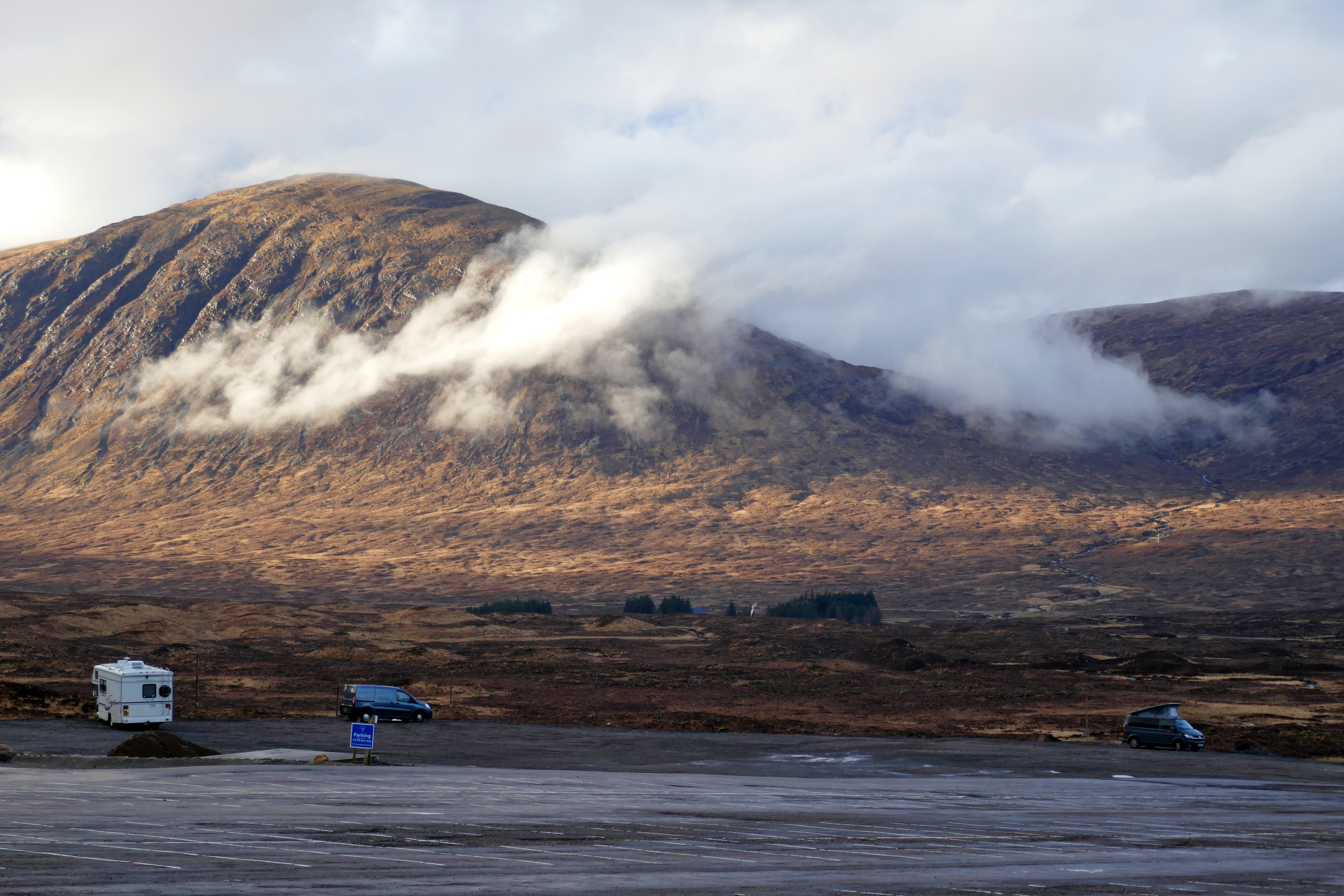
It is hard to beat Glencoe Mountain Resort for views, looking along the glen to the pyamidal shape of Buachaille Etive Mòr that dominates the entrance to Glencoe. We have stayed here before and always enjoy it and this business deserves campervanners support. There are now only a few level campervan pitches with hook up next to the rows of small huts which are popular with those walking The West Highland Way. For £22 a night [£2 less if you use your own shower] you get everything you would find on an expensive campsite and more. The facilities are heated [a luxury that we didn’t always enjoy on sites that charged £35/night!] The showers are good and hot [also not always a given]. There is a drying room [very useful and rarely found] and indoor washing up sinks. Behind the cafe are modern toilets. The light and airy cafe is open during the day and often in the evening too if you want to avoid cooking, otherwise it is a fabulous walk down to The Kingshouse Hotel. You can park overnight for free at the bottom of the car park and just pay to use the showers but if, like me, your equilibrium needs a level pitch then you might struggle to feel stable on the slope.
We have used quite a few of the small campsites affiliated to the Camping and Caravanning Club and called Certified Sites [CS]. Over the years we have found these sites do vary hugely in standards and facilities. While the unexpected can be delightful it can be best to read the reviews for a CS carefully to see if it is a site for you. This one on the edge of Ipswich worked very well for us and gave us a lovely rural retreat with reasonable facilities.
The campsite, as the name suggests, is on a hill. The landscape is large fields of cereals which look a tad dreary after harvest, although there is a planning application in for solar panels which will brighten things up. At the top of the hill is a wooded idyll that contrasts with the sterile agricultural surroundings. The owners have created a vibrant oasis of wildlife that is peaceful and we watched all sorts of birds, butterflies and insects from our pitch.
The campsite is grassy and isn’t open all year but it appears to be well drained. Pitches are not marked out, although there are some nooks that are the perfect size for one campervan and other spaces that are obvious rows. Fortunately it wasn’t too busy when we were there in mid-September so we could spread out. As well as being surrounded by trees and bushes there are shrubberies dotted around that screen other campers, giving a sense of privacy.
After opening the gate using the lock code we had been sent before arrival, we took some time choosing a pitch as there were no instructions. Later we found the path through the trees behind the facilities that took us to the owner’s house to pay. The owners are friendly and, if you don’t find them at home you will most likely see them later as they regularly wander around the pitches in the early evening to check everyone is happy.
The facilities are in what I [mistakenly] called sheds! I was corrected and told they are beach huts! One of these ‘beach huts’ has a sink for washing up that was a tad lacking in elbow room. Another has a toilet and sink. The largest [and most beach-hut-like] of the huts is equipped with an electric shower [this was okay], toilet and sink and was brighter and airier. Showers were an additional £1 and this is left in an honesty box. These facilities were mostly sufficient when we were there along with only three or four other units, although we did have to queue to shower and wash up at least once. If it was busier, particularly with guests in tents, these facilities would be pressed into more action and it could get crowded. Everything worked fine although, as the September days became cooler we would have welcomed some heating in the shower room.
The fourth shed is an information hut and when we visited there was honey from the owners bees on sale.
Walk down the gravel track and turn left along the lane, cross the main road [B1113] and you are in the village of Bramford. This 10 minute walk takes you to a bus stop from where there is an irregular week day bus service into Ipswich that we used both days we were here. Bramford also has a pub that provides meals and a village shop.
Ipswich is well worth visiting. It has a fabulous waterfront, plenty of shops and Christchurch Mansion, a beautiful Tudor house that is an interesting museum and art gallery. We ate a delicious lunch in Hullabaloo Vegan Cafe, a comfy and friendly establishment on St Peter’s Street, between the marina and the city centre.
If you like cycling on country lanes, a regional cycle route, number 48, follows the lane by the campsite and is part of a 48 mile route around Suffolk.
The Blue Bus, our Renault Master Devon Tempest campervan, is now eight years old and has travelled almost 70,000 miles. In 2022, with no lock downs and Covid-19 restrictions, we enjoyed 124 nights in our campervan in 60 different places, stretching from Meissen in south-east Germany to the Isle of Skye off the west coast of Scotland.
We spent at least one night in the ‘van in every month of 2022, from a chilly weekend with friends in the Ribble Valley in January to a night parked on a Manchester residential street on New Year’s Eve. Using our campervan all year keeps it aired and means that I always have a camping trip to look forward to.
Looking through our log book of our nights away we paid between nothing for an overnight when we free camped to £38 a night at Pinewoods at Wells-next-the-Sea. Spending a night off-grid for free is a big plus to owning a campervan and we have parked up and had some enviable views to ourselves. Pinewoods is a beautifully positioned campsite within walking distance of Wells-next-the-Sea that came highly recommended and was a bit of a one-off treat during our Suffolk and Norfolk trip.
As we all know, campsite overnight costs have increased in 2022 and we mostly paid between £20 and £25 a night, even on Certified Locations [Caravan and Motorhome Club] and Certified Sites [Camping and Caravanning Club]. Due to our age we receive a discount on Camping and Caravanning Club sites and these often work out cheaper for us than Caravan and Motorhome Club sites. For the most part we are lucky enough to have enough money to be able to choose on location rather than cost. We have also found that, when it comes to campsites, the overnight charge seems to have little to do with the standard of the facilities!
During our trip to Germany and the Netherlands in May and June we made good use of our ACSI discount card, although, as we were sticking to the River Elbe, we also used sites not part of this scheme. ACSI discount sites were a maximum of €21 a night, including EHU, in 2022. I noticed when our new ACSI book arrived before Christmas that you can now pay as much as €23 a night. Germany also has a couple of public holidays in May and school holidays and some sites were full price [and very busy] during this period. German campsites generally have high standards but there are always exceptions and we found one or two of them!
We stayed on plenty of idyllic campsites while we were in Germany but our favourite was Campingplatz Rehbocktal near to the gorgeous city of Meissen. This small site tucked into a valley with a babbling brook running through it is immaculately kept, friendly and just a short distance away from Meissen. I didn’t really want to leave this delightful spot and it was well worth the £27.50 a night [the most expensive campsite we stayed at in Germany].
It is hard to pick a favourite UK campsite from 2022 but if I was pushed, Silverburn Park near Leven has to be up there and not just because we had a light covering of snow when we were there and also had the small site to ourselves. The friendly welcome, the open views across the beach and the Firth of the Forth, the campsite cat and the birds in the walled garden all made it perfect. Add to this the knowledge that you are supporting a charity and happiness is off the scale.
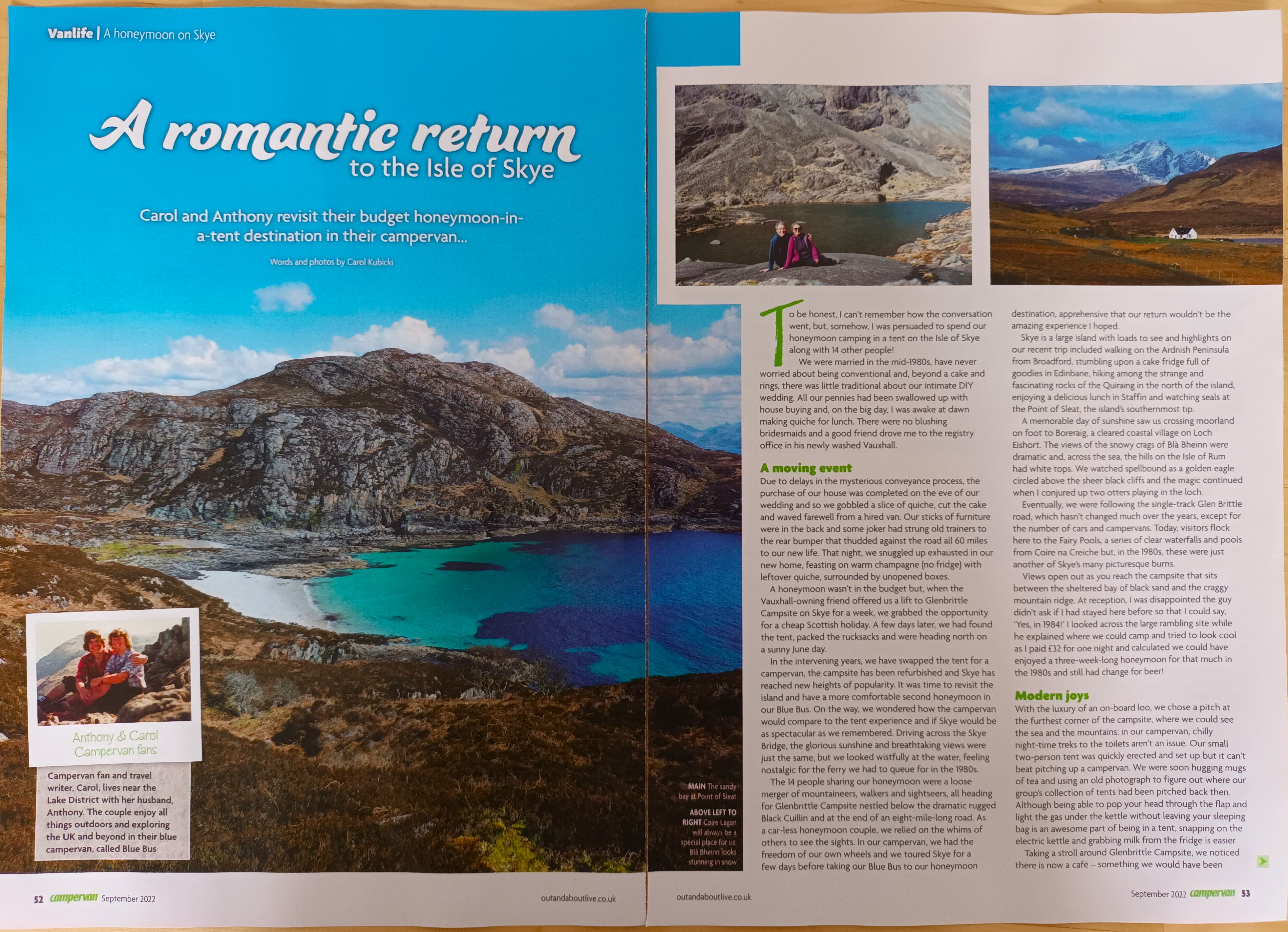
This is a story that I hope will make you smile or [if you’re an old romantic like me] might even bring a lump to your throat. Buy the September 2022 edition of Campervan Magazine [in the shops now or subscribe] and you can read about how we revisited our budget honeymoon-in-a-tent destination in our campervan and compare how the Isle of Skye was then [it was the 1980s when we got married] and now.
Big weddings were less of a thing in the 1980s but even so there was little that was conventional about our honeymoon. The article begins …
To be honest I can’t remember how the conversation went but somehow I was persuaded to spend our honeymoon camping in a tent on the Isle of Skye along with 14 other people!
Campervan Mag September 2022
Back in the 1980s we had just purchased our first house, had little spare cash and we travelled to Skye on the cheap. We packed the tent and scrounged a lift in our friend’s olive-coloured Vauxhall and along with those 14 other people, we camped at Glenbrittle Campsite for a week. It possibly isn’t the start to married life I would recommend but we’re still together 38 years later!
In 2022 we returned to Skye in our relatively luxurious campervan, the Blue Bus. Crossing the bridge to Skye I thought wistfully about the ferry journey we had made back then.
The Fairy Pools, a series of clear waterfalls and pools from Coire na Crieche, are along the road through Glen Brittle. We must have passed them every time we went away from the campsite but back in the 1980s we didn’t give these a thought, they were just another of Skye’s picturesque corners. Driving by in the 21st century it is clear the falls have become a tourist hot-spot. I had read about this but hadn’t realised the scale of their attraction until I saw the mind boggling size of the car park.
Not surprisingly the cost of camping has increased somewhat in the last 38 years. Glenbrittle Campsite is not the cheapest and as I wrote in the article, we paid, ‘£32 for one night and calculated we could have enjoyed a three-week-long honeymoon for that much in the 1980s and still had change for beer!’
What never changes is the jaw-dropping landscape and revisiting our romantic walk up to Coire Lagan [in the top photograph] was as impressive as I remembered. We followed our youthful newlywed footsteps to this wonderful place and remembered how awestruck we were when we escaped the group and first came here. Sometimes it is a mistake to return to somewhere with special memories but it can be a positive thing too.
If you can’t get hold of a copy of Campervan Mag, you can read the full September 2022 article from this page of my blog.
In May and June 2022 we spent seven weeks touring Germany and The Netherlands. We caught the DFDS ferry from Newcastle to Ijmuiden and explored at a slow pace, staying at 21 different places during our trip for up to four nights. We made good use of our ACSI low season discount card.
This is a large grassy site surrounded by trees. It is mostly level but some pitches can be slightly uneven. The facilities are cleaned regularly & the five minute showers are roomy & hot. The free wifi is good and the site is peaceful. The check-in process seemed a bit long winded & the automatic barrier wouldn’t recognise our number plate. We stayed here on the way there and back & walked through the forest to the nearby village. It was about £25/night in May and a couple of £s more in June.
An extremely peaceful & green site with marked pitches. We had a view over a pond from our pitch and there was lots of birdsong here. No bread is available & the facilities are dated but clean with hot showers & indoor wash up sinks. There are walks and cycle routes from the site. The ACSI price includes 4 kw/day of electric which was enough for us in summer and the site is around £15 / night with an ACSI card.
This is a level & nicely laid out parking area with clear pitches. On arrival you need to book in at the sports centre. There is some road noise but trees do screen it. The facilities are 2 toilets & 2 showers for each sex and these are clean with hot showers. A pitch costs about £12.50 a night.
This large site is by a lake with a number of camping fields, no defined pitches & a long cable might be needed. There is some road noise. The facilities are clean but the showers a bit hit & miss for temperature. No bread was available when we visited. There is good cycling from the site & the railway station for Magdeburg is about 2kms away. The site cost around £20 a night in May.
This is another large campsite where long electric leads are needed. We received a friendly welcome in German & bread was available daily. The facilities are clean with hot continuous & adjustable showers but just 1 hook to hang your clothes & the shower heads are at chest height (we got used to this)! The cycling and walking from the site are fantastic. It cost around £17 a night in May.
Situated on a small lake and on the Elbe Radweg (so plenty of cycling options) this is a grassy & fairly level site with facilities reached by a flight of steps. If you can’t manage the steps there are a few hard-standing pitches on the same level as the toilets. No English was spoken at reception. The facilities are clean & modern & the showers hot, adjustable & roomy. The site is by a small town with a convent church, a supermarket and bakery and cost about £20 a night.
This green & tranquil site with marked out pitches was a big hit with us. English was spoken at the friendly reception, bread was available & the facilities were clean with hot adjustable showers. The site is on the Elbe Radweg and just 4kms from beautiful Meissen This was the most expensive campsite we stayed at, costing about £27.50 a night but still our favourite.
This large site is by a small lake and has mostly marked out pitches. The showers were cramped with poor lighting, were €1 for four minutes & were hot. The rural site has plenty of walking and cycling options. We paid around £22 / night which includes approx £3 for 3.5kw of metered electric.
There is a stellplatz at Wörlitz with EHU but that gets busy & is around €15 so we opted to have our own space on the large level car park for €5 for 24 hours. There are toilets from 07.00 until 19.00 and the car park was quiet and is very near to the beautiful park.
We stayed here for a night during a holiday weekend and so didn’t see it at its best & had a small cramped pitch. The campsite is by the Elbe and there are some lovely pitches with views. The showers are €1 each & are hot but you don’t have much room. The electric is metered & the owners are friendly but don’t speak much English. To get hot water at the washing up sinks you have to pay 50c. The site has a small bar and is about 2kms from the centre of the town in an industrial area. This cost around £21.50 / night.
This newly developed 50 place camping area is in trees & by a hotel. The site has new modern facilities & self-service touch-screen check in (available in English). The check-in machine gives you a card that is used to access all the facilities (EHU, toilet emptying, water, showers) & updates to show what you have spent. We had some difficulties figuring out how to use this for the showers but eventually got there and had excellent hot showers. We saved money by switching the shower off while we lathered up & this way could shower for around 30c. The automatic system went wrong somewhere & didn’t charge us for extras & so it was good value at just the basic €15 / night!
While reception is lovely, the rest of this site is slightly rundown. It is near to the town with reasonable sized pitches that are marked. The facilities are also scruffy but we appreciated the good hot showers that are adjustable, continuous & spacious & have a sink. The site is near the river & has a small cafe at reception where bread is available. With the tourist tax we paid almost £27 a night.
A small & pleasantly arranged site with some marked pitches that slope a little, 4 bathrooms & additional toilets. The showers are temperature adjustable, hot & clean. The site is near to the large fort & by the town. With showers & metered electric this cost around £22/night.
A prettily laid out rural and grassy site that is Dutch run, this is a well organised campsite with morning bread & a restaurant. The facilities are kept clean but the showers were only just warm enough for me & cost 50c for 2 mins, so if you have long hair you need lots of 50c pieces! It is on Elbe cycle path and there is plenty of good cycling. With an ACSI card this was about £19/night.
A large woodland campsite that is geared up for transit overnights. It has a large sanitary block that is dated but functional with good hot continuous showers. Toilet paper is on a large roll outside the cubicles. With an ACSI card this site cost around £15.50 / night.
This rustic and green farmhouse site has bushes & trees around the narrow, somewhat cramped pitches. The showers are dated but very hot & adjustable. Bread is available & the site sells local apple juice & a few other food items. The site is just 5kms from the train station for Hamburg & on the Elbe Radweg so there is plenty of good cycling in the area. Around £21/night.
An ACSI discount card site with marked pitches, clean & modern facilities & indoor wash up. It is by an airport & planes took off during the daytime. Fresh bread is available at the snack bar. The push button showers were only just warm but the facilities were clean. The site was around £17/night.
A busy site by a lake, the reasonable-sized pitches are grassy & some were marked with hedges. Tokens give a four minute shower which were good & hot in clean & modern facilities. Reception was friendly although no English was spoken. No bread was on sale & there are no nearby shops. Excellent cycling in the area. The site was around £17 / night.
The pitches are laid out in small groups on this campsite with central facilities that are clean, with roomy showers for five minutes that are just warm enough. There are trees and bushes and lots of sparrows & geese on the site. Free wifi that is fast is provided. Fantastic cycling from the site around the nature reserve & into Lelystad. With an ACSI card this cost about £20/night.
A large rural site with unmarked pitches mostly arranged around the edge of fields. The free wifi was good. The facilities are clean & it cost 50c for a four minute shower in a roomy cubicle but the water was only just warm enough. Bread is available at reception every day. There is good cycling in the area including to Alkmaar and the coast. With an ACSI card this cost under £19/night.
This is a large popular and crowded site on the Markermeer. Tokens provided timed showers that were variable, the block near reception was better & cleaner with hotter water. There is access to the beach & the site has a bar & restaurant. Edam is a delightful town & is about 15 minutes walk away. Regular buses to Amsterdam leave from the bus station This site cost around £20/night with an ACSI card.
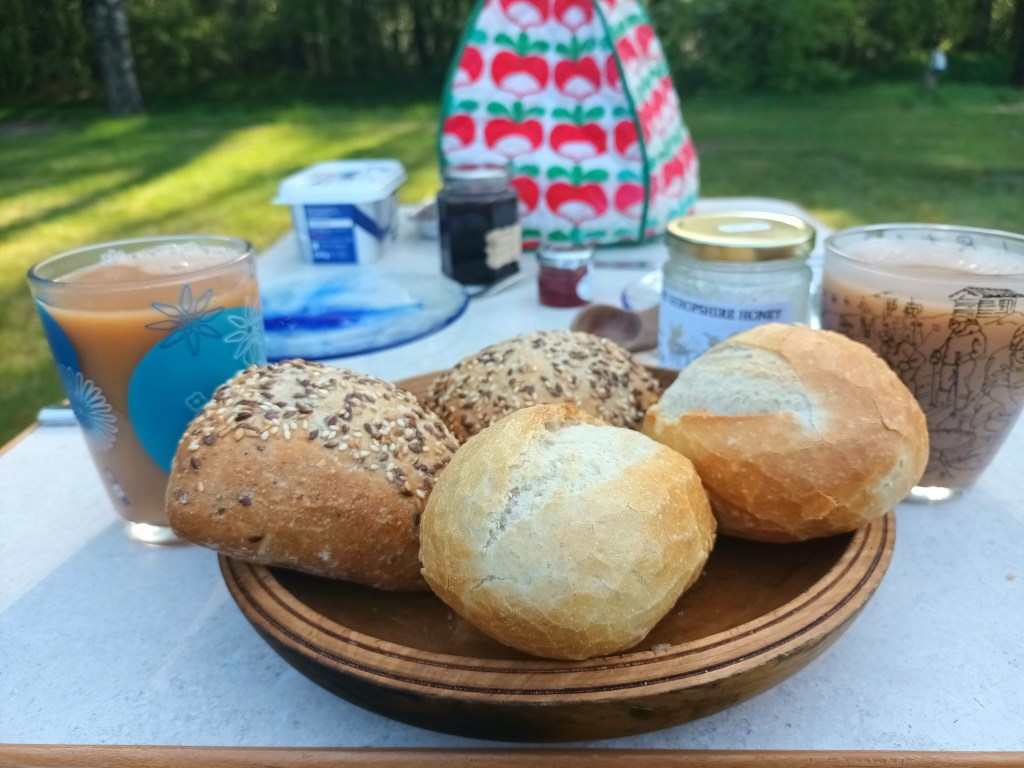
Taking a photograph of our breakfast table for the #warcoffee community on Twitter [check out Yaroslava Antipina @strategywoman to get a feel for life in Kyiv during the war] I realised how many gorgeous and useful things we have in our campervan that are regular reminders of our happy travels around Europe. Of course, we drive a French Renault van but the European theme doesn’t stop there, we have picked up things we like and need in many different countries.
Our rustic wooden bread bowl in the photograph is used for our continental breakfasts and came from Slovakia, back when it was part of Czechoslovakia. We took a backpacking railway trip to the Tatras in 1992 and managed to squeeze this beautiful bowl into the rucksack, along with a bottle of Czech beer! It is perfect for breakfast and dinner bread.
Our honey of the day might be from Shropshire [we always pick up local honey when we are travelling] but the wooden honey spoon was bought in the idyllic Italian village of Sorano in southern Tuscany. We were visiting a friend who lived there at the time and she showed us the sights and took us into the town for a meal. Browsing around a shop packed full of wooden chopping boards and spoons I admired this honey spoon and she generously insisted on buying it for me. I am so glad I didn’t point out anything more expensive in the shop and feel sad that we have lost touch but I think of her everyday when I use the spoon.
When it comes to slicing those large crusty continental loaves we use a steak knife from a village shop in Slovenia. A bread knife isn’t something we have room for and the steak knife does the job. The glass plates with blue swirls are from one of those interesting French hypermarkets that I could browse around for hours and the jolly teacosy with the stylish red radish pattern is from Denmark. We slum it with teabags when we are camping but still use a teapot. Our camping teapot is from Blomus, a German company who make quality stuff that we grabbed as a second-hand bargain on Ebay. The handle folds down making it perfect for stowing in one of the cupboards in the campervan.
While my mug with the blue flowers is another Italian find from the beautiful Malcesine on Lake Garda and gives me pleasure everyday, Anthony’s mug is from the Serra da Estrela in Portugal. We enjoyed our time in this stunning mountainous area of Portugal so much it is lovely to have a reminder of it on a daily basis wherever we are. The tray our teapot sits on has a map of Salford that includes our former home. This was a thoughtful retirement gift from a friend so we could show people where we lived.
Our evening hot drink mugs [yes we have mugs for different drinks!] are Morecambe mugs, so we never forget where home is now! Mine has a picture of the Midland Hotel and Anthony’s has Morecambe in big colourful letters and Eric Morecambe’s iconic specs.
These are all small treasures that are both useful, hold precious memories and make me feel blessed. None of them cost us an arm and a leg but all of them are cherished.