North Ledaig Caravan Park north of Oban in Scotland is a popular campsite. For us it has good and bad points but we made the most of a couple of nights here, leaving our campervan onsite and walking from the site.
The Campsite
This is a large site with different areas for Caravan and Motorhome Club members and non-members. This isn’t a club site but it is affiliated. The site slopes down to the coast and many of the pitches have a sea view but you have to deal with the tilt, unless you carry large levelling blocks. There are some pitches that are level, often tucked away without a sea view. Pitches are allocated by the site, and, as we found, changing the pitch you have been given is more of a palaver than it really should be.
There are two facilities blocks, one in the centre of the site and one by reception and the shop. These are both kept clean and have modern showers that are okay.
As well as the sea view and colourful sunsets, the disused railwayline that is now a cycle path and runs through the site is the other big plus at North Ledaig. This is part of the Caledonia Way from Campbeltown to Inverness. It is a mixture of road and traffic-free cycling. Most of the 49-mile section between Oban and Fort William [the stretch this campsite sits on] is on this disused railwayline and it is a fairly level route with fantastic views.
A Walk around the Lanes – approx 8km
This is an almost completely flat walk. We turned right on the cycle path and walked down to North Connel on the traffic-free route. Crossing the main road, we took the lane through Black Crofts and around the shore of Loch Etie. We were walked around the Moss of Achnacree and caught glimpses of the heather moss occasionally through individual houses and we could gaze along Loch Etive. This is a residential road with houses of different ages and sizes and there is some traffic. It became quieter once we turned onto the straight road back to North Ledaig. A signed along here warned us about red squirrels and sure enough, one bounded up a lane towards us and scampered under a fence into the trees.
Walk up Beinn Lora – approx 9km
With a sunny day forecast, we decided to climb Beinn Lora, a small hill that overlooks the campsite. It is only 308m high but being on the coast it is a marvellous viewpoint. This time we turned left on the cycle path to Benderloch, which is only 1.5km from the campsite. We were disappointed that the lovely café here closed on Mondays and Tuesdays so we took a flask. From Benderloch we climbed steeply through the woodland on well-made paths with regular picnic benches and viewpoints. We could look down on the coast and see the rows of caravans and motorhomes at North Ledaig below us, as well as the runway of the hardly-used airport.
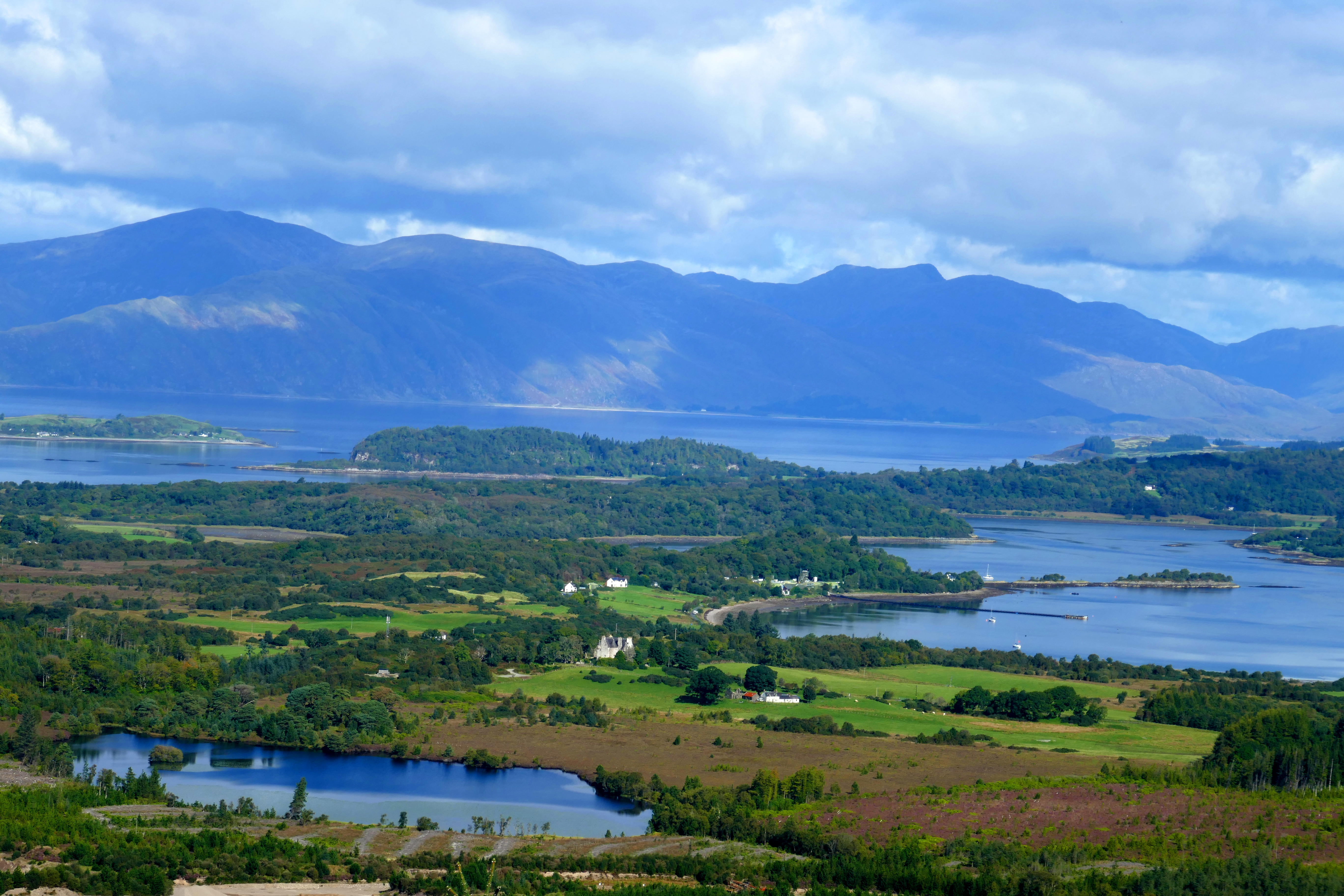
Stopping for coffee and an early lunch on the last picnic bench, we had views north over Benderloch to Morvern. Walk Highlands suggested the final push to the summit can be boggy but it was okay on our September walk. On the open hillside of rock and short wet sections, skeins of geese flew over honking enthusiastically. From the rounded trig point we could see Ben Cruachan and along Loch Etive and laid out below was the moss we had walked around the day before. It was clear enough to see over Lismore and across to Mull and in the distance were the Paps of Jura. For effort vs reward, Beinn Lora tips the scales very much towards reward. We returned to the campsite the same way.
Tal-y-mignedd Campsite in the Nantlle Valley is a campsite that is made for the word nestling. Tucked away between steep hills on the edge of the Eryri National Park [Snowdonia] in North Wales, this is a place to find tranquility, fabulous hiking and, maybe surprisingly, good coffee.
The Campsite
Pitches – At Tal-y-mignedd, the camping is divided over a number of fields from large to small enough for just a few tents. These are all either totally level or mostly level and all have open views. For campervans there are a few hardstanding pitches with electric hook up and some grass pitches with electric too. There is also plenty of room for non-electric pitches for tents and ‘vans on grass.
Facilities – There is one facilities block with male and female showers and toilets, an accessible bathroom and a kitchen with sinks for washing up, a microwave, hob, kettle and fridge/freezer and washing machine and dryer. There is also a second campers kitchen which wasn’t open when we were there. There is a chemical toilet disposal point and fresh water taps. Everything was kept clean and tidy. A pleasant surprise in a valley that has little in the way of phone signal was good and free wi-fi.
Access – The B4418 between Rhyd-Ddu and Nantlle is single-track in places. You either have to drive three miles on this quiet narrow road from the Beddgelert to Caernarfon road or around two miles from the village of Nantlle.
The campsite wasn’t busy when we were staying there. It was mid-week and May and only three or four other pitches were in use. This didn’t put any strain on the facilities but a stay here would be a livelier experience during a busy summer weekend.
Reception is in the farmhouse and the family were always friendly and helpful. This is still a working farm and their vehicles drive up and down the track but this was never intrusive. Sheep sometimes find themselves on the camping field and the sound of birdsong is interupted by cattle!
We paid £27/night with electric hook up and it is £20/night without. This seemed good value for hot showers and fabulous views.
Things to do
The campsite sits on the Snowdonia Slate Trail. This 83-mile long circular route starts and ends in Bangor and visits sites associated with the slate industry of North Wales and takes walkers through forests, by lakes and into villages. The section along the Nantlle Valley is fairly level and reasonably well signed. From Tal-y-Mignedd we picked the trail up in both directions.
Walking East – Heading towards the peak of Yr Wyddfa [Snowdon], we joined the narrow lane for a short distance, through the hamlet of Drws y Coed where we left the road and followed an increasingly damp path past an unused dam towards woods. A cuckoo called from across the valley and making our way around the craggy Clogwyn Y Garreg we had views of Yr Wyddfa. You could extend this walk and make a day of it with a rest at the pub in Rhyd-Ddu.
Amazing sunsets – The valley is aligned pretty much east-west and watching the light soften as the sun goes down is special.
Walking West – We also followed the Snowdonia Slate Trail along the valley bottom into Nantlle village and walked back along the lane, making a circular walk. The farm track passes a lake, Llyn Nantlle Uchaf, before reaching the village. At one time there were 40 slate quarries in the Nantlle valley and the village developed at the end of the 18th century to serve this industry, many of the quarrymen coming from Ynys Môn [Anglesey] and Arfon [the mainland of Wales facing Ynys Môn. For more about the history of Nantlle see the Dyffryn Nantlle website.
Drinking good coffee – In Nantlle we visited Poblado Coffi. In a unit in the old quarrymen’s barracks, coffee experts roast and blend beans. All the beans are sourced from sustainable coffee growers and they have strong relationships with these growers and pay a fair price for the coffee. We sat in the courtyard tasting the delicious coffee of the day, along with a slice of ginger flapjack and left with a couple of bags of coffee in the rucksack. If you find yourself anywhere near this gem, take the time to visit.
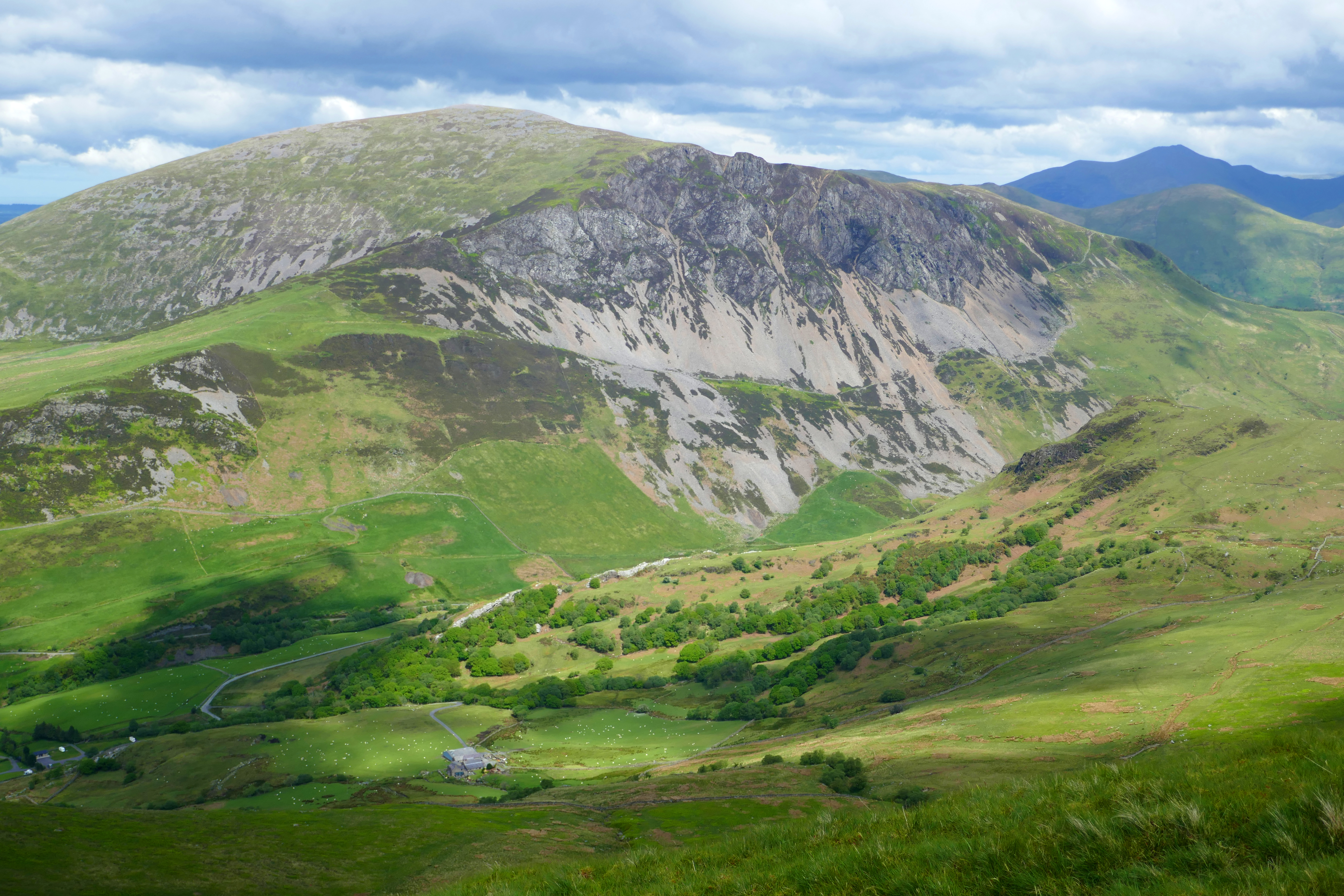
Walking up – We couldn’t resist climbing the hill that the farm shares its name with. This is a relentless steep climb but worth it for the views over the mountains, including Yr Wyddfa and to the sea. The first section is on a zig-zag track that climbs through sweet-smelling bluebells in May. The hill is only 653m high but punches above its weight and the rocky summit has a tall obelisk that you can see from the valley. Once at the top, fit and experienced walkers will continue along the stunning Nantlle Ridge for a longer walk and in warmer weather we would probably have done the same.
The Derbyshire market town of Buxton is famous for water; having the highest market place and its graciously curved Georgian crescent. We have visited many times and find it perfect for two campervanners who like hiking. Buxton has a number of campsites [see below] and does offer sights for those who don’t want to spend the day in the surrounding countryside. But if, like us, you enjoy a warm day in the great outdoors, below are five of my favourite walks for five days camping in Buxton.
The distances on the walks below are approximate and are based on walking from the Caravan and Motorhome Club’s Buxton site. I haven’t given step-by-step directions but the paths in this popular part of the country are well-walked and I hope that you can pick up our route [or make up your own] from an OS map.
Day One – Exploring Buxton [at least 7kms]
Buxton’s heritage trail leaflet will help you make the most of a stroll around the town. But first you have to walk to the town centre and leaving the campsite, you will immediately be distracted by the delightful paths through Grin Low Woods and to Solomon’s Temple.
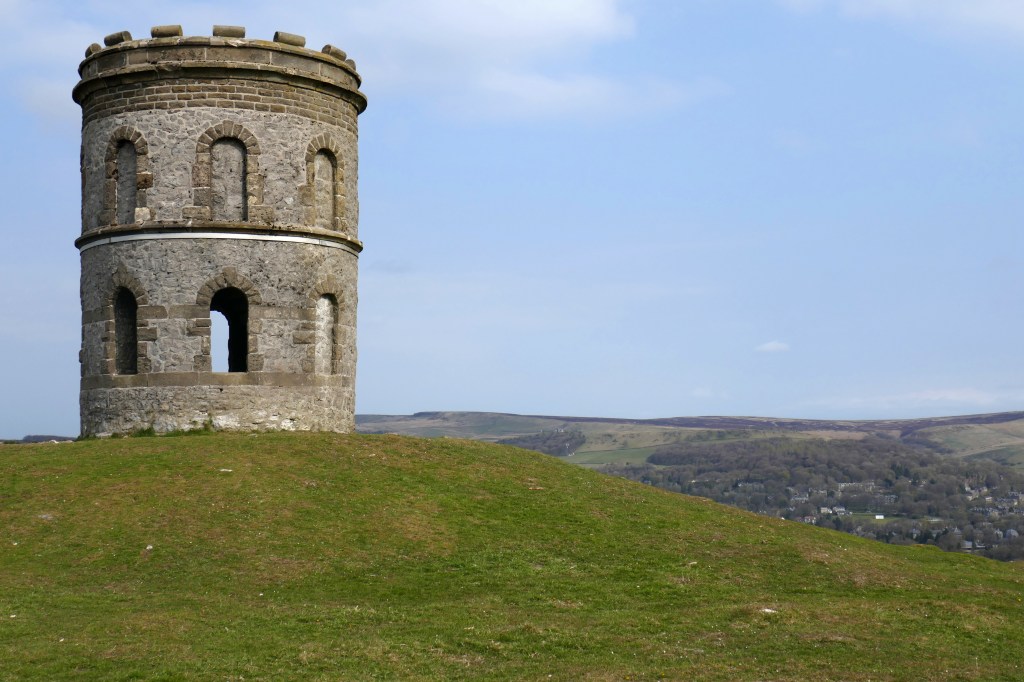
Solomon’s Temple is a perfect introduction to Buxton. Climb the winding staircase of the hilltop tower and Buxton is laid before you, clustered around the dominating slate-grey Devonshire Dome.
Having taken in the view, we head downhill on the woodland paths with occasional wooden sculptures and reaching the streets by Poole’s Cavern. If you’ve never visited you might want to dally and explore this underground cavern.
We like to amble through the town’s restored Pavilion Gardens. There might be an art fair being held in the Octagon Hall or we will idly watch the ducks and look hopefully for chicks on the lake. I also like to admire the preserved tree trunk sculpted into figures and animals that stands in the park. The water-carrying figure of Arnemetia is a reminder that in Roman times Buxton was named Aquae Arnemetiae after this Romano-British goddess.
Our next stop is The Crescent, a Georgian grade one listed masterpiece and the pride of Buxton, recently restored as a luxury hotel. The gracious symmetrical curve of the stone building, the ground floor colonnade and fountains playing at the front are stunning. Opposite is St Anne’s Well which is decorated with flowers in the annual well dressing, a tradition followed in many Derbyshire villages and towns. The Pump Room has a tap and souvenir glass bottles, and I did once fill one with Buxton spa water to taste the lukewarm mineral-rich water. It is an aquired taste!
Buxton’s spring water emerges from the ground at around 28°C and has been exploited since the Romans, who built a bath and threw coins into the spring for luck. In the 16th century visitors took the water and in the Georgian era the Duke of Devonshire developed a spa resort. A ‘Well Woman’ was appointed to care for the well and tourists, a post that continued into the 20th century.
After all this strolling, we are ready to sit and there are plenty of cafes and tearooms in Buxton. Later we will walk over for a close-up of The Devonshire Dome. This building has an interesting history and has been used as stables, a hospital and is now a University. Finally, we will climb the paths up The Slopes to the upper part of Buxton, where the town’s oldest buildings surround England’s highest market place and from there head back to the campsite.
Day Two – Goyt Valley and Errwood Reservoir [about 14kms]
After the streets of Buxton, day two is a contrasting and challenging hike over moorland. A map will be essential to find your way around these moors but you will be rewarded with the sounds of lapwings and curlews and buckets of fresh air.
From the A53 near the campsite, we picked up Bishop’s Lane and climbed the hillside until a path took us to the disused railway line. Views over the two reservoirs in Goyt Valley will open out before you.
Reaching a lane, we descend to the shores of Errwood Reservoir. From here we chose paths that climb through the trees to the ruins of Errwood Hall. We are walking through what was once the grand ornamental garden where fountains played and the Grimshawe family, who lived here, relaxed on the lawns. Demolished in 1934 after the last of the Grimeshawes died, Errwood Hall was originally a dressed-stone building with a tower above an impressive entrance and rooms packed with fine furniture and art works. In those days the hall enjoyed views over the valley but is now surrounded by trees and rhododendrons. For me, the ruins have always retained a sense of romance tinged with loss but on our last visit it seemed particularly woebegone. The site deserves a little more care and I was disappointed there isn’t even an interpretation board to show what used to be here. However, there is an app and more information here.
From the hall we headed uphill finding the small circular St Joseph’s shrine that huddles in a hollow with pine trees. Dedicated to Dolores, a Spanish companion to Jessie Grimeshawe in 1889, the shrine has an elaborate altar of Spanish tiles and there are often fresh flowers. As we descended the moorland back to the reservoir a grey cloud threatened rain and we followed a circling buzzard towards the trees and shelter but the storm never arrived.
Walking south along the valley beyond Errwood Reservoir we crossed the old packhorse bridge and picked up a path over the moorland and back to Buxton. More walks in the Goyt Valley and its history can be found here.
Day Three – Three Shires Head [Around 17kms]
If you only have time for one day of hiking around Buxton, make it this one! The walk begins on the Dane Valley Way and you soon leave the traffic behind as you cross Axe Edge Moor, an expanse of moorland that holds the headwaters of four rivers, the Manifold, Dane, Wye and Goyt. Despite the warm weather, it was just us on this path enjoying the gurgling streams and passing a few isolated farms and old mine workings.
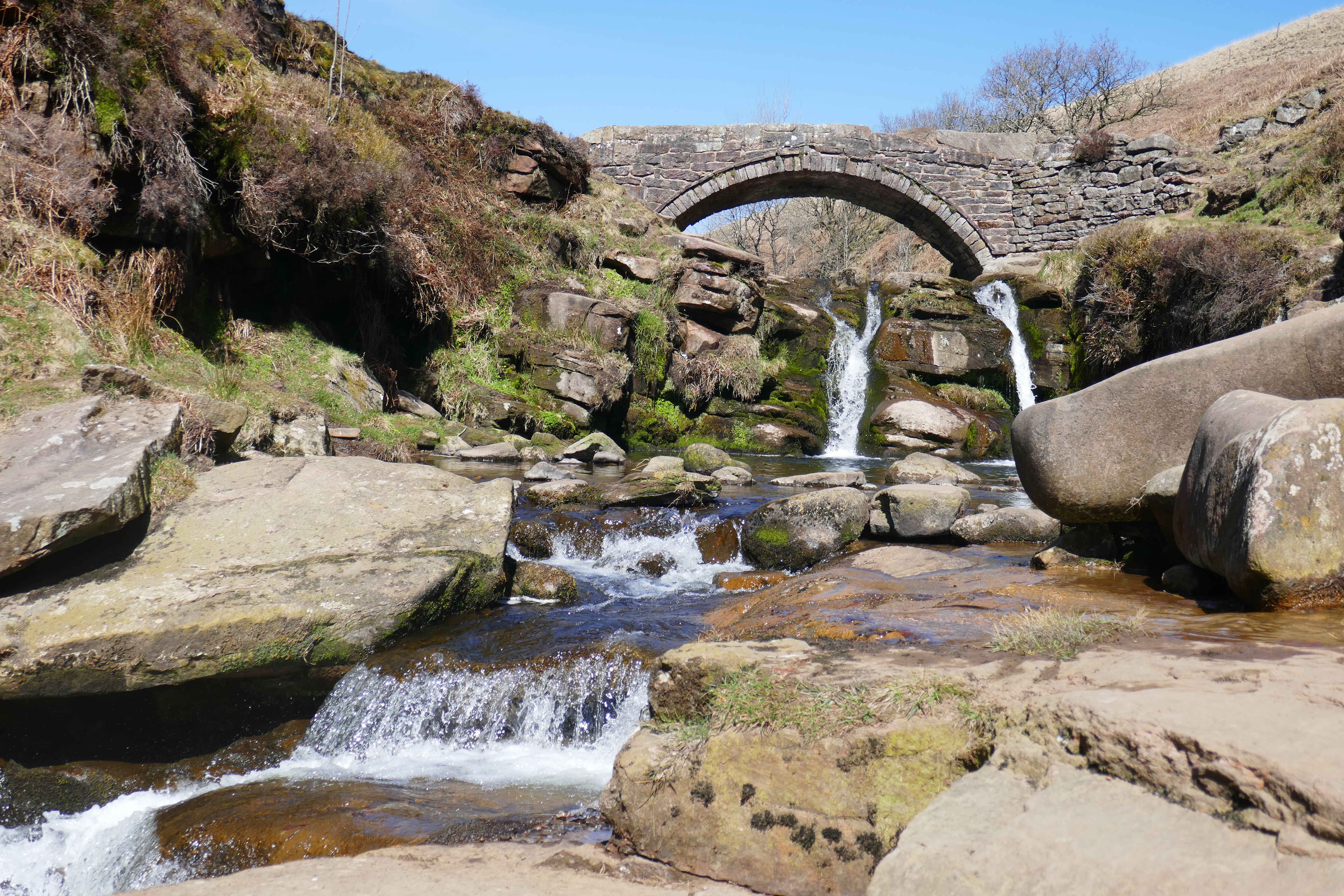
At Three Shires Head, where Staffordshire, Derbyshire and Cheshire meet, we joined the throng. These falls are a popular picnic and wild swimming spot. Sitting by the waterfalls I slipped off my shoes and dipped my toes in the gaspingly-cold water of the River Dane. As I dried my tingling feet I watched the hardy woman swimming in Pannier’s Pool in admiration.
Climbing up the hillside to Flash, a sheltered lane alive with butterflies took us to Flash Bar Stores where we devoured two of their delicious homemade vegetable pies at an outdoor table. A popular halt for cyclists, we chatted to a young man who was fuelling up having cycled from the West Midlands and was surprised how hilly the Peak District was!
Exuberant skylarks sang as we crossed the fields, criss-crossed by stone walls, below Flash. Multitudes of signs heralded the Health and Safety Executives huge Science and Research Centre. We skirted the buildings on the public footpath and picked up a lane that took us back to the road below the campsite.
Day Four – Five Dales from Tideswell [13kms]
On a perfect spring day we drove the short distance to the car park in Tideswell Dale. This perfect Derbyshire walk took us along, in and out of five dales.
We began in Tideswell Dale where a winding stream lined with bright yellow celandine wound beside us and rock cress hung from the limestone cliffs. Ash trees grow here but many have been chopped down due to ash dieback, a destructive fungal disease.
Miller’s Dale, not surprisingly, is home to many disused mills along the River Wye, often now converted to housing. I was concentrating on looking along the river for kingfishers. I didn’t see a kingfisher but a birdwatching couple pointed out a peregrine they had spotted on the skyline above us.
At Cressbrook we sat by the millpond watching the climbers on the crags and a pair of tufted ducks. The ducks dived into the shallow water to feed, stirring up the silt into billowing muddy streaks so that we could watch their underwater progress. Cressbrook Dale is thickly wooded with pungent wild garlic and carpets of soft green moss covering the dry stone walls.
The landscape opened out as we reached the short Tansley Dale where we found cowslips just coming into flower among the grasses. We climbed up to the patchwork of walled fields above the dales where lambs gambolled in the sunshine and the shallow Litton Dale led us back to the ‘van.
Day Five – Five Wells & Deep Dale walk (13kms)
In more sunshine, we walked through the wood to Buxton to catch a bus towards Bakewell. We hopped off near the village of Taddington and walked back to Buxton.
Our first stop was Five Wells Chambered Cairn. Here the stones that remain of a circular chambered cairn perch on high ground above the source of five springs. Although many of the stones have been taken, the two back-to-back chambers can be recognised. Descending to the village of Chelmorton we passed Bank Pit Spring, inexplicably and bizarrely known locally as Illy Willy Water.
The path into the wooded Deep Dale was steep but the sheltered dale was perfect for a lunch stop. As we ate, three sheep nose-to-tail went purposefully by on a lower path. When minutes later a fourth sheep appeared we assumed she was lagging behind and helpfully pointed in the right direction. Instead she came over and nudged my arm with her nose demanding food. We were eating more delicious pastries from Flash Bar and so there was no chance we would share!
The scenic uneven path along Deep Dale, over moss-covered stones and between trees, took us below the cave known as Thirst House before climbing up to King Sterndale and returning into Buxton under the 13 arches of Dukes Drive viaduct. Back in Grin Low Woods, we found a thick carpet of wood anemone and on the way back to the campsite picked up part of Buxton’s Ring of Trees Walk, a circular route through surrounding woodland.
Lime Tree Holiday Park – We have stayed here a few times. It is in a peaceful position just a short walk from Buxton.
Beech Croft Farm – this family-run site is between Buxton and Bakewell and in quiet countryside. Walk Five is near here.
Longnor Wood Camping – This adult-only site is near the village of Longnor. There is good hiking from the campsite and some cosy country pubs in the vicinity.
We are never put off by chilly weather and walking under wide and luminous skies and beside sparkling seas on the Solway Firth is a winter treat. The dark days of the year can seem endless and an injection of this clean light and a few colourful west-coast sunsets help me feel optimistic about spring. This is an isolated corner of England, no one just passes by these coastal towns along the Solway, and for me, this sense of being on the edge adds to the charm.
The estuary known as the Solway Firth separates England and Scotland and we began our tour on its English shores in the small Cumbrian seaside resort of Allonby. The hazy February sunshine was welcome, the sea shimmered with a pearly light and across the water we could see the distinctive hill called Criffel in Scotland.
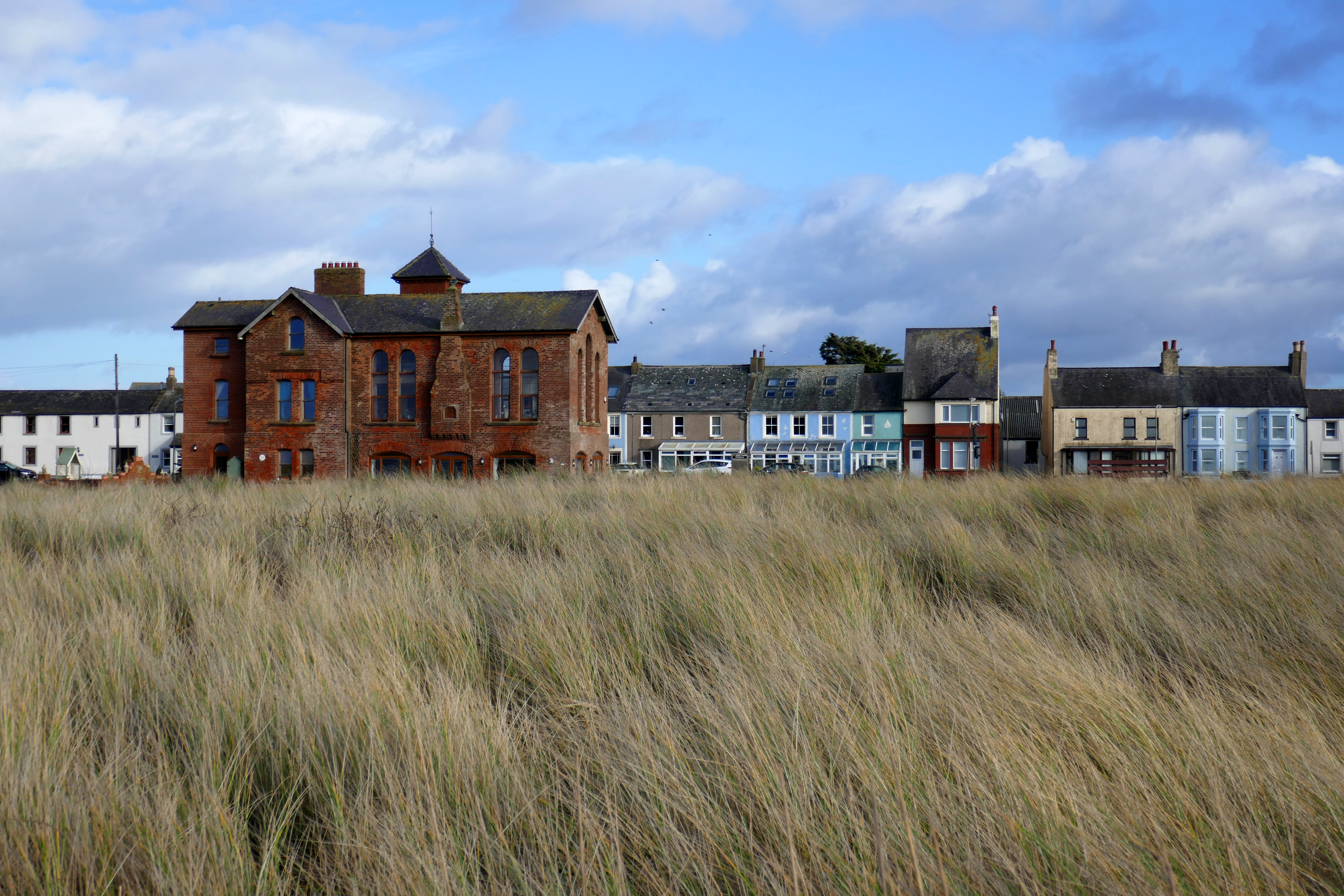
Wrapped in layers we headed for the beach for some invigorating fresh air. Anthony watched for birds and I walked along the tideline, constantly stopping to admire a shell, pebble or piece of pottery that caught my eye. The chilly breeze whipped up the sand and we both had a healthy sand-blasted glow as we wandered back along Allonby’s street. A quiet backwater out of season, Allonby is still a popular resort with swanky houses from its heyday. Most striking is the old Quaker Reading Room, an unusual red-brick building with a clock tower and an uninterrupted sea view. The building was a sorry derelict sight for many years but has now been renovated as a stylish private house that I yearn to peek inside.
The rolling green countryside in this corner of Cumbria is largely ignored by tourists and the quiet roads are a pleasure to cruise along. With the exception of a friendly ginger cat, we had the remains of Holme Cultrum Abbey to ourselves. I was delighted to find one of my favourite flowers, snowdrops brightening up the rambling graveyard and ruins with their shiny green stems and bobbing brilliant-white heads. Snowdrops cheer up the dreariest day.
Planning our trip, Grune Point had caught my eye. This remote spit of land, shaped by the tides, stretches along the Solway Firth from the town of Silloth. Before walking along Grune Point the next morning we went in search of an essential warming coffee and stumbled into the Fairy Dust Emporium Café, a flamboyant and charming café with welcoming staff. Sitting at one of the wooden tables surrounded by fairies of every shape and size, we rang a bell for service and another fairy gained her wings. As well as hot coffee the irresistible warm cheese scones with fiery chilli jam were a tonic.
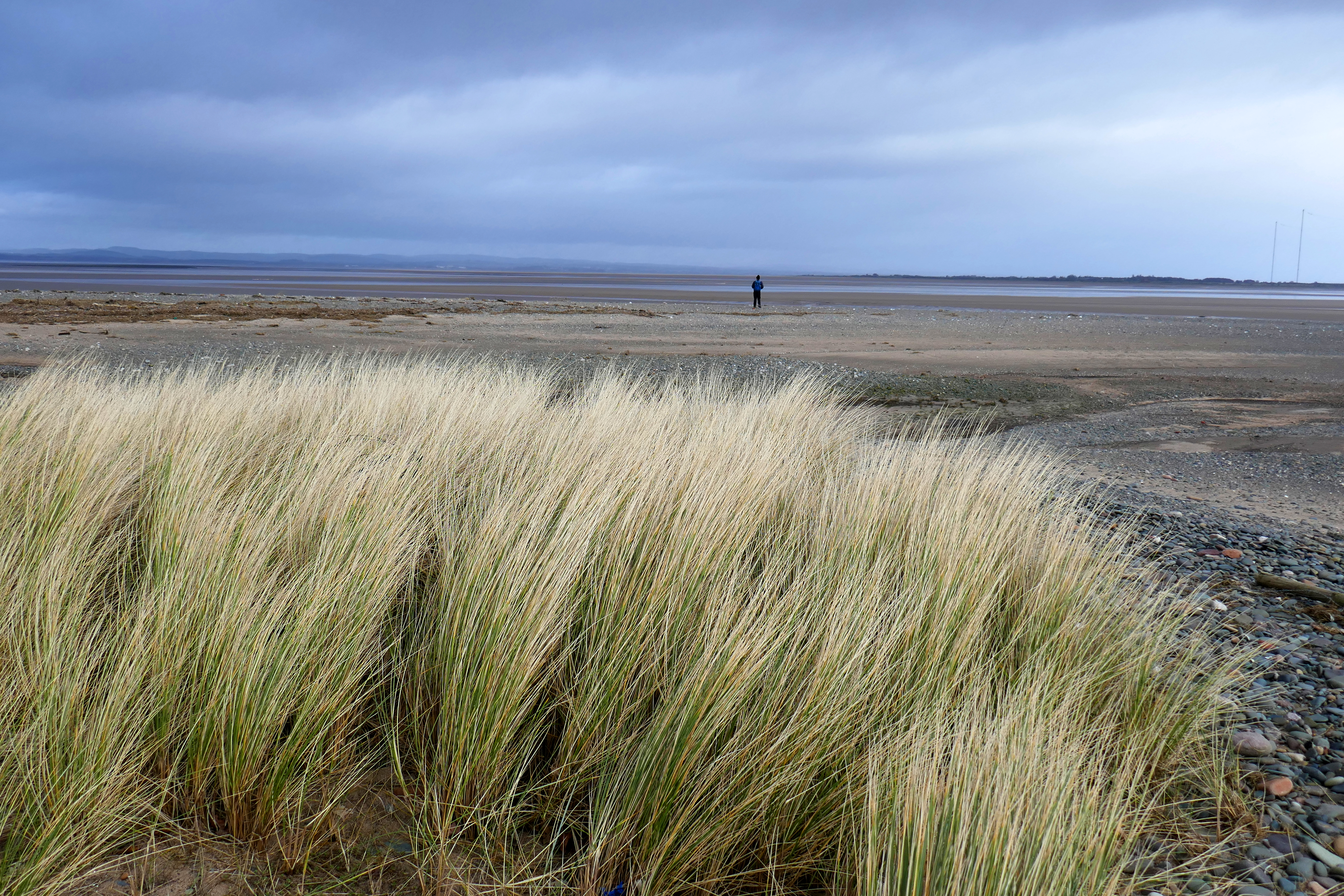
Striding out along the wide promenade above the beach, the Solway Firth and Scotland were to our left and houses with an enviable sea view to our right. After a larger-than-life metal sculpture of a man and his dog and East Cote Lighthouse we picked up a lane lined with yellow flowering gorse bushes that held the promise of spring. Nearer to the point we walked along a beach that alternated shingle of colourful pebbles and soft deep sand blown into mini dunes and dotted with bleached driftwood. The blues of the sea merged into the huge sky, sharp calls of oystercatchers filled the air and the sun warmed our backs; it was as stunning as I had hoped.
Turning the corner of Grune Point we were looking over a vast area of salt marsh and mud flats, wriggling with channels. The cheese scones and coffee had worn off and we found shelter near an old pill box and cupped our hands around mugs of hot chocolate from our flask, another winter essential. In a clamour of honking, hundreds of barnacle geese rose from the salt marsh and flew over our heads in unruly v-shaped skeins. A heavy shower followed the geese and we hurried back to Silloth.
We received another warm Silloth welcome in the Motorcycle Museum, a Tardis-like place packed with bikes and motorcycling memorabilia that will delight anyone. Silloth once had a racing circuit at the airfield and the owner talked passionately about his experiences of racing there and on the Isle of Man. Wistfully I recalled my visit to the TT in the 1970s but couldn’t pinpoint the year; of course the knowledgeable owner soon pieced it together from my muddle of vague memories.
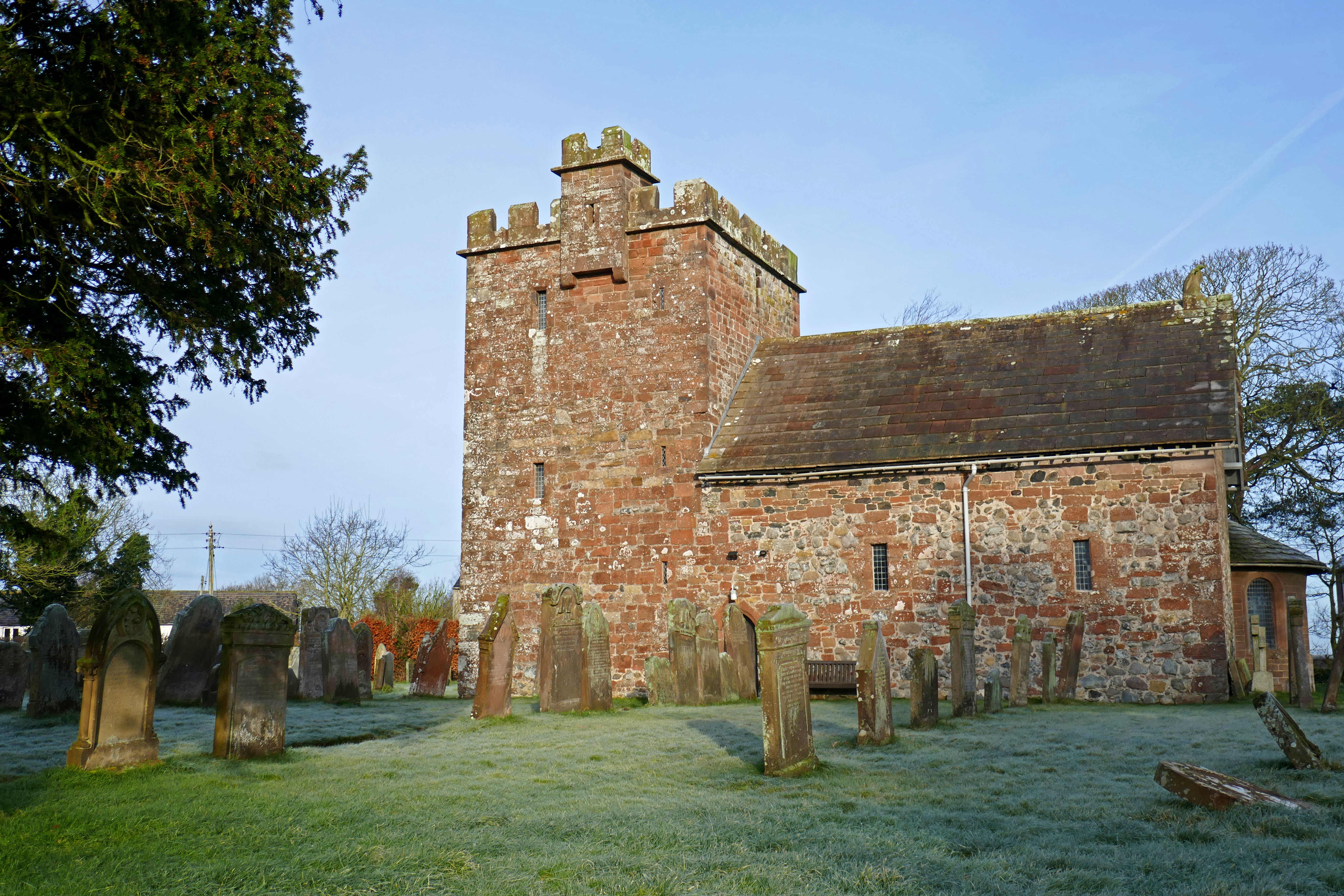
A frost had turned the green countryside into a winter-wonderland white the next morning as we drove to Newton Arlosh to see the fortified church. In this border area churches were built with thick walls, narrow doorways and a tower as a refuge for people and animals during attacks from Scotland. This medieval church fell out of use and became a roofless sheep pen but was restored in the 19th century by Sarah Losh, a local wealthy and determined woman and it now has many fascinating features including a stone eagle on the roof.
The Solway Firth had narrowed when we picked up its shores again and pulled into the RSPB reserve at Campfield Marsh where the pools were frozen and the ducks waited patiently for the water to melt. A railway line once crossed these marshes and a viaduct took it over the Solway to Scotland. In the cold winter of 1881 ice, up to 6ft thick, bumped against the pillars of the railway viaduct destroying sections. A local paper reported that workmen on the viaduct were distracted when they spotted a hare stranded on a block of ice and floating out to sea! The railway closed in 1921 and the disused line became part of an ambitious and dangerous pub crawl. Thirsty Scots would cross the viaduct on foot to take advantage of the more lenient Sunday licensing laws in England. There are stories of inebriated individuals missing their footing on the bridge and never making it home and until the viaduct was demolished a guard was employed to try and prevent these fatal journeys.
We wandered around the quayside remains at Port Carlisle before parking in Burgh by Sands to hike onto the salt marsh to the monument to Edward I who died here on his way to invading Scotland. This land is the grazing for prized salt marsh lamb and an annual auction for parcels of land called stints is still held every year. Across the River Eden we could see traffic on the M6 and The Metal Bridge Inn, [not surprisingly] named after the metal bridge over the River Esk. This would be our stop for the night.
The Metal Bridge Inn is a landmark for anyone driving north on the M6 and a place that combines isolation with six-lanes of traffic. Under another orange-red sky I climbed the steps of the railway bridge and looked down on the River Esk as it wound its way through salt marshes to the Solway and the Irish Sea. Skeins of pink-footed geese flew overhead, their energetic honking so loud and uninhibited they drowned out the traffic on the M6!
Although I was craving light, coziness is also essential to get through the winter months and this snug pub welcomes campervans on a dedicated parking area and serves good beer and hearty food. By the time we walked back to the Blue Bus in the dark all the ‘pitches’ were taken and I was pleased to see we weren’t the only campers enjoying our ‘van all year.
Part Two and our journey into Scotland and the Scottish shore of the Solway will be in my next post.
Photographs of the Allonby’s old Reading Room, Grune Point and Newton Arlosh church below.
One of the sculptures at Les Lapidiales near Port-d’Envaux in France
We think we want things to be real, but does anyone really want to read about an anxious travel writer? I’m not sure they do and so recently I haven’t actually lied, as one segment of my head adores our campervan travels, but there is a dark wedge of my brain I have kept to myself.
It was during our last trip to France that I noticed how contradictory I was feeling. While relishing exploring the beautiful country in our campervan I was also secretly doom-mongering. Anything that could go wrong [and probably wouldn’t] spun around and around in my head, driving my anxiety levels through the roof. My brain convinced itself it knew the future and it was bleak!
At first I tried ignoring my anxious feelings thinking that would make them go away. This didn’t work! Changing tack, I gave my anxiety some attention. This helped me see how my fears were familiar from our trip to Germany last year. I had muddled along then but this time my anxiety levels were higher and overwhelming and going home seemed the only answer!
Anxiety can sound trivial but it multiplies, feeding on itself. It starts in my brain but very quickly affects my whole body. Always the writer, my notes from the time describe the physical symptoms of a tight chest, nausea and fast and shallow breathing. And all because my head was busy imagining the worst things that might never happen.
Healing begins with sharing
I struggled to understand why I would be anxious when I was living the dream and travelling with my partner in our campervan. I felt guilty and stupid for having these negative feelings. I did not want to let anxiety about tomorrow spoil our trip and I thought the best thing was to keep my anxiety to myself, keep calm and carry on.
It took a few weeks to admit to my partner in campervanning how I was feeling. He is a caring individual and didn’t tell me I was being ridiculous. Being open about my anxious feelings shone a light on them, revealing the deceit they wallowed in. Saying them out loud helped me see how my anxiety was so clever it could fool me into thinking my imagined threats were real. It helped me to engage the rational side of my brain, calm my adrenaline-fuelled body and see that these worst-case-scenarios were fantasies. To even imagine I could predict the future was an illusion!
His caring approach didn’t make the anxiety go away but it helped. He recognised how difficult it was for me to admit that something in my brain was broken. There were no visible wounds to soothe but he gave me the love and patience I needed. Sympathy and talking were positive but no cure, so together we came up with a few strategies to ease my anxiety and be able to continue our holiday.
Small Steps
Firstly, we slowed down our tour, staying in one place for longer so that I could settle in, feel at ease and work at re-booting my brain. We travelled short distances on the days that we moved too and this relaxed approach to our trip worked well for us both.
As well as driving less, I lived at a slower pace. We had no deadlines and were footloose and it wasn’t necessary to rush to see a particular attraction or place. We adopted a calm approach to our days, taking a leisurely breakfast, lunch and evening meal when we would talk and laugh together. We stayed away from large towns and cities, choosing countryside locations where we were surrounded by nature.
Daily exercise has always been important for my wellbeing and the French countryside is perfect for the active holidays we enjoy. We walked or cycled, taking time to stop to watch wildlife, identify flowers or read about the local history of the village we were in. I focussed on joyful things that made me smile.
Strange as it seems, I also made time to fret, allowing an early evening worry-time slot. I used this to write down all the things I was anxious about and how I was feeling. I practiced some controlled breathing and worked at being more accepting of uncertainty. I was mindful of my anxious and racing thoughts and the accompanying rush of adrenaline and allowed them to have their moment without a fight. I used the My Possible Self app to give some structure to this time.
After a few days I would recognise the doom-laden thoughts as soon as they popped into my head. I would acknowledge these thoughts and sing, ‘Hello darkness my old friend, I’ve come to talk to you again.’ Sometimes this enabled me to see the dishonesty of my fears and stop the out-of-control downward spiral in its tracks. Whether cycling, cooking or pottering around the campsite, The Sound of Silence became my holiday tune!
I worked at being nice to myself and tried to accept that everyone has something that is hard to do. I occasionally felt positive that I would once again be an anxious-free traveller.
Letting in the light
This anxiety has crept up on me since the Covid-19 lockdowns. Covid-19 proved to all us naysayers that bad things can be just around the corner. The pandemic led to many changes and for me having to stay at home and worry about catching a potentially deadly bug was enough to trigger anxiety.
Although I am pleased that we are much more open about mental health issues in the UK than we used to, I am not convinced anyone wants to open their motorhome or campervan magazine and read travel articles peppered with mental health worries. So my articles dwell on the light, rather than the daily grind. Sharing in this blog post is a big step, so please be kind.
I don’t want to be the person that is ruining my own day, I know how few I have left! I do want to reduce my anxiety levels and become ME again and I am hopeful I can do that … so watch this space.
A quick note on resources: As well as the My Possible Self app I have worked through Joshua Feltcher’s book Anxiety: Practical About Panicand I signed up for his Anxiety Josh newsletters, the NHS Every Mind Matters emails and The Friendly Mind.
Red Kite Touring Park in Llanidloes in mid-Wales is an adult-only high quality campsite. Staying there had been on our wishlist for a while and this year we got the chance to enjoy the excellent facilities it offers for three nights.
If you don’t know the campsite, it sits above the small town of Llanidloes and has hard-standing pitches with views down the valley. The facilities are modern and excellent and the welcome is friendly.
We like to leave our campervan on our pitch and walk and a quick look at the map suggested there would be no shortage of options and this was true. The campsite is well-run and reception keep a folder of walks from short strolls to long hikes. There are multiple copies of each walk so you can take away the instructions, pack a picnic and set off into the Welsh countryside.
Llyn Clywedog & Old Lead Mines (approx 13 km / 8 miles)
Red Kite Touring Park sits on the hillside above the Afon Clywedog that flows into the River Severn. From the campsite dog walk we picked up a lane that follows the Afon Clywedog away from Llanidloes. The lane climbed steadily through woodland to a farmhouse where we turned right and joined the Glyndŵr’s Way. This is a 217 Km long-distance path that meanders from Knighton to Welshpool. It is named after Owain Glyndŵr who was a Welsh prince and leader who led a rebellion against Henry IV in 1400.
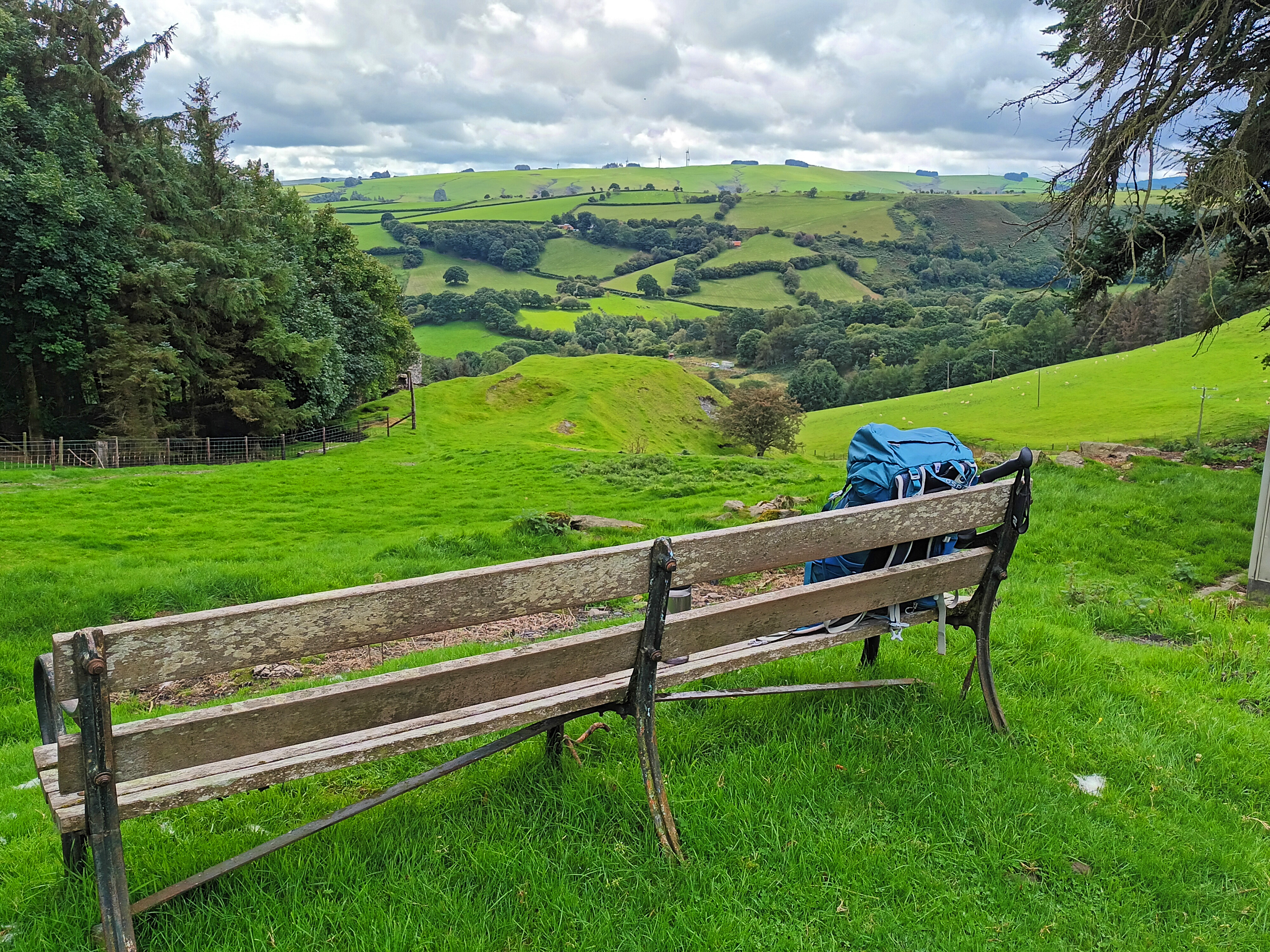
The section of this path by Bryntail, passing a former outdoor centre, had open views across the valley and was so enjoyable we stopped for lunch on the bench in the photograph above.
Dropping down the hillside we could see the massive dam holding back the waters of Llyn Clywedog. We explored the buildings of the old lead mine and appreciated the information boards that explained the grimy processes that were carried out in this industrial site.
We chose to take a path around the head of a small valley to Cwm Deildre. The first section of this path traversed the steep-sided valley and was tough going as we fought our way through flourishing bracken. This was so arduous we were relieved to reach the head of valley and an easier-going track. At Cwm Deildre we joined lanes that took us to paths back to the wooded banks of the Afon Clywedog which we crossed the bridge back to the campsite.
This walk had plenty of interest and big views and I would recommend it.
Llanidloes, the Severn Way & Glynbrochan (approx 16 km / 10 miles)
From Red Kite Touring Park you can either walk into Llanidloes the pretty way, crossing Afon Clywedog and skirting the valley side through woodland. This is about 2.5 km (1.5 miles) or you can walk along the pavement by the road which is slightly shorter. We followed the campsite instructions for the pretty route and after looking around some of Llanidloes elegant and interesting buildings we sought out a coffee shop. The Wild Oak Cafe was an excellent choice for the range of food, good coffee and comfortable atmosphere.
We left Llanidloes on the minor road that follows the River Severn, turning left to cross the river on the quiet lane towards Glynbrochan. Leaving the tarmac we picked up paths on the hillside to our right and became just a little lost until we realised which side of a hedge we should be on! Eventually we scrambled down a steep path through trees to reach the dam of a small reservoir where we had our picnic lunch.
The path from the reservoir to the farm was boggy and we were glad to reach the tracks without our feet getting soaked. A farm track took us downhill back towards the River Severn where we joined a lane that led back to the bridge where we had crossed the river earlier and we were soon back in Llanidloes and climbing the hill back to the campsite on the road route.
Apart from Llanidloes, which is worth a visit, this walk only had the reservoir as a focus for our interest but we stretched our legs and felt we had deserved tea and cake later!
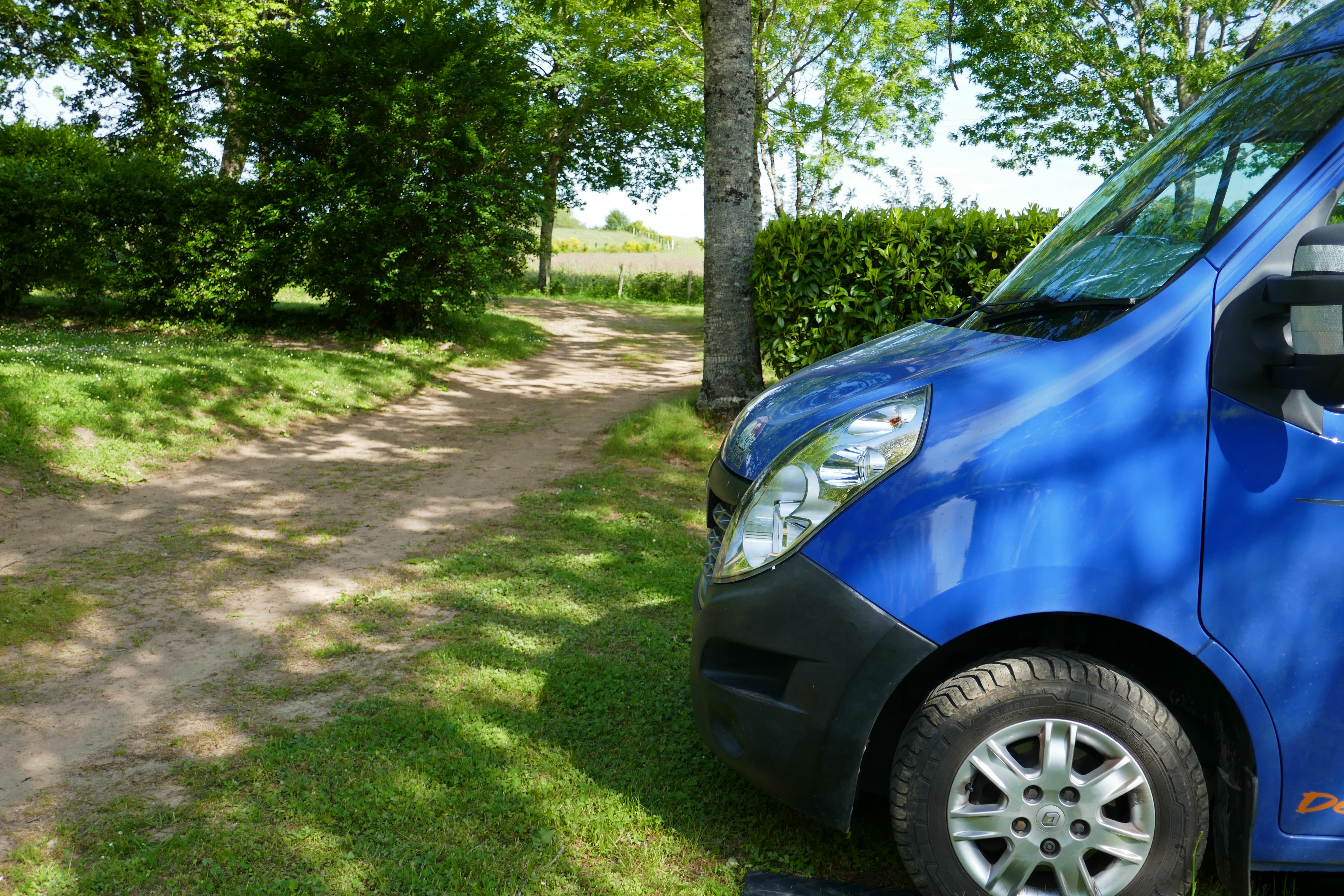
We started the conversation during our campervan trip around France. Was it time to change our campervan? We adored our Devon Conversions Tempest on a chic blue Renault, it had everything we needed. After eight-and-a-half years, over 900 nights and around 80,000 miles it had been the workhorse campervan you expect from a Renault Master. Sitting in the French sun with a bottle of wine we mulled over options. Not owning a campervan at all was one we needed to consider but my tears at even the thought answered that question! We are a good team and generally get the best solutions when we put our two heads together and eventually we realised that what we wanted was a smaller ‘van.
When we bought our Devon Tempest we were keen to try the luxury of a travelling with a bathroom and didn’t want the faff of turning the front seats around. We had enjoyed what we think of as our enormous 5.4 metre long Blue Bus but both now felt ready to return to a simpler way of camping. We also felt uncomfortable owning a diesel ‘van with a Euro Five engine, we wanted something less polluting.
The research began with electric ‘vans but it soon became apparent that although there are a few out there they are still a rare beast and would cost almost as much as our Lancashire bungalow! A second-hand but newer campervan with a Euro Six engine was a cleaner option that wouldn’t leave us destitute. Visiting campervan dealers it quickly became clear that what we wanted was difficult to find. Campervans have become so popular they fly off the forecourt and those on offer were unsuitable in so many ways.
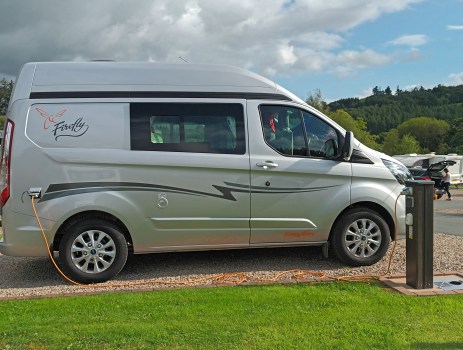
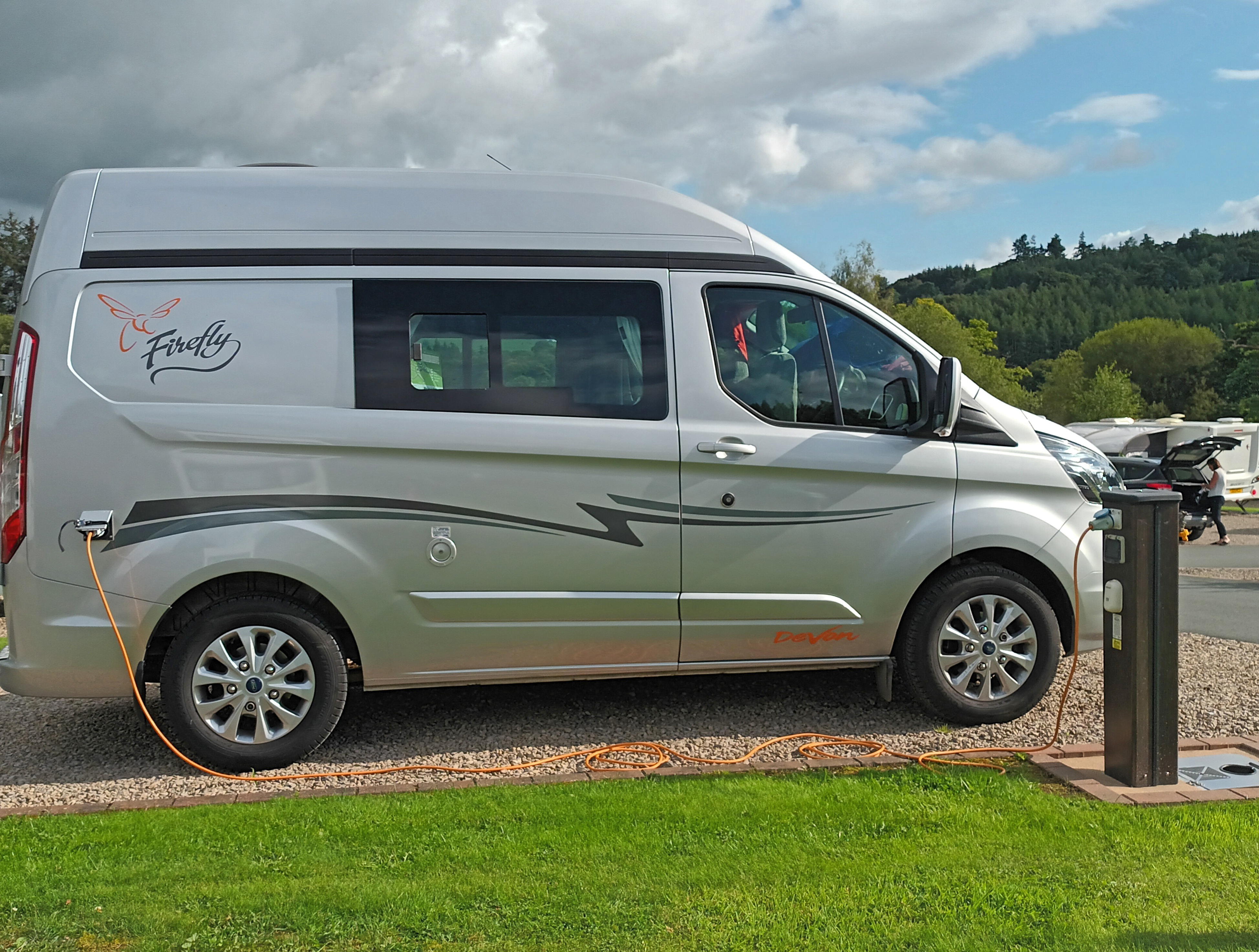
Then we had a piece of luck. A chance conversation alerted us to a short wheel base Devon Firefly on a Ford Custom Transit coming up for sale. We like the Devon Conversions campervans and had owned two previously so we were beyond excited while we waited. The Firefly is a similar layout to our previous Devon Conversions campervan, the Sundowner, although that was on a VW. It was a layout we prefered as it includes a toilet tucked away at the back, so we could downsize without losing all the facilities we had been used to.
Seeing the Firefly, the only thing wrong with it was its colour! Our first three campervans have all been blue and we were looking at a silver campervan. I quietly started to wonder how much a re-spray would cost! Eventually I came to accept that silver is on the blue scale and we were buying a ‘van that identifies as blue!
Buying second-hand is so different from buying new. As well as not being able to pick the colour we couldn’t pick and choose from the menu of expensive extras and the ‘van came with someone else’s choices. We had the electric water heater they had fitted taken out, as it took up space and, with no shower, was no more use than a kettle. We also had a diesel heater fitted. I am mystified to know why someone wouldn’t put a heater in their campervan as in the UK this really only leaves about three months of the year when you can comfortably go camping. This was also our first experience of owning a conversion with a compression fridge rather than a three-way fridge.
Emptying our Tempest took a week as we considered each item, trying to decide what was essential and what wasn’t ready for down-sizing. The essentials still seemed a very large pile to fit into a small five-metre-long campervan. At the dealers I said a tearful goodbye to our Blue Bus and wished it a happy second life. Back home we thankfully found a place for all our stuff in the Firefly and set off on our first camping trip to Small Batch campsite near Church Stretton in Shropshire.
Our shakedown trip only had a few mishaps. After so many years with our Tempest and knowing all its quirks and corners, we felt like beginner campers again with this new machine. Most embarrasingly and publicly, we were that ‘van that set off the alarm at bed time, disturbing the whole campsite! We had never had an alarm before and some learning was required. The compression fridge had more space than our previous fridge and I had packed it with food, including garlic bread for our evening meal, forgetting we no longer had an oven! Fortunately, we were away with friends with a larger ‘van and an oven so we didn’t have to try cooking garlic bread in the RidgeMonkey. We learnt to switch the compression fridge off during the night as it is very noisy! And we got back into the habit of turning those front seats. After six nights away we were settling down and getting used to living in a campervan that was just underfive metres long. We also had a long list of modifications we wanted to make.
A kind friend, watching us struggling to figure out locking the Firefly so that the alarm wouldn’t go off, suggested that changing ‘vans was good for our brain health as we were having to re-learn so many things. I hung on to her positivity as we muddled through all the new-ness of the Firefly.
It seems that our Tempest has sold to new owners so we hope we meet it on the road one day and that whoever purchased it has lots of fun travels and enjoys all that space.
We don’t buy gadgets! But this one has been so useful in our campervan I had to share it with you. Wet clothes and shoes draped around our small campervan make me stressed. They get in the way and make the ‘van feel damp. Some ‘vans have luxurious bathrooms with heating and you can hang up clothes there, shut the door and forget about it but this isn’t an option for us. Now, providing we have a hook up, the Aerative shoe and clothes drier takes the strain out of rainy days and laundry.
At £69 this has to be good, so what do get for your money? The Aerative comes in a draw string bag and takes up about the space of a small pair of shoes. Folded up it sits in your shoes but the drier also has a hook that unfastens so you can easily hang it up. It then opens out into a coat hanger shape, with air ducts along the arms. You simply plug it in and press go. It also comes with pegs for items that don’t hang up so easily, such as socks. Another advantage is that it only uses around one amp so won’t blow the campsite electric system or cost you a fortune if you’re on a meter.
To dry a shirt we hang the Aerative from a hook or from a cupboard door handle near to a plug, open the Aerative out fully, hang the shirt on the Aerative and switch on. It does dry fast but this will depend on the fabric of your shirt. We find that often the very bottom of a shirt remains damp and we will turn it upside down and peg it around the hanger to finish it off.
Drying boots and shoes is easy and there is no need to extend the arms into a hanger. In the folded position shown in the photograph above you can place each ‘arm’ in a shoe and switch it on. It takes a long time to completely dry a pair of soaked through boots but this and air drying overnight should mean you have dry boots the next day which is luxury.
The only downside to this useful piece of kit is the noise. It hums like a low-powered hair dryer so is fine while we are sitting reading or cooking but you wouldn’t want it on all the time. If you have a bathroom and can pop it in there and shut the door this will be less of an issue.
Twelve months on, I wouldn’t be without this piece of kit. It still fits in our downsized campervan and feels essential for drying wet gear and washing. If more campsites had a drying room [or it never rained] we probably wouldn’t need an aerative but in the real world …
I haven’t been paid to write this review or received a free piece of kit I merely wanted to share with readers something we have found that has made our camping experiences better.
In May and June this year [2023] we travelled through France for around just over six weeks. We moved around the west [Atlantic] coast in a fairly adhoc way, deciding where to go next as we went along and booking nothing. To help anyone planning their own trip to France I have listed where we stayed by departments below, rather than in the order we visited them.
Every campsite we stayed on was offering a discount with an ACSI card. In France this discount is generally available out of season until the beginning of July and again from the end of August or the beginning of September. The amount we saved varied from just a couple of Euros a night to more and we recovered the cost of the card in around a week. Over a six week trip the ACSI card more than paid for itself.
With a couple of exceptions, the sites all had unisex facilities, most provided toilet paper but not all of them and some provided soap at the sinks in the sanitary blocks. Many of the sites had swimming pools too. We also always paid a tourist tax of around €1/night each. We were often only travelling short distances between campsites and sometimes we arrived before the 12.00 lunch break and this was never a problem.
Loire-Atlantique & Maine-et-Loire
These are the regions around Nantes and Angers. Maine-et-Loire is inland from Nantes around the River Loire and the Loire-Atlantique is the coastal area north and south of the Loire estuary.
Camping Paradis La Promenade, Montjean-sur-Loire This large site on the banks of the Loire has good-sized marked pitches, some open views and indoor and outdoor pools. The facilities are fine, although the showers were warm rather than hot. There was no bread available early in the season but there is a fantastic bakery 700m away in the village that baked their own rich brioche. The village also has a corner shop. We cycled on pleasant off-road paths and quiet lanes by the Loire. ACSI price €17.00/night.
Camping La Guichardière (Flower Campings), La Plaine-sur-Mer – Just a five minute walk from the sea, this slightly sloping site has good-sized hedged pitches with some shade. The pitches are separate from but surrounded by bungalows. The facilities are very smart with good hot showers in roomy cubicles that also have a sink. The site has an indoor and outdoor pool and a pleasant snack bar. We could order bread for the morning. The coast is rugged here with sandy coves and we walked and cycled on the coastal path and inland agricultural tracks. The ACSI price €19.00/night.
Camping Les Paludiers (Flowers Campings), Batz sur Mer – This sandy undulating site has very little shade and some uneven pitches. The facilities are dated and really need a refurbishment. The showers are roomy but not adjustable and only just warm. You were lucky if there is one hook in the shower! We have stayed here before as we have friends who live nearby. It is close to the beach, a pretty town and an area of salt pans. ACSI price €19.00/night.
The Vendée & Deux-Sèvres
These areas are south of the River Loire. The Vendée has a popular Atlantic coastline of sandy beaches but inland is mostly agricultural. La Roche-sur-Yon is the place to go for out-of-town shopping. Deux-Sèvres is also rural, growing cereals and potatoes and apples. The idyllic Marais Poitevin, an area of marshland crisscrossed by picturesque canals and drainage ditches, is in this area too.
RCN la Ferme du Latois, near Coex – This large site has clearly marked grassy pitches around ponds in peaceful countryside. There are four facility blocks and three of these were open when we visited in May. The showers were good and hot with adjustable temperature control and the facilities clean. RCN is a Dutch organisation that runs campsites in the Netherlands and France. They use the profits to provide holidays for people who otherwise would not have the opportunity. The site is north of Lac du Jaunay and we walked there and around half of the reservoir and cycled a local route. ACSI price €17.00/night.
Camping Le Martin-Pêcheur, Magné – On the edge of the Marais Poitevin and near to Niort, this small site suited us very well. The pitches are generous, the facilities are modern and clean with the best showers we had all holiday. There was toilet paper and soap too. They didn’t have morning bread but I enjoyed my five minute cycle ride to the smart bakery in the pretty village before breakfast. There is a supermarket in the village too. The site is handy for picking up the cycle route along the canal to Coulon and there are buses too. We cycled on different lanes and paths through the woodland and fields and fell in love with this picturesque area. ACSI price €19.00/night.
Camping Paradis La Bretonnière, St Julien des Landes – A grassy site with some hedged pitches and touring pitches separate from bungalows. The site is in peaceful countryside south of Lac du Jaunay and has a pool. The showers and toilets are open to the outdoors and this is fine in warm weather and there was plenty of hot water. The village is 2kms away and this has a convenience shop and a cafe. We cycled to Lac du Jaunay and around the quiet countryside. ACSI price €15.00/night.
Charente-Maritime & Charente
The beautiful River Charente runs through these two departments. La Rochelle and the Ile de Ré are in the north of the Charente-Maritime and this coast is popular with tourists. Inland, Charente is quieter and has a tradition of producing cognac and pineau, an aperitif of wine and cognac.
Camping La Tour des Prises, Ile de Ré – This is a popular campsite but well positioned in the centre of the island, allowing us to cycle to either end of the island. The site is walled and the pitches are not enourmous but many of them have solid hedges giving privacy. There are two facilities blocks which are clean and the showers are good with temperature adjustment. There is a pool and morning bread is available. We were given a cycling map when we arrived so we could explore the island. Despite being easy to access and cycle from, the campsite is peaceful. It is about 10 minutes cycle ride to a small supermarket about 2.5kms away. ACSI price €21.00/night.
Camping de Cognac, Cognac – This grassy and shady site by the river is about a 30 minute walk [or a quicker cycle ride] into the city of Cognac. The site has some road noise from the surprisingly busy road that crosses the river. The male and female facilities were roomy and the shower temperature is adjustable. There was no morning bread out of season. La Flow Vélo, a long distance cycle route passes the campsite and you can cycle by the river in either direction. ACSI price €17.00/night.
L’Ile Madame Camping, Jarnac – This level and prettily laid out grassy site is on the edge of Jarnac and a short and attractive walk into the town centre. Jarnac is a lovely place with a small shopping area, an indoor market, an edge of town supermarket and some Cognac houses. The campsite facilities are fine, with good hot showers, although the washing up sinks are outdoors. Campers have to walk to the bakery. Off road cycle routes by the river go in either direction as part of La Flow Vélo. ACSI price €19.00/night.
Camping des Ribieres, Confolens – This popular site has a riverside setting and is near to the tourist town of Confolens that has restaurants, shops, some charming buildings and a 13th century arched bridge. The site has two kayaks you can take onto the River Vienne and you can rent huts and ready-erected tents. Unusually, we found that campers are allocated a pitch even out of season. The facilities are fine, the showers warm but somewhat cramped. The road alongside the campsite is busy and there is some road noise but if you are nearer the river this is negligible. There is a snack van that does a roaring trade. ACSI price €15.00/night.
Dordogne
The large rural Dordogne Department in southwest France is mostly north of the River Dordogne. We spent a few weeks in the Périgord area in the north of the Department. This historical region is sparsely populated and has abundant woodlands and meadows of cattle and crops, cut through by winding steep-sided river valleys.
Camping Chateau le Verdoyer, Champs Romain – In the Périgord countryside this campsite is in the grounds of a traditional-style chateau. Many of the pitches have open views over meadows and woodland and they are marked and some have hedges. There are also pitches with private bathrooms on your pitch but not for the ACSI price! The showers are timed for five and a half minutes and are warm rather than hot but kept clean. The washing up sinks that were available when we stayed here had no roof but others do. There is an indoor and outdoor pool and reception has a small shop, snack bar and morning bread is available. Good evening meals are available in the chateau and they have a vegetarian option. We purchased a local walking map for a few Euros and hiked on the waymarked paths over a few days. The village is about 30 minutes walk away and has a cafe, a corner shop and a free weighbridge. ACSI price €19.00/night.
Camping Brantôme Peyrelevade, Brantôme – This is a large riverside site with plenty of pitches with shade and three sanitary blocks, although they were not open fully when we were there out of season. The pitches are marked out. The facilities are okay and the showers hot. The site is well run and close to the busy tourist town of Brantôme which has an abbey and gardens to visit. There is a good network of local waymarked walks in the woodland and meadows from the site. ACSI price €17.00/night.
Camping La Chatonnière, Jumilhac-le-Grand – This terraced campsite was a big hit with us. It is family-run and friendly, our shady pitch overlooked the river and it was peaceful and tidy. The three facilities blocks are kept clean and eventually we found that the ones nearest reception had the hottest showers. Bread is available at reception and they sell some essentials including local honey. The campsite also sells takeaway pizzas in the evening that are good. The village of Jumilhac-le-Grand is a short walk away uphill and has a corner shop, a pharmacy, a couple of cafes and a beautiful chateau. There are numerous waymarked walks from the village and we hiked along the valley and up and down the steep hillsides of this idyllic countryside. ACSI price €15.00/night.
Ille-et-Vilaine
One of the departments in Brittany, Ille-et-Vilaine spreads inland from the coast around Saint-Malo and Dinard. Rennes, its main town, is in the centre of the department and the name comes from two rivers in the area, the Ille and the Vilaine.
Camping des Chevrets, St Coulomb near Saint-Malo – If we have visited a campsite more than once it means it certainly has our seal of approval. This large and popular site was busier in June than it was at the end of August when we last visited. The weather was warmer too and we chose a shady pitch. There are red squirrels in the trees and direct access to beaches and coastal walks. The facilities are fine although I would have liked some soap for handwashing as we were paying more than other campsites. The campsite has a cafe overlooking the beach and a shop that has morning bread and other essentials. ACSI price €21.00/night.
Domaine de la Ville Huchet, Saint-Malo – We stayed at this site with some trepidation having read very mixed reviews. We would now use it again for one or two nights as it was okay and has good bus [about ten minutes walk to the stop] or cycling access into the fascinating town of Saint-Malo. The site is grassy with trees and marked pitches that are allocated. The reception and snack bar are bright and modern and campers are given maps for Saint-Malo. The facilities are light and airy and the shower temperature is adjustable and so can be as hot as I like it and the cubicles are roomy. ACSI price €21.00/night.
Shopping can be a bit of a chore but when we are abroad it is an exciting part of the holiday. There are different products, interesting labels and everything just seems so much more colourful. From the shelves of strange liqueurs to the dazzling range of cheeses it is all thrilling and a feast for the senses. This year inflation added colour to our shopping trips as I constantly expressed horror at the prices!
In May and June 2023 we spent six weeks in France, mostly exploring the Atlantic Coast and areas just inland. Last year we visited Germany and the Netherlands and I concluded that food prices were much the same as the UK. This certainly wasn’t the case in France in 2023.
In France, our supermarket shopping was 30% of our total spending [excluding the cost of the ferry]. Last year it represented 20% of our total. We spent similar total amounts on each trip but how this was distributed was very different.
Our food and drink budget while we were travelling around France came to €941/ £809. This is just our spending in supermarkets [our cafes and restaurants bills is another thing] and is an eyewatering equivalent of around £540/month. At home our supermarket bill averaged £340/month between January and April. So where did we spend this additional £200/month?
2024 update – After five weeks in Normandy in September 2024 we spent €718/£610 on supermarket shopping. This is the equivalent of around £574/month (including the same red wine consumption as 2023), so suggests a small rise in prices. Without the additional red wine we drank and carried home and the duty-free gin, we averaged around £490/month on supermarket shopping in France. At home, our UK supermarket bill is averaging around £383/month in 2024. The main difference is that while in the UK we mostly shop in Lidl, in France we didn’t use the discount supermarkets, we shopped in Carrefour, E.Leclercand Intermarché.
Some examples from our 2023 shopping baskets- 500g of penne pasta €2.08/ £1.79 (not own brand) (Tesco equivalent £1.50), 200g of Gouda slices €2.25/£1.93 (Tesco £3.75 for 50e0g), 175g houmous €2.99/£2.57 (Tesco 200g £1.20), red peppers €6.40/kg/ £5.50/kg (approx 6 peppers) (Tesco 60p each or approx £3.60/kg) and 250g of mixed cherry tomatoes €2.60/£2.24 (Tesco £1.80). One of the few things that came in cheaper were courgettes at €2.70/kg/ £2.32/kg (Tesco £2.78/kg). We mostly shopped in Super U but did occasionally use other supermarkets.
So was it our fondness for red wine that tipped the scales? We drink about three bottles of wine a week when we are away, rather than just one bottle a week at home. On top of these twelve extra bottles we returned across the Channel with 17 bottles of wine stashed away under the bed of our campervan for drinking at home. Even at an average of €5 each [and we often spent much less] these additional 29 bottles would only account for €145/£123 of that £809 or £82 per month. Of course, we have saved some money returning home with cheaper wine so hurrah for that small win.
I hope you are keeping up with the maths … Allowing for the additional wonderful red wine we purchased, we are still looking at approximately £118/month additional cost on our food shopping. This is around 1/3rd more than we spend at home, so did we do anything different? After all we were on holiday.
We ate in restaurants four times during our holiday [at home we eat out around once a month], the rest of the time we cooked in the Blue Bus. We ate similar food to home, vegetable dishes with pasta, rice or couscous. We did develop a liking for the vegetarian frankfurters you can sometimes find and these were around £3 a pack but they were a weekly, not a daily, extravagance. At home we make houmous regularly but don’t on holiday. This was more available than ever in France but was too expensive to have more than three or four times. Even peppers, that we eat kilos of at home, became a treat and I suspect, due to the cost, we ate less fruit and vegetables than we do normally. We did eat more bread and cheese than at home but this simple fare is one of the things I love about being in France. We cannot take dairy and fresh vegetables into mainland Europe since Brexit but we did pack our van with enough soya milk, teabags, tins of chickpeas and pesto to last the holiday.
Looking at these figures, the only conclusion I can come to is that almost everything was just more expensive than the UK. Fortunately, French campsites are cheap! Look out for another post soon with the full costs of our holiday.
I am certainly not saying don’t go to France, as it is fantastic for a campervan holiday, just budget for spending more on food!









 Back on the road again