Travel and Change of Place Impart new Vigour to the Mind

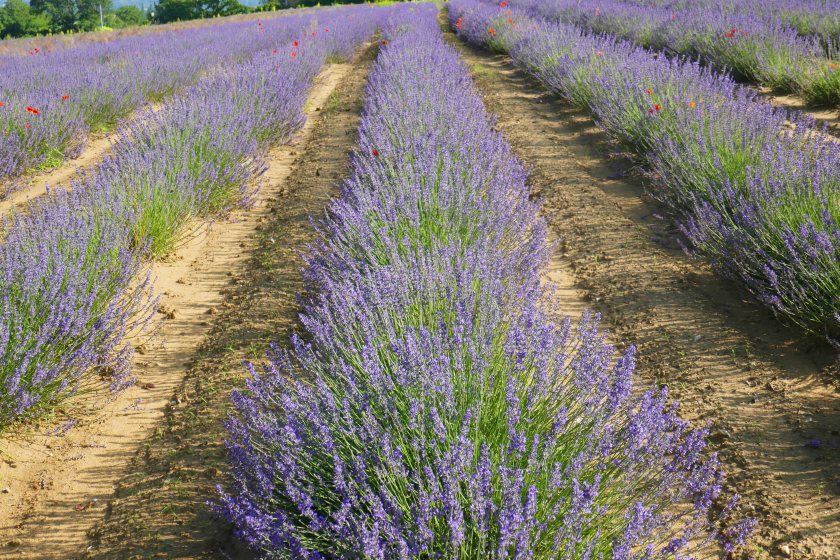
France 2018 Lavender

‘Travel and change of place impart new vigour to the mind,’ is an often cited and apparently thoughtful quote from  Seneca, a wealthy and powerful Roman Stoic philosopher and writer.  Many travellers use this quote as, although it was written 2,000 years ago, these words still holds some truth today.  Many of us feel that taking a break from the everyday comfortable routine can be refreshing, give me a chance to see things with new eyes and look beyond the familiar daily grind, encountering vivid ideas that can lead me to innovation and change.  Seeing new sights can be mind expanding and renews our get-up-and-go and connects us to Seneca the philosopher.

Wanting to understand what Seneca was saying, I searched for the specific reference or context of this quote but hit a brick wall, only finding others who state this is wrongly attributed to Seneca but no information about who the quote is from.  Also the more I read about Stoicism the less sense these words meant in relation to its teachings.

Stoicism teaches the four cardinal virtues for a good life, wisdom, temperance, justice and courage.  As a Stoic, Seneca argued that passionate anger or grief should be moderated and he would approve of the classic stiff upper lip.  Stoicism teaches that happiness is found in acceptance and by not allowing our desire for pleasure and our fear of pain to control actions.  Seneca thought it was important for everyone to consider their own mortality and face up to dying, not to encourage a pessimistic attitude but to reinforce how lucky we are to be alive and live for today.  Studying Stoicism can lead to reflection and philanthropy and can help us understand our place in the world and encourage us to treat others fairly and justly.  As a Stoic Seneca recognised his own short-comings compared to his own role models and was always willing to learn.

Stoicism in many ways fits well with today’s minimalist movement.  A Stoic admires frugality and sees no shame in being seen wearing old clothes, driving a battered car or living in a run down house … image is nothing and boasting about a luxury holiday or posting glamorous photographs on social media would be a far cry from Stoicism.

There seems some tension between this often quoted phrase of Seneca’s and the principles of Stoicism.  Some argue that Seneca would support the sentiment of the quote while considering that it is the intent of the travel and the disposition of the traveller that are important.  He wrote, ‘Where you arrive does not matter so much as what sort of person you are when you arrive here.’

Travel to find peace of mind is not promoted by Stoicism as this inner harmony needs to be achieved from within and moving to a new place won’t make you happy, ‘You must change the mind, not the venue,’  Seneca wrote.  Stoicism argues that travel in itself cannot lead to self-improvement.  Yet, travel that combines frugality with learning could fit into the Stoic’s way of life.

Taking a break from work can give your mind a chance to wander into new areas and that is when some bright spark of an idea can pop in but I find that even getting out for a walk can give the same result, never mind a full-blown holiday.  As Tim Harford argues in this FT article, you don’t need a long holiday to give your brain chance to relax and re-boot.  A weekend away works just as well and the benefits of a longer break wear off just as quickly as a short one.  Such news is all a bit distressing for someone who loves long holidays and I personally find that the benefits of a long holiday lie deeper and of course, all this is different when you are not returning to work.  It is true that when we were working folk we would get away on a Friday night for a weekend and face Monday morning much refreshed.

Whether or not this quote is actually something Seneca wrote, Stoicism suggests that happiness can be found through our acceptance of how things are and imparting new vigour to the mind certainly doesn’t have to be found by investing in an expensive holiday or retreat.  If a few days camping is out of the question we can all get a similar feeling of new vigour from seeing your own locality with fresh eyes.  You might take a different route to work or explore a local park you’ve never visited before or even read a different genre of novel or watch a new TV programme.  Constant learning and removing yourself from your comfort zone can impart new vigour to your mind.


Moving on: Leaving Super Salford for Marvellous Morecambe

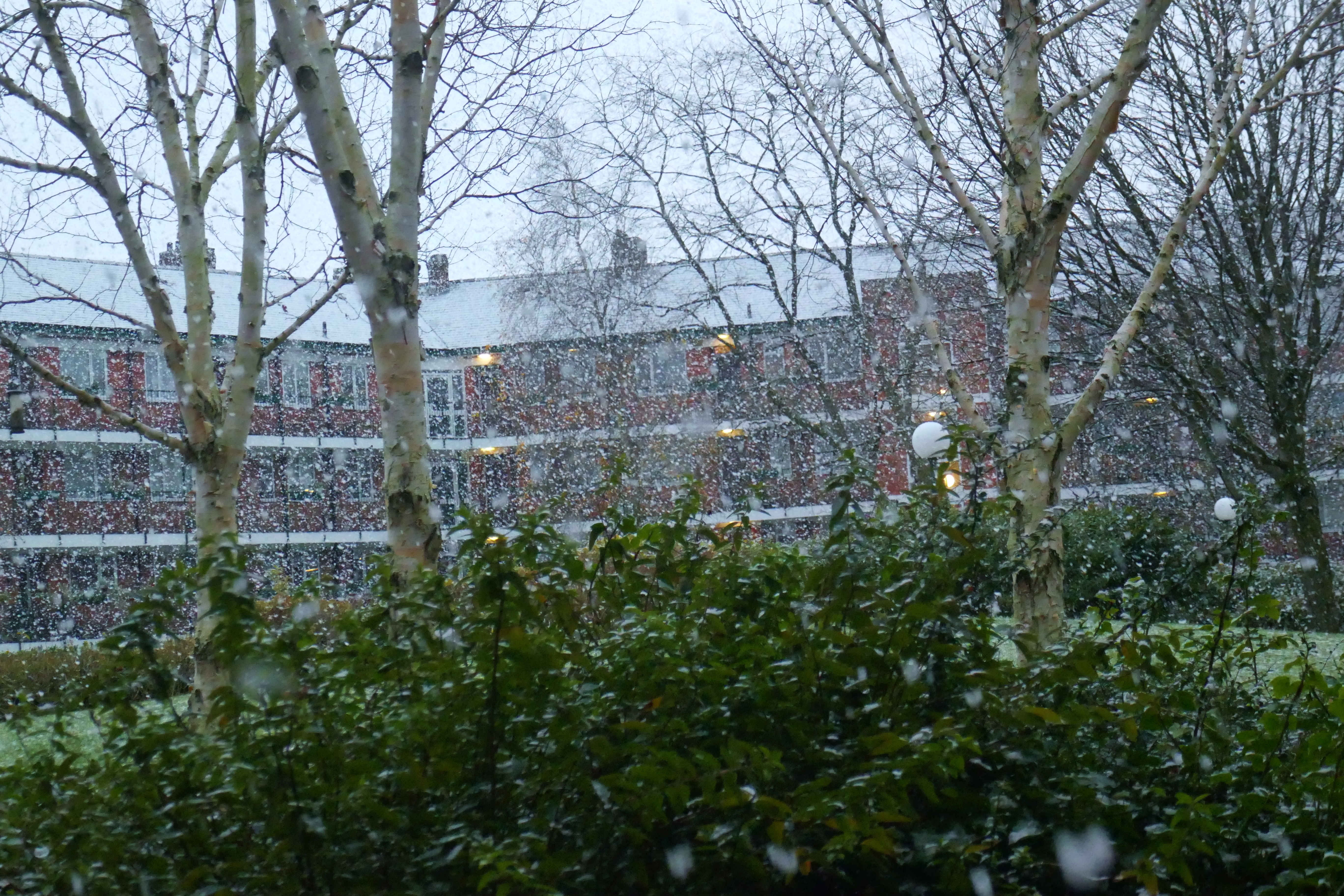
We have been a trifle busy just lately.  After eleven years of living in a flat in Salford we decided it was time, as they say, to move on.  Salford has been good to us and in many ways we will miss living in a vibrant and dynamic city and being a part of Greater Manchester.  Leaving our many friendly and helpful neighbours and our lovely tai chi class [a nicer bunch of people you would struggle to meet] was a hard but positive decision.

When we moved to Salford, a city packed with modern, shiny high-rise blocks of flats, we chose an unusual 1930s development of flats with three floors arranged around large courtyard gardens and open shared areas.  Thanks to the design of the flats, we got to know more neighbours than we have anywhere else we have lived.  The site is secure and we have never worried about the leaving our flat on our long holidays and the gated parking for our campervan has been appreciated.  The large garden is a sheltered and sunny place to sit on a warm day with none of the worries of having to actually do any gardening yourself, it was a happy and liberating place to live.

A short walk from home was Salford Quays and a stroll around the water was a regular favourite way to spend some time.  This is where we could encounter nature; the trees changing colour through the year, Canada geese and black-headed gulls and sometimes coots and pied wagtails and different weather transforming the river and canal from sparkling blue to slate grey.  In addition there is always something new to see; someone might be filming around Media City, we could encounter groups queuing for a popular TV show or stumble upon one of the many special events such as the Makers Markets or Lightwaves.

We were surrounded by plenty of other favourite places; Weaste Cemetery, Peel Park and Buile Hill Park, Chapel Street and the River Irwell.  There are so many things to like about Salford, check out my Surprising Salford page for the full list.

If Salford is so perfect why are you moving on?  A search for quiet is the simple answer.  Although there had been other nudges, it was after spending two months in Scotland earlier this year that we both returned to our urban flat and struggled to adjust to the bustle of the city.  The 1930s flats were solidly built with thick external and internal walls and there is rarely any noise that gets through from neighbours to either side of us.  What my acute hearing did pick up was from the flat upstairs.  The guy was always respectful and well-behaved but I began to get tired of knowing when he was home, when he went to bed, when he decided to listen to music, when he had visitors and even when he visited the bathroom!  In addition, in the 1970s it was decided to build the M602 through Salford and the roar of the traffic on this short adjacent motorway was a continuous presence.

That said, we would have stayed in Salford if someone had built / was building small affordable bungalows and not just tall blocks of flats or if we had won on the Premium Bonds and had been able to afford the half a million or so for a penthouse flat overlooking Salford Quays.  With none of those options available, we checked our budget and began the search for a bungalow [we like living on one-floor] that wasn’t off the beaten track but offered some tranquillity, alongside some culture, and had natural areas within easy walking distance.

Having lived in Lancashire for many years, it is not surprising that we soon decided on the seaside resort of Morecambe where we follow in the footsteps of a long line of retiring Lancastrians.  Morecambe has plenty of bungalows to accommodate retirees and along with Lancaster has a thriving art and cultural scene and has that magnificent view across the sands of Morecambe Bay to the Lake District.

Our move to Morecambe isn’t so much a downsize as a new era.  We have gained a garden [again] and a kitchen that seems vast after living with one where I could stand in the centre and stretch out and reach everything!  But, having got used to our huge bedroom in the flat our new bedroom can best be described as cosy and our 1960s bungalow needs a long list of improvements to bring it up–to-date … but now when there are footsteps overhead it is just a herring gull landing on the roof.

The last glorious day of summer in Langdale, the Lake District

It was early October in the north-west of England and our weather expectations were low … but the isobars were working in our favour and there was one day in a blustery and showery week when the sun shone, the sunglasses were dusted off and the short trousers had one last airing … and on this splendid day we were lucky enough to be in the Lake District!

We were staying at the National Trust Great Langdale campsite.  This campsite has some shortcomings; it isn’t the place for you if you are looking for somewhere with luxurious heated facilities [despite the sunshine it was chilly in the evenings and mornings]; or a site with spacious campervan pitches [the pitches work best for smaller campervans] or even if you want somewhere cheap and cheerful [it costs £25/night in September/October but varies between £21 and £30 for two adults with EHU].  What this campsite does offer is stunning views of the wonderful Langdale Valley, peace and quiet, the Old Dungeon Ghyll just five minutes away [where you can get a pint of Old Peculier, my favourite beer] and access to superb walking.

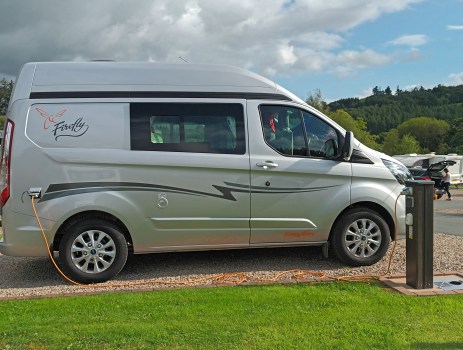
We enjoyed one of those days when the hills are so magnificent you don’t want to stop hiking and we were having so much fun we ended up following a route somewhat longer than we originally planned.  It was so glorious on the hills we just kept adding another hill and the sun had left the valley by the time we descended back to our cosy Blue Bus.

We climbed upwards from the valley and emerged from the crags above Langdale onto Loft Crag, a superb viewpoint.  The panorama down the steep hillside into the valley and across to the summit of Bow Fell were magnificent and further away we spotted Great Gable among the multitude of fells.  We moved on to Pike of Stickle, skipping Harrison Stickle that we have climbed before and took in Thunacar Knott before deliberating over our lunch about where to head for next.  High Raise was beckoning and we set off across the slightly boggy land dotted with small tarns to this hill with views into Borrowdale and across Derwent Water to Skiddaw.  Sergeant Man is easily recognisable from almost any direction except from High Raise it seems but we hiked on and navigated to this little peak.

Our final objective became Blea Rigg, a Wainwright neither of us had knowingly climbed before and the top of which isn’t really clear on the map or the ground.  We had searched for Blea Rigg on an earlier occasion this year during a walk from Grasmere to Silver How and failed to find it.  This time, in the continuing sunshine, we climbed up every pimple and nobble between Sergeant Man and Silver How, examining Wainwright’s drawings on each one, determined to be sure we had stood on top of Blea Rigg.  Comparing my photographs with those of others on the internet later we are confident we did get there!

We descended on sheep tracks below the crags, eventually joining Stickle Ghyll and the well-made path into Langdale.  We had walked about 15 km but most importantly had experienced a truly memorable Lake District day.


Living on a Northern Terraced Street in Preston

1987 matthew and c august on larkhill st
1987 on a Preston street, wrapped up for the rain

1986 seems like another era; I had big hair, we owned a British Leyland Metro, Spitting Image was still on TV and we moved to Preston in Lancashire.  Along with fashions, the pattern of the communities in our cities have also altered many times since those days.  As a young couple with a tiny baby and two cats, living away from our home town and our respective families, we moved into a 19th century brick-built terraced house in a row of similar terraced houses.  This was our stomping ground for two years before we became upwardly mobile and moved to a more spacious semi-detached house.

These Lancashire terraced streets are still there and continue to provide great housing for families.  Our small terrace had two downstairs rooms and upstairs a double bedroom, two single bedrooms and a small bathroom.  Along the side of the house was a narrow alley that went underneath our upstairs rooms and that we shared with our neighbour.  This gave us access to the back yard and garden and was where we stored ladders and bikes.

In the 1980s we weren’t on our journey to financial independence, our priority was keeping our heads above water.  We were a single-income family with a mortgage on a house that had cost us £15,000 [you now need almost this much for a deposit on these properties].  Our terraced row of houses felt crowded but comfortable.  Along with our neighbours, none of us were wealthy; here was the wonderful diversity of what might be called the working classes, all struggling to make ends meet.  Although our family income came from a ‘professional’ job at the university, this is where we could afford to live.

To one side lived a couple with one child.  He had worked as a jockey, riding horses, as a young man but was now a butcher, both fascinating worlds I knew little about.  She was an outgoing hairdresser, working in a city centre salon.  On her day off she styled the hair of the neighbours in their homes, including me, giving us mates rates.  While we lived next door their marriage broke down and she began working evenings in a Preston nightclub for extra income as a pole dancer, another world I knew little about.

To our other side lived a couple with two children, a family living on the single income of his manual job.  It was this mum that was usually the parent that would offer to sit on the front step and watch her own children play in the street during the early evening, along with those of neighbours.  If the weather was fine I would often join her for a while with the baby and sitting on our respective steps we would talk generally about family news, the best schools and favourite TV programmes.  It was on these steps that I was informed that the best local primary school was the Roman Catholic school; I mentioned that we were atheists but she didn’t really grasp why that would mean this school wasn’t suitable for our little one.

During the daytime the street was a place for women and young children, all the men were at work and my early lessons in bringing up a child came from these women.  The street was lived in by families that were white-British but we were on the edges of more diverse areas of Preston and nearby there were shops that sold exotic fruit and vegetables that I enjoyed exploring.  At the end of the street, in the 20th century social housing, was a Muslim woman with children.  She was divorced, somewhat unusual in her community, and this single status sadly led to bullying by people who shared her religion; she needed a friend and sometimes I listened.

Just around the corner were an elderly couple, long-time residents of the area.  On warm afternoons he liked to bring a dining chair outside his tiny two-up-two-down terraced house and sit and chat to anyone who came by.  I walked by his house to the local shops and into town, always carrying our baby in a papoose, and would stop for a while.  He told me funny and interesting stories of his days as an engineer building bridges on the M6.  Life seemed to be slower in those days in this corner of Preston and people had time to talk.

Another family across the road had a son who was difficult to manage, he was often aggressive and sometimes violent.  He was removed from home and sent to the local children’s home that was unfortunately just 100 metres away.  He continued to return home and scream loudly outside his family home and once he broke a window while everyone along our street cowered indoors, no one trying to help.  In these narrow streets there is nowhere to hide and the family’s shame was a burden they carried, knowing the next day that everyone was talking about them.

On the corner of the road was the vicarage.  The vicar and his friendly wife had four children and were considered the middle-class residents of the street.  Quizzing me about how many more children we would have, I told her, ‘One is enough.’  She failed to persuade me that a big family was the way to go.  Their house was an enormous rambling property surrounded by a garden and easily swallowed their large family and the numerous visitors they happily entertained.

I have said before I have a literal mind and so when I learnt there was a Mums and Toddler Group nearby [these would now be called a play group or parent and toddler group] I understood the term precisely and didn’t attend until our son was actually toddling at 11 months old.  I laughed when I was told I didn’t have to wait until he could walk!   The group was held twice a week in a draughty and dismal church hall with a selection of old toys for the children to play with and tea and biscuits for the mums / parents.  In this unpromising environment, there was no sense of competitive parenting and everyone was supportive and helpful and I learnt more child-rearing skills.  It was here that I met parents who shared my love of reading, cooking good food, an interest in environmentalism and fellow atheists who recommended the local county primary school.  I made some firm friends here and the plan to move a short distance away to a bigger house began.

The narrow terraced streets are still there and probably still lived in by hard-working families.  The vicar no longer lives at the end of the road and the extensive garden is now a car park, the social housing has been improved.  The corner shop has gone, along with the telephone box where we would ring distant family and friends as we didn’t have a home phone.  Traffic has increased everywhere and I doubt if I walked here on a sunny evening I would still see parents sitting on the steps watching their children playing in the street but then again …


Exploring Northern Hungary in a Campervan

Hungary 2013 Visegrad 005
The view over the Danube from Visegrad Castle

Some years ago we travelled to Hungary, equipped with a guide book, a couple of maps and a postcard with useful phrases in Hungary’s difficult language, such as, ‘Can we camp here?’  This was kindly written by my Hungarian friend who sympathised with how difficult Hungarian is for English people to learn.  ‘It will be hot,’ my cold-loving Hungarian friend had assured me; she often told me how unbearably hot a Hungarian summer is and so we took shorts and t-shirts.  As it turned out it was a particularly wet late May and early June and our most worn clothing was our waterproofs!

All the same we had an amazing time exploring this interesting country, although due to time constraints [and work] we only saw a small chunk, we did explore areas less often the haunt of sun-loving travellers.  We toured around the north of the country, driving into Hungary from Austria and leaving via Slovakia.  Our first stop was the charming town of KÅ‘szeg that is full of beauty and surrounded by hills and trees; in the rain we had it to ourselves.  Known as the ‘Jewel Box of Hungary,’ with cobbled streets and colourful buildings it is certainly worth stopping here to explore the lovely square and the castle.

Our first Hungarian campsite was near the large thermal spa at Buk.  The receptionist didn’t speak English but did speak German and so we muddled along and I didn’t need the postcard of useful phrases.  Taking an evening walk through the many baths and tourist shops we were amazed how popular taking to the water here is.

Driving through fields and vineyards towards the Danube, we stopped at the lovely town of Tata that has a ruined castle picturesquely set by a lake.  An event was being held and local people, young and old, were dressed as ancient Magyars and practising with bows and arrows.   Here we had our first Hungarian soft ice-cream on a cornet, the ice-cream dipped into melted chocolate creating a crisp chocolate layer to bite through to the sweet ice-cream.

On the River Danube we found the slightly down-at-heel campsite run by the Hotel Honti in Visegrad and settled in for a day or two.  Exploring the town on a Sunday morning we came across a procession along a colourful flower-strewn path to the church.  Another walk took us up the hillside to the stunningly-positioned castle.  There are ferries on the wide river here, including to Budapest.

Mátra Kemping Sástó was a newly refurbished campsite at the time of our visit and had the best facilities we encountered in Hungary.  The large well-organised site on the hillside above Gyöngyös has bungalows, a hotel as well as camping pitches.

The Mátra mountain range has Hungary’s highest peak KékestetÅ‘ (1014 m).  From the campsite we walked through beautiful beech woodland on well-marked paths, stopping at a roadside stall for sweet tea with lemon before heading up the steep section.  You can drive to the top of KékestetÅ‘ and the tree-covered summit gives you no view to reward your effort unless you climb the look-out tower.  We returned on a different footpath which gave us wide open views down to the plain below and was a wonderful walk, even though we missed the path back to the campsite and ended up in the lower village and had to walk back up the hillside.

We had a beautiful drive around the northern valley of the Mátra to the city of Eger the next day, through attractive villages and vineyards where the grapes for Egri Bikavér (Bull’s Blood of Eger) are grown.  After stocking up in the supermarket and buying our favourite calorie-laden lángos [deep fried flat bread smothered in garlic] for lunch we explored Eger.  This city is packed with stunning buildings, narrow streets and pretty courtyards.  Most interesting was the one minaret that remains of the ten built here in the Ottoman era.  This and the Baroque mansions, the wide plaza and the castle make the city an interesting mixture of styles.  Hungary understands how to create a welcoming cafe and there are plenty in Eger; despite the lángos we found space for good cake with coffee.

Nearby is the Bükk National Park and here we sought out the Beehive Stones near Szomolya.  The rural roads were so heavily potholed we had to weave along the road and we almost gave up but we were glad we persisted and found somewhere to park.  Szomolya has a cherry festival in July and is another wine-growing area.  On our walk we passed many cave houses, some of which are now used as wineries.  The Beehive Stones are a feature of this area and are unusual stones of tufa rock with oblong recesses or niches cut into them.  Although there are various theories, it is thought these may have been for keeping bees, hence the name.

We had hoped to camp at Thermal Spa Bogács that evening but after the unseasonable weather the grassy field was sodden and in heavy rain we moved on to the campsite at Mezokovesd that has since closed.

Heading further east, we meandered towards Tokaj, following the River Tisza.  Tokaj is the home of delicious, golden and sweet wine that is valued far and wide.  The town is attractive, surrounded by hillsides covered in vineyards, nesting storks on the rooftops and old buildings.  There are no shortage of independent producers and shops selling the wine and there are plenty of opportunities for wine tours.

Our final night was spent on the edge of Sárospatak; any further east and we would be in Ukraine.  Once again the campsite had a hostel for school groups, as well as the camping pitches.  The next day we crossed the border into Slovakia and began our return west.  We enjoyed exploring some of the natural areas and off-the-beaten-tracks parts of Hungary but realise that we had only dipped our toes into this wonderful country.

Campsites we stayed at:

Romantik Camping, BukThe facilities were faded but the showers were very hot and roomy and all water hot, no marked pitches, near to large spa resort.
Kek Duna Camping, Hotel Honti Panzio, VisegradA small site behind a snack bar and next to hotel, grassy with some trees.  There was a five minute wait for hot water, showers clean, toilets dated.
Matra Kemping Sasto, MatrafuredNewly refurbished site, with marked grassy pitches in trees, new facilities with hot water, by a small lake and walking
Zsory Camping kft, MezokovesdMarked pitches in a spa complex, shabby reception and facilities but hot water and very good showers.  This campsite has now closed.
Camping Tengerszem, SarospatakGrassy, marked pitches, some trees, facilities shabby and water only lukewarm

Recommendations for Campervan & Motorhome Travel Books

20190825_133936
A selection of campervan and motorhome books

For those days when I am at home rather than travelling in our Blue Bus, I travel in my head by reading about other people’s journeys.  Not surprisingly, I particularly have a weakness for buying travel books where the author stays in a campervan or motorhome and I can live the lifestyle vicariously through the pages of someone else’s trip and maybe learn a thing or two.  If you are interesting in reading some of these travel books then read on for recommendations.

Over the years, I have noticed that these campervan and motorhome travel books can be divided into two sub-categories.  There are those where the campervan or motorhome is the main event; these are all about the pleasure and fun of the ‘van lifestyle.   The second category is books that are about a journey where the motorhome is incidental and just a practical and affordable way to travel.

My own journey with these books started when I read Hazel Jackson’s, Europe in a Motorhome; A mid-life Gap Year Around Southern Europe as part of my planning and preparation for our own mid-life gap year.  I found this an excellent and well-written book that was useful before we headed off on our own trip around Europe.  Helen Jackson and her partner, bored with the nine-to-five, took their teenage son on a journey in an RV called The Beast, selling their home and possessions.

Leaving winter behind Helen Jackson slept in a different place almost every night and packed in all sorts of activities.  She has her share of anecdotes about robberies and small disasters, as well as friendships and beautiful places, all told with humour and sensitivity.  She gives a good sense of what such a trip would be like and although Hazel Jackson’s trip was very different from our own in a small VW campervan, it was both a useful reference and an inspiration for our own journey.  This book might inspire you to take a gap year but even if it doesn’t it is a good read from beginning to end.

Falling into the second category of journeys that just happen to be in a motorhome are some of my favourites.  Some are out of print but you should be able to find them second-hand.

Helena Drysdale’s Mother Tongues, Travels through tribal Europe, focuses on the author’s search for the minority languages in Europe.  She travelled around in a motorhome, with her partner and children and she tells lighthearted tales about the scrapes and difficulties they experienced.  To save money Helen Drysdale and her family mostly wild-camped and they had a number of interesting experiences in sometimes beautiful and sometimes dodgy areas.  She certainly has a way of engaging with strangers to explore the story and she writes well.  The book is also a fantastic opportunity for the reader to reflect on how the language we use everyday shapes our attitudes.

Heidi’s Alp, One Family’s search for storybook Europe by Christina Hardyment is one of my will-read-again favourite motorhome related books.  Christina Hardyment is a prolific writer and in this book she travels around Europe in a campervan called Bertha with her four children for eight weeks or so.  They visit sites relating to childhood stories, exploring Andersons Fairy tales, Heidi’s Alp and Pinocchio’s Italy and bringing these places to life for the children.  This is a joyful & honest personal tale with interesting information about these stories.  ‘Our journey was not dependent on the places we found, but on how we chose to see them,’ Christina Hardyment tells the reader.  This is a charming book, the highlight of which is a night in an Alpine hayloft, reliving Heidi’s story.  A great read for those of us who have never grown up, Christina Hardyment will bring back happy memories of old favourites and reveal stories you never knew.

Susie Kelly is a writer who lives in France and Travels with Tinkerbelle: 6,000 Miles around France in a Mechanical Wreck was motivated by her realisation that she had visited very little of her adopted country.  With her partner and dog, she bought an elderly campervan and travelled in a circuit around France exploring the history and culture along the way.  If you are looking for a guide to owning a motorhome, this isn’t the book for you, but if you are looking for ideas of places to visit in France, this is a great start.

Martin Moran, climber and mountain guide who died recently in the Nanga Devi region, had a plan to climb all the Munros (mountains over 3,000 feet in Scotland) during the winter months back in 1985.  Along with his winter clothing and ice-axe, his wife and a motorhome were key to making this possible.  His book The Munros in Winter is more about the difficulties of winter mountaineering than about motorhoming but the sense of comfort he found each time he returns to the motorhome shines through.

The Coast Road: A 3,000 Mile Journey Round the Edge of England by Paul Gogarty won awards when it was published in 2005.  As relevant today as then, this is a journey around the English coast and an account of how those coastal communities are faring.  This travel book has that liberating feeling of a road trip with a purpose and he approaches most places he visits with sensitivity and enthusiasm, although I take issue with his initial description of Morecambe as, ‘After sedate Southport and bubbling Blackpool, Morecambe looks as if it has suffered a recent terrorist attack.’  Paul Gogarty is an excellent travel writer and I forgave him this slip and learnt many things from this well-researched book.  From my notes I also see that my other small criticism is that he spends more time in the south than along our northern coasts.

There are any number of motorhome travel books out there that want to tell you how funny / hopeless / quirky they are.  These books are often self-published and with some of the writers you will wonder how they even made it across the Channel.  Here are examples I have read:

Many people like to name their motorhomes and in How Katie pulled Boris – with an American Motorhome (RV) in Europe by Keith Mashiter not only is the RV named but also the car they towed as well.  Written in a format that is more personal diary than travel literature, this couple take a large RV-type motorhome to France and Spain during autumn and winter and the book might be of interest to others contemplating a trip in a similar size vehicle.   Keith gives details of road numbers, prices paid, campsites used, places they ate, attractions they visited.  He gives a very clear idea of what it is like travelling in such a huge motorhome and the practical difficulties they faced because of the size of the vehicle they took.  He occasionally includes small vignettes of the people they met and encounters they had with other motorhomers and campsite owners.  This is not a book that gets under the skin of France and Spain, they are very clearly passing through and this is not introspective travel writing.  It is clear and concise and based on their experience

Two Clots in a Camper by Steve Coppard – This book has at its heart an appealing idea; two novice campervan owners on their first long trip in France, Spain and Portugal, written in a chatty style.  However, there is too much concentration on the beer, wine and food they partake in during their trip to be of any real interest as travel literature.  If this is your cup of tea then give it a go.

One Steppe Beyond: Across Russia in a VW Camper by Thom Wheeler.  Thom Wheeler and Jo set off in a VW bay window called Max to Estonia. There they hear about the possibility of work in Vladivostok and enterprisingly set off across Russia.  Thom’s account is honest and interesting.  This means that the reader is told when his relationship with Jo is tested and when they are naive in their dealings with Russians. This innocence and sense of adventure gets them through and they enjoy the kindness of strangers many times. The book doesn’t give lots of practical details about shopping, banking or driving in Russia although he does tell his reader when the roads run out and they have to take the train and when they can’t access any currency.  We hear about the problems getting a visa and crossing the border and the constant checking of papers. The narrative is interspersed with facts about a place. I couldn’t help but admire their spirit, travelling across Russia in 1997 and the beauty of the landscape in many places came through the words. The book also manages to give some sense of the vastness of Russia and the spirit of the people.

Never Ask Why by Barbara Phipps  This travel book isn’t quite what I expected.  I assumed it would be a tale of a woman in her 50s, grieving after the death of her husband, setting off on a journey in a motorhome to heal and discover herself; the book does cover this subject area but in a surprising way.  The first section is about Helen; it is two years since her husband suddenly died and she decides to take control and buys a motorhome.  Helen has an open and relaxed attitude and the reader feels confident that she will enjoy travels in her van.  She has an urge to get away but worries about her two sons; they both still live at home, have good jobs and are in their 20s.  Strangely, for someone who seems to have a good rapport with young people from the encounters we read about, Helen struggles to communicate with those dearest to her and she doesn’t tell her son’s about her travel plans or her wish that they would move out of the family home.  The novel gives a light touch to relationships and events and I found I wanted more depth to her characters to understand their actions.  In the second part of the novel we are transported to a different world of drug taking and murders and for some time this appears to have no connection with the first part of the novel, until the two worlds collide.  Homorously and sometimes a little clumsily, Helen tells her reader how she learnt lessons from the people she meets on her travels and this was an interesting and diverting read.

Allie Sommerville’s Uneasy Rider, Confessions of a Reluctant Traveller – This claims to be an ‘antidote-to-travel book!  Allie Somerville has written a book with a collection of stories about travelling in their camper van. This is not a then-we-went-here chronological travel book, Allie has grouped incidents together under chapter headings, for example small problems with the van and money concerns.  Some chapters refer to just one incident and I simultaneously cringed and smiled at the Parador chapter when they struggled through narrow Spanish streets; rather them than me.  Allie Somerville looks for the humour in situations and tries to convey this in her writing, which is a difficult task. However, she does manage to transmit to her reader the delight to be found from touring in her campervan, the pleasure of meeting various fellow campers and the entertaining encounters you can have at a campsite.

Do any readers have their own favourite campervan or motorhome travel books?

Bridgewater RHS Gardens: #surprisingsalford #47

The RHS [Royal Horticultural Society] has come to Salford!  Even though I had read the news reports, it wasn’t until I visited the site of the RHS Garden Bridgewater that I appreciated the scale of the project to transform the 154 acre site near Worsley into a new garden.  Visits to the building site are being offered regularly and I would encourage anyone to book a tour.  It is a fantastic opportunity to see how the RHS are resurrecting this site and turning it into an amazing garden.

Worsley New Hall was a magnificent Victorian mansion surrounded by elegant gardens, with terraces and a lake.  Demolished in the 1940s and the site used by a garden centre and scout groups, the RHS are now making changes that remember and respect the past and also take horticulture and conservation into the future.

On our guided tour we began by looking across the site of the Welcome Building, where visitors will arrive when the gardens open.  In front of this will be a new lake and gardens that will lead you to the 11-acre walled gardens.  As building work is still very much ongoing our tour took a circuitous route around the site to stand in one corner of what will become the walled Paradise Garden.  Planting has now started on this site and we could begin to get a feel for what a stunning space this will be.  This walled garden area will also have a kitchen garden area, where food for the cafe / cafes will be grown.

Walking through the woodland we met the rare breed pigs who have been doing a tremendous job of clearing the ground for planting.  We reached the terraces that were once formal gardens below the hall and looked over the currently drained lake.  Our knowledgeable guide told us about the horticultural apprentice posts there will be here, the increasing biodiversity that will result from the planting and management, the links with the community that have been made and the educational opportunities the garden will provide.

We cycled to Worsley but negotiating the roundabouts to the M60 and the last section along Leigh Road are particularly busy and unpleasant.  We were told they hope to open up access from the canal and that will be much better for pedestrians and cyclists.

RHS Garden Bridgewater opens next year, although the whole site won’t be complete for many years.  That means you won’t need an excuse to visit every year and we will certainly be going along to see what it looks like when it isn’t a building site.

Camping Le Fonti & Climbing Monte Ventasso in Reggio nell’Emilia, Italy

The SS63 across the Appenines from Tuscany in to Emilia Romagna is a fantastic drive.  The road winds around the mountains with different and more amazing views at every corner.  We were heading towards Modena but were enjoying the area enormously and in the mild spring weather we opted to stay at Camping Le Fonti near Cervarezza Terme (Busana) for a few days and enjoy some mountain serenity and walking.

Camping Le Fonti is open all year round and has plenty of shade under chestnut and beech trees for the heat of summer.  In spring it is quieter and the site offers an ACSI discount and pitches on the higher parts of the site out of the trees and with panoramic views over the surrounding countryside.  From our lofty pitch we could see the distinctive crags of the flat-topped Pietra di Bismantova a few kilometres away, dramatic in the evening sunset.

This is a large and rambling hillside site at 1,000 metres above sea level and in season it has everything for family camping with a restaurant, shop, organised activities and indoor pool.  We don’t really need these things and were grateful to get fresh bread every morning, heated facilities in the chilly evenings and good hot showers.

The campsite is family-run and when we arrived mama was on reception.  Although she spoke limited English we received a friendly welcome and managed to order bread [that her husband delivered in the morning] and get hold of a sketch map for the walk up Monte Ventasso, a steep-sided 1,727 metre high mountain that is clearly a popular walk from the campsite.

Monte Ventasso proved to be a fantastic full-day outing.  The way-marked path initially climbs steadily through beautiful sun-dappled beech woods dotted with wood anemone, primroses and wild crocuses.  If you don’t want to walk to the summit you could just go as far as the chapel and refuge at St Maria Maddalena and picnic here enjoying the marvellous views over the Secchia valley.  Alternatively, in hot weather you could take the woodland paths to Lago Calamone, a pretty glacial lake below the mountain that is perfect for summer bathing.

We had lunch at the refuge below the rocky crags of the east flanks of Monti Ventasso before carrying on.  The steep, narrow and rocky path up the east ridge was exposed in places but brings you to the wide and grassy ridge to the summit.  We passed a curious wooden hinged figure on the way and met our first other walkers of the day, a German couple who were also on the campsite.

The summit is marked by a cross and we had views of the distinctive Pietra di Bismantova and a wide flat valley.  Lago Calamone was immediately below us and in the further distance were higher snowy mountains.  We took the direct route down that was steep and difficult.  We reached the picturesque Lago Calamone and sat watching a group of young men enthusiastically playing football on the shore.  We climbed upwards  across scree slopes of large boulders and below the craggy face of Monti Ventasso to join our previous path, returning the same way, stopping for a rest and chocolate bars at the view point.  We returned to our campervan tired but happy after walking about ten miles and climbing about 742 m of ascent.

Directions: From the A1 take the exit for Reggio Nell ‘Emilia and follow the SS63 to Cervarezza Terme. The campsite is signposted beyond Castelnovo ne Monfi.


Once you have travelled, the voyage never ends, but is played out over and over again in the quietest chambers

05.28.2018 lago di corlo walk small

‘Once you have travelled, the voyage never ends, but is played out over and over again in the quietest chambers. The mind can never break off from the journey.’  From Pat Conroy in The Prince of Tides

Spend a lazy half-an-hour searching for travel quotes on the internet and you will find oodles and oodles of them.  I do this occasionally when I am struggling with my writing and looking for inspiration for my own words; on one such occasion I discovered the quotation above.  I made a note of it because the quote resonated and seemed to have some truth in it.  Since then I have come back to it regularly and mulled it over.

It is a certainly a comforting thought that when I can no longer physically travel, I will continue to take journeys in my head.  I like the thought of being able to play voyages out over and over again as often as I like.  Those of us who have older friends who no longer travel as much as they once did will have witnessed the joy of this.  Talking about my own travels can spark memories in these friends and give them a chance to reminisce and recall journeys they made and tell me their own travel stories from the past.

Perhaps my travel memories will be particularly strong.  Being observant is part and parcel of being a travel writer, I make notes, take photographs and try and fix a place in my memory.  Once I return home I spend my time editing photographs and writing travel articles and blog posts about my experiences and what I have seen.  This process keeps the journeys constantly playing out in the forefront of my mind and they stay with me longer than if I had returned to another job.

The memories don’t disappear and therefore the trip doesn’t really end when the copy is sent to my editor or posted on the blog.  I find I can be thinking about something else / anything else and a thought comes in sideways.  I might be planning our next trip or doing something as mundane as wondering what to cook for our evening meal, a connection is made and recollections of a place will suddenly pop into ‘the quietest chambers’ of my mind.

Perhaps travel changes how my mind works and in more complex ways than I can ever explain.  My travel-related research takes in the attractions, the history, the people and culture of a region and this breadth might help my mind establish new associations, tying together the new and old experiences and journeys.  Perhaps these exciting labyrinthine links are one of the reasons that travel is so addictive.

A number of bloggers discuss travel addiction or dromomania.  Like any addiction it seems that the constant new sights and sounds that travel provides can deliver a contented high to the brain.  The brain likes this pleasurable sensory overload and will ask for more of this travel-gratification.  While loving travel can be a demonstration of a passionate and adventurous nature, needing travel to thrive could be considered obsessive and damaging.  And if this travel high only delivers if you visit new places you are on a road to compulsive journeys that take you way off the tourist trail.

I’m not concerned about dromomania.  I am happy returning again and again to the same destination, there is always something new to find even in a well-visited area.  Even in a familiar area, when we are travelling our days are packed with new experiences and this can be intoxicating.  Yet, what I love the most on a trip is the stripped-down nature of our travelling life, everything feels happily straightforward, we are mostly in control of what is happening [although not always] and have the freedom to take each day as it comes.  Whether we are an hour away from home or in a foreign country, I am always eager to relax, explore and get under the skin of a region.

We had a year travelling a few years ago and we had a ball but we both knew that we didn’t want to go for so long again.  This was for various reasons but the main one was wanting to keep other relationships alive. Travelling for two or three months at a time is our compromise that works fairly well for us both; I get my fix of travelling that sustains me through a few months at home.  Then I enjoy being where I am with my travel memories playing out over and over again in the quiet recesses of my mind until it is time to get our Blue Bus back on the road again!


Pat Conroy wrote many novels including The Price of Tides and The Great Santini.


Campervan Gap Year Dream vs Reality: Tips for Full-time or Long-term Campervan Trip

1412 Near Balerma Almeria 005
Our VW Devon Sundowner in Italy

Updated July 2024

Travelling full-time or for around 12 months in a campervan is becoming increasingly popular, for people of all ages, including among those of us who are too old to have had a gap year. If you are yearning to make that long trip, you might be wondering how you can make this adventure happen, and does reality match up to the dream. In 2009 we were two people in our late 40s early 50s, with jobs that paid the average wage for the UK and yet after a few years of planning and saving we were able to set off and do just that. Here are my tips to help you plan your own dream trip:

  1. First Buy Your Campervan
  2. Saving Money so you can Afford the Trip
  3. What to do About Working When you Come Back
  4. Living for 12 Months
  5. What Clothes do you Need?
  6. Dream vs Reality

1. First Buy Your Campervan

We bought our first campervan in 2005 but felt that this traditional VW was too small for full-time travel. By the time we set off on our adventure we owned a Devon Conversions VW Sundowner; this is a long wheelbase VW and has an on-board toilet but no bathroom. For many people this ‘van would still be much too small for two adults to live in for 12 months but for us it worked perfectly, small and discrete it never felt too big but it had everything we needed.  That said, we pretty much stayed on campsites all the time and we were in the warmer parts of mainland Europe.  Whether you have a huge RV or a micro-camper, my top tip is try out your ‘van for long holidays before you commit to 12 months in it, think about whether you want to wild camp all or most of the time and see how your outfit works for you.

We had owned the Sundowner for two years before we set off travelling, we had been away twice for over three weeks at a time and we were familiar with the ‘van and knew we could live in its confined space. Also after two years the van and the conversion had bedded in and any niggles had been sorted and problems ironed out.

Of course, some people travel full-time in a caravan and you might want to consider that option too.  If your dream trip is to southern Europe for three or four months during the summer then you could save loads of money and just take a tent.

2. Money, Money, Money

Unless you can work on the road – and then that makes it a whole different trip – or have won the lottery, you will need to save some money before you travel.  Before we went travelling we put away what we hoped was enough to live on for twelve months.  In addition to this travelling fund we chose to save enough for a further six months to cover the period when we got back home and were looking for work. Tracking your spending for a year or so before you travel helps you know what these amounts will be for your own lifestyle and will vary depending on what you eat, how often you visit restaurants, how many attractions you take in and whether you use campsites or free camping. On our year away we spent £19,900, you can do it cheaper or you can spend a lot more and prices will have increased since 2009/10.

We saved this money by down-sizing our home, doing without stuff and treats, selling everything we didn’t need through Ebay and working hard.  For a few months, during the year before we set off I was juggling three jobs to contribute towards the savings. This was hard going but I had the motivation to get through a short period of stress to meet a clear aim.

Fluctuations with the Euro and Sterling made our planning more tricky and this will still be an issue.  At the last minute in 2008 it became clear that thanks to the collapse of the banks and recession we had to save a few more thousand to cover our living costs as we were getting considerably less for our hard-earned pounds. We were lucky that a chunk of well-paid contract work turned up at just the right time.

We didn’t rent our property while we were away as we wanted to have it there should we need to return home in an emergency but this could be a good option for some people. The downside of our approach was that we also needed the money to keep the flat ticking over.  We stopped any unnecessary bills such as broadband and telephone but continued insurance and minimum payments for utilities; at the time this was an additional £4,300.

A problem we found was that no one was able to offer affordable contents insurance for our empty flat, even though the site we lived on was secure.  Instead our son came to stay every couple of months to check the flat, clear the mail and ensure we were complying with the insurance. We were lucky that he was available to do this.

3. Giving up the Nine to Five?

Unless you are made redundant and have a large redundancy pot to spend on your trip you will need to decide what to do about work. We both resigned, leaving our jobs before we set off travelling.  Another friend managed to secure a sabbatical and his job was kept open and this is a fantastic option if you can get it and it is worth asking but it will depend on your employer.

We believed [rightly it turned out] that we were both highly-skilled individuals and that at least one of us would find work that paid enough and was within commuting distance of our home in Salford in six months or less. The risk that we were wrong about this did increase thanks to that recession. You will know your local job market and how easy or difficult this will be but I would guess if you are based in a smaller town this could be hard, unless you have much needed skills or are willing to commute further.

What made a big difference to our circumstances was that having down-sized we were mortgage-free. This meant that we did not need to earn as much as we had in the past and jobs at even minimum wage would have been sufficient for us to keep the wolf from the door. As it turned out we both secured reasonable jobs within three months of getting home.

4. Living for 12 Months

Just to be clear – being away for 12 months is nothing like a holiday.  For me it was much better that a holiday.  Unlike a break from work, you don’t go through one week of unwinding and another of gearing up to go back to work.  Full-time travel gives you an opportunity to be unshackled from being a wage slave, wake up without an alarm and plan your own day and we found this completely relaxing.  All we really had to worry about was where we were going to go next and what we would eat that day.  Life becomes fairly stripped down and simple and this is a liberating and exciting experience.

We deliberately kept our trip flexible.  This meant that we could spend as long as we wanted in different places.  Slovenia hadn’t really been on our list but we were so bowled over with the country we spent a month there and we were delightfully surprised to find that Austria was a great place to spend August.

Being away for 12 months does throw you together as a couple (unless you are travelling alone). We had been married for over 20 years and were confident that we could deal with this but it certainly isn’t something to do with a shaky relationship.  I found that spending every day with my partner meant I got to know him even better and love him even more. We did talk about this and there were times when we did our own thing.  If you need your own space then I would suggest that you discuss this, think through how often you need to get away on your own and how to make it happen.  Sometimes just a half-hour morning walk on your own to get the milk is all you need.

5. What Will You Wear?

Our VW didn’t have unlimited amounts of storage space and we travelled light. The numbers of items of clothing we took are below to get you started in thinking about this practical issue [where there are two numbers the lower one is my super-lightweight travelling partner]. You will notice there is no posh frock in the list and almost all of these items are technical, quick to dry and robust kit from specialist clothing manufacturers.

  • Shorts – 2 pairs each
  • 3/4 length trousers -2 or 3 pairs each
  • Trousers – 3 pairs each
  • Skirt – 1 [just me]
  • T-shirts or shirts – 8 each
  • Jumpers – 2 or 3 each
  • Long-sleeved tops – 1 or 4 (one of us does not feel the cold!)
  • Nightwear – 2 sets
  • Underwear – 6 pairs of Lowe Alpine / Helly Hansen / Rohan pants each
  • Footwear – 2 pairs of sandals, 1 pair walking shoes, 1 pair of outdoor shoes and 1 pair of Crocs each

We also packed cycling shorts, swimming costumes and each had a fleece jacket and cagoule / waterproof jacket.

6. Dream vs Reality

How did our 12 months travelling around Europe match up to the dream? Well I certainly wouldn’t have missed it for the world and here are some things I learnt:

  • Distance didn’t matter – some days we would only travel a few kilometres to a different campsite with a new view.
  • We did lots of things and saw so many new places but not every day was fun-packed – there were days when we just chilled and pottered around the campsite and those were good days too.
  • We stopped worrying if we didn’t get to see every ‘must-see’ sight, it was our trip not a bucket list. We missed out all sorts of things we might have crammed in if we hadn’t been so relaxed, including Rome and Florence.
  • There are still chores – we still had laundry and van cleaning to do but they always happened somewhere different and were always much more fun than at home.
  • Despite being married for over 20 years, the trip gave us space to get to know each other even better and after living in a small space for 12 months our partnership was stronger.
  • Books – we book swapped rather than take e-books. These book swaps were from other campers or from campsite libraries and often resulted in interesting finds and amiable conversations.
  • Mainland Europe is not an homogeneous place, every European country is different with varied ways of doing things, different cultures and new products available in the shops.  We loved this difference then and still do.  We also tried to learn at least a few phrases of the local language.
  • Be open to meeting new people and new experiences – within your own safety boundaries!
  • We walked and cycled almost every day, keeping fit was easy with so much time.
  • The weather isn’t always sunny. We travelled through France, Italy, Slovenia, Austria, Italy again, France some more, Spain and Portugal. It is surprisingly cold throughout inland Spain and Portugal from December to March and we mostly hugged the coastline for the milder weather.  Even so for the three months from January to March in Spain and Portugal we had 38 days with some rain, more details here.
  • We didn’t book any campsites and only had a problem in Austria during August in one area because a large campsite was closed for refurbishment and that had a knock-on elsewhere.  Some sites in Spain during the winter were busy but we always got a pitch.  This may be more difficult these days as there are more people travelling.
  • What we missed most was our son and daughter-in-law and paying for them to fly out twice during our year was a great investment. They met us in self-catering cottages we had booked and this made a real difference to our enjoyment of the year away.
  • Other things I missed were Radio 4 [we travelled before listening to the radio on the internet was a thing], crumpets and good tea bags!
  • The time goes very fast!
  • When I returned I didn’t really want to go back to work and our gap year gave me the motivation to start saving for early retirement.