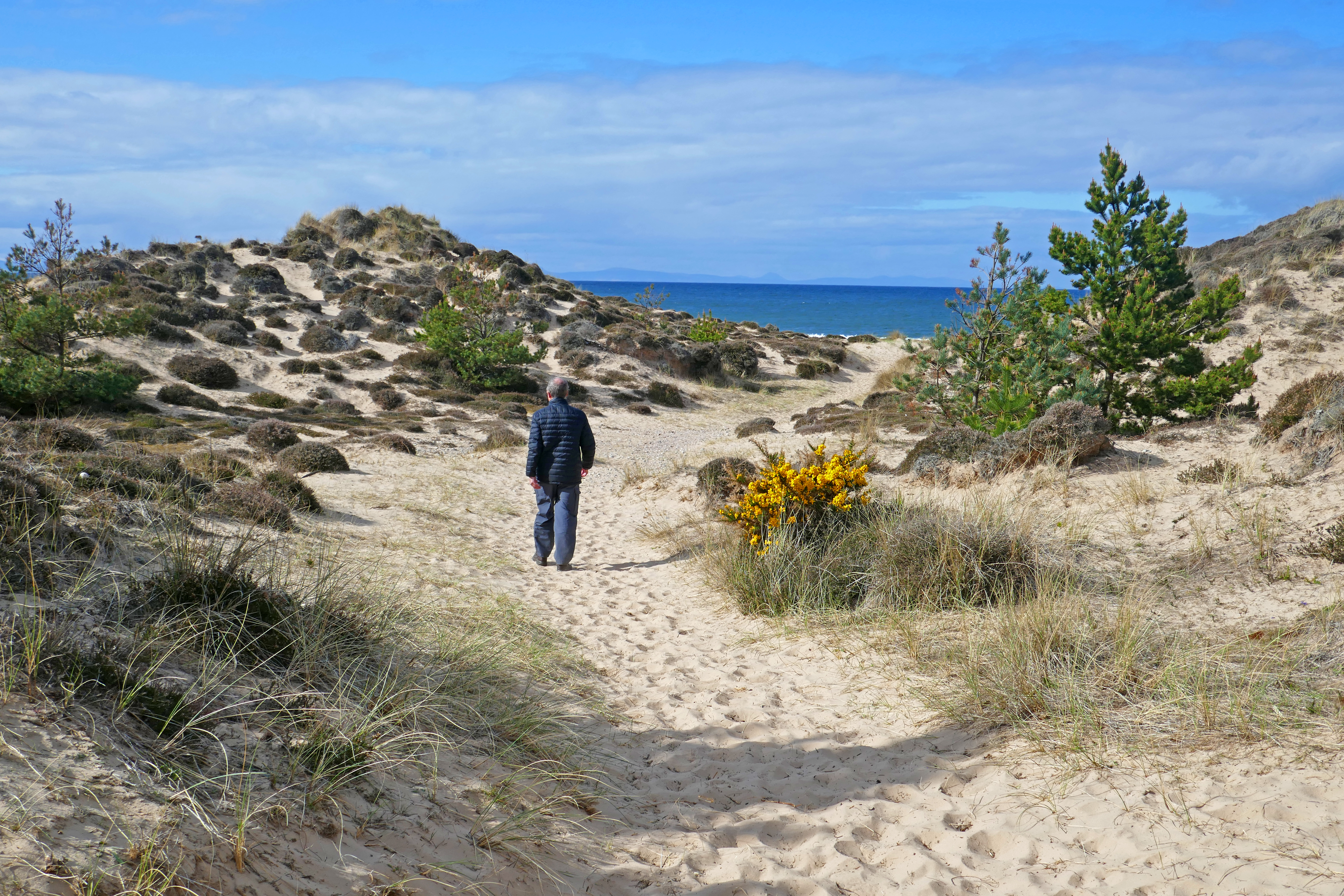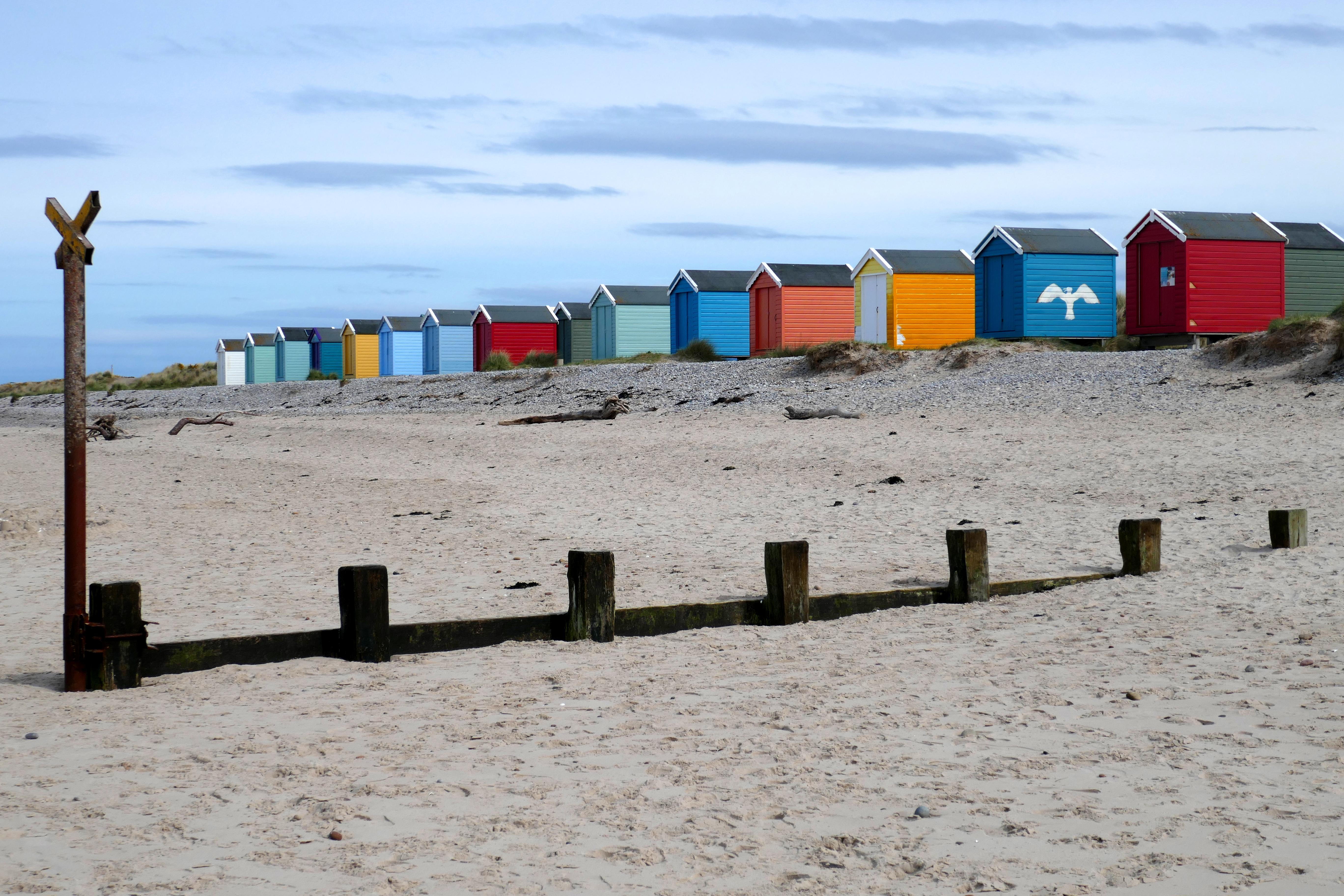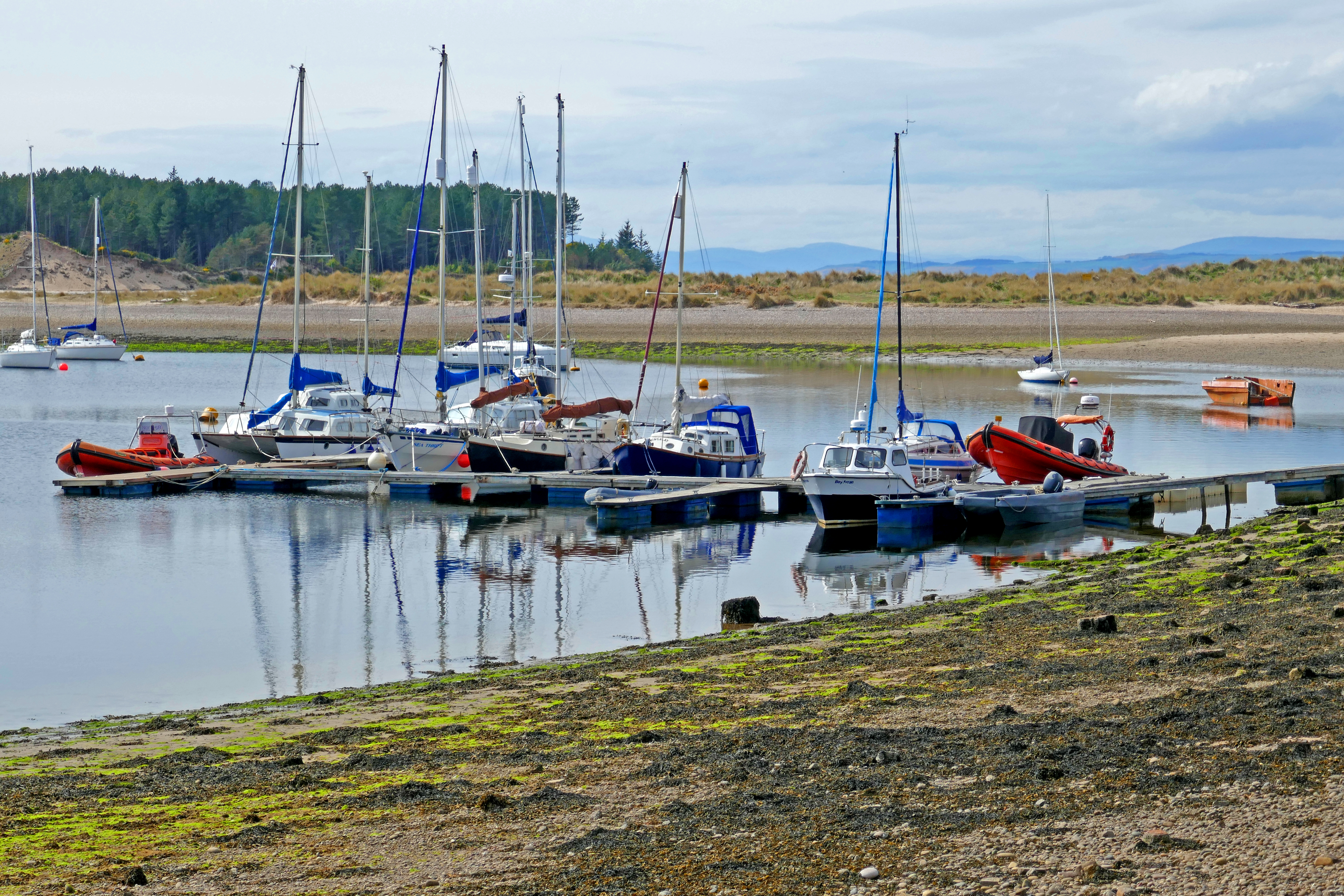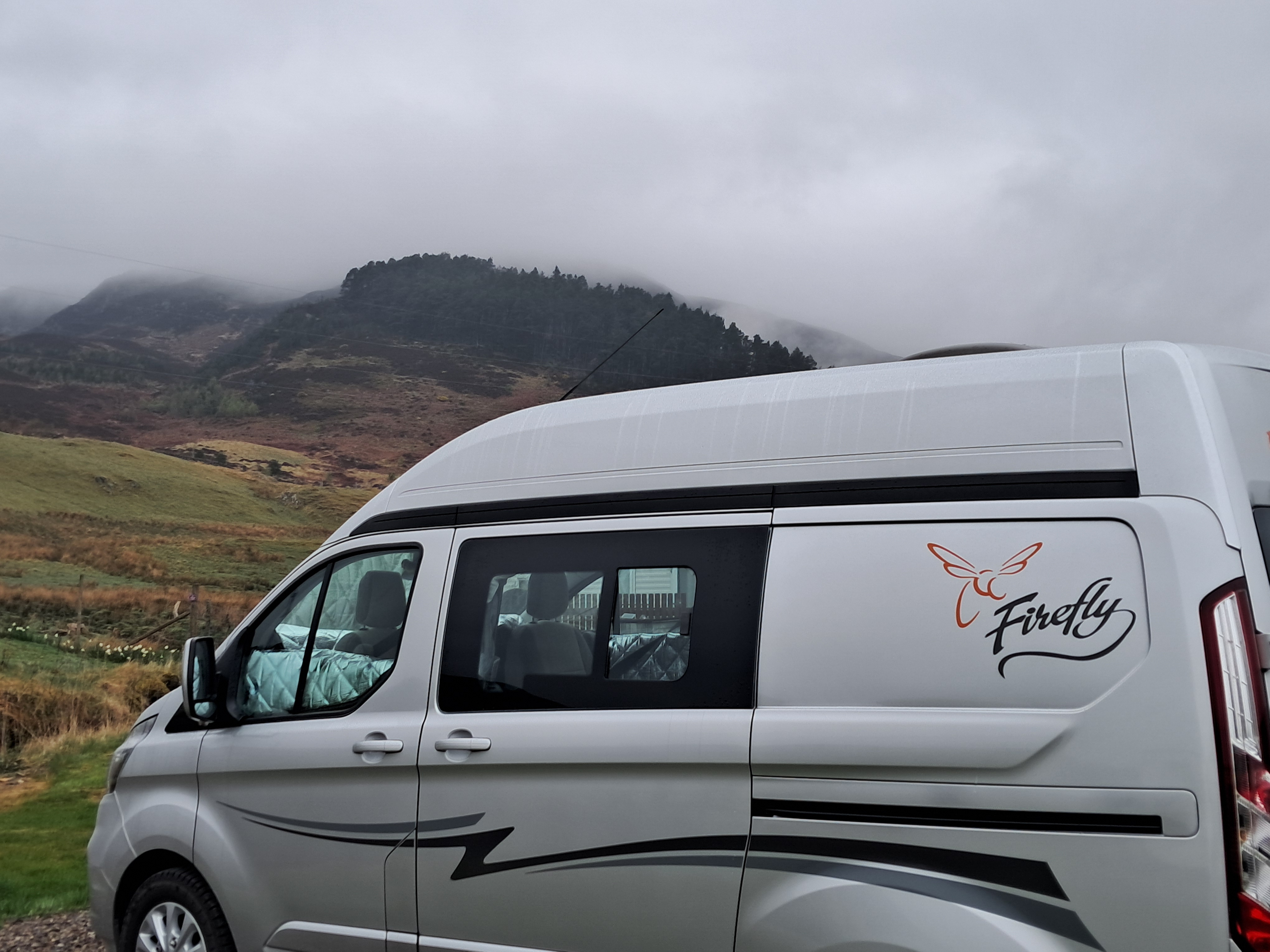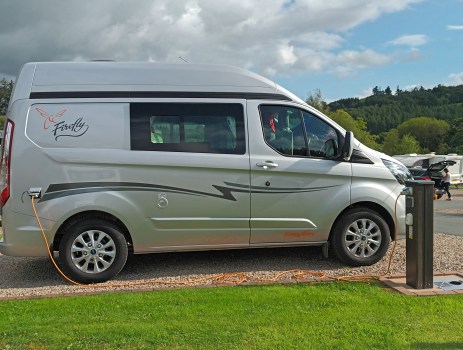
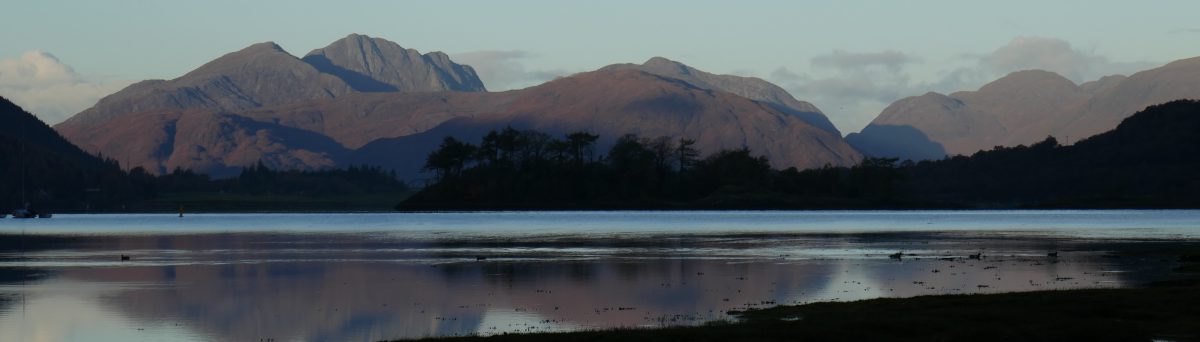
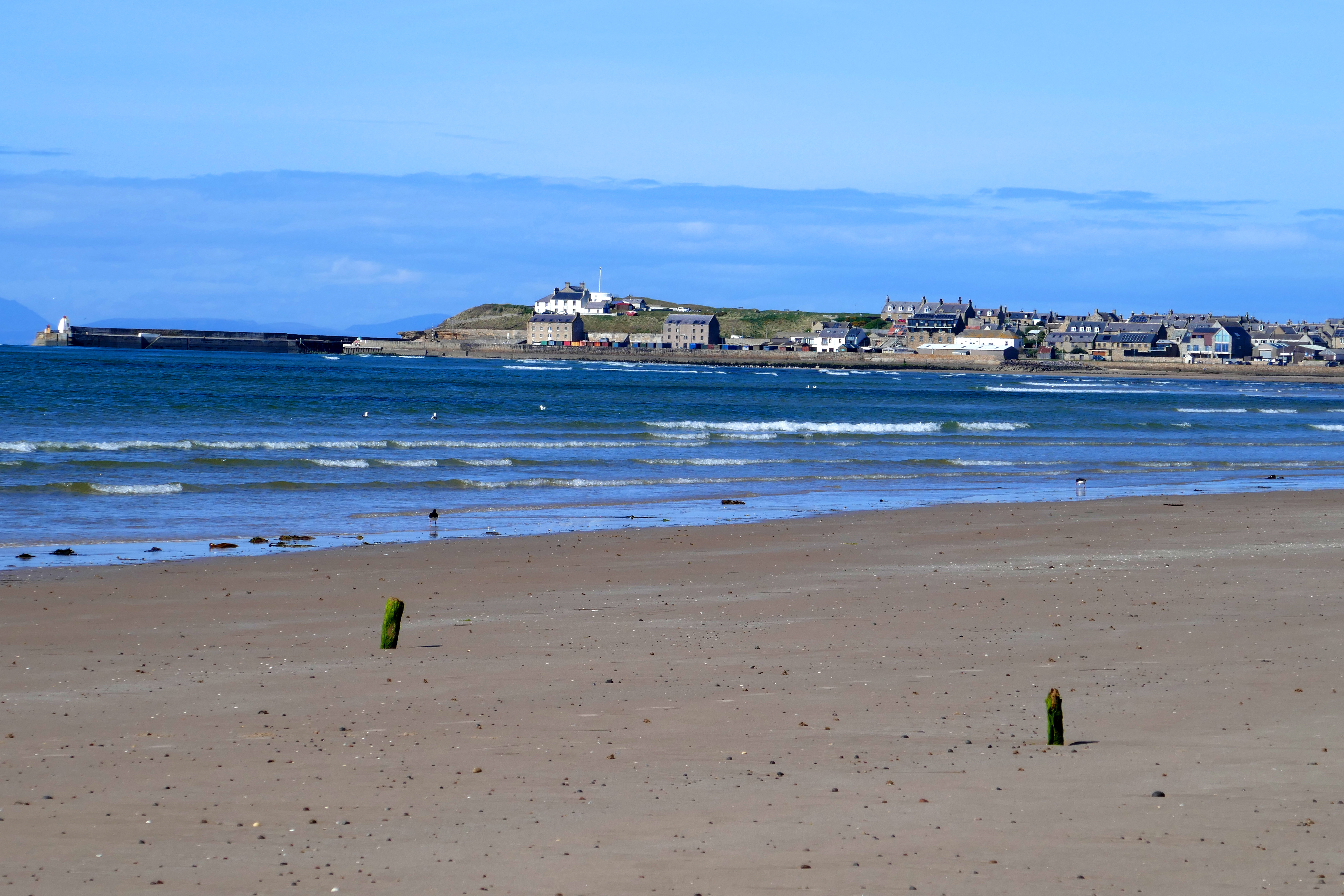
From our pitch I was easily distracted from learning French on Duolingo as a dipper flew along the burn below us and disappeared under the bridge where hardy campers walked to the camping field. Further distractions came with the evening insects, as the acrobatic wheeling of sandmartins around our campervan was so much more interesting than language learning!
This was Glengoulandie, a glen in the hills between Loch Tay in the south and Loch Tummel in the north and about 15 minutes drive from the small town of Aberfeldy. Here, if all this avian activity becomes boring [never!] you can always move your attention to the herd of farmed deer on the hillside.
At Glengoulandie we were camping in a hope-filled future. Back in 2001 when a local upland farm came on the market, the community saw land that was overgrazed with limited biodiversity and wanted to manage it better. Today this land is owned and managed by a community land trust. The centre of the land is the hill across the burn from our pitch, Dùn Coillich, at 572m high. Planting and natural regeneration on and around this hill over the past two decades has already created attractive native woodland and the wildlife has followed. This positive story is being repeated in many other communities in Scotland and carries the burden of my hopefulness.
On our first evening we made the most of dry weather and took a short walk through the deer park, contouring around the slopes of Dùn Coillich and down to the burn. As we strolled our first cuckoo of the year called from the woodland.
Following the paths from the glen
The next day we had planned a longer walk up the hill but the drizzle and low cloud led to a rethink and we enjoyed being lazy in the shelter of our campervan.
By the afternoon, we were ready to stretch our legs and, togged up in waterproofs, we set off on the marked paths around the community land, first following the red route and then the green and white path after climbing the short link path. This was a total of around five kilometres.
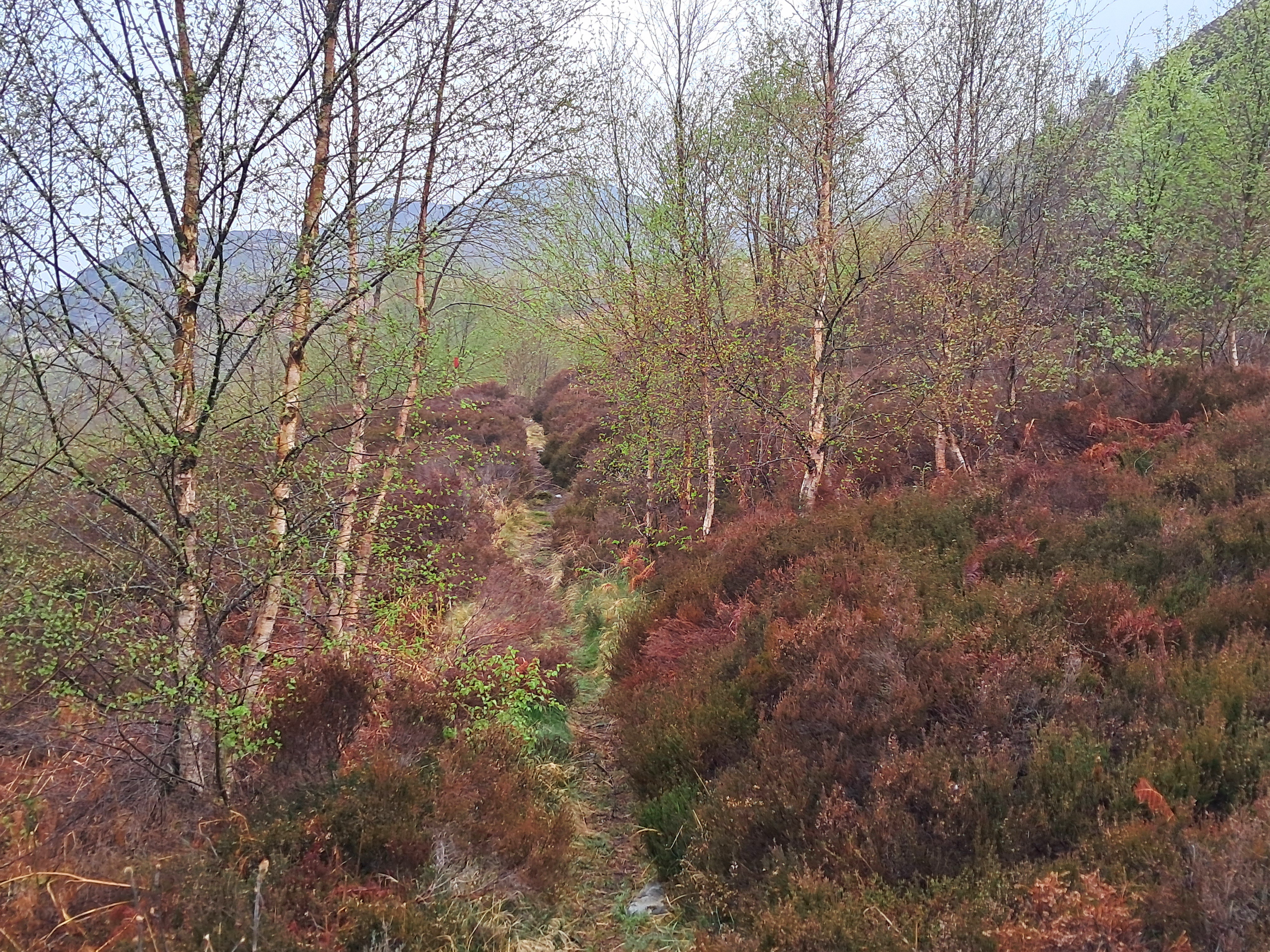
This red route follows an old path above the gorge of the tumbling waters of the Allt Mor, taking us through regenerating woodland of birch and rowan and thickets of sweet-smelling bog myrtle.
Climbing up to the green and white route we were walking through the heart of Dùn Coillich. Even on a damp day the landscape was beautiful and the peace enveloping . The route to the summit branches off from this path but the low cloud put us off climbing higher. Instead, we continued back towards our campervan and reaching the burn we walked on winding paths through delightful lush planted woodland and climbed up to the road to reach the campsite.
Colours on a grey day in Glengoulandie
The regenerating woodland on the community land made Glengoulandie a special place to visit and offers a vision for the future of Scottish landscapes. I am sure we will be back to climb the hill.
The campsite
Glengoulandie Camping and Caravanning is a small site, so don’t all rush there at once! If you like quiet campsites with a laid back feel this will suit you. It has just a few campervan pitches, some static caravans, cabins and space for tents, so with or without a campervan you can stay in this special place. You’ll receive a warm welcome and enjoy hot showers, with adjustable temperature settings. The campsite has a cafe and sells a few essentials but there are no pubs or shops within walking distance.
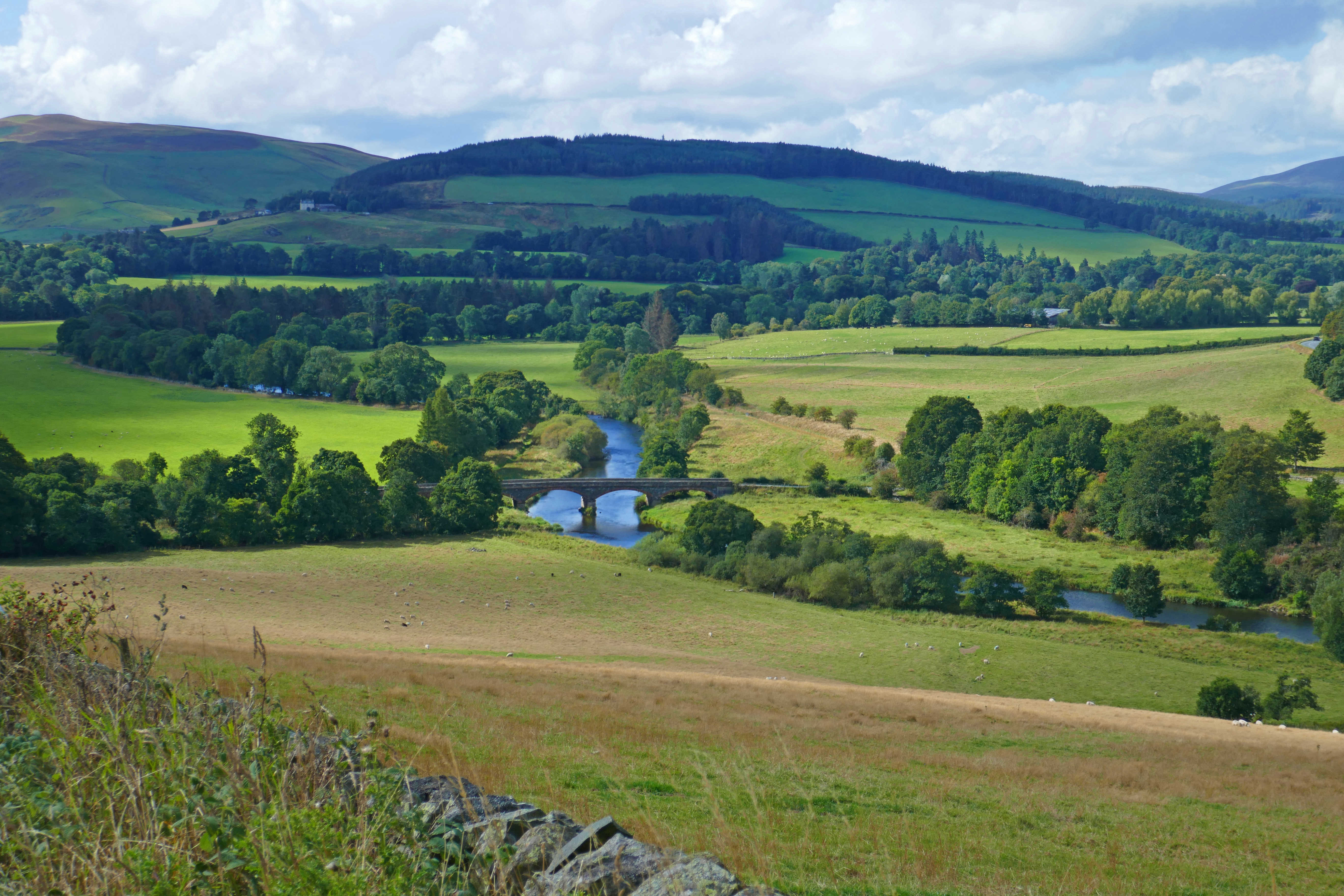
Looking below me and taking in the view in to the steep-sided hollow of The Devil’s Beef Tub I was aware we weren’t far from the source of the River Tweed. The ridge we were following over Annanhead Hill and Great Hill is a dividing line, a watershed. To the south and Moffat I could see the valley of the River Annan as it flows west to the Solway. To the north of the ridge the Tweed flows east to the North Sea. I peered over the trees and grassy lumps and bumps but the young Tweed was still hidden.
The River Tweed runs for 156 kms from the hills above Moffat to Berwick-on-Tweed in England, near the Scottish border. The river flows through the borderlands and some suggest its name comes from an old word for border but this name is also closely associated with a woven woollen fabric. Tweed is often in herringbone or hounds tooth check patterns and has been used for years for coats and jackets.
Moffat
From the high ridge above the unforgettably named Devil’s Beef Tub we descended through restored woodland. Since 2009 The Borders Forest Trust have been bringing back the native woodland, wetlands and heathlands around Corehead, restoring the Ettrick Forest. This already flourishing woodland was delightful walking, with the hillside to ourselves we hiked through varied montane scrub and wildflower meadows, joined by butterflies and bird song. We reached the road at Ericstane from where the walking was long but easy back to Moffat, where we were camping.
When in Moffat we always visit Cafe Ariete, a tradition that began some thirty years ago when we lived in Preston and Moffat was the perfect distance for our first brew stop on any trip north. In all this time the cafe has hardly changed, the coffee is excellent and the breakfasts, lunches and cakes are all tasty and served with a smile. Cafe Ariete is always worth the short detour off the M74!
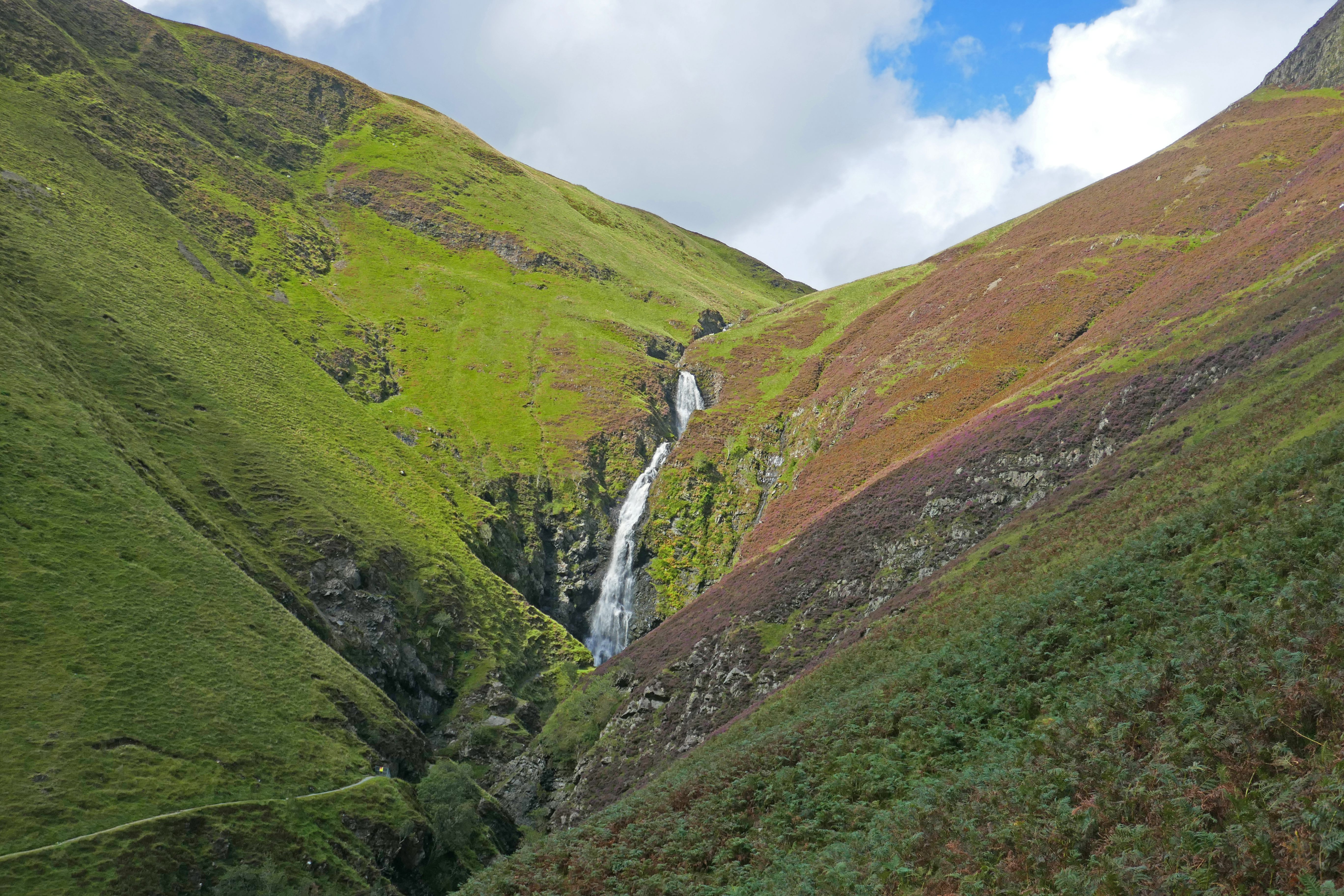
Grey Mares Tail
Grey Mare’s Tail, a waterfall with a 60m drop, is about 20 minutes drive from Moffat. There are two National Trust car parks at the foot of the cascade and from there you can take the short walk to view the falls. We wanted to do more and climbed the steep well-made path above the series of waterfalls. Eventually, the path levels out and meanders through a hummocky landscape to the hidden shore of Loch Skeen, a mountain loch surrounded by crags.
This trip had been planned to follow the River Tweed and we picked it up on the road to Peebles, stopping at Dawyck Botanic Gardens, one of four botanic gardens in Scotland, including Edinburgh. The woodland garden of Dwyck climbs the hillside from the River Tweed floodplain. The landscaping has created a network of sinuous paths among the trees and along the stream, dotted with sculptures and information boards about plant collectors and notable trees. It is a joyful place to visit and worked well on a sunshine and showery day; we could run back to the cafe when dark clouds loomed or shelter under a huge redwood. In September the autumn crocuses were flamboyant and there were early signs of leaves turning.
Peebles & Innerleithen
We had planned this trip after stopping in Peebles briefly last year. It seemed such a lovely small town we wanted to get to know it better. The next morning we parked by the river and walked into the town, filling our bags with goodies, including Selkirk Bannock, from the bakery, browsing the charity shops and enjoying coffee in one of the many cafes.
Our circular walk from Peebles along the River Tweed was only six kilometres long but packed in so much, including natters with friendly locals! From the riverside path we spotted a kingfisher and dippers and had views of Neidpath Castle. On the opposite bank we joined centuries of walkers crossing the hump-backed Old Manor Bridge and climbed uphill, stopping to enjoy the views over the Tweed valley. Our descent through the shady lushness of South Park Wood eventually took us to the old railwayline and back to Peebles.
A little further downstream is the small town of Innerleithen, a spa town and former woollen mill centre. We explored the lovely town and its history and were surprised to meet a local with a grumpy dislike of Peebles! Climbing Pirn Hill [apparently known locally as Windy Knowe], we found a set of stone cairns topped with carved tablets on the Iron Age hillfort site. The view over the town and the Tweed valley is well worth the exertion and I can confirm, it is windy!
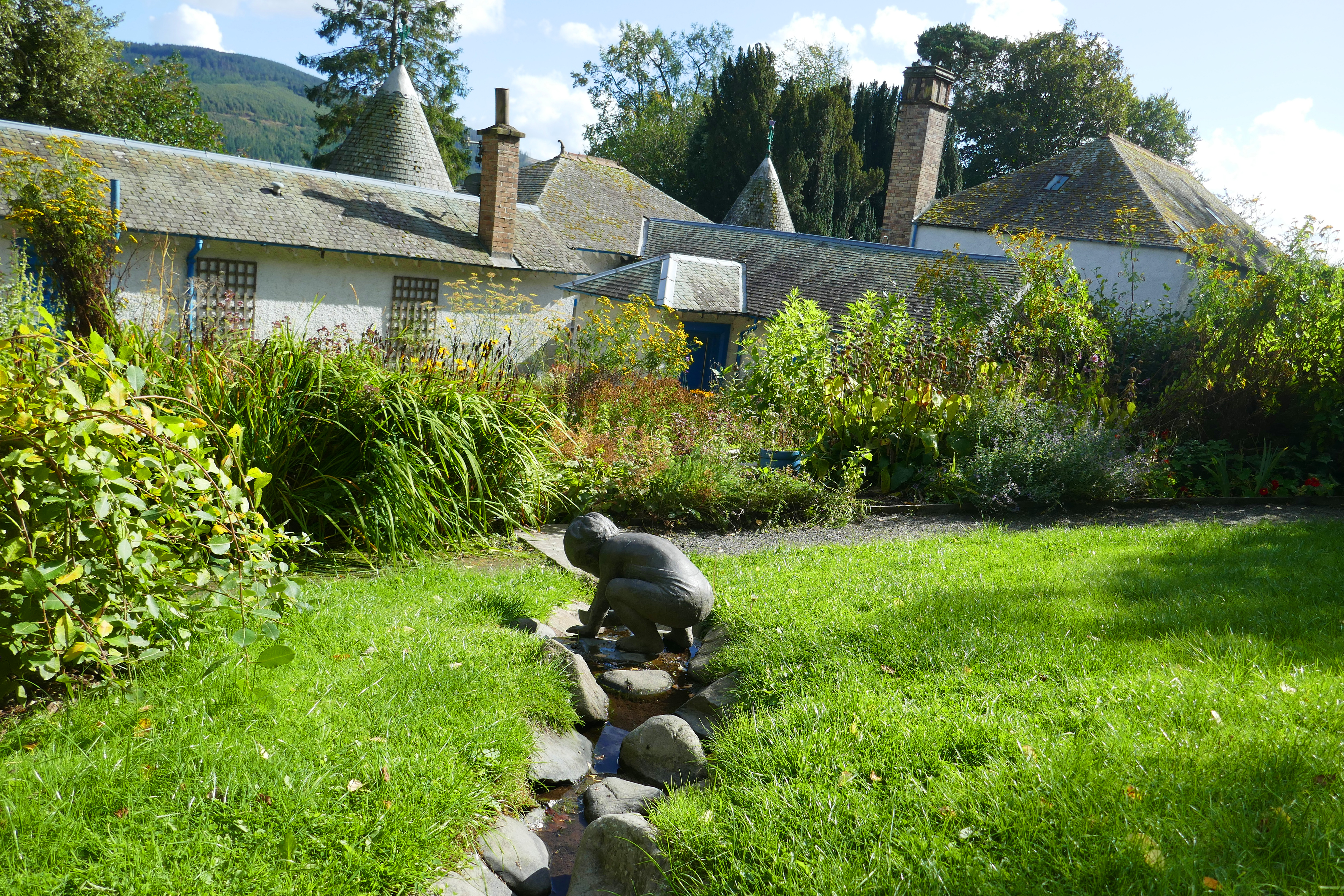
The garden at St Ronan’s Well
Back in the warmth of the valley, we made our way to Innerleithen’s St Ronan’s Wells. The elegant and colourful 19th century pavillion is unmissable on the hillside. In the past two Scottish writers provided advertising for the health-giving properties of the local springs. Robert Burns wrote about the spa during his 18th century travels and Walter Scott’s novel St Ronan’s Well in 1823 encouraged literary tourism. Behind the pavillion we found an idyllic community garden. Full of flowers and herbs, insects and butterflies, with a trickling spring running through it, the garden has winding paths, seating areas and the love that created it seeps from every leaf.
Selkirk
Selkirk is a hilly town that sits on Ettrick Water, a tributary of the Tweed. It is a thigh busting walk from the campsite at the leisure centre to the town, but worth it for the good and ethically-sourced coffee from Three Hills Coffee on the main street.
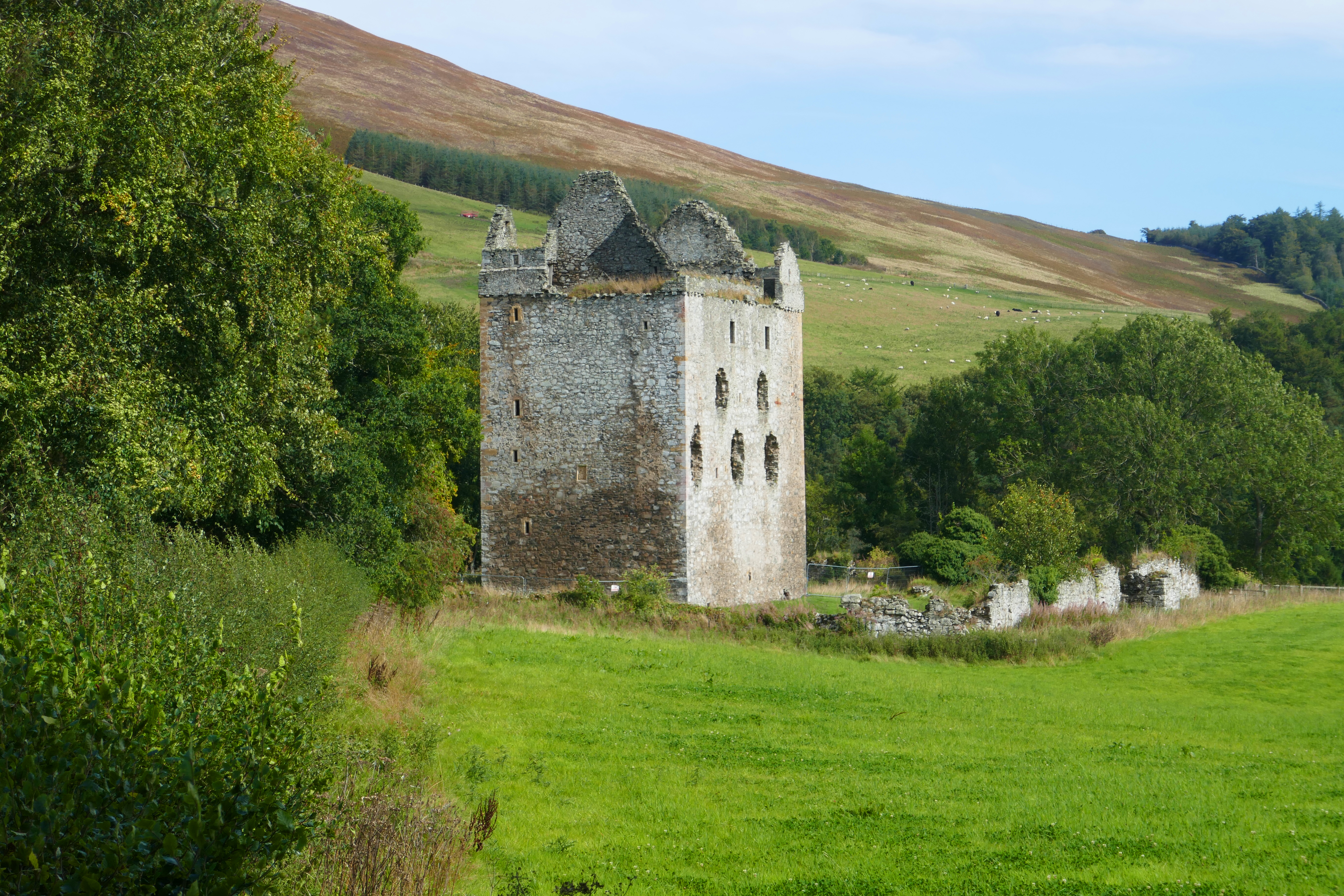
The sun was shining and we planned to complete the Three Bretheren Walk, a classic hike near Selkirk. However, the small car park was packed by the time we arrived. Checking our trusty Walk Highlands app we drove the short distance to Bowhill Estate. The Duchess’s Drive route on the Bowhill Estate was designed for showing off the land to visitors, ascending through woodland to the open moorland. Although on good tracks, the walk was more exhausting than we expected but full of variety and good views across the lumpy Borders countryside. We returned to the car park by the ruins of Newark Tower, whose white stones were bleached by the sun.
Newark Tower at Bowhill
Melrose
We picked up the River Tweed again at Abbotsford, the home of the writer Walter Scott. The large rambling house looks interesting to visit but we concentrated on walking up to Cauldshiels Loch, returning along the bank of the secluded Faldonside Loch before completing our circuit on a woodland path along the River Tweed.
In Melrose we visited the abbey, although due to works being carried out we could only walk around the outside, admiring the red sandstone that blushes when caught by the evening sun. Nearby are two National Trust gardens, Harmony House and Priorwood and, keeping an eye on the weather as showers were heading our way, we sauntered through these two walled gardens. They were both well-stocked and interesting, still full of colour and scents even in mid-September. Priorwood Garden also has an orchard and a stall selling produce from the gardens.
We had planned to spend some time at Berwick-on-Tweed, completing our trip along the River Tweed. However, stuff at home unexpectedly got in the way and Melrose was as far as we got. Until next time!
Faldonside Loch near Abbotsford through the trees
Walking details
Unless otherwise noted, the walks can be found on the Walk Highlands website and app.
The full Devil’s Beef Tub circuit from Moffat is 22.5 km with 521m of ascent. We used a taxi [Moffat Taxis] to get us to the Devil’s Beef Tub viewpoint on the A701 [£10] and walked along the ridge and back to Moffat, reducing the exertion to approximately 15.25 km of walking and only 230m of ascent while retaining lots of interest.
Grey Mare’s Tail and Loch Skeen in the Moffat hills, this 4.5 km walk with 278m of ascent climbs past the series of waterfalls and on to Loch Skeen that is overlooked by craggy hills.
Neidpath Castle and the Tweed walk from Peebles is 6.25 km long with just 89m of ascent. Kingsmeadows car park in Peebles is a large car park and has motorhome spaces.
Pirn Hill Fort Trail in Innerleithen is 2.5 km long with 79m of ascent. Parking is available in a roadside parking area near the entrance to the paths.
The Duchess’s Drive, Bowhill is 11.25 km and 339m of ascent on easy to follow tracks and lanes. There is good parking on the Bowhill Estate for a small charge. The walk is through woodland and across moorland and on lanes by Newark Castle.
Abbotsford has a leaflet of walks you can download, with routes from 2 to 10 km. The Cauldshiels Loch walk is 6.5 km long and takes about two hours from the car park. It was mostly easy to follow, although we did resort to our OS maps as we descended to the River Tweed.
Tweedside Caravan Park at Innerleithen – this site on the edge of Innerleithen has a small touring area, surrounded by static caravans.
Selkirk Victoria Campsite – on the edge of Selkirk, the pitches are marked out on the tarmac car park at the community-run leisure centre. Campers have keycode access to move the height barrier and access to the three shower rooms and a wash-up sink.
Lilliardsedge Holiday Park – in the countryside between St Boswells and Jedburgh, this is a large site with many statics and a tidy touring area of hardstanding pitches. The site has a restaurant and golf course.
Looking across The Bay from the memorial to the cockle pickers who died in February 2004
From Sunderland Point on the estuary of the River Lune in north Lancashire to Walney Island by Barrow-in-Furness, the coastline of Morecambe Bay meanders and loops for around 60 miles, encompassing a large intertidal area and home to many creatures. The tidal range of up to 10 metres transforms the view twice a day, revealing sand banks, skears [banks of stones] and channels. Towns and villages fit in among the sandy beaches, salt marsh, shingle and crags. Everywhere you have a view of sea and sand and a backdrop of hills, either the Lake District fells or the distinctive limestone hills to the south.
From our home in Morecambe we set out to walk around The Bay in a series of day trips over the years, usually using buses and trains. This post covers Sunderland Point to the Cross Bay walk from Arnside to Grange-over-Sands.
Sunderland Point to Middleton
The number five bus takes us to the village of Overton, south of Morecambe and the closest we can get to Sunderland Point by public transport. From Overton we like to climb up to the trig point first for the view across the causeway to the village. The tarmac tidal causeway travels about 2.5km over muddy channels and salt marsh to the village of Sunderland Point. This can be accessed at low tide but is covered by water at most high tides. You can check the tides and access here. Cars can also park at Potts Corner and you can walk to Sunderland Point from there.
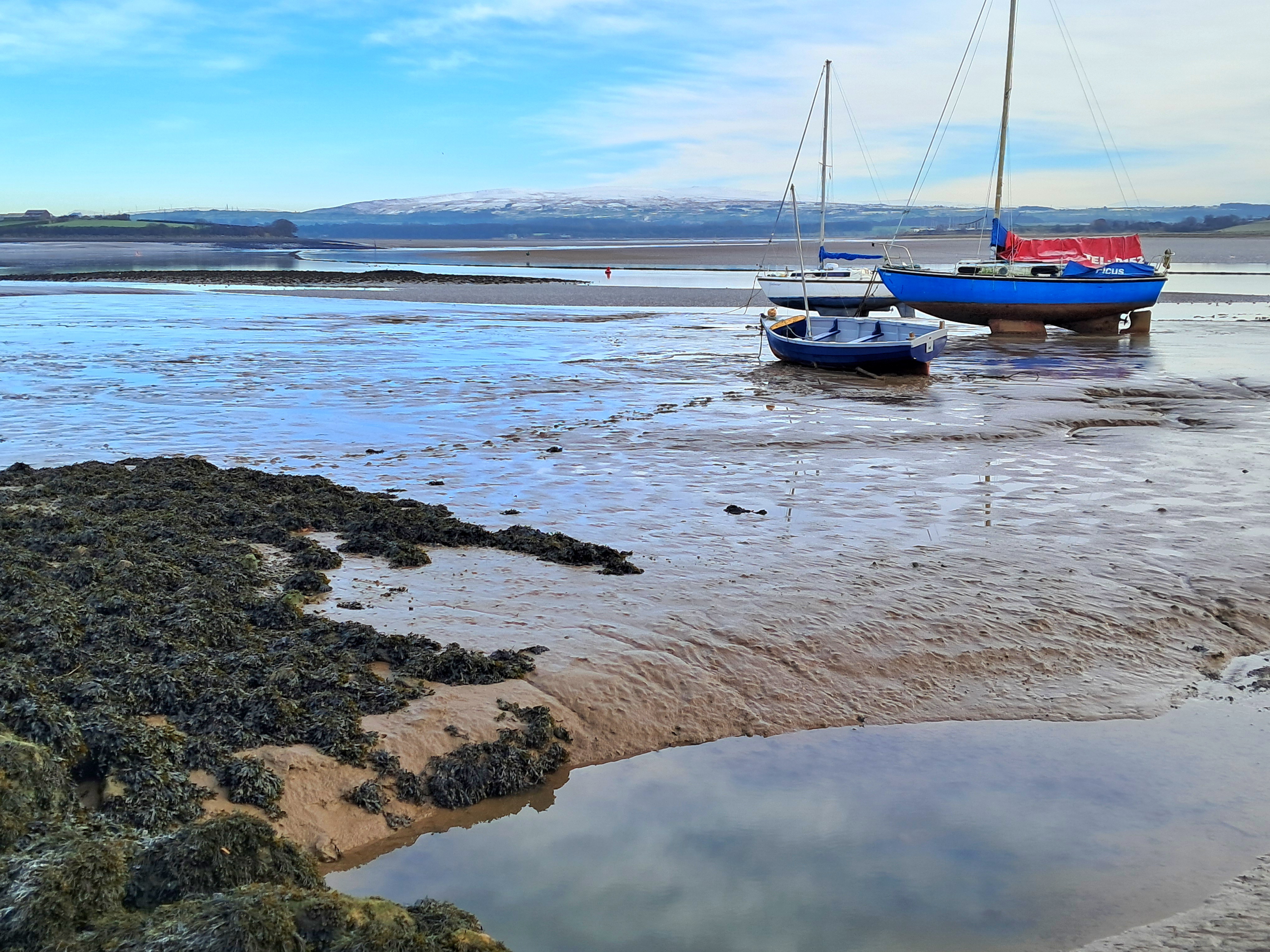
I look and listen for birds as we approach the boats and attractive terraces of 18th century houses that make up Sunderland Point, at the southerly end of Morecambe Bay. Each house has a history dating back to the days when this was a busy port. The last house, The Old Hall, is the oldest in the village, built in 1683 for the Pearsons, merchants who traded in cloth, coal and felt hats in the colonies in return for tobacco.
Boats on the River Lune at Sunderland Point
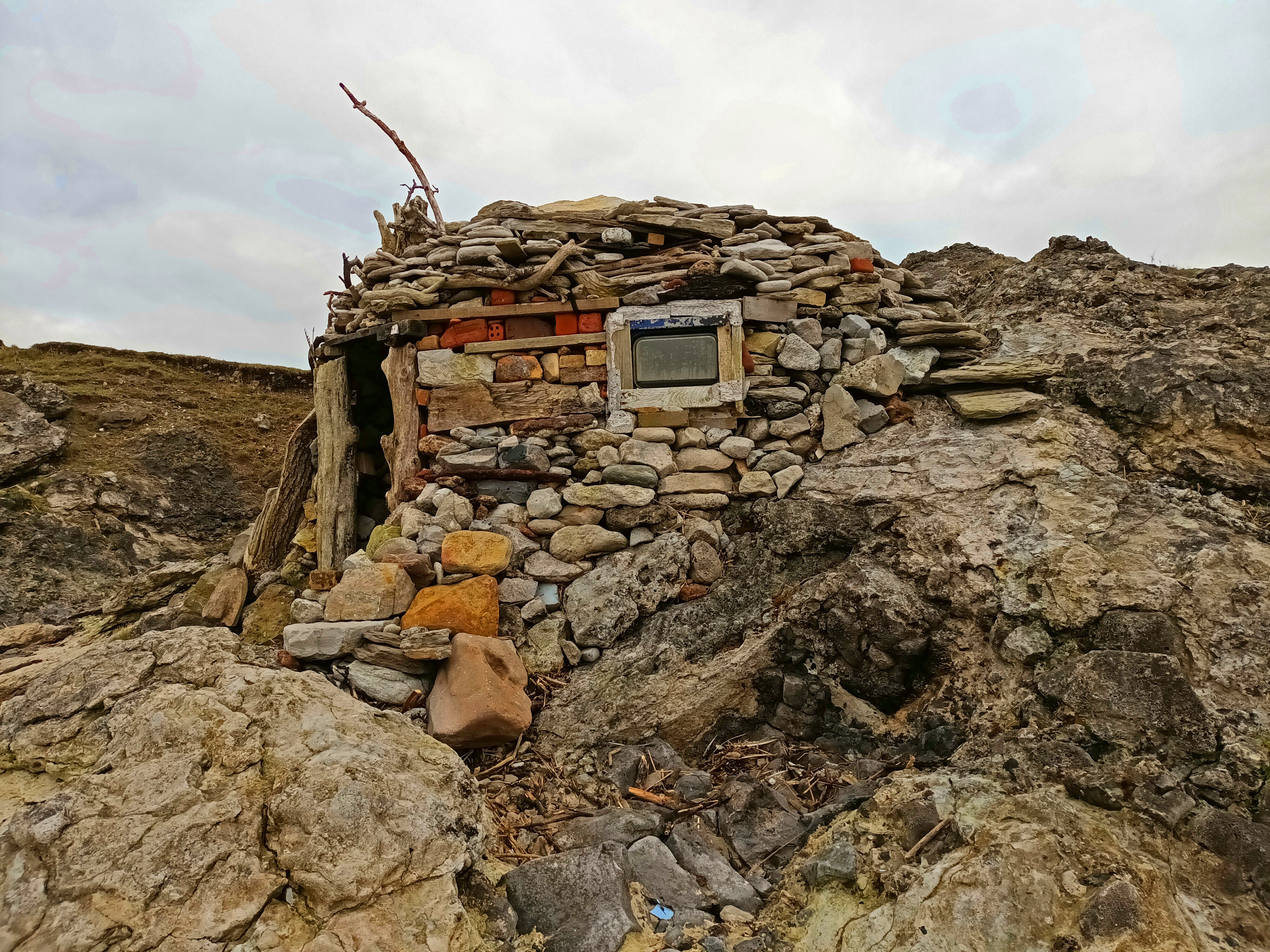
Stumbling along the stony shore you will notice Plover Scar lighthouse and Glasson Dock across the Lune. If the weather is clear you might see Blackpool Tower. Turning around the point to head north you soon reach the Bird Hide and Horizon Line Chamber, an stone domed installation. Go inside and see an inverted view of the Bay. Just beyond stop for a moment at the grave that is thought to commemorate an enslaved black African, who died in 1736, shortly after his arrival here.
You can take the path to cross back to the village here, but to walk more of the coast we continue along the track to Potts Corner. The shoreline always throws up driftwood and shells and we often see egrets feeding in the winding salt marsh channels. Holiday parks take up the coast for a short distance and we head inland on the narrow lane that meanders back to Middleton where we pick up the next bus back to Morecambe.
Heysham to Morecambe
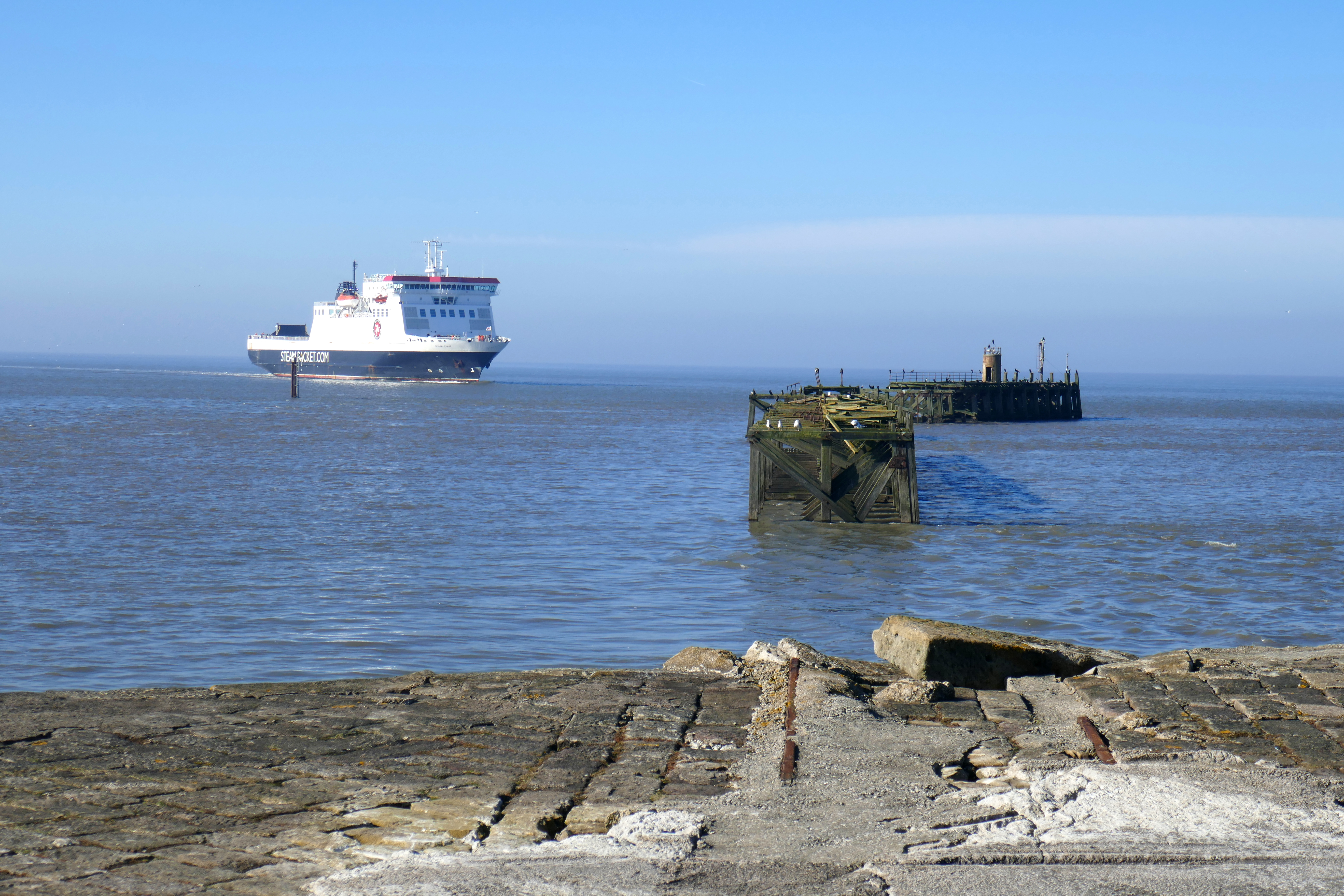
Using the regular bus to Heysham Towers we make our way towards Heysham Port and turn down Moneyclose Lane towards Ocean Edge Caravan Park. After 350m you can turn right off the lane and pick up the paths in Heysham Nature Reserve. These paths are popular with dog walkers. Follow them around the two nuclear power stations to the coast and turn right on to an airy concrete walkway. This stretches about 1km to the lighthouse at the mouth of Heysham harbour. At high tide on a fine day there is no place quite like this; the sea is at your feet on your left while the nuclear power station hums to your right. We were lucky to catch the Isle of Man ferry coming in on our first visit and waved at the captain, who returned the greeting.
Retracing our steps we skirted around Heysham Harbour on the roads to rejoin the shore at Half Moon Bay. The Ship sculpture here is a stunning piece, with two opposing figures on the ends of an outline of a ship’s hull. Paths wind around the grassy headland covered in gorse that rises to the ruins of St Patrick’s Chapel and the much photographed rock-hewn graves.
The paths take you back to Heysham by the picturesque St Peter’s Church, which dates from the Saxons. The view from the churchyard over Morecambe Bay is breathtaking and, if the church is open, pop in to see the Viking gravestone. The nearby Royal is a cosy pub and perfect for refreshments before joining the promenade and walking to the stretch to Morecambe.
The Isle of Man ferry coming in to Heysham Harbour
Morecambe to Carnforth
This is a favourite walk that we can easily do from home. We take the bus to Carnforth and walk back along the coastal path, beginning along the mouth of the River Keer and then skirting the salt marsh to Red Bank Farm. In winter, depending on the tide, there will be plenty of birds including oystercatchers and lapwing.
Just beyond Red Bank Farm is the moving memorial to the cockle pickers who died in Morecambe Bay in February 2004, a reminder of how dangerous the tides can be. Morecambe Bay’s tides move in with speed, along channels and around sand banks and skears in unpredicatable ways. Add river channels and quicksands and you have sands that deserve respect.
From the grassy bank lined with wind-blown trees, the path returns to the shore and can be rough with large pebbles, but it is hard to get lost, all you need to do is keep the sea by your side. There are also lots of places to stop for refreshments. Bay View Garden Centre near Bolton-le-Sands is hard to beat for the view and they serve good food. Red Bank Farm has a cosy cafe, there is a cafe at Hest Bank by the railway crossing and another as you leave the stony shore before the promenade and Morecambe. This walk also has plenty of benches for outdoor picnics.
Reaching the Promenade in Morecambe you will pass the beautiful Venus and Cupid statue. I always stop and admire this statue, finding new meanings each time.
Venus and Cupid
Carnforth to Silverdale
Both Carnforth and Silverdale are on the train line that skirts Morecambe Bay, making this linear walk easy to plan.
From Carnforth you can head straight up Warton Crag but an interesting diversion awaits on the coast beyond the Warton Stock Car Club circuit. Take the road towards Warton, turning off after going under one railway bridge, after another railway bridge you cross the River Keer. Follow the tarmac lane by the railway line and at the end turn left and walk on tracks around the farm and the race circuit, a busy and noisy place on race days but usually quiet. Beyond here you will find an unusual coastline formed by slag heaps from the local iron works that operated from the 19th century up until 1929. There were once five blast furnaces working here and these coastline peaks and iron-red rocks are what remain, now beginning to blend in with the surrounding salt marsh. Explore as much or as little as you wish.
Along the coast from Carnforth
Retracing our steps, we continue through Warton village to climb Warton Crag. If you want refreshments there are a couple of pubs in Warton and a brewery that sells their own beer and food.
There are many ways up Warton Crag and you can choose your own. We like the stony path that is by the picnic site at the top of Coach Road. This takes you steeply through the woodland to a bridleway and possibly drovers road known as Occupation Road. Leave the track on one of the paths to the left to reach the top of Warton Crag. There isn’t a view from the trig point but just nearby you will stand on a limestone crag and have Morecambe Bay laid at your feet, from Heysham and the distinctive power stations to the south to the outline of Barrow-in-Furness across the Bay.
Warton Crag is criss-crossed by footpaths and one will take you back to Occupation Road and turning left you will reach a lane. Turn right to Crag Foot and there turn right and right again for Silverdale railway station opposite the golf club.
Looking across Jenny Brown’s Point to Grange from Warton Crag
Silverdale to Arnside
Once again the Furness Line railway helps linear walkers. Silverdale railway station is some distance from the village but the walk there is superb. Dodging the traffic for a short distance going left from the station, you can pick up a woodland path down to Jenny Brown’s Point. Check the tides, as parts of this path can be under water when the tide is very high. If necessary you can take the lanes to the point.
Jenny Brown’s Point is a special place for many. There is a sense of space on the point, with woodland behind you and Morecambe Bay spread out before you. A tall chimney stands on the shore and channels wind through the sands at low tide. The chimney is probably the remnant of a metal furnace here in the 18th century. Morecambe Bay Partnership have an excellent booklet about the history of this area that you can download here.
From Jenny Brown’s Point paths and a lane wind round the coast to Silverdale. The Silverdale Hotel is an excellent spot for refreshments but don’t linger too long as this is a 12km walk and there are plenty of highlights to come.
Just after the hotel pick up a path across a meadow that takes you to The Cove, another picturesque spot. From here you’ll need to take the road past the caravan site, but it is fairly quiet. There is a path from the Holgates site entrance if you prefer and there is a cafe here too. The road to two more caravan sites on your left gives you access to the coast path around Arnside Knott.
This is a stretch of coastline as delightful as any you will find. The woodland hugs the craggy coast and the sounds of the sea mingle with woodland birds. You will walk above occasional sandy and pebbly bays with views across to Grange-over-Sands. If you’re lucky you will feel as if you have this stretch of coast to yourself and you’ll find a spot to linger.
Turning the corner to the Kent Estuary you cross a boggy area on a good track and then follow the shore to Arnside’s front. Arnside is a popular village with visitors and there are plenty of pubs and cafes.
The Cross Bay Walk
This unique walk isn’t something you can do on your own but it is the best way of understanding what Morecambe Bay is all about. A guided walk across the sands is a safe way to enjoy this experience, so check out the dates for the guided walks and book one.
Using the train makes lots of sense for this walk, as you start in Arnside and finish in Grange-0ver-Sands. The length of the walk varies depending on the tides, quick sands and river channel and the number of fellow walkers depends on the weather and the number of charities involved. We have completed this walk three times now and I have enjoyed it every time.
The walk does involve paddling through the River Kent. It is fun, exhilarating and at moments I stop and look around with awe. Land can seem a distant apparition from the midle of Morecambe Bay and I have a sense of being lost in sand and water. Before the railways this route was used frequently and I often think of the bravery of those travellers from the past crossing to head north or south. Fortunately, the Kings guide, Michael Wilson, is experienced and I always feel in safe hands.Â
A string of people walking across Morecambe Bay
With thanks to The Gathering Tide, A Journey Around the Edgelands of Morecambe Bay by Karen Lloyd.
Grassington is always a buzzing village, but on our last visit the throng were in high spirits. A film crew were in town and the usual paved streets were covered in earth and shop windows had drab displays that lacked elegance and light. We learnt they were filming the latest All Creatures Great and Small, the cosy 1930s veterinary TV drama and time in Wharfedale was being wound back almost 100 years.
We stayed almost in the present, browsing the second-hand book shelves in the library for a couple of bargains and grabbing a coffee in a cafe with a 21st century coffee machine before climbing the hill out of the pretty, but hectic, village. We were focussed on completing a favourite walk that has open views over Wharfedale, a craggy hill, a scramble down [or up when we walk in the opposite direction] a dry gorge and numerous stiles over dry-stone walls.
We had started at the Caravan and Motorhome Club Wharfedale site, which is about a 40 minute walk from Grassington. We stay on this campsite regularly and it was an obvious place to use the free overnight voucher the club had sent to members.
From Grassington’s narrow streets we picked up the Dales Way [an 80-mile long distance footpath from Ilkley to the Lake District] on a track that soon opens out to grassy paths across the open moorland. It was a bright spring day and curlew were flying across the moor, their exuberant bubbling call making me smile and evoking memories of previous spring walking days.
The light was so bright it dazzled and the sun had that remembered warmth that gets lost in the dark of winter. A stiff breeze searched out gaps in our clothing, making sure we didn’t get sweaty and another walker wearing shorts had cold-red knees! Below us the River Wharfe’s green flat valley floor was dotted with stone barns.
Leaving the edge of the dale, the moorland is almost treeless, only occasional bushes and trees, still unclothed and baring their winter branches, have managed to avoid the sheep and achieve stunted growth from a gap in a limestone crag. The blue sky is cloudless and vibrant but the startlingly bright March sun washed out any colour in the grasses and rushes. The air tasted fresh and sharp and I breathed in deeply, trying to store the memory of it.
Skirting around the top of Conistone Dib, a dry limestone valley, we continued to Conistone Pie, a flat-topped limestone outcrop that someone once thought was shaped like a pie. In March the sun is still low and on the northern edges of the outcrop the rock created shadows but the south-westerly wind blustered around the sunny side. We circled the outcrop until we found a just-right spot for our lunch and sat with a view over Yorkshire.
After eating, we doubled back to descend Conistone Dib. This dry limestone valley was most likely formed by glacial meltwaters after the last ice age. Whenever we walk here I stop and shut my eyes, imagining the lively stream that once flowed over the crests of the now-dry waterfalls and became tumbling rapids. I can hear the pulse of the clear water as it falls over rocks. After a grassy and less steep section, Conistone Dib narrows and it is even easier to imagine the long-gone waterfall funnelling into the narrow channel, eroding a plunge pool before carving a deep twisting gorge through the limestone. The sun glanced over the gorge and we were walking in shadowy blue depths. Then suddenly, we emerge from Conistone Nib and are once again bathed in bright sunshine as we walk through the village and over the River Wharfe.
We stopped for drinks at the cafe by the fishing lakes and shared a cake. We were looking across to Kilnsey Crag, the limestone overhang that is another glacial remnant. Our final climb of the day was up the track to Kilnsey Moor. The grassy path that cuts across to Malham Moor always has lapwings in the spring and it didn’t disappoint. We followed the quiet lane back to the campsite enjoying the golden evening light after covering about 19km over around eight hours of perfect leisurely walking.
The short read – This is a tidy and peaceful campsite near Stirling and sitting in woodland just south of the village of Doune. With local walks and a farm shop and a castle nearby. it is perfect for a few days away in the ‘van.
We like the campsite and often use it as a one-night stop on the way north or south. Last time we decided to stay longer and explore the area.
The Campsite
Most of the pitches at Blair Drummond are within a sheltered walled garden. This was particularly welcome on our last visit as a gale blew across Scotland from the west. There are pitches around the outside of the walled garden too, but we have never tried any of these as we like the feel of the walled garden. The pitches are level and the hardstanding is surrounded by grass with tarmac roads around the site.
Everytime we have visited, the reception staff have been friendly, welcoming and helpful. They will give you a campsite leaflet with ideas for things to do and information about two walks, a long and short walk. It was this leaflet that inspired us to stay longer. Reception also has a small shop for basics and it is only a short way to a farm shop [see below].
The site has one facilities block. This is modern inside and kept clean. It is often wintery weather when we visit and we appreciate that the building is kept warm and the showers are good.
Things to do
The Short Walk – The campsite’s short walk through woodland will take you on winding paths through a woodland garden and eventually to the Smiddy Farm Shop, where you can grab a quick brew or lunch as well as buy good food. On our last visit we spent our first afternoon spotting spring flowers on this delightful walk. It was a sunny but blustery day and daffodils and primroses were emerging from the mossy ground. The route meandered among trees, up to an obelisk and around a cemetery.
Doune – This longer walk of around 9km is fairly level and easy. If you prefer to drive, there is a handy Park and Stride car park on the edge of Doune on the A84. The walk to Doune is mostly on tracks through the estate and takes you by Quarry Loch and the River Teith, with views of the castle. In the village there are a few shops and an information and heritage centre and the activities below. A stroll around the village might take you around the castle and over a stunning modern wooden bridge.
We are generally more informal teashop than hotel people but The Woodside Hotel advertised itself as unpretentious so we gave it a go. Even two scruffy campers were welcomed with a smile and this turned out to be a comfy place for coffee and scones.
Doune Ponds Nature Reserve, flooded gravel pits surrounded by woodland can be accessed from the Park and Stride car park, making it perfect for a stop and leg stretch on a longer journey. The reserve is taken care of by volunteers and there is a network of paths as well as benches for picnics and wildlife watching. Cross the A84 from the same car park and you can walk through woodland to the River Teith, opposite the distillery.
Doune Castle is certainly worth a visit. This solid castle was used for filming Monty Python and the Holy Grail in the 1970s and has been on our must-do list for years. At the entrance we were given an audio guide narrated by Python member Terry Jones. In his warm, comedic style Terry introduced us to the castle’s 14th century builder, Robert Stewart, the First Duke of Albany and the power behind the Scottish throne for years.
Doune Castle doubled up for a number of locations in the film and, along with the history, Terry Jones narrates stories from the shoots, interspersed with clips from the film. We were soon reminiscing and giggling in a corner of the sunny courtyard looking up to the battlements where they filmed the scene of a guard insulting Arthur and Sir Galahad. Doune is also Castle Leoch in Outlander and there is an audio guide for fans of that TV drama.
Even without a film interest Doune Castle turned out to be one of my favourite castles to visit. The Great Hall is impressive and I could picture lavish and rowdy dining here. I’m fairly sure if I had been a medieval woman I would be a kitchen maid and the castle kitchen has an intimidatingly large fireplace, easily big enough to roast a small and inept kitchen maid! We both found the grooves in the stone where cooks sharpened their knives and puzzled over the unusual double fireplace in the Duke’s Hall while in our ears Terry Jones mused on whether this was an early version of the two-bar electric fire.
We finished in the gift shop, laughing to see they sold coconut shells, which must baffle anyone who hasn’t seen Monty Python and the Holy Grail!
Deanston Distillery – We haven’t visited this distillery but it has an interesting and unusual history. The 18th century buildings were originally a cotton mill, which closed in 1965. The owner saw the potential of the riverside position of the old buildings and opened Deanston Distillery a year later. Tours are available.
For more information about the campsite, visit their website.
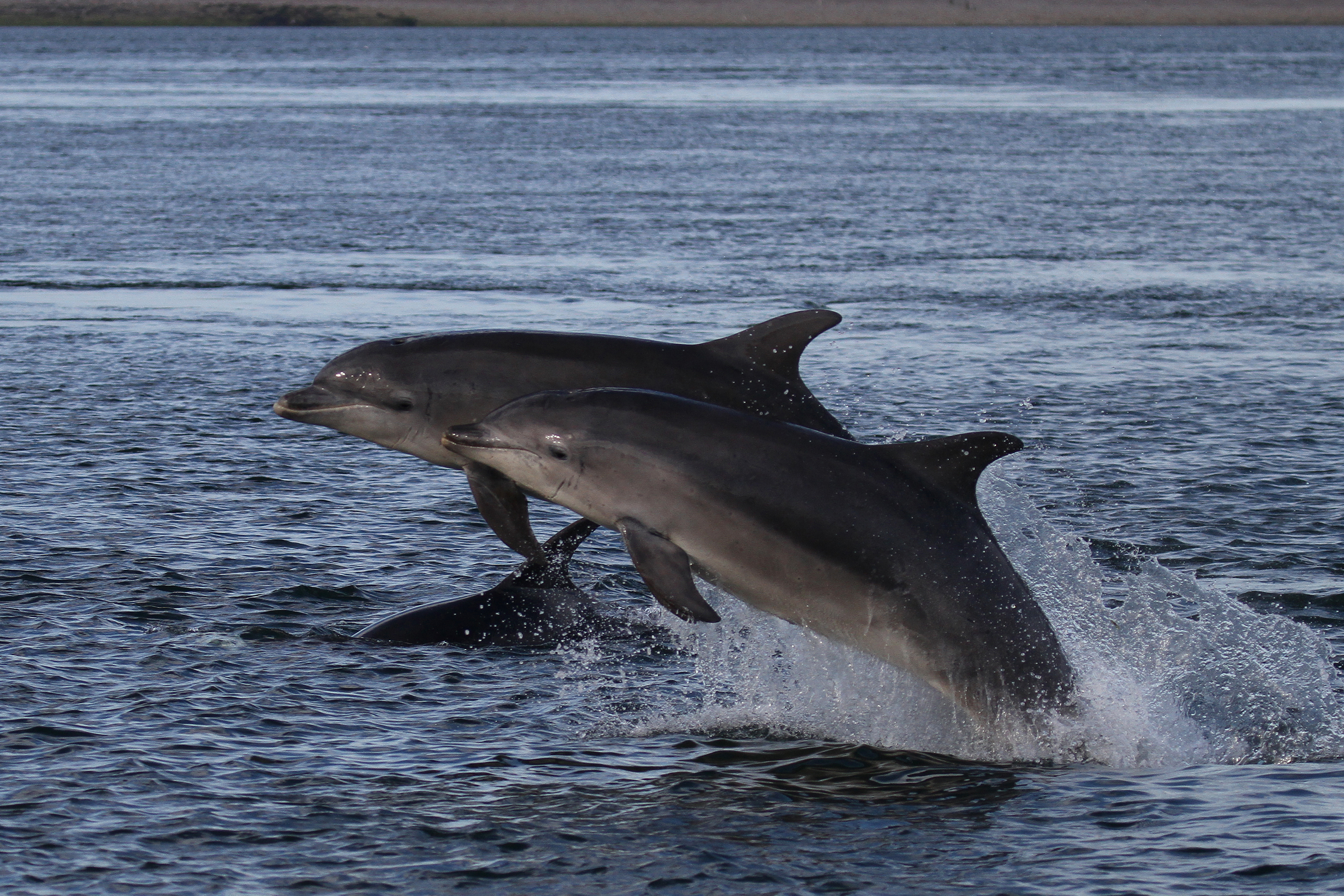
Fans of dolphins know the best time to see them at Chanonry Point near Inverness is an hour or so after low tide when the dolphins follow the current, chasing the fish up the Moray Firth. It therefore wasn’t surprising that even in arctic conditions (I was wrapped up like Nanook of the North) we found a small crowd on the pebbly beach below the lighthouse. Among them was the Whale and Dolphin Conservation’s Field Officer and, knowing him from previous visits, we caught up while we shivered in the bitingly cold wind, constantly looking hopefully across the choppy water. ‘You can say you’ve seen The Black Isle turn white,’ he quipped as we turned around to see the fields above Chanonry Point dusted in snow. Our bone-chilling patience was eventually rewarded with an acrobatic and cheering display from five dolphins.
Scottish Gaming
Our Scottish trip had started in much warmer temperatures in the pretty town of North Berwick on the Firth of the Forth. It felt like mid-summer not late March when we walked to Tantallon Castle that sits dramatically on the cliffs near North Berwick. Skylarks fluttered high in the blue sky, joyfully singing their hearts out and seabirds were already bagging their spots on the cliffs below the castle’s stone walls. Shimmering in the blue sea was the volcanic island lump of Bass Rock, home to gannets,
In North Berwick we had more fun than I expected in the Scottish Seabird Centre thanks to an array of interactive games that are popular with children and adults who haven’t quite grown up! The games were challenging for a non-gamer and I was soon a hungry seal and a dead fulmar chick! There are more traditional exhibits too and watching the close-up film of flying geese I was mesmerized, feeling part of the flock. Used to seeing these birds high in the sky, witnessing the power radiating from their necks and wings was remarkable.
Fog rolled in that evening ending the unseasonably warm weather and lingered into the next morning as we left North Berwick. Driving down a narrow lane, a hare raced towards us hugging a mossy stone wall. Knowing how devastating it would be to hit one of these mythical symbols of good fortune we pulled in and watched the beautiful animal gallop by.
Wildlife Havens
It was chilly at Loch Leven RSPB reserve and we walked briskly between the hides around the pools. Despite the cold the birds seemed to sense spring was on the horizon and pairs of lapwings twirled in the air, their swanee whistle call reminding me of Sooty’s fun and accident-prone friend, Sweep. The noisiest neighbours, the black-headed gulls, mixed up their own raucous mating dance with swooping attacks at the swans. Unperturbed the male swans, feathers impressively puffed up, powered through the water in pursuit of nonchalant females.
The woodland uphill trail not only warmed us up but showed that Loch Leven has more than birds. A couple of adorable red squirrels bounded around the trees, a roe deer raced up the hill when it spotted us and another lucky hare crossed our path. From the top we had a birds-eye view over the reserve.
Looking out the next morning there was a colourful sunrise and a flurry of snow which soon melted. In fresh weather we walked along the sandy beach to the charming seaside village of Lower Largo. Here creative and colourful gates and sculptures adorned with local scenes and seafaring themes brightened up the streets. In the opposite direction the beach took us to Leven. Returning through golf courses we had views across the Firth of the Forth with Bass Rock highlighted by the sun.
Fine and Dandy
Shopping for some essentials in Dundee we admired The Discovery, one of Scott’s ships displayed on the quayside, and stumbled upon the amusing and energetic Desperate Dan statue. The publishers of The Dandy and Beano comics were based in Dundee and a life-size Dan struts confidently across a square dragging his sidekick Dawg on a lead while Minnie the Minx is ready with her catapult.
Before driving to the campsite at Stonehaven, a favourite of ours, we stopped at Fowlsheugh Cliffs.  Even this early in spring this crinkly coastline was packed with noisy kittiwakes, the birds balancing on the narrow ledges of their high-rise accommodation. Stonehaven campsite has fabulous coastal cliff walking, a castle and a picturesque harbour on the doorstep. An added bonus are the quirky metal sculptures of boats, planes and lighthouses that line the bay, but don’t take my word for it, if you’ve never been add it to your list!
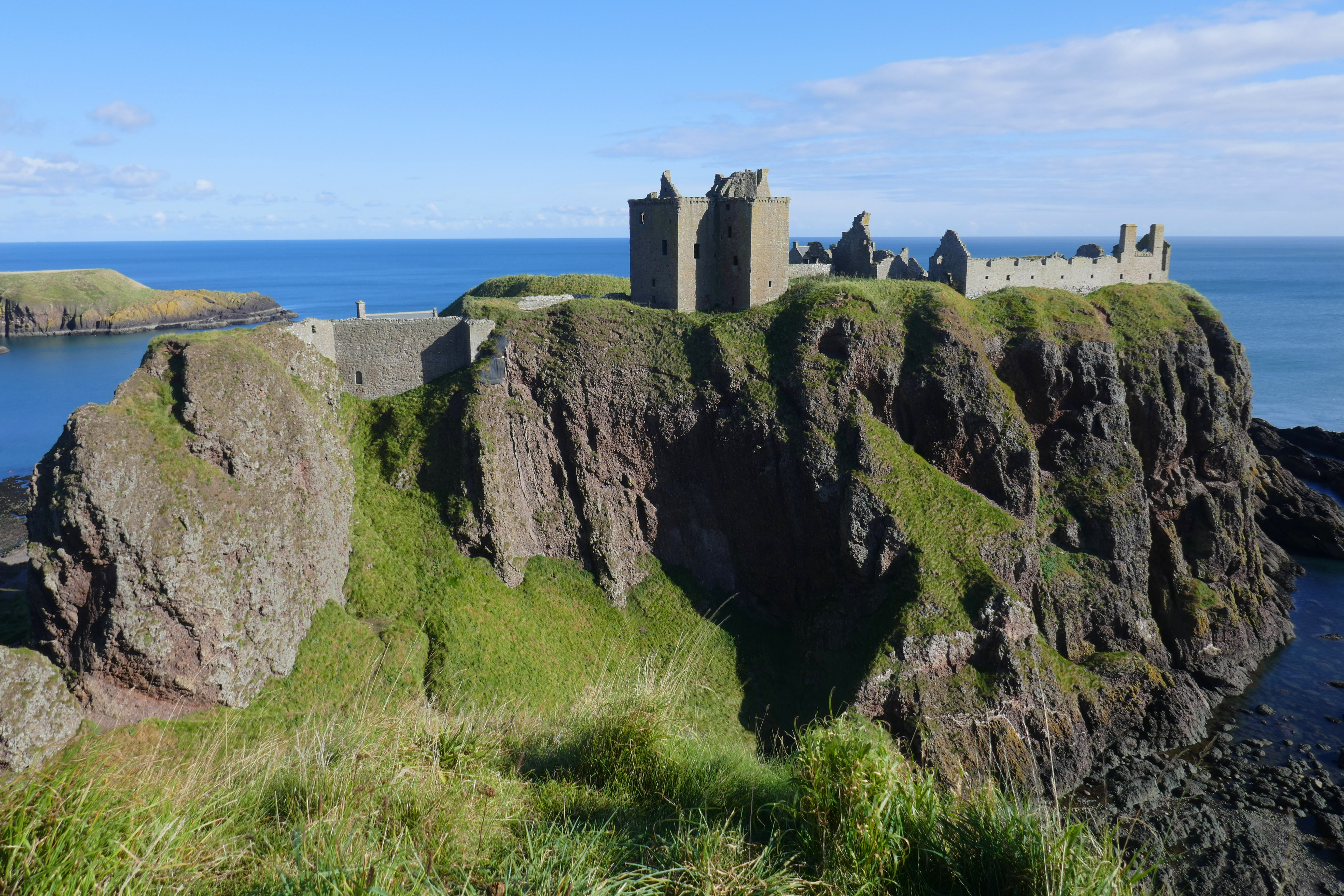
The cliff path to Dunnottar Castle is packed with breathtaking views, starting with Stonehaven and its harbour. Spring weather had blown in and we stopped at the temple-like war memorial to take in the panoramic views that now included the towers of Dunnottar Castle that perches on a rocky outcrop above the sea. We’ve visited the castle before so returned through Dunnottar Woods where, judging by the profusion of tiny doorways, the fairies hang out.
Happiness Comes in Waves
Heading north, we were treated to the magical sight of a marsh harrier at Loch of Strathbeg. Parking at the ruined Rattray Chapel that overlooks the loch we had lunch watching the birds. The narrow road deteriorates after the chapel so we hiked the mile or so to Rattray Head, a remote and striking stretch of coast. Sand dunes sculpted by the wind and sea to form mini-mountains covered in spiky grasses that whispered in the wind led us to the beach. The tide was high and water surrounded the small lighthouse. Walking along the beach watching the waves and the cormorants we felt so lucky to have this spot to ourselves.
The sea stayed close at the Fraserburgh campsite and as warming sun streamed through the ‘van windows I was comfy watching the tides, the surfers and some hardy swimmers in the bay. Anthony muttered about salt and mud and made the most of the good weather to clean the worst muck off the ‘van. Later we strolled around the harbour packed with boats of different sizes and colours and watched scores of herring gulls skilfully wheeling through the air, amazed you never see them collide.
Later we walked along Fraserburgh Bay, a sweep of golden sand where children paddled in a shallow stream and gleefully raced up and down the largest sand dune. At the end of the bay we headed inland by a serene river and returned on sheltered paths between the dunes.
Back on the road we pulled in to Cullykhan Beach car park for a short walk by a stream that tumbles through a gorge to a delightful sandy cove. Beyond we could see the row of white cottages of Pennan. We have explored this north-facing coast between Fraserburgh and Inverness many times and I have happy memories of the beaches, cliffs and picturesque villages but there are still new corners to explore.
Tweet of the Day
A bumpy farm track took us to the car park for Troup Head where RSPB signs directed us to the cliffs where gannets nest. Graceful gannets always take my breath away. About as big as a goose, gannets are experts in elegance as well as being accomplished fishers. Close up we could see their heads were the colour of thick clotted cream and their fearsome-looking beaks were baby-soft blue. Huge-winged gannets soared below us, their throaty call filling the air and we watched others gathering clumps of grass for nesting.
We had never visited Lossiemouth so, as the weather cranked up for an autumn-like wet and windy storm, we pulled into the East Beach car park hoping to explore. In a break in the heavy showers we strolled around the harbour and the grid pattern of streets before battening down for a windy night in the ‘van. Always looking for the bright side, Anthony hoped the torrential rain would clean off some of the mud we had picked up during the day.
Culbin Forest and Nairn’s East Beach are so vast, even though we have visited before we were soon on unfamiliar paths through the fragrant pine trees. There is plenty of space for everyone here and even though Nairn isn’t far away we easily found quiet corners. Leaving the trees and dunes we reached the sandy beach and I spotted handsome black and white oystercatchers with their long orange beaks that are perfectly designed for probing mud. As they deftly flew along the tideline we grinned at each other as we heard their exuberant sharp calls.
Dancing Dolphins
If you’re lucky at the Rosemarkie campsite you will bag one of the pitches with an uninterrupted sea view. We were fortunate perhaps because everyone else had seen the wintery weather forecast and stayed home. It was bitterly cold and the next morning we once again woke to sleet. Undeterred, after breakfast we walked along the shore to Chanonry Point, the best land-based place in Scotland to watch dolphins. After our amazing dolphin encounter we thawed out in the ‘van and spent a cosy afternoon relaxing, eating and drinking, occasionally glancing up to watch the birds on the shore.
The bonny Cromarty Firth was dotted with a bizarre collection of rustic (or rusting) defunct oil platforms. These strangely beautiful structures loom like industrial dinosaurs and contrast sharply with the picturesque cottages and attractive streets of Cromarty. Striding out along The Links we came upon The Emigration Stone, a tall artwork that commemorates the ships packed with people that left these shores for the New World. It is inscribed with the description of one ship’s bittersweet departure.
We have been to Scotland more times than I have fingers and toes to count on so it is remarkable that we still find new and awesome sights to see, but then it is an outstanding country. As usual we experienced every season but there is no doubt we will be back again for pizza and dolphins and so much more.
North Ledaig Caravan Park north of Oban in Scotland is a popular campsite. For us it has good and bad points but we made the most of a couple of nights here, leaving our campervan onsite and walking from the site.
The Campsite
This is a large site with different areas for Caravan and Motorhome Club members and non-members. This isn’t a club site but it is affiliated. The site slopes down to the coast and many of the pitches have a sea view but you have to deal with the tilt, unless you carry large levelling blocks. There are some pitches that are level, often tucked away without a sea view. Pitches are allocated by the site, and, as we found, changing the pitch you have been given is more of a palaver than it really should be.
There are two facilities blocks, one in the centre of the site and one by reception and the shop. These are both kept clean and have modern showers that are okay.
As well as the sea view and colourful sunsets, the disused railwayline that is now a cycle path and runs through the site is the other big plus at North Ledaig. This is part of the Caledonia Way from Campbeltown to Inverness. It is a mixture of road and traffic-free cycling. Most of the 49-mile section between Oban and Fort William [the stretch this campsite sits on] is on this disused railwayline and it is a fairly level route with fantastic views.
A Walk around the Lanes – approx 8km
This is an almost completely flat walk. We turned right on the cycle path and walked down to North Connel on the traffic-free route. Crossing the main road, we took the lane through Black Crofts and around the shore of Loch Etie. We were walked around the Moss of Achnacree and caught glimpses of the heather moss occasionally through individual houses and we could gaze along Loch Etive. This is a residential road with houses of different ages and sizes and there is some traffic. It became quieter once we turned onto the straight road back to North Ledaig. A signed along here warned us about red squirrels and sure enough, one bounded up a lane towards us and scampered under a fence into the trees.Â
Stopping for coffee and an early lunch on the last picnic bench, we had views north over Benderloch to Morvern. Walk Highlands suggested the final push to the summit can be boggy but it was okay on our September walk. On the open hillside of rock and short wet sections, skeins of geese flew over honking enthusiastically. From the rounded trig point we could see Ben Cruachan and along Loch Etive and laid out below was the moss we had walked around the day before. It was clear enough to see over Lismore and across to Mull and in the distance were the Paps of Jura. For effort vs reward, Beinn Lora tips the scales very much towards reward. We returned to the campsite the same way.
Tal-y-mignedd Campsite in the Nantlle Valley is a campsite that is made for the word nestling. Tucked away between steep hills on the edge of the Eryri National Park [Snowdonia] in North Wales, this is a place to find tranquility, fabulous hiking and, maybe surprisingly, good coffee.
The Campsite
Pitches – At Tal-y-mignedd, the camping is divided over a number of fields from large to small enough for just a few tents. These are all either totally level or mostly level and all have open views. For campervans there are a few hardstanding pitches with electric hook up and some grass pitches with electric too. There is also plenty of room for non-electric pitches for tents and ‘vans on grass.
Facilities – There is one facilities block with male and female showers and toilets, an accessible bathroom and a kitchen with sinks for washing up, a microwave, hob, kettle and fridge/freezer and washing machine and dryer. There is also a second campers kitchen which wasn’t open when we were there. There is a chemical toilet disposal point and fresh water taps. Everything was kept clean and tidy. A pleasant surprise in a valley that has little in the way of phone signal was good and free wi-fi.
Access – The B4418Â between Rhyd-Ddu and Nantlle is single-track in places. You either have to drive three miles on this quiet narrow road from the Beddgelert to Caernarfon road or around two miles from the village of Nantlle.
The campsite wasn’t busy when we were staying there. It was mid-week and May and only three or four other pitches were in use. This didn’t put any strain on the facilities but a stay here would be a livelier experience during a busy summer weekend.
Reception is in the farmhouse and the family were always friendly and helpful. This is still a working farm and their vehicles drive up and down the track but this was never intrusive. Sheep sometimes find themselves on the camping field and the sound of birdsong is interupted by cattle!
We paid £27/night with electric hook up and it is £20/night without. This seemed good value for hot showers and fabulous views.
Things to do
The campsite sits on the Snowdonia Slate Trail. This 83-mile long circular route starts and ends in Bangor and visits sites associated with the slate industry of North Wales and takes walkers through forests, by lakes and into villages. The section along the Nantlle Valley is fairly level and reasonably well signed. From Tal-y-Mignedd we picked the trail up in both directions.
Walking East – Heading towards the peak of Yr Wyddfa [Snowdon], we joined the narrow lane for a short distance, through the hamlet of Drws y Coed where we left the road and followed an increasingly damp path past an unused dam towards woods. A cuckoo called from across the valley and making our way around the craggy Clogwyn Y Garreg we had views of Yr Wyddfa. You could extend this walk and make a day of it with a rest at the pub in Rhyd-Ddu. Â
Amazing sunsets – The valley is aligned pretty much east-west and watching the light soften as the sun goes down is special.
Walking West – We also followed the Snowdonia Slate Trail along the valley bottom into Nantlle village and walked back along the lane, making a circular walk. The farm track passes a lake, Llyn Nantlle Uchaf, before reaching the village. At one time there were 40 slate quarries in the Nantlle valley and the village developed at the end of the 18th century to serve this industry, many of the quarrymen coming from Ynys Môn [Anglesey] and Arfon [the mainland of Wales facing Ynys Môn. For more about the history of Nantlle see the Dyffryn Nantlle website.
Drinking good coffee – In Nantlle we visited Poblado Coffi. In a unit in the old quarrymen’s barracks, coffee experts roast and blend beans. All the beans are sourced from sustainable coffee growers and they have strong relationships with these growers and pay a fair price for the coffee. We sat in the courtyard tasting the delicious coffee of the day, along with a slice of ginger flapjack and left with a couple of bags of coffee in the rucksack. If you find yourself anywhere near this gem, take the time to visit.
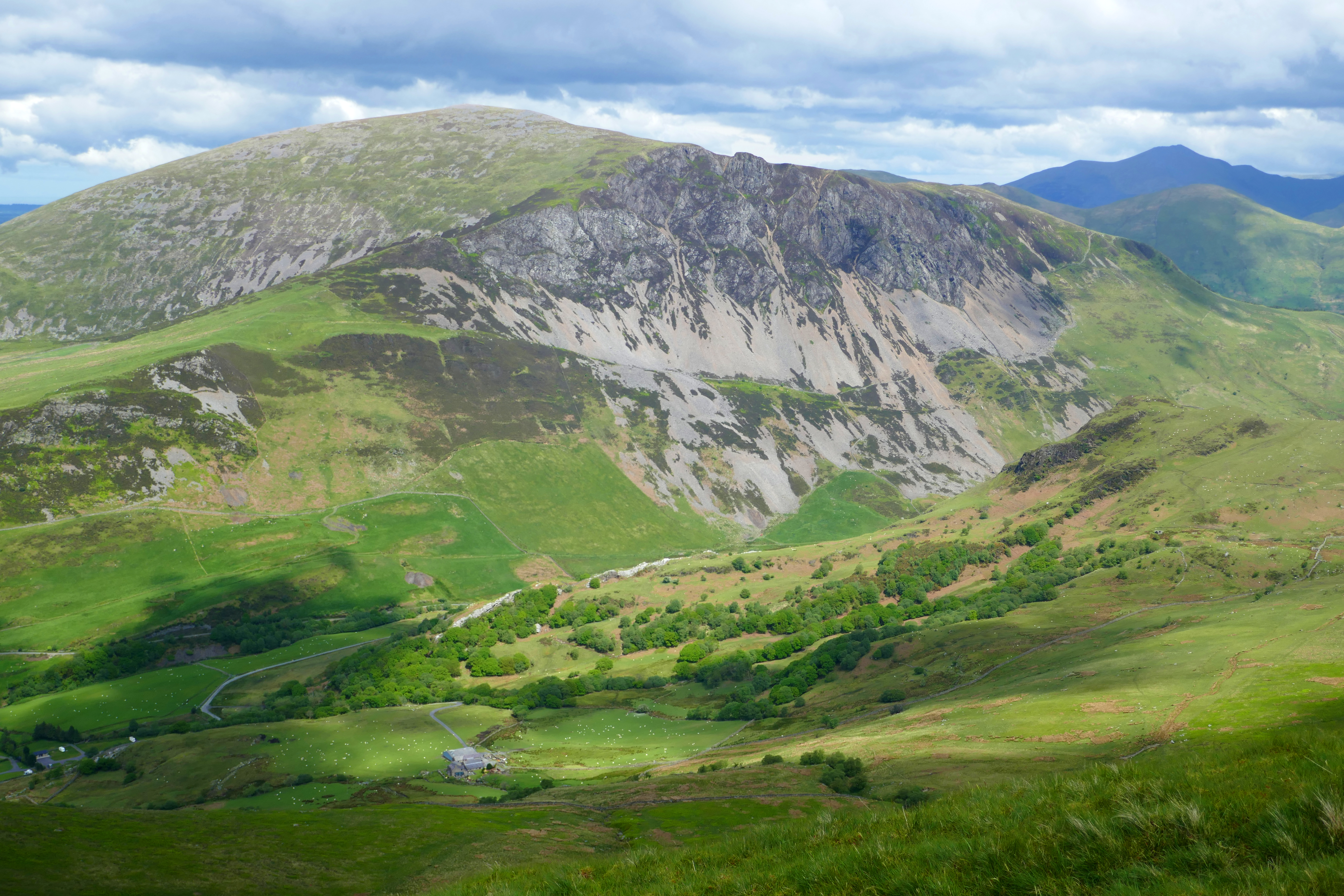
Walking up – We couldn’t resist climbing the hill that the farm shares its name with. This is a relentless steep climb but worth it for the views over the mountains, including Yr Wyddfa and to the sea. The first section is on a zig-zag track that climbs through sweet-smelling bluebells in May. The hill is only 653m high but punches above its weight and the rocky summit has a tall obelisk that you can see from the valley. Once at the top, fit and experienced walkers will continue along the stunning Nantlle Ridge for a longer walk and in warmer weather we would probably have done the same.
The Derbyshire market town of Buxton is famous for water; having the highest market place and its graciously curved Georgian crescent. We have visited many times and find it perfect for two campervanners who like hiking. Buxton has a number of campsites [see below] and does offer sights for those who don’t want to spend the day in the surrounding countryside. But if, like us, you enjoy a warm day in the great outdoors, below are five of my favourite walks for five days camping in Buxton.
The distances on the walks below are approximate and are based on walking from the Caravan and Motorhome Club’s Buxton site. I haven’t given step-by-step directions but the paths in this popular part of the country are well-walked and I hope that you can pick up our route [or make up your own] from an OS map.
Day One – Exploring Buxton [at least 7kms]
Buxton’s heritage trail leaflet will help you make the most of a stroll around the town. But first you have to walk to the town centre and leaving the campsite, you will immediately be distracted by the delightful paths through Grin Low Woods and to Solomon’s Temple.
Solomon’s Temple is a perfect introduction to Buxton. Climb the winding staircase of the hilltop tower and Buxton is laid before you, clustered around the dominating slate-grey Devonshire Dome.
Having taken in the view, we head downhill on the woodland paths with occasional wooden sculptures and reaching the streets by Poole’s Cavern. If you’ve never visited you might want to dally and explore this underground cavern.
We like to amble through the town’s restored Pavilion Gardens. There might be an art fair being held in the Octagon Hall or we will idly watch the ducks and look hopefully for chicks on the lake. I also like to admire the preserved tree trunk sculpted into figures and animals that stands in the park. The water-carrying figure of Arnemetia is a reminder that in Roman times Buxton was named Aquae Arnemetiae after this Romano-British goddess.
Our next stop is The Crescent, a Georgian grade one listed masterpiece and the pride of Buxton, recently restored as a luxury hotel. The gracious symmetrical curve of the stone building, the ground floor colonnade and fountains playing at the front are stunning. Opposite is St Anne’s Well which is decorated with flowers in the annual well dressing, a tradition followed in many Derbyshire villages and towns. The Pump Room has a tap and souvenir glass bottles, and I did once fill one with Buxton spa water to taste the lukewarm mineral-rich water. It is an aquired taste!
Buxton’s spring water emerges from the ground at around 28°C and has been exploited since the Romans, who built a bath and threw coins into the spring for luck. In the 16th century visitors took the water and in the Georgian era the Duke of Devonshire developed a spa resort. A ‘Well Woman’ was appointed to care for the well and tourists, a post that continued into the 20th century.
After all this strolling, we are ready to sit and there are plenty of cafes and tearooms in Buxton. Later we will walk over for a close-up of The Devonshire Dome. This building has an interesting history and has been used as stables, a hospital and is now a University. Finally, we will climb the paths up The Slopes to the upper part of Buxton, where the town’s oldest buildings surround England’s highest market place and from there head back to the campsite.
Day Two – Goyt Valley and Errwood Reservoir [about 14kms]
After the streets of Buxton, day two is a contrasting and challenging hike over moorland. A map will be essential to find your way around these moors but you will be rewarded with the sounds of lapwings and curlews and buckets of fresh air.
From the A53 near the campsite, we picked up Bishop’s Lane and climbed the hillside until a path took us to the disused railway line. Views over the two reservoirs in Goyt Valley will open out before you.
Reaching a lane, we descend to the shores of Errwood Reservoir. From here we chose paths that climb through the trees to the ruins of Errwood Hall. We are walking through what was once the grand ornamental garden where fountains played and the Grimshawe family, who lived here, relaxed on the lawns. Demolished in 1934 after the last of the Grimeshawes died, Errwood Hall was originally a dressed-stone building with a tower above an impressive entrance and rooms packed with fine furniture and art works. In those days the hall enjoyed views over the valley but is now surrounded by trees and rhododendrons. For me, the ruins have always retained a sense of romance tinged with loss but on our last visit it seemed particularly woebegone. The site deserves a little more care and I was disappointed there isn’t even an interpretation board to show what used to be here. However, there is an app and more information here.
From the hall we headed uphill finding the small circular St Joseph’s shrine that huddles in a hollow with pine trees. Dedicated to Dolores, a Spanish companion to Jessie Grimeshawe in 1889, the shrine has an elaborate altar of Spanish tiles and there are often fresh flowers. As we descended the moorland back to the reservoir a grey cloud threatened rain and we followed a circling buzzard towards the trees and shelter but the storm never arrived.
Walking south along the valley beyond Errwood Reservoir we crossed the old packhorse bridge and picked up a path over the moorland and back to Buxton. More walks in the Goyt Valley and its history can be found here.
Day Three – Three Shires Head [Around 17kms]
If you only have time for one day of hiking around Buxton, make it this one! The walk begins on the Dane Valley Way and you soon leave the traffic behind as you cross Axe Edge Moor, an expanse of moorland that holds the headwaters of four rivers, the Manifold, Dane, Wye and Goyt. Despite the warm weather, it was just us on this path enjoying the gurgling streams and passing a few isolated farms and old mine workings.
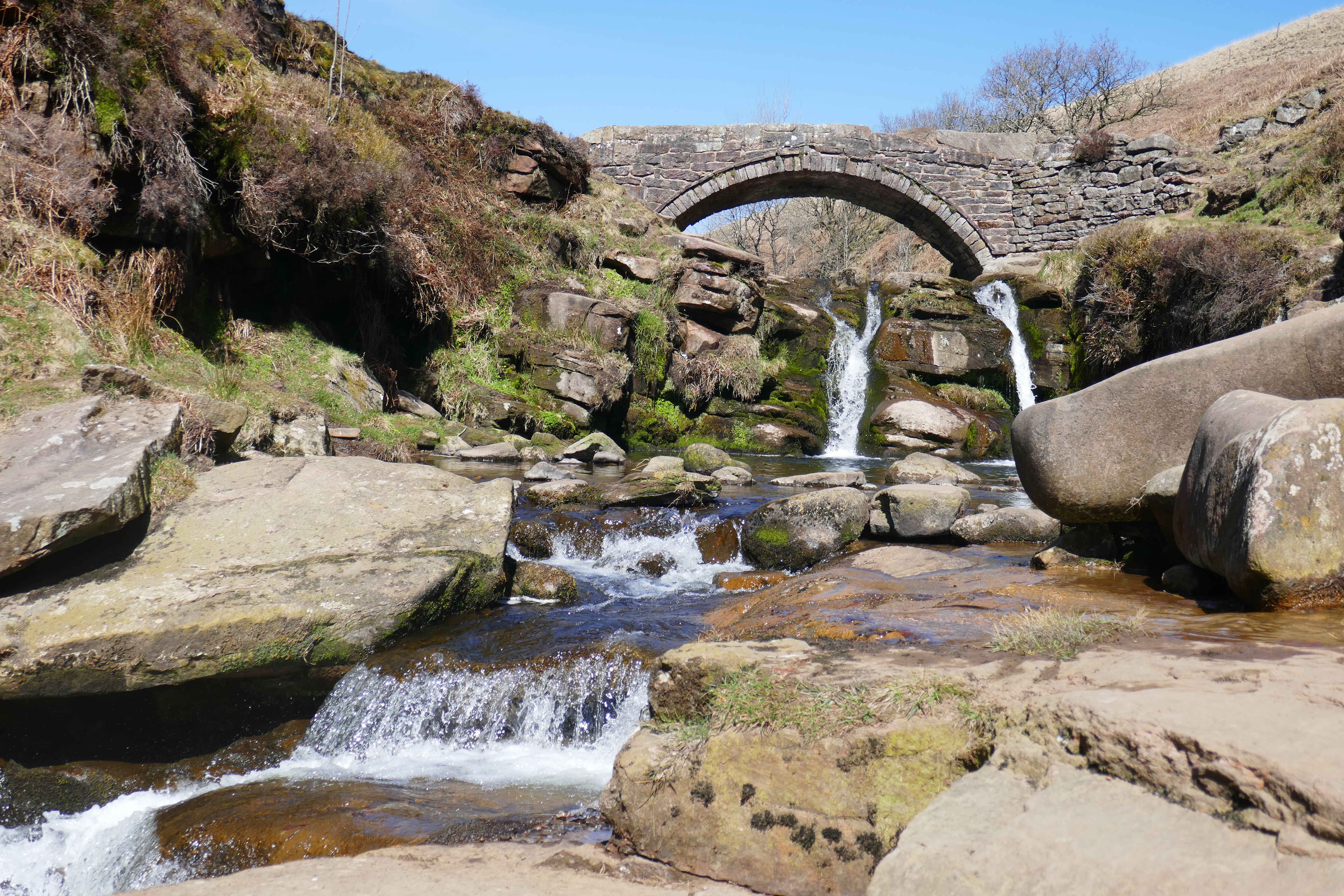
At Three Shires Head, where Staffordshire, Derbyshire and Cheshire meet, we joined the throng. These falls are a popular picnic and wild swimming spot. Sitting by the waterfalls I slipped off my shoes and dipped my toes in the gaspingly-cold water of the River Dane. As I dried my tingling feet I watched the hardy woman swimming in Pannier’s Pool in admiration.
Climbing up the hillside to Flash, a sheltered lane alive with butterflies took us to Flash Bar Stores where we devoured two of their delicious homemade vegetable pies at an outdoor table. A popular halt for cyclists, we chatted to a young man who was fuelling up having cycled from the West Midlands and was surprised how hilly the Peak District was!
Exuberant skylarks sang as we crossed the fields, criss-crossed by stone walls, below Flash. Multitudes of signs heralded the Health and Safety Executives huge Science and Research Centre. We skirted the buildings on the public footpath and picked up a lane that took us back to the road below the campsite.
Day Four – Five Dales from Tideswell [13kms]
On a perfect spring day we drove the short distance to the car park in Tideswell Dale. This perfect Derbyshire walk took us along, in and out of five dales.
We began in Tideswell Dale where a winding stream lined with bright yellow celandine wound beside us and rock cress hung from the limestone cliffs. Ash trees grow here but many have been chopped down due to ash dieback, a destructive fungal disease.
Miller’s Dale, not surprisingly, is home to many disused mills along the River Wye, often now converted to housing. I was concentrating on looking along the river for kingfishers. I didn’t see a kingfisher but a birdwatching couple pointed out a peregrine they had spotted on the skyline above us.
At Cressbrook we sat by the millpond watching the climbers on the crags and a pair of tufted ducks. The ducks dived into the shallow water to feed, stirring up the silt into billowing muddy streaks so that we could watch their underwater progress. Cressbrook Dale is thickly wooded with pungent wild garlic and carpets of soft green moss covering the dry stone walls.
The landscape opened out as we reached the short Tansley Dale where we found cowslips just coming into flower among the grasses. We climbed up to the patchwork of walled fields above the dales where lambs gambolled in the sunshine and the shallow Litton Dale led us back to the ‘van.
Day Five – Five Wells & Deep Dale walk (13kms)
In more sunshine, we walked through the wood to Buxton to catch a bus towards Bakewell. We hopped off near the village of Taddington and walked back to Buxton.
Our first stop was Five Wells Chambered Cairn. Here the stones that remain of a circular chambered cairn perch on high ground above the source of five springs. Although many of the stones have been taken, the two back-to-back chambers can be recognised. Descending to the village of Chelmorton we passed Bank Pit Spring, inexplicably and bizarrely known locally as Illy Willy Water.
The path into the wooded Deep Dale was steep but the sheltered dale was perfect for a lunch stop. As we ate, three sheep nose-to-tail went purposefully by on a lower path. When minutes later a fourth sheep appeared we assumed she was lagging behind and helpfully pointed in the right direction. Instead she came over and nudged my arm with her nose demanding food. We were eating more delicious pastries from Flash Bar and so there was no chance we would share!
The scenic uneven path along Deep Dale, over moss-covered stones and between trees, took us below the cave known as Thirst House before climbing up to King Sterndale and returning into Buxton under the 13 arches of Dukes Drive viaduct. Back in Grin Low Woods, we found a thick carpet of wood anemone and on the way back to the campsite picked up part of Buxton’s Ring of Trees Walk, a circular route through surrounding woodland.
Lime Tree Holiday Park – We have stayed here a few times. It is in a peaceful position just a short walk from Buxton.
Beech Croft Farm – this family-run site is between Buxton and Bakewell and in quiet countryside. Walk Five is near here.
Longnor Wood Camping – This adult-only site is near the village of Longnor. There is good hiking from the campsite and some cosy country pubs in the vicinity.
A couple of nights in Glasgow has been on my wishlist for some years and a birthday celebration was the ideal time to enjoy 48-hours in this handsome Scottish city. Plans were hatched and the decision was made to leave the campervan at home. Leaving our almost-blue campervan behind is hard and feels disloyal but one of the reasons for down-sizing our ‘van was a hankering to try other sorts of holidays again. So we patted it’s bonnet, gently explained and planned a train and hotel-based trip. It would be interesting to see how it compared to life on the road.
Train & Hotel
The train is an easy way for us to get to Glasgow as Lancaster is on the main West Coast Line. We had pre-booked cheap seats and while we ate our picnic lunch and read our novels we sped over the border and we pulled into the stunning Glasgow Central Station on time.
We had chosen a hotel a hop and a skip from Glasgow Central. Grasshoppers Hotel (since unfortunately closed) has a strange name but excellent reviews and we booked two nights online. The hotel is on the top floor of one of the buildings around Glasgow Central and climbing the stairs to the hotel [there is a lift] we passed drab Scotrail offices and seriously started to doubt our decision. We needn’t have worried, as soon as you reach the hotel floor you are in hushed luxury. Our high-ceiling room was stylish, warm and not a whisper of train engines reached us. The only quirk was the odd sliding door into the bathroom.
As well as tea and coffee making in your room, this hotel has a special feature. The welcoming lounge overlooks the vast glass roof of the railway station. Here you can browse books, make drinks and pick up a slice of cake, with vegan options always available or a bowl of ice-cream. When we asked if these were homemade, we were told the night staff make these delicious cakes in the wee hours.
Finding Free Things to do in Glasgow
It was a sunny afternoon as we strode out across the city to Glasgow Necropolis. This large Victorian garden cemetery sits on a hill near Glasgow Cathedral and on the edge of the city centre. The tombs and grave monuments compete for attention with their intricate carvings and statues and are evidence of the flourishing economy of 19th century Glasgow.
Later in the evening we strolled around the city and found a bar for drinks before retiring to our hotel room with a money-saving picnic.
The next morning, fuelled by a good hotel breakfast, we caught a train to Pollokshaws West. There are regular trains for this 30 minutes journey and we were soon walking through Pollok Country Park, enjoying the frosty morning air. We followed The White Cart Water through this former estate to the walled and woodland gardens around Pollok House before swinging around to The Burrell Collection. Some of the 9,000 objects that make up The Burrell Collection are displayed in an airy and modern museum in Pollok Country Park that is free to enter. The collection has something for everyone and includes Chinese art, medieval stained glass and tapestries. We concentrated on some of the paintings by French artists including Manet, Cezanne and Degas and my favourite without doubt, for it’s colour and life, was Degas’ The Red Ballet Skirts. The Thinker by Auguste Rodin was also a treat to have the chance to see.
Back in the city centre we walked by the River Clyde to Glasgow Green, a large urban park. We were last here on a chilly and wet day in 2021 listening to the speakers at the end of the march during COP26. This time we had chance to wander and visit The People’s Palace, the city’s museum of popular history, where we learnt about living in Glasgow tenements and taking your laundry to the communal steamies. And all for free!
Not Everything was Free
One of the reasons for coming to Glasgow was The Purple Cat Cafe and it was here we headed for tea and fun with cats. While we ate cakes, cats of all colours and ages raced across bridges above our heads, hurtled down walkways, slept in fluffy baskets, played with toys and rubbed around our legs. I laughed blissfully.
That evening we ate at Mono Cafe Bar just off Argyle Street, another wonderful place that gave an unpromising first impression. We had sauntered by this cafe bar during the daytime, it wasn’t open and frankly it looked gloomy and univiting. But, in the same way that the floor of the hotel surprised us, at night the lights were lit, the venue came alive and we entered a warm and welcoming space that served delicious, hearty and creative vegan food. I cannot recommend this place enough and it was the perfect birthday treat.
Our last morning in Glasgow took us to The Tenement House, a National Trust property with an astonishing story. This middle-class tenement takes you back to the first half of the 20th century when Miss Agnes Toward, a shorthand typist, lived here with her mother and later alone. As an independent woman, she valued her possessions and never de-cluttered. When she died she left a unique personal archive in a flat that had been empty for ten years while she was in hospital. The flat is a treasure trove of old cards, china dogs, mantle clocks and antique wallpaper. Agnes Toward’s story has occupied my mind since and I think of her often. If you get the chance, do visit.
Comparing Hotel & Campervan
As we sat on the train returning south I pondered on how this trip had compared to one in a campervan. Although it is possible to visit cities with a campervan and we have done this many times from York to Pisa, for a couple of days exploration a city centre hotel is a hard act to beat. We could crash in our room for a couple of hours between sightseeing, we didn’t have to carry lots of kit around and the sights were mostly on our doorstep. Being in the hotel meant we enjoyed some of Glasgow’s nightlife too. Much as I love our campervan, for this sort of short break the hotel wins for convenience.
Travelling to and from Glasgow by train was effortless and relaxing and cost the two of us £38 return [with a railcard], booked about a month in advance. Driving the 300+ miles would have cost around £50 just for diesel.
Of course, at £90/night for bed and breakfast it was more expensive than any campsite we’ve stayed on. We did save money by minimising our eating out and finding free things to do. In 2024, a night at the Caravan and Motorhome Club Strathclyde Country Park Club Campsite would be around £30/night at the same time of year [but our hotel was much quieter than this surrounded-by-motorways campsite]. Even if you add the cost of public transport in and out of the city and try and cost the impossible-to-price convenience, the hotel can’t be described as a budget option … but it was my birthday!