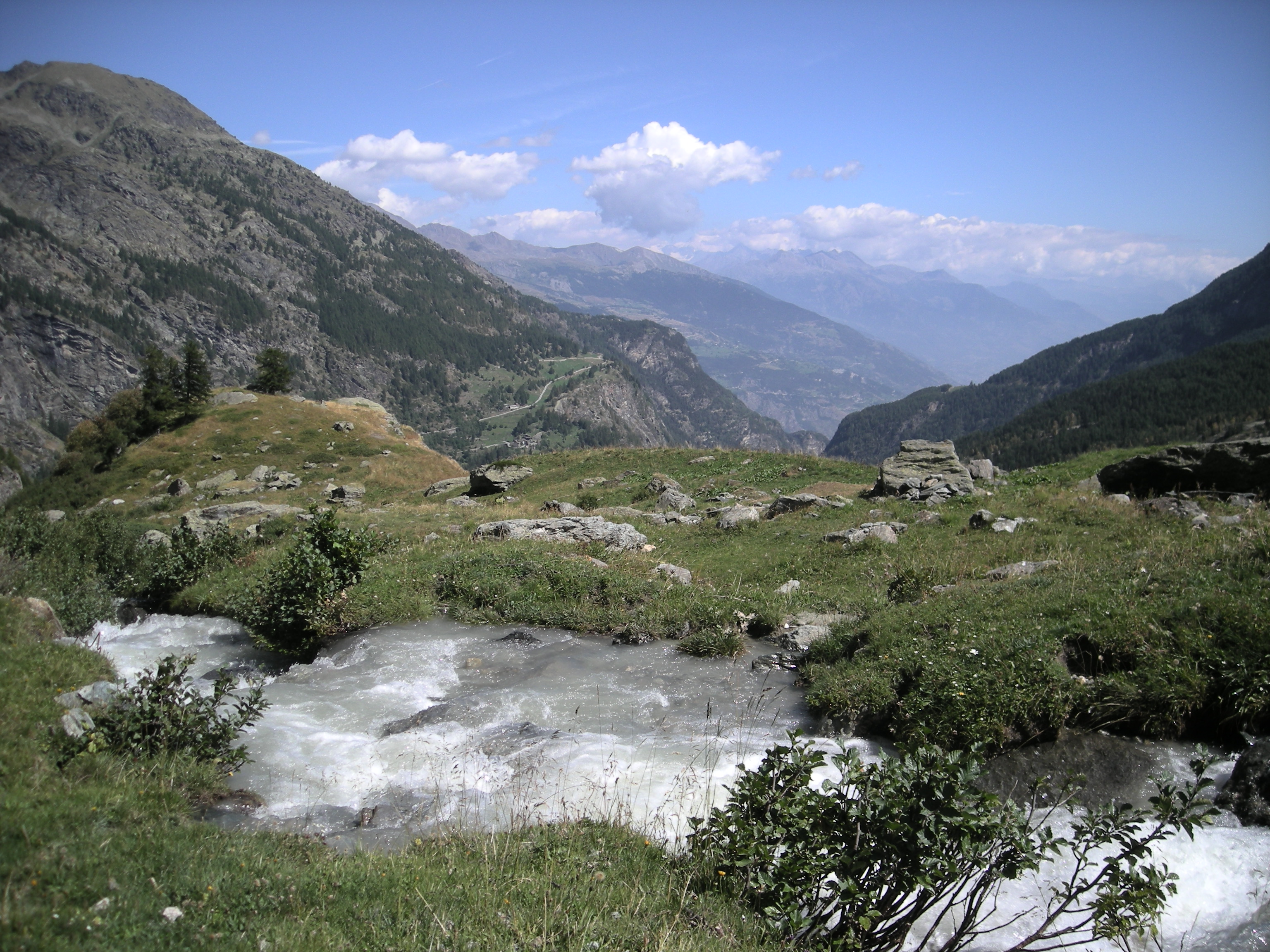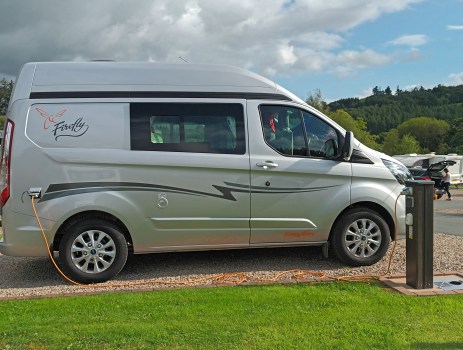
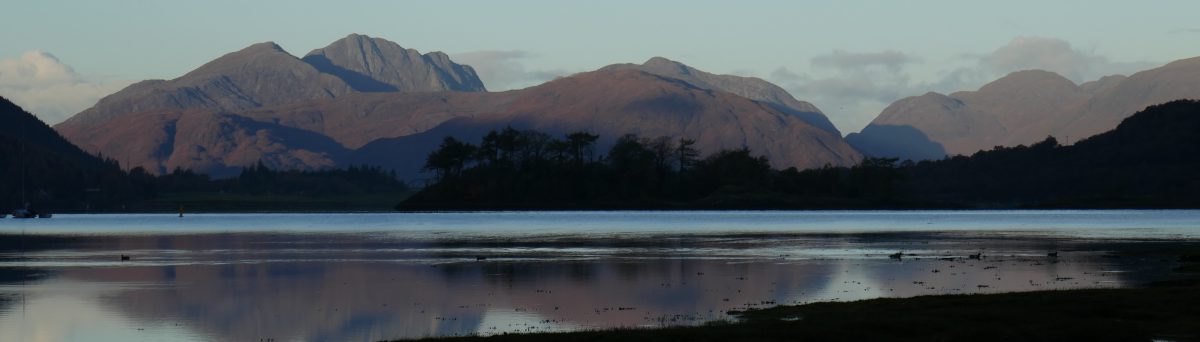
Liguria & Tuscany by train [& without a Campervan]

The River Arno & the Ponte Vecchio Florence

Three days and five trains, plus one planned replacement bus, across Europe to Firenze [Florence] in Tuscany and not a hitch. Given our experiences of appalling train reliability in the northwest of England, this seemed remarkable.

Why Travel by Train?

We have been trying to save the planet for decades and choosing sustainable travel options is second nature. We first travelled across Europe by train in 1991 with our five-year old son. Strikes in France disrupted the ferries and the trains on that journey and our trip to Milan was memorable for a lot of waiting around, some thoughtful French train staff and not always having enough food. For some reason, we were not put off and continued to use public transport to Slovakia, Spain, Germany and Austria through the 90s and 2000s

Since buying a campervan, our train travel has been in the UK and from campsites. We wanted to travel on the rails across Europe once again.

Why Firenze?

Somehow, we have travelled around Firenze and Tuscany plenty of times but never visited the city. Everytime, we thought about how busy it would be and how hot and bothered we would get and we stayed in the countryside. It was last winter’s jigsaw project that inspired us. The jigsaw showed the Duomo di Firenze and, as we worked on the pieces, a plan to visit began to emerge. Firenze is easy to reach by train, has plenty of accommodation, lots to see and do and the Duomo looked awesome! An out of season trip sounded perfect.

The Journey, Day One

The Lancaster to London Euston train was the part of the journey I was most nervous about but Avanti managed to run a service. We gave ourselves plenty of time for a leisurely walk to St Pancras via Camden. We had selected an evening Eurostar as this was cheaper and the journey was uneventful. A top tip was to buy Metro tickets on the Eurostar so that we could get straight to our hotel when we arrived. We stayed at the Novotel right outside the Gare de Lyon, which I highly recommend.

The Journey, Day Two

Leaving our bags at the hotel, we walked to the Cimetière du Père-Lachaise, as our Gare du Lyon train didn’t leave until mid-afternoon.  This vast cemetery is crammed with monumental graves, arranged around rows of narrow paths that climb the hillside.  There are so many famous people buried here, you will want to look out your own heroes. We firstly looked for the grave of the author Colette, finding a simple black granite stone adorned with flowers. Oscar Wilde’s grave was a modernist fanciful creation in concrete. Cobbled lanes and narrow earth paths wind around the hillside and we eventually found Jim Morrison’s grave.  This American singer-songwriter and lead singer with the band The Doors is popular. His life was not without controversy and his actions not always exemplary but we came in respect of his music.

The 14.48 TGV from the Gare de Lyon to Milano hurtled through the French countryside faster than our campervan. We cruised through the snow-covered mountains in the dusk until we reached Saint Jean-de-Maurienne, where, thanks to a landslide, we had to leave the train for a replacement bus through the Frejus Tunnel to Oulx. We had about 40 minutes to wait in Oulx in the chilly mountain air before the train arrived for the last stretch. We arrived in Torino [Turin] at around 22.00 and walked briskly to The Turin Paradise Hotel.

Torino

Day Three in Torino

Torino has been on my must-visit list since I saw The Italian Job and the minis racing through all those arcades. Breaking our journey here for a couple of days was an easy thing to arrange when we booked our tickets with Rail Europe.

Everything about The Paradise Hotel was lavish, including the breakfast buffet. Served in a high ceilinged airy room there were cheeses, yoghurts, cereals, fruit and veg, different breads, four types of honey and a whole table stacked with various croissants, including charcoal ones! This was better than anything we could serve up in our campervan.

It was a sunny day and we had a ball exploring Torino. From the fascinating National Mountain Museum on Monte di Cappuccini, where they seemed to have some of our old camping gear to Café Fiori, one of Torino’s elegant and historic cafes. We tried the local beverage, bicerin, a chocolate-coffee combo that was confusingly sweet and bitter at the same time.  We walked around the large outdoor market, under grand arcades, found some of the locations from The Italian Job and window shopped.

Vermouth rosso [rojo in Spain] is one of my passions and Torino is where this aperitif was first concocted. At the stylish hotel bar we ordered vermouth rosso and the bartender spotted two interested amateurs and organised an impromtu tasting. Having chosen our vermouth he poured glasses, added a curl of lemon and bought bowls of olives, crisps and peanuts. This felt such a luxurious start to our evening we needed bringing back down to earth and we ate in the nearby M**Bun, a slow fast-food restaurant.

The Journey, Day Four

Our final train to Firenze was just three hours. There was no buffet car, just a vending machine that dispensed nothing that resembled coffee! The appartment we had booked was about 25 minutes walk across the River Arno. We had a week in a flat that overlooked The Boboli Gardens and we felt in the centre of things. We dropped our bags and set off to explore.

Walking in and around Firenze

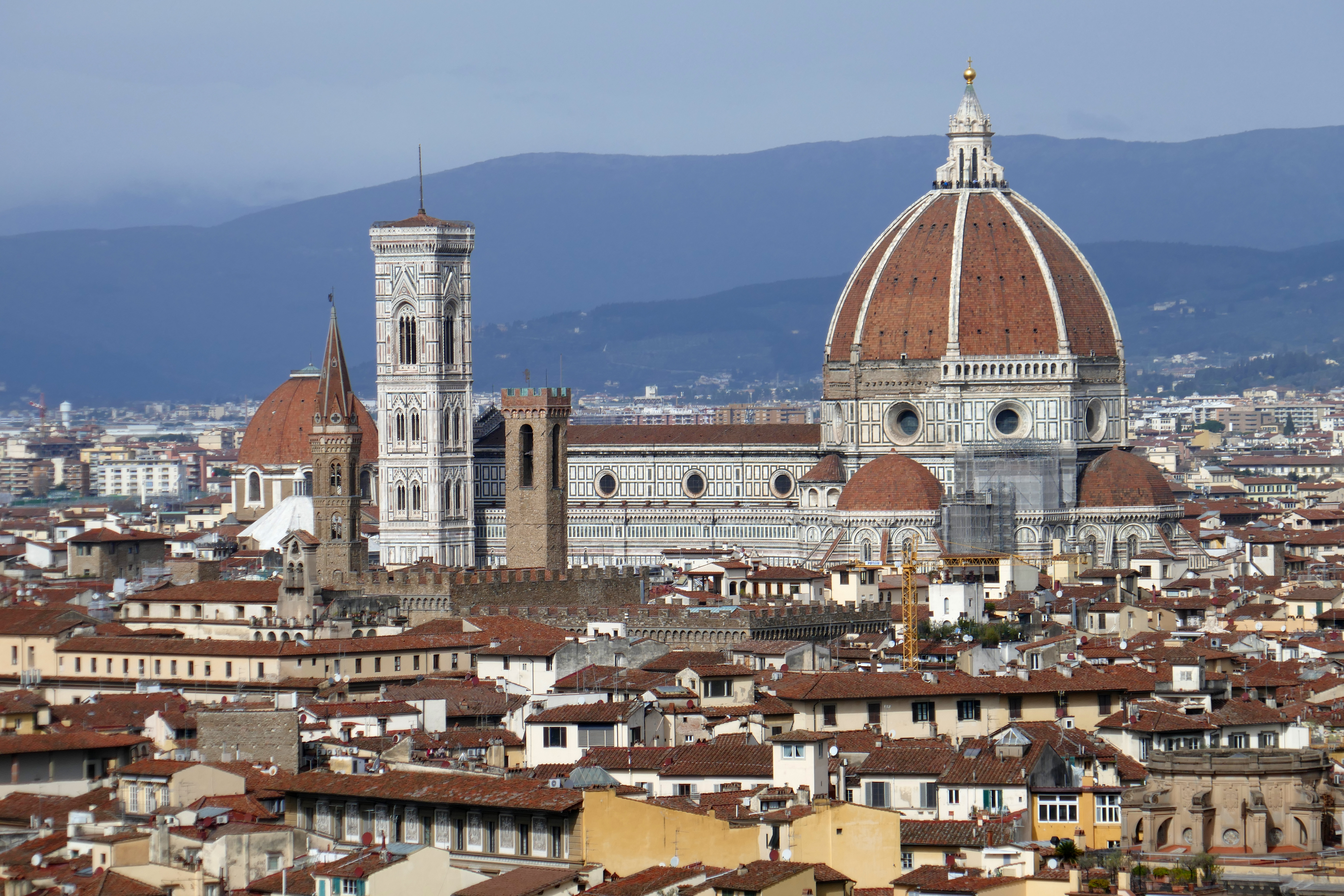
Over the next seven days, we walked around the city, getting our bearings and enjoying finding quiet corners as much as the big sights. We crossed the Ponte Vecchio many times, had evening aperitifs in the Piazza di Santo Spirito and were often drawn to the Duomo, just to enjoy its magnificence.

The dancing starlings in the evening sky in Piazza Santa Maria Novella was one of the unforgetable sights and sounds of Firenze. This grand piazza was also where we joined the rally to remember Ukraine on the second anniversary of the full-scale war and invasion by Russia and it became a special place for us. 

Bellosguardo – Steep hilly lanes from Porta Romana in the southwest of Firenze took us along the Via San Carlo and to Bellosguardo.  Dotted with grand villas, olive groves and vineyards the views over Florence were wide.  Cimitero di Soffiano, a vast cemetery with burials on different levels and an art deco style was a highlight on this walk. 

Fiesole to Settignano – The number seven bus climbed high into the hills of northeast Firenze to Fiesole. After coffee, we visited the remains of a Roman theatre and baths and an Etruscan Temple. Setting off hiking, we followed narrow lanes and tracks to Monte Ceceri, a maze of trees and small quarries. The network of paths was confusing and online maps such as Lokus and Komoot were useful.  At viewpoints we stopped to enjoy the panoramas over Firenze.  It was a spring-like day, the birds were singing and breathing in we got a lungful of pine. We descended into Maiano and then doubled back, contouring around the hillside on paths through varied woodland and by terraced olive groves.  This part of the walk was much quieter than Monte Ceceri. A damp path took us steeply down to a stream and then climbed up to the houses of Settignano that perched on the hillside.  In this sleepy village we caught the next bus back to Firenze.

South of the River Arno along Via Colli to Piazzale Michelangelo – Skirting around the Boboli Gardens, lanes packed with villas took us to Forte Belvedere, which wasn’t yet open for the season. Following Via Colli we wound above Firenze, each turn opening up new views over the city. We turned off the main road, picking up paths to Chiesa di San Miniato al Monte.  The church is surrounded by a crowded cemetery and has Firenze spread below. Piazzale Michelangelo thronged with visitors, even in February, but the views of the River Arno, the bridges and the magnificent Duomo are spectacular. We descended through a pretty garden with sculptures.

We visited some sights

The Boboli Gardens cost €10 per person and are perfect for strolling, although beyond green there is little colour from flowers. In February they close at 16.30 and for the last 20 minutes a continuous announcement that the garden is closing is broadcast. This reverberates around the, until then, peaceful gardens! We felt we were in a public announcement torture chamber!

The Galleria dell’Accademia for a dose of art and to see Michelangelo’s David. We had to queue for about 30 minutes, even in February!

The Duomo is a full day in itself. We booked Brunelleschi tickets that can be used over three days, although you still have to join queues. We climbed the cupola and the campanile [both 400+ steps] because we love getting above the roofs of a city. The views were astounding. We also visited the interior. Travel light as you will be searched over and over again!

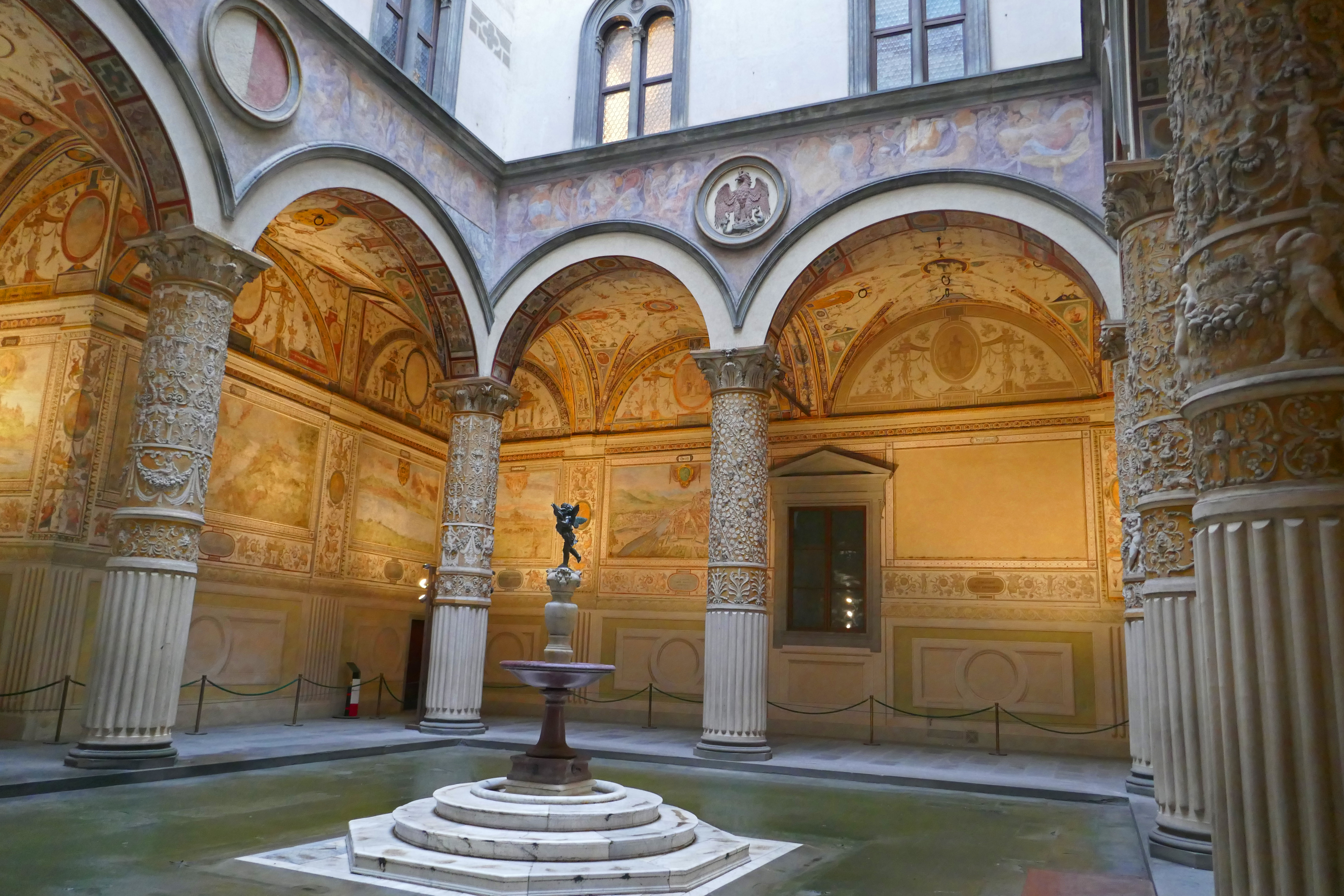
Palazzo Davanzati is a Firenze palazzo on four floors and arranged around a covered atrium with internal balconies. The rooms are all interesting and sumptuously decorated and at the top of the house is the kitchen.  There are vases and paintings and ornate furniture from different centuries from the 14th to the 19th centuries.  For €6 this was great value in a generally expensive city and interesting and I am suprised how few people seem to visit.

Museo Galileo – Seeing the actual telescopes that belonged to Galileo was astonishing and it was hard for other exhibits to compare to this. It is the place to help you appreciate intricate and shiny scientifi instruments as works of art. There is also an interactive room where we could play at being Galileo!

We visited a couple of churches – The Basilica di San Lorenzo had an austere air to it but the cloisters are light and airy. There are paintings and sculptures by Donatello. Santa Croce, a Franciscan Monastery in front of a handsome piazza, has many memorials and frescoes and double cloisters.  There was some information about the 1966 flood that caused so much devastation.

Siena – It was a chilly grey day when we caught the train to Siena for the one hour and twenty minutes journey. Steps and escalators climb up to the city level inside the walls. The streets are narrow and hemmed in by stone buildings, that open up at Il Campo, an undulating public space used for horse racing twice a year. Santa Maria della Scala was the highlight of our Siena trip, this large building complex is a former hospital and is now a museum and art gallery on many floors.  The 15th century frescoes showing life in the hospital delighted us with their colour and life, telling stories of the everyday. This warren-like building had other exhibitions, including works by 20th century artist Giuseppe Gavazzi.

A couple of notable places to eat

Caffe Scudieri near the Duomo was expensive but charming.  The pinenut torta was tasty and not too sweet and the cappuccino was the best ever, the perfect combination of bitterness and creamy smoothness.

Brac, a bookshop and restaurant that is all veggie and all delicious.  We ate surrounded by shelves of bottles of wine and cookery books and had a piatto unico each.  This was three dishes, a salad, a pasta and a special dish.  The food was elegantly presented and so tasty.  The ginger sauce on my tortellini was exquisite.  Anthony’s fennel salad was fresh and the pasta with a spicy sauce was excellent.  My mouth is still watering thinking of this meal!

Return Journey

Day One – Firenze to Torino and Torino to Paris, with a replacement bus service in the opposite direction. We stayed at the same hotel in Paris.

Day Two – Paris to London and London to Lancaster.

Summing up

We were away for eleven nights, seven in a self-contained flat and four in hotels. The whole trip cost us around £3,000. It is more expensive than a campervan trip but the train was a more sustainable way to travel for such a distance.

Travelling by train still felt like the perfect way to cross long distances in Europe, meet people, experience different cultures and relax while the scenery passes the window. We used the expertise of The Man in Seat 61 in our planning and if you’re thinking of doing a similar trip, this is a good place to start.

Firenze in February seemed busy but I guess this is nothing compared to summer months there. I couldn’t describe it as peaceful and the backdrop in the city centre is the constant rumble of suitcase wheels. Those of us who fling a rucksack on our backs have no comprehension why these are so popular! The weather was mixed with some fine spring-like days and some wet and chilly days. The good thing about a city holiday is that the weather doesn’t really matter.
Grado, northern Italy: A great choice for easy cycling

Grado (1)
Wildlife-rich wetlands of Friuli-Venezia Giulia near Grado

At the moment, with coronavirus restrictions, I can only dream about campervan trips.  When we are able to travel again, Italy will be on my list of places to revisit as I always enjoy finding some of that stunning country’s lesser known sights.  Tucked away in the north-east of Italy, near the Slovenian border, is the Friuli-Venezia Giulia area, a lovely part of Italy that we only found thanks to our lack of planning.

Our campervan trips to mainland Europe are only ever sketched in, with little detailed planning.  We were therefore excited to have the opportunity to explore somewhere new as we drove over the Slovenian border into Italy’s Friuli-Venezia Giulia.  Invaluable in this exploration was a guidebook we had picked up in Slovenia by chance that showed the wealth of natural protected areas in this corner of Italy; it seemed like our sort of place and we decided to stay for a while.  From the guide I learnt that Friuli-Venezia Giulia has it’s own Fruilian language and is packed with landscape variety, from wildlife-rich flat coastal wetlands on the Adriatic to the splendour of the foothills of the mountainous Dolomites and also has plenty of history.

We chose Belvedere Pineta Camping Village as it gave us good access to the excellent network of dedicated bicycle paths around Grado.  This is a large and rambling site that was quiet in late May.  Set among the trees, insects can be a problem but this does mean that there is plenty of bird life.  We would eat breakfast entertained by jays, a nuthatch, magpies and blackbirds and in the evenings scops owls made their sonar-like calls overhead and fire flies lit up the bushes.  One morning we watched a hare lolloping around the empty pitches at the furthest edges of the site.

Before reaching the campsite we used the guide to find the Doberdo Lakes Nature Reserve where lakes have formed in depressions [poljes] of the limestone / karst.  We had some trouble reaching the lake as the road was closed due to road works; however the diversion took us to a parking spot on the northern edge from where we walked through the woodland to the jungle-like reedy edges of the lake.  The best views over the pretty lakes were from a high crag that we hiked up to and where there is climbing and a climbers hut at Castelliere Gradina.  We also stumbled upon World War One defensive tunnels cut into the rocks.

Cycling north from the campsite there is an excellent traffic-free cycle lane alongside the main road for the 6.5 km to Aquileia.  We returned this way but got to the ancient Roman city of Aquileia on a longer route following quiet winding lanes [11.5 km] after turning left from the campsite entrance.  This took us through large flat fields of crops and vines and alongside drainage ditches and canals.  We stopped often to take in the agricultural scenery and see the ducks and geese on the water.  Aquileia is popular with visitors and has information boards to describe the sights.  We walked along the Roman harbour remains where the now silted-up river made it difficult to make much sense of what you could see.  For a small fee you can visit Aquileia Cathedral which has some stunning early mosaics.

Grado (4)
Boats in the harbour of the smart resort of Grado

Cycling to Grado through this low-lying landscape is an easy 7.5 km from our campsite on dedicated paths and it is popular with all abilities and ages.  The short distance look us a while only because we stopped so often to admire the views across the lagoon and see the wildlife; we were particularly excited to spot a pair of African sacred ibis.  The town of Grado is on an island in the Adriatic and we were cycling over a five-kilometre long bridge that crosses the dramatic and panoramic waterscape of the lagoon.  Grado is a classy resort with a harbour full of boats and a well-kept promenade dotted with sculptures.  We wandered through the town’s attractive historical centre and found its cluster of ancient churches that use re-cycled Roman columns and have sixth century mosaics.  The Basilica di Santa Eufemia has a pulpit resting on old Roman columns and is covered by a brightly coloured Venetian canopy.  The octagonal baptistery is 5th century, as is the Santa Marie delle Grazie that again has re-used Roman columns and capitals in its interior.

You could cycle to the Valle Cavanata Regional Nature Reserve from Belevedere Pineta Camping Village [it is just over 30 km round trip] as there are dedicated cycle routes all the way.  Alternatively you could stay at one of the many campsites to the east of Grado and be nearer.  We opted to drive to the Valle Cavanata visitor centre on the Grado lagoon so that we could cycle around the nature reserve.  At the visitor centre we were given a free map showing cycle routes that allowed us to explore the area at our own pace.  This reserve is a paradise for casual bird watching and near to the centre we stopped to watch the flamingos and egrets.  Cycling out towards the Adriatic coast on sandy tracks we met flocks of bee eaters.  At the coast we cycled along the top of the dyke with views across the sea until we reached Caneo.  Here small fishing boats were moored in tree-lined creeks and we watched two coypu swimming along the Isonzo / Soča river at the estuary.  We returned a different way along the minor roads by canals and drainage ditches and by fields of cereals and fruit trees.  The area is well organised for cycling and popular with German and Dutch visitors.  On the way back to the campsite we stopped at one of the many roadside stalls to buy fresh strawberries, asparagus and red onions that are grown here.

It was only from a recommendation by a couple we got chatting to on the campsite that we heard of the small town of Palmanova, about 25 km north of our campsite.  We drove to the town that sits inside a 16th century Venetian nine-point star-shaped fort and was only completed in the Napoleonic era.  We found parking for the Blue Bus outside the walls and entered the town through the Udine Gate, one of three gateways, after taking a look at the aqueduct system.  A short walk along the main street and we were soon in the huge central square, the Piazza Grande, the scale of which feels out of proportion for the town.  Reconstructions of military and water management equipment from the past sit in the square and six roads radiate from this large piazza, each grandly flanked by two statues.  Palmanova was built as an experimental utopian community as well as a defensive fortress city against the Ottomans; however, for some reason this charming town had little appeal and in the 17th century people were paid to encourage them to live there.

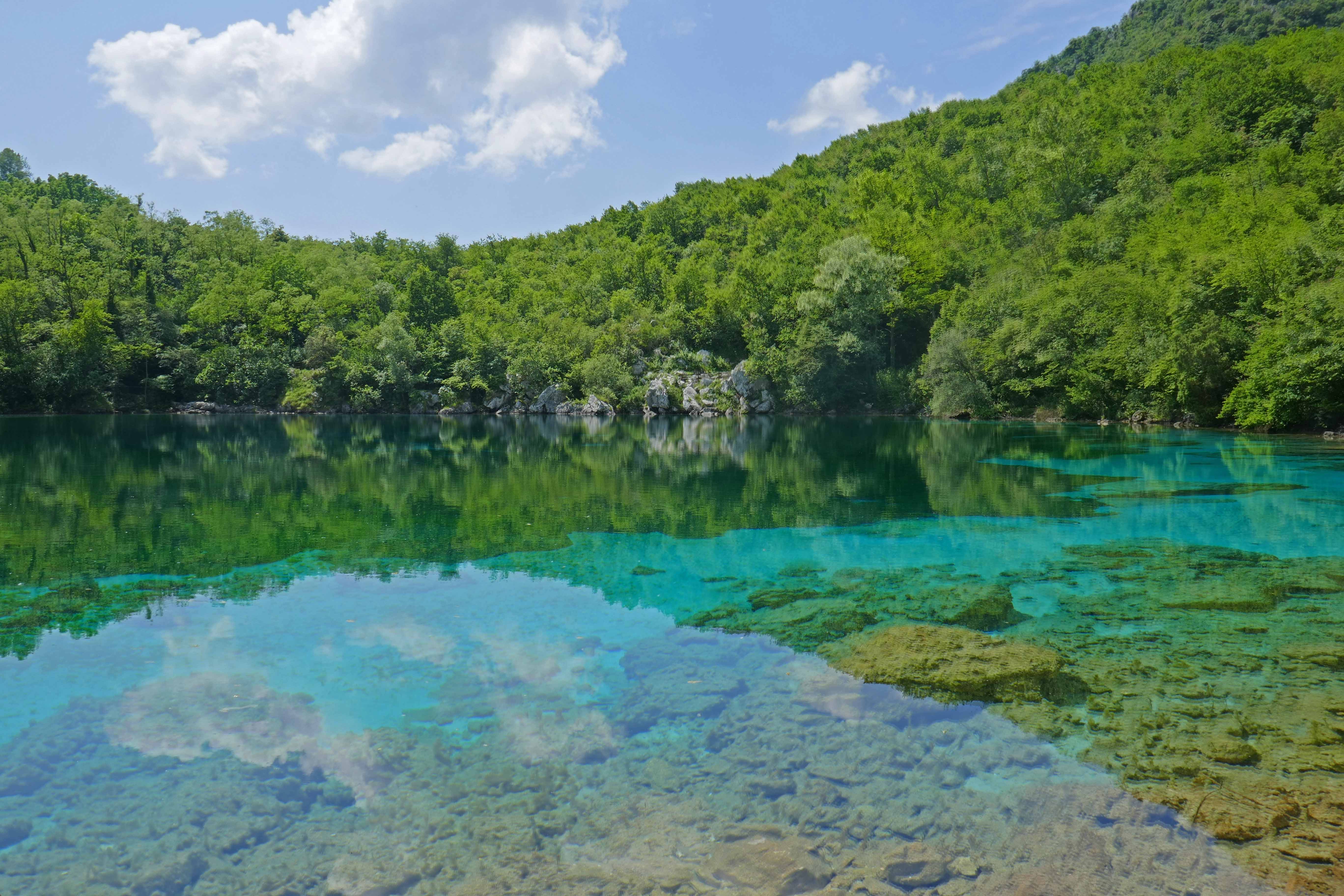
We moved on to Riserva Naturale Regionale Del Lago di Cornino.  This small lago provided a perfect short halt, with parking above the lake that is an almost unbelievable vivid clear turquoise and sits prettily among trees and high crags.  After lunch looking over the view we sauntered around the circular lake footpath.  Peering through the trees over the water, we fortunately spotted an adder hanging ominously from a branch over the water before we alarmed it.  Overhead numerous griffon vultures, reintroduced to the area, circled slowly.  No doubt if we’d been a victim of the adder they would have made a tasty meal of us!

Grado 6
Lago di Cornino is brilliant turquoise

2017 Campsites through France, Italy to Greece

Greece (98)

We spent a month driving through France and then touring Greece.  Here are the campsites we stayed at until our dream trip was cut tragically short.


Campsite name Comments
Pont a Mousson Aire, France Busy aire by river Moselle and pleasant town, full even in April, shops nearby, toilets and shower until 20.00
Les Cent Vignes Municipal Site, Beaune, France Tidy site with hard-standing near the town centre, facilities clean, showers warm, hot water for wash-up, water on pitch and 6 amps.
Le Bourget du Lac aire near Chambery, France Marked pitches, next to campsite, no EHU, can use campsite facilities, open views
Camping Du Bourg, Digne les Bains, France Good views, chalets, friendly welcome, showers have very hot water but shower head hopeless!  Facilities clean but basic, 10 mins walk to town
Camping Val Fleuri, Cagnes sur Mer, France Marked good-sized pitches, pool, 4 km from sea, facilities clean & modern & showers hot, although push button.  Bread brought to pitch in the morning.
Campeggio dei Fiori, Pietra Ligure, Italy 800 m from the sea but peaceful.  Marked pitches, hot water, showers small, 15 mins walk to shops
Le Fonti, Cervarezza Terme, Italy Large site with lots of bungalows, pitch had spectacular views over the valley, sanitary blocks modern with doors, friendly welcome, roomy hot showers & hot water in sinks
Camper Club Mutina, Modena, Italy Well laid out sosta with some grass & trees, clean facilities & good hot showers, 30 mins cycle ride to centre & given a map at reception
Camping Village Mar Y Sierra, Stacciola near Mondolfo, Italy Terraced site & shaded pitches, lovely views across a valley to a pretty Italian town, peaceful.  Facilities clean & modern, showers cramped but hot, adjustable & continuous
Camping Acrogiai, Riza, Greece Had a pitch facing the sea, lots of statics, right on beach, pitch sloped, facilities clean & spacious, water lukewarm, 2 small yapping dogs run around freely!
Camping Apollon, Delphi, Greece Terraced site with stunning views across the bay.  English spoken at reception, bread, marked pitches with some trees, hot water for wash-up & showers, clean facilities, good
Afrodites Waters, Ancient Corinth Very friendly welcome and given fruit & honey.  Small gravel site with marked pitches but little space, 2 toilets & shower & wash-up, water lukewarm, 10 mins walk to Ancient Corinth
Nicholas II, Epidavros On the seafront and under trees, facilities shabby but clean, water only lukewarm for wash up but very hot for showers
Camping Apollon, Delphi As good as the first time!
Camping Sikia, Kato Gatzea, Pelion Peninsular Simply the best campsite.  Friendly owners, beautiful facilities, peaceful coastal location with lovely views from pitches, great walking from the site, lovely bistro.

Camping Le Fonti & Climbing Monte Ventasso in Reggio nell’Emilia, Italy

The SS63 across the Appenines from Tuscany in to Emilia Romagna is a fantastic drive.  The road winds around the mountains with different and more amazing views at every corner.  We were heading towards Modena but were enjoying the area enormously and in the mild spring weather we opted to stay at Camping Le Fonti near Cervarezza Terme (Busana) for a few days and enjoy some mountain serenity and walking.

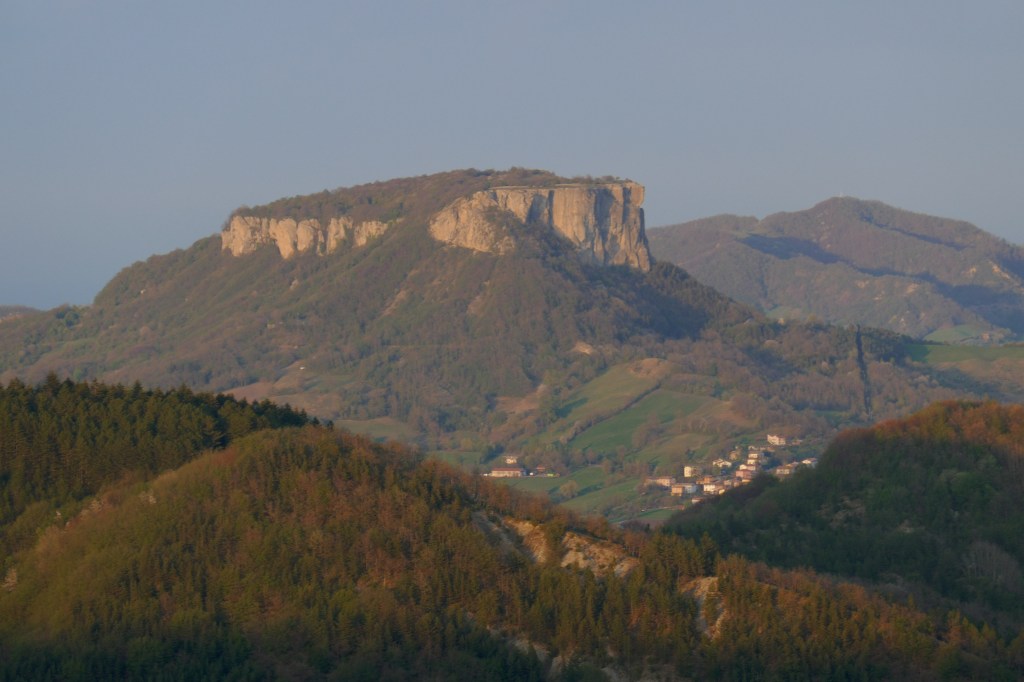
Camping Le Fonti is open all year round and has plenty of shade under chestnut and beech trees for the heat of summer.  In spring it is quieter and the site offers an ACSI discount and pitches on the higher parts of the site out of the trees and with panoramic views over the surrounding countryside.  From our lofty pitch we could see the distinctive crags of the flat-topped Pietra di Bismantova a few kilometres away, dramatic in the evening sunset.

This is a large and rambling hillside site at 1,000 metres above sea level and in season it has everything for family camping with a restaurant, shop, organised activities and indoor pool.  We don’t really need these things and were grateful to get fresh bread every morning, heated facilities in the chilly evenings and good hot showers.

The campsite is family-run and when we arrived mama was on reception.  Although she spoke limited English we received a friendly welcome and managed to order bread [that her husband delivered in the morning] and get hold of a sketch map for the walk up Monte Ventasso, a steep-sided 1,727 metre high mountain that is clearly a popular walk from the campsite.

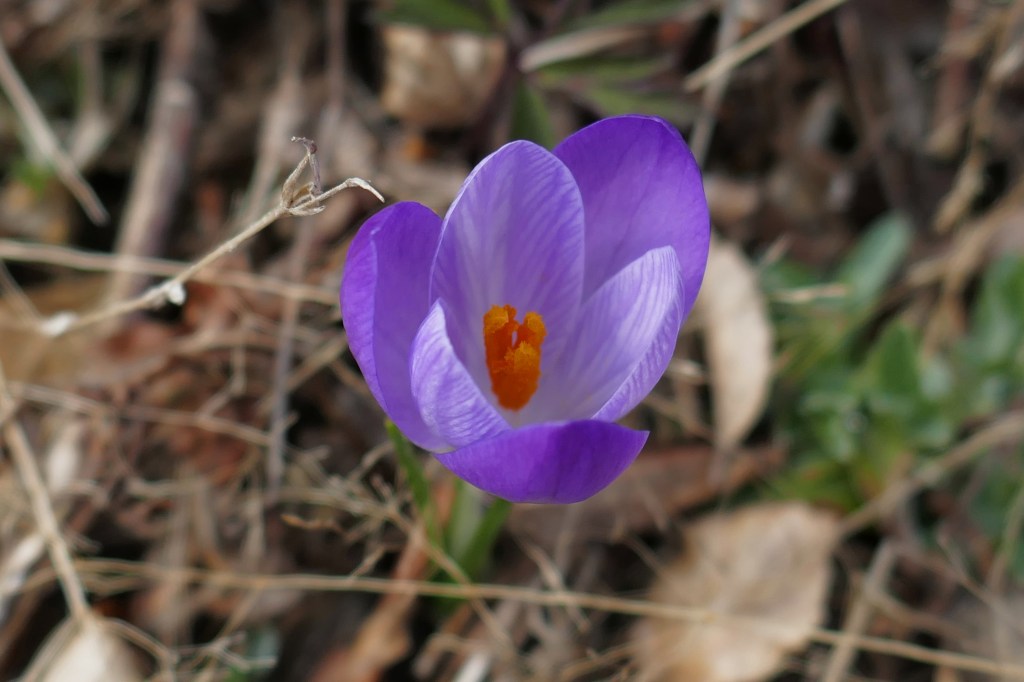
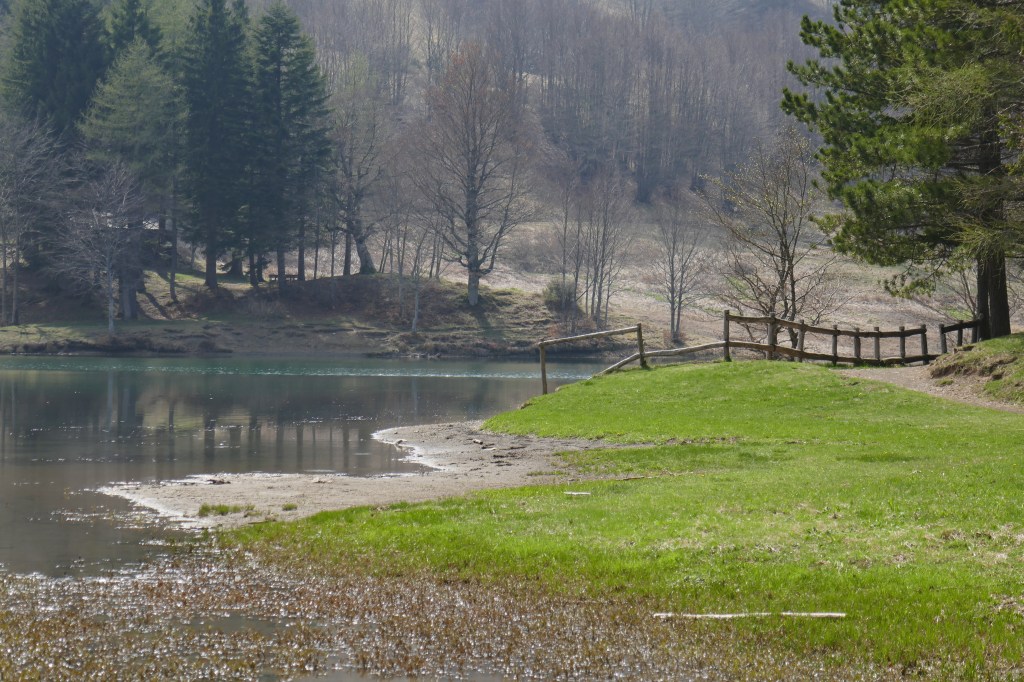
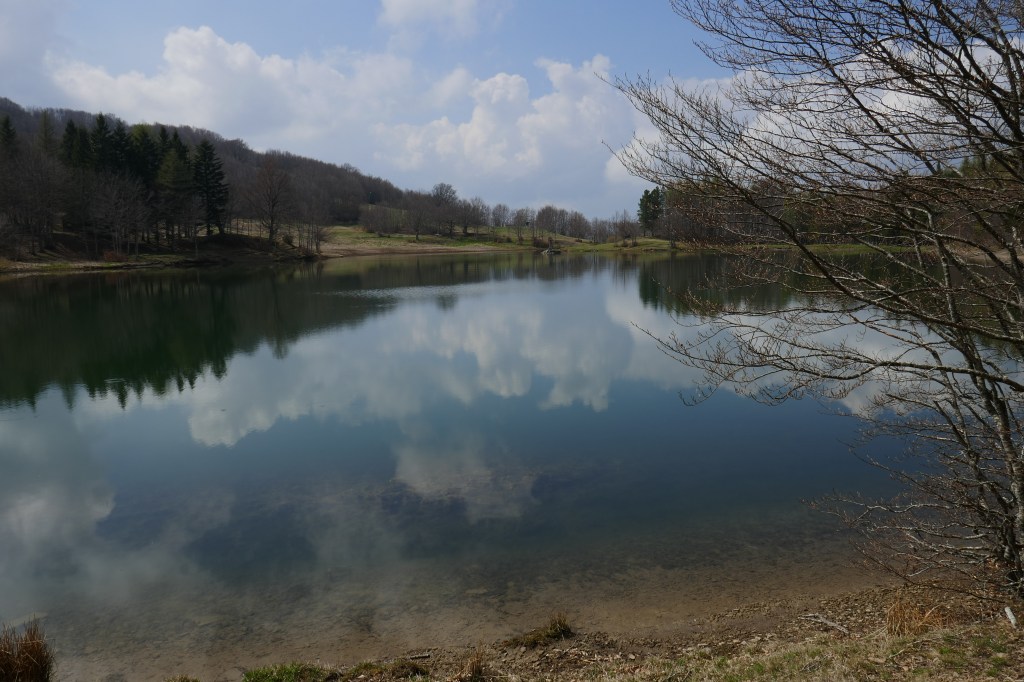
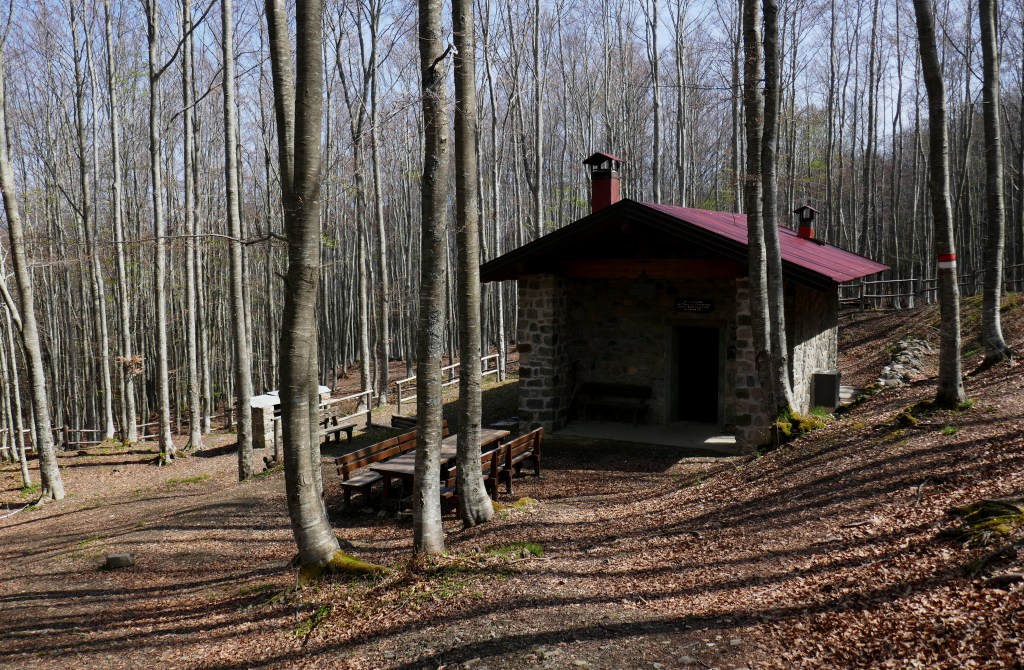
Monte Ventasso proved to be a fantastic full-day outing.  The way-marked path initially climbs steadily through beautiful sun-dappled beech woods dotted with wood anemone, primroses and wild crocuses.  If you don’t want to walk to the summit you could just go as far as the chapel and refuge at St Maria Maddalena and picnic here enjoying the marvellous views over the Secchia valley.  Alternatively, in hot weather you could take the woodland paths to Lago Calamone, a pretty glacial lake below the mountain that is perfect for summer bathing.

We had lunch at the refuge below the rocky crags of the east flanks of Monti Ventasso before carrying on.  The steep, narrow and rocky path up the east ridge was exposed in places but brings you to the wide and grassy ridge to the summit.  We passed a curious wooden hinged figure on the way and met our first other walkers of the day, a German couple who were also on the campsite.

The summit is marked by a cross and we had views of the distinctive Pietra di Bismantova and a wide flat valley.  Lago Calamone was immediately below us and in the further distance were higher snowy mountains.  We took the direct route down that was steep and difficult.  We reached the picturesque Lago Calamone and sat watching a group of young men enthusiastically playing football on the shore.  We climbed upwards  across scree slopes of large boulders and below the craggy face of Monti Ventasso to join our previous path, returning the same way, stopping for a rest and chocolate bars at the view point.  We returned to our campervan tired but happy after walking about ten miles and climbing about 742 m of ascent.

Directions: From the A1 take the exit for Reggio Nell ‘Emilia and follow the SS63 to Cervarezza Terme. The campsite is signposted beyond Castelnovo ne Monfi.


Finding beauty and tragedy in the Dolomites in Italy

05.27.2018 Celina and Vajont valleys (10).JPG
The village of Casso sits high on the slopes of the valley

Northern Italy is pretty much all jaw-dropping beautiful.  We had been driving through green alpine valleys, stopping often to stand and look in awe at the craggy mountains above and the ice-blue river we were following.   Leaving the stunning River Cellina valley we followed the Torrente Cimoliana to the pretty village of Cimolais, all the time making a note to come this way again.  We drove over the Passo di Sant’Osvaldo coming down to the village of Erto.  Ahead I could see a scoured hillside, devoid of trees or vegetation, this certainly looked out of place.  We stopped the ‘van to take it in, at first wondering if this was a quarry but quickly realising the mountainside was too steep for such activity.  The scale of the ‘M-shaped’ scar on the hillside was hard to take in but we realised we were looking at a landslide.  What we didn’t realise at that moment was how devastating the landslide had been.  We had stumbled upon the Vajont Dam and the legacy of the disaster that occurred here on the night of 9 October 1963.

The Vajont Dam, a 265-meter high arch dam was in 1963 considered an amazing construction that created a large reservoir in the mountain valley.  The dam was well built and still stands as it withstood the unprecedented destructive power of that night.  On the 9 October 1963 a huge slice of the mountain slid in to the reservoir behind the dam.  Around 260 million cubic metres of rock hit the water and this created a massive wave that breached the Vajont Dam, the displaced water rising high and pouring with unimaginable force in to the Piave valley below, gaining speed all the while.

We stopped below the Alpine village of Casso that clings to the mountainside.  From here we could see the scar on the flank of Monte Toc and look down on the Vajont Dam that stands as a memorial to the thousands who lost their life.  We walked below Monte Toc trying to take in the scale of this avoidable disaster.  As the dam was planned and built many people warned about the geological instability of the area and the risk from the dam but corrupt and powerful institutions failed to listen.

We drove down the mountainside to the town of Longarone.  This lovely town is below the dam and in 1963 it was flattened by the tsunami of water that poured over the dam.  In the moving museum in the basement of the modern church there are photographs showing the aftermath and the names of people who died.  It is estimated that around 2,000 people were killed that night and I thought about all those lives cut short.

Although I left feeling somber, I was glad we had stopped to learn about this disaster that has left its mark on this beautiful landscape.

For photographs of the reservoir and the destruction of the landslide take a look here.  Today the Parco Naturale Dolomiti Friulane has been created to bring tourism back to this incredible and beautiful area.

05.27.2018 Celina and Vajont valleys (13)
In the museum in Longarone


Campsites during our trip to Croatia, Italy & France

06.15.2018 Le Poet Celard (3).JPG
The lovely campsite at Le Poet-Celard

During our trip through Germany and Austria to Croatia [with occasional excursions in to Slovenia] and on to Italy and France we stayed on 37 campsites.  Each site has some notes about our experience of the site:

Campsite nameNumber of nightsCommentsCost
Camping Freizeitzentrum, Sagemuhle, Trippstadt, Germany1Large site by a small lake with bar & restaurant, lovely clean faclities, very hot water & indoor wash up, grassy pitches on well drained soil & open site, very good bread rolls£19.50
Hofgut Hopfenburg, Munsingen, Germany2Open site above the town with hard-standing walking from site in woodland, facilites excelletn, clean, warm, very hot showers, indoor wash-up, drying room, fresh bread, great site for €15.  For a fuller review read here.£15.00
Alpencamping Mark Weer Austria2Green site with grass & trees & friendly welcome, walking & cycling, clean facilities, good hot showers, bread rolls & lots of info£17.00
Camping Goldeck Seeboden, Austria1Grassy terraced site with clean facilities, building work going on & entrance steep, facilities dingy & cold but warm water, air of neglect£19.00
Camp Slapic, Duga Resa near Karlovac, Croatia3Nicely laid out site with open & shady pitches by river, English spoken at reception, lovely modern facilities, bar & restaurant, walking & cycling & railway station 5 mins away£19.00
Camp Marina Lozovac Sibenik, Croatia2Small site with marked pitches & some shade, clean facilities, roomy shower/wet rooms & hot water that runs continuous 2 kms from national park & excursions from site£15.00
Autocamp Peros Zaton Nin, Croatia1Small site, friendly welcome, grassy with trees, facilities basic but the water is hot & showers fine, peaceful, a few kms to Nin a lovely old town£17.00
Bluesun Camp Paklenica Starigrad, Croatia4Large site by the sea with bungalows & chalets, stony ground, level & pine trees for shade, modern facilities & good hot showers with no push buttons & roomy cubicles near the town£17.00
Hostel Plitvice Rastoke Camperstop, Slunj, Croatia1Car park with fantastic views over the river gorge to the town and EHU.£15.00
Camp Slapic, Duga Resa near Karlovac1Different pitch, the site now has bread in restaurant£19.00
Vugec Plac Camper Stop Samabor, Croatia2Small site for 4 vans, flat & grassy with 1 bathroom & sitting area / itchen & pool, all new & clean, hedged & gated in peaceful area with open views, good hot shower, friendly owner£20.00
Terme Olimia Camping Podcetrtek, Slovenia1Clean facilities, shaded pitches, aquapark not open so fairly peaceful but some road noise£17.00
Camping Terme Ptuj Slovenia1Grassy site, pitches in circular areas, busy with group from Netherlands, good hot showers£19.00
Camping Amarin Rovinj Istria, Croatia2A large grassy sloping site with trees, facilities basic but clean & hot water, fresh bread & shop water taxi & bus to Rovinj£17.00
Motovun Motorhome Parking Motovun, Croatia1Sloped gravel parking area for 12 vans, some trees only 1 shower & 1 toilet per sex, good hot showers & water by pitch£25.00
Camping Park Lijak Active Sempas near Nova Gorica, Slovenia1Grassy site with views of hills, friendly welcome, facilities modern & clean, water in showers only just warm enough, €5 tourist tax£17.00
Belvedere Pineta Campng Village Grado Italy3Large site by lagoon in pine woods, good size pitches, cycling routes from the site, no toilet seats or toilet paper, €17 on ACSI (we used some free camping cheques) good hot showers, supermarket, restaurant & bleach, wi-fi €5 a day£0.00
Lago 3 Comuni Alesso, Italy2Small site with pleasant bar, small pitches, showers push button & barely warm but facilities clean by a lake & mountain views£21.00
Sosta Barcis, Italy1Level car park by lake & cycling from site, small town with some shops, toilets nearby & water & electric on pitch, some music noise until 01.30 it was Saturday£14.00
Camping Lago Arsie, Italy2Level grassy site by lake with shop & restaurant, good size pitches, very little shade, helpful reception, showers hot but showerheads a burst of water rather than a shower, facilities modern£19.00
Camping Valle Verde Predazzo, Italy3Excellent & peaceful site in mountain valley, given a map of 10 local walks & cycle routes, facilities clean, toilet paper & paper towels, good hot showers£19.00
La Sosta, ponte di Legno, Italy1Car park on the edge of the mountain town with cafe & hook up, slight gradient, toilet with cafe, water on pitch£15.00
Camping Presanella Temu, Italy1Lovely views from this grassy site, clean facilities, cycle route from site, free wi-fi, hot showers but no heating in facilities£28.00
Camping Covelo, Iseo, Italy4Small site between lake & railway line, cramped pitches, friendly & helpful staff, good hot showers & clean facilities, near to town, extra €2 for lakeside£19.00
Montgenevre Aire, France1Large gravel aire with views over the village & mountains at 1,859 metres£13.00
Le Glandasse, Die, France2Large friendly site by the river popular with Dutch, marked pitches, showers small & push button, clean & almost warm enough, no toilet paper£13.00
Champ la Chevre, Lus-la-Croix-Haute, France1Sloping site with few level pitches but open views to the mountains & by village, indoor pool, good hot showers & clean facilities£15.00
Les Chapelains, Saillans, France2Small site by a town, friendly welcome, marked pitches, facilities open & showers only lukewarm & push button£15.00
Les Clorinthes, Crest, France1Level site with trees, friendly welcome & near to the town, facilities clean, showers push button & could be warmer£17.00
Le Couspeau Camping, le-Poet-Celard, france2Terraced site with wide open views across to hills, friendly welcome, 5 hrs of free wi-fi, all facilities, peaceful location, modern facilities & good hot showers, restaurant & bar£15.00
Camping de Mars, Cordelle, France1Overlooking the Loire, peaceful spot, facilities a bit dated & showers tepid, friendly rabbit, paid with free camping cheques so only paid tourist tax£1.10
Couleurs du Monde, Montrichard, France1Level site next to supermarket & 1 km from Montrichard & the Cher River, wrist bands obligatory, facilities clean but water tepid, popular with English£15.00
Les Acaacias Camping, Tours, France2Level site with some road noise, friendly & helpful welcome, good facilities, showers roomy & warm enough, 7 kms cycle route to Tours£17.00
Camping Les Plages de Loire, Rochefort-sur-Loire, France1Flat site by small town between Le Louet & Loire, facilities mixed, showers have been updated but were not very warm & push button, wash up is somewhat grim, pitches marked but narrow£13.00
Les Paludiers, Batz-sur-Mer, Le Croisic, France2Large rambling site with marked pitches, some very sloped, showers were roomy with sinks & warm enough in good weather, helpful reception£17.00
Municipal Campsite Corlay, France1Grassy area by play ground with hook up for 4 vans, toilets, basins and showers that were hot & good but a bit scruffy, no one came to be paid£0.00
Riva Bella, Ouistreham, France2Flat site near town & supermarkets with indoor pool but also peaceful corners, modern facilities, roomy showers with wash basins that had warm water£17.00
Camping La Fontaine des Clercs, Montreuil, France1The pleasant aire was full so we used this terraced site with some small pitches & dated facilties, free wi-fi, showers tepid but very hot water in sinks, popular & busy£19.90

Two months campervan trip to Croatia, Italy & France: what did it cost?

05.05.2018 Krka National Park (1).JPG
Krka National Park in Croatia

On our long foray to the European mainland we spent just over two months from April to June travelling around Europe in our campervan.  I always monitor the spending of our trips.  Sp how did the spending go?  For various reasons this trip was certainly more expensive than our autumn trip to Spain and Portugal.  Here is the breakdown in sterling:

  • Diesel – £610 (Croatia is quite a long way and we travelled over 4,200 miles)
  • Supermarket shopping – £956 (we did stock up on wine)
  • Cafes, restaurants & ice-creams – £467
  • Campsites – £983 (for 64 nights)
  • Tolls, bus & train fares & parking – £218
  • Entrance fees – £279 (including about £100 for the Krka National Park excursion)
  • Miscellaneous – £115 [maps, campsite washing machines, occasional wifi & bits of kit]
  • Ferry [return Hull to Zeebrugge] – £489
  • TOTAL – £4,117 – average [without the ferry] £55 / day [this is £11 a day more than our autumn trip to Spain and Portugal]

We had travelled a long way to Croatia and to some extent this affected our spending.  We paid almost €110 for the two of us an excursion in a minibus around Krka National Park.  This tour [organised through Camp Marina] meant that we saw more than we would have and for us it was well worth it.  We used some toll motorways in Croatia and bought vignettes for Austria and Slovenia.

Not surprisingly the cheapest country we stayed in was France with some nights of free camping and plenty of ACSI sites that are reasonably priced.  Campsites are notoriously expensive in Italy but we stayed on some very good sostas to keep our costs down.

We had a fantastic trip and we both loved visiting Croatia but to stay within budget during our retirement a trip this costly isn’t something we can do every year.


Wherever you travel becomes a part of you

25 Aug Val grisenche walk with marmots 021
The beautiful Valgrisenche in the Gran Paradiso National Park in Italy

is it just me or do places you have visited and loved suddenly pop in to your head at random times.  I can be doing anything, totally unrelated to travelling, and a memory of a place will slip in to my head and I am once again there in that place.  There are many places I have visited that stay with me and I am sure that all of them have shaped and changed me.  The photograph above is the beautiful and remote Valgrisenche in the Gran Paradiso National Park in northern Italy.  We stayed a week in Planaval, a small and stunningly beautiful village a little way up the valley in 2009.  Valgrisenche is missed by many tourists and we followed the quiet valley road to its end a number of times.  Passing the lake, there are a few farms dotted around the valley and more abandoned stone houses.  After having hot chocolate in the tiny cafe by the car park we would walk along the trail to the refuge and the high mountains of the Alps, glaciers appearing as you turn a corner.  There are marmots here and wild flowers, berries brighten up the autumn rowan trees.  This was September and in the week we were here there were days so hot all we wanted to do was bathe our feet in the cool streams, other days the cloud came down and the fresh smell of rain made it feel like Scotland; this place has a wild and remote beauty.

Planaval itself is easily by-passed as you have to turn off the valley road to even see the village.  We were there during a village celebration and we watched a promenade play around the narrow village streets that in the local dialect was mostly incomprehensible and we listened to melancholy music that echoed around the steep mountains.  From Planaval we walked up steep tracks to look down on the village, finding bubbling mountain streams to quench our thirst from in Alpine meadows.  A long snake slithered away on feeling the vibration from our walking poles.

The beauty of Valgrisenche is deep inside me and I am sure that even if I never return the sights, smells and sounds of this stunning place will never leave me.

28 August Planaval walk 003.JPG
Alpine meadow above Planaval in Valgrisenche

A day in Brescia northern Italy & a museum inside a building, inside a building, inside …

06.06.2018 Brescia (28)
Inside the Museo di Santa Giulia

Brescia in Lombardy in northern Italy might not be at the top of your list of Italian cities to visit but in my experience it won’t disappoint.  You might have Rome, Venice and Florence on your wish list but over the years I have realised that less well known cities are always worth spending time in and that everywhere has something to offer and I particularly appreciate visiting cities that are not overwhelmed by other tourists.

From our campsite near Iseo it was easy and inexpensive [€6.60 each] to take the train to Brescia for the day.  This proved to be an excellent and relaxing day out in a lovely city that has plenty to offer.  We arrived without a map but this was no problem as Brescia handily has signposts to all the major attractions in the city.  Our first stop was the monumental Piazza della Vittoria, a 1930s piazza that is striking and I rather liked its brutalist charm.  The post office with tall striped columns dominates one end of the piazza and Brescia’s first skyscraper is here, a 40-metre high brick structure with decorative details.

Through a collonade is Piazza della Loggia, an attractive 15th century Renaissance piazza that contrasts sharply with Piazza della Vittoria.  Piazza della Loggia has buildings and memorials to many important events in Brescia’s history.  Below the clock is an emotional memorial to a bomb attack by fascists against an anti-fascist demo on 28 May 1974.  Nearby there is a statue remembering those who died in the 19th century ten-day rebellion against Austrian rule.  The piazza is dominated by the ornate palazzo, now the town hall.  Opposite this is a 16th century clock tower whose clock is only of limited use for a time check as the dials of the clock show the phases of the moon and the signs of the zodiac.  Two charming figures, ‘i macc de le ure’ or ‘Tone and Batista’ strike the hours on a bell.  There are cafes around the piazza and it is a lovely place to stroll or sit and people watch.

We continued to Piazza Paulo VI which is packed with important and impressive buildings and symbolises the religious and civic power of Brescia.  Most unusual is the old cathedral; this circular structure was built in the 11th century and was disappointingly closed when we were there.   Next to this is the new cathedral, a more frothy building from the 17th century.  We chose to sit in a lively cafe and have our lunch in this grand piazza.

We followed the signs for the Museo di Santa Giulia a unique and complex museum, housed in an 8th century Benedictine nunnery.  The museum site comprises exhibits within buildings that are within buildings; the whole spanning many centuries and this can make it difficult to fathom at first but I found the self-guided tour with information in both Italian and English helped me to understand the context and history.  On this vast site there are three churches including Santa Maria in Solario which has extravagant colourful frescoes.  Also beautifully decorated is the nun’s choir where the Benedictine nuns of the Santa Giulia convent took part in services while hidden from view.  There is a crypt and Renaissance cloisters too that visitors can explore.  Dotted around the buildings are modern sculptures that I felt contributed to and enhanced my enjoyment of this museum.  Underneath the monastery garden archaeologists found the remains of Roman villas and I followed the walkways over these buildings; the perspective from above gave a good sense of the layout of the villas and great views of the intricate mosaics.

As if all those buildings and art were not enough, the museum also includes displays of artifacts from Roman to Venetian periods of Brescia’s history; something for everyone’s interest but you would need days to look at everything.  A big draw is the Roman bronze life-size winged victory statue from the 1st century.  This impressive bronze of a woman draped in a cloth glimmers with layers of beautiful colours and appears to move and flow.

The whole of Santa Giulia is harmonious and interesting and exploring this amazing museum took so long we ran out of time for Brescia’s other sites.  We will have to return to Brescia one day to see the castle, all the Roman remains, the Museo delle Mille Miglia … .

We finished our day in Brescia back at the elegant Piazza della Loggia.  We sat relaxing with a beer in a cafe and listened to the clock strike the hour before catching the train back to Iseo.

06.06.2018 Brescia (2)
Piazza della Vittoria

Making the most of a short break in Milan

03.16.18 Milan (6) Walking tour
The beautiful Galleria Vittorio Emanuele II in Milan

The northern Italian city of Milan is the perfect city for a short break and its popularity has grown in recent years following the 2015 Expo.  A couple of days were certainly not enough to see everything in Milan but we managed to pack in some of the well-known and lesser-known sights creating a weekend that was pure Italian and gave us glimpses in to the spirit of the city.  These are my highlights for your own visit:

Piazza del Duomo – You won’t want to miss getting to the Piazza del Duomo.  From here you will be overwhelmed by the extravagant and ornate front of Milan’s gothic Duomo.  Once you have taken in the grandeur of the cathedral, look to your left to see the equally stunning entrance to the Galleria Vittorio Emanuele II 19th century shopping mall.  This is the heart of Milan and a must for every visitor and it is always crowded but gazing at the surrounding splendour you forget the hordes.  Strolling through the Galleria to La Scala is free; visiting the Duomo isn’t and except maybe in the depths of winter involves joining queues.  The experience not to be missed is climbing up to the terraces on the roof of the Duomo and going here at sunset has many advantages.  Late in the day the queues are shorter and the crowds less; we were the next to last group in the lift to the roof [the staff tried to put us off, telling us we might not get up before they closed but we stuck with it] and with no further visitors following us we could find some quiet corners among the many statues that adorn the building.  Reaching the front of the Duomo that faces west and the setting sun, I could hear the music and chatter from the surrounding rooftop bars. The disadvantage of going late at night was that we couldn’t get in to the interior until the next day and so had to queue again [for about an hour and a half] and after so much build up the interior of the Duomo is a bit of a let down.

Coffee and cake in a classic italian Cafe – Pasticceria Marchesi has been making cakes and coffee since 1824 and is worth the expense for the excellent coffee and delicious cakes.  There are three shops in Milan and we visited the charming and smaller cafe near to Sforza Castle.  As lunch time approached the cafe became busy with people coming in for lunch and a swift coffee and the system of ordering from one counter and paying at a till appeared chaotic.  We had been walking all morning and enjoyed a relaxing sit down in the calmer back room so felt we had our money’s worth.

Panzerotti Luine – Eating in Milan is rarely cheap so you need to take the opportunity for something affordable when you can.  For a few Euros you can buy delicious Italian streetfood; fried, baked or sweet panzerotto, a stuffed bread snack.  The classic panzerotto is fried with a mozzarella and tomato filling.

With locals walking tour – Over two-and-a-half hours our guide took us to places we would never have found without her local knowledge and gave us an inside flavour of the city and this proved to be an excellent introduction to Milan.

Rinascente food hall and roof top cafe – I could have spent hours in the food hall at Rinascente department store; it is packed with Italian goodies.  It is also worth climbing up the seventh floor of this store for the roof top cafe.  We visited in the early evening and had a selection of Campari cocktails and snacks for the full Milan experience with a view of the ornate roof line of the Duomo and surrounded by noisy chattering Italians.

Leonardo da Vinci’s Last Supper – It is an incredible story that this painting on the wall of the Refectory at the Monastery of Santa Maria delle Grazie survived at all.  In its 500-years it has lived through being an armory, prison and animal shelter, as well as bombing and many restorations.  It is claimed that the last restoration in the 1990s took the painting back to its original and it certainly brilliantly and humanly captures a moment in the story of the last supper.

Chiesa di San Maurizio al Monastero Maggiore You could spend all your days visiting churches in Milan and you might walk by this unassuming church and not think twice about popping in but make sure you do.  Inside this former convent are such glorious frescoes on every inch of the walls it is worth seeking out.

Basilica of Sant’Eustorgio – Near to the Navigli district and one of the oldest churches in Milan, this church doesn’t have the abundance of frescoes of the Chiesa di San Maurizio but has some interesting features including an early Christian church underneath the existing building.  In the 15th century Portinari Chapel there are colourful frescoes on the ceiling and an ornate ark with the remains of Peter Rosini, known as Peter Martyr or Peter from Verona, the prior of Como.

Naviglio Grande – You can walk or cycle for many kilometres along this canal that once was used by ships bringing the marble for the Duomo in the centre of Milan.  On a rainy morning we attempted to work off some of the calories we had consumed in the cafes, restaurants and bars of Milan by walking some of the canal.  Near to its end the canal area has been gentrified and is now lined with cafes and there are often market stalls.  After working up an appetite we found a canalside vegan cafe for a delicious and healthy lunch.

Buskers – I like to find time to stop and listen to or watch some of the many street artists wherever we visit and I will happily hand over some change to say thank you for the entertainment.  The street artists of Milan are regulated and are usually high quality artists.

Braidense National Library – Enter the courtyard of the old Palace of the Collegio Gesuitico di Brera, pass the classrooms full of students at the art college and climb the stairs to the library, opened to the public in 1786 thanks to Maria Theresa who considered that Milan needed “an open library for the common use of anyone who wants to cultivate his mind, and acquire new knowledge.”  The peaceful and atmospheric library has shelves of old books and holds temporary exhibitions about some of its collection.

Brera Botanical Garden – Tucked away behind the Braidense National Library we found this small botanical garden famous for its old Ginkgo biloba trees.  Here were signs of spring with blossom on the trees and flowering bulbs.  In summer this would be a cool place to relax that is away from the bustle of the city.

Parco Sempione – Beyond Sforza Castle is this large park that is popular with both visitors and locals.  Covering 116 acres the park has many grand monuments and winding paths among grass that are perfect for a walk.  On our visit there was a fairground in the park with terrifying rides.