Back where you belong

P1040317.JPG
Can you spot the shiny new wing and bonnet?

It took eight weeks to fix our campervan after the Greek tragedy and what a long eight weeks they were.  For two of those weeks the ‘van was making its way back from Greece, another two weeks were spent sitting around while firstly the body shop did the estimate, then the insurance company assessed the damage and then we waited for parts.  The repair took three weeks and the final week was spent in daily anticipation that the ‘van would be fixed only to be informed sometime mid-afternoon that there was another problem.  One day it was the airbag, another a mechanic put too much weight on the oil filler and broke it off, another day the ABS fault was lighting up.  Every day we were packed and ready to roll but each day the new fault required more parts and another wait on tenterhooks.

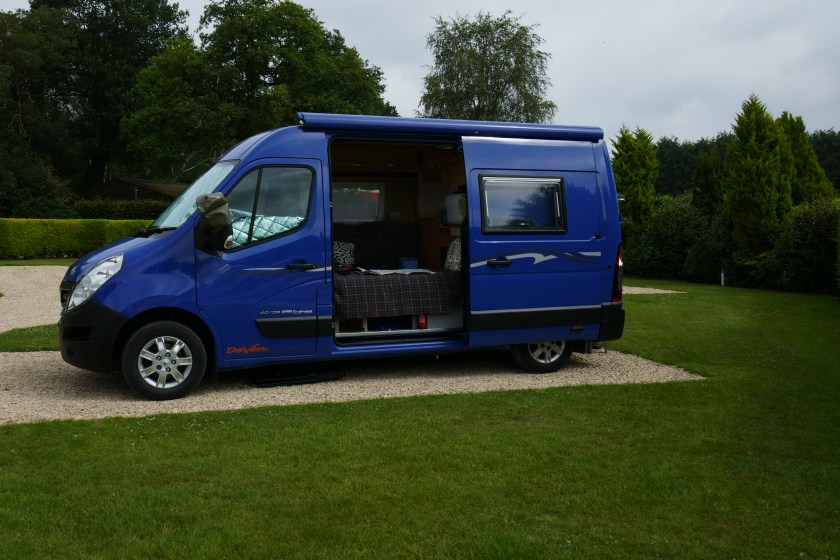
We were so pleased to get our blue Renault back and we went straight from the body shop to a campsite.  We would have camped in any weather but as it turned out we were blessed with glorious and sunny weather and the Cheshire countryside proved to be perfect for a few days cycling.  But first we spent a sunny afternoon cleaning the accumulation of Greek and garage dust from the van interior.  I emptied every cupboard reminding myself what goodies we had left in there, having a little weep when I found the tins of giant Greek beans in tomato sauce and the bottles of dark Greek olive oil.  Despite the mixed emotions, somehow this process healed the weeks of separation and made the ‘van feel like ours again.

In Cheshire we discovered The Whitegate Way, a 10 km cycle route on an old railway line and we cycled around Delamere Forest.  We relaxed and took life easy feeling that our life was back on track again.

We followed this with a weekend camping with friends on the Staffordshire / Cheshire border and then more sociable camping in Derbyshire.  We didn’t travel far and we didn’t need to, we were just content to have our campervan back where it belongs.


Nothing compares to a campervan

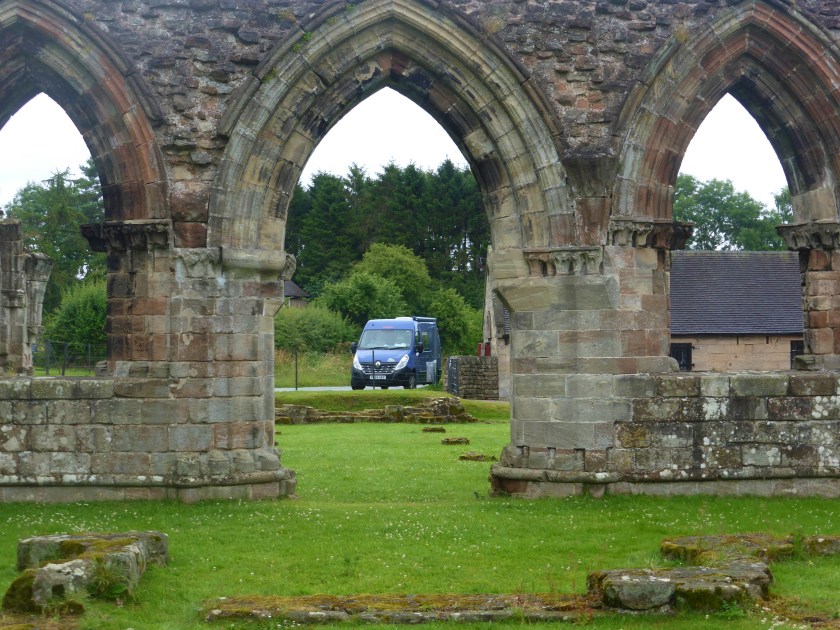
Croxden Abbey (4).JPG
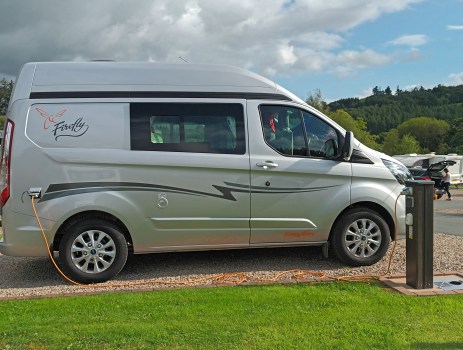
The ‘van at Croxden Abbey

It is now over nine weeks since ‘the incident’ and without a campervan we have been forced to try other accommodation ideas for our holidays.  What this period of exile from our ‘van has done is not only reinforce our love of the campervan lifestyle it has also made me realise how much having a van is a part of me and without it the knowledge that something is missing from my life pervades everything.  None of the options we have tried, youth hostels, self-catering cottage, tent and hotel, compared to the sense of freedom we get from travelling in the ‘van.  These different holidays had to be booked and organised beforehand and none of them were as relaxing as being in our own campervan.  Below is the types of accommodation we have tried and how I found them.

Youth Hostels – We used to do lots of youth hosteling with the YHA and I worked at Buttermere youth hostel for a summer season in the 1990s, so we gave this budget option a try for our first break.  Youth Hostels have the big advantage of having a kitchen so we could have home-cooking and remain frugal.  The YHA website allows you to book a series of hostels and at between £29 and £39 a night for a room for two this is a good budget option.  The kitchens can get busy at meal times but they are sociable places; as we had found in the past, youth hostels are great places to meet and chat to other people.  The downside of this is that you can’t find your own space and when I wanted some peace and quiet to sit comfortably chilling and reading my book there wasn’t anywhere to go.  Although we had sole use of a room the bunk beds meant that they were not great for lazing around.  Youth hostels are also often closed during the day time.

Self-catering cottage – This is much less of a budget option, although you can save a lot on eating out as home-cooking is still an option.  We paid £370 for a luxurious cottage for five nights on the edge of the Lake District.  We had our own space, could come and go as we pleased and had everything we needed to hand.  This was a relaxing and enjoyable holiday that came closest to being as good as the campervan.

Camping in a tent – The weather was warm so we set off with a borrowed tent to camp in the Peak District for a couple of nights.  I love being on campsites and so this holiday ticked the box for relaxing on the site watching the world go by.  I was less keen on having to run to the toilets first thing in the morning and we were ill prepared with no relaxing chairs or a table.  With better equipment and in good weather this is a pleasant option, costs the same as staying on a site in the ‘van and we could cook our meals, although the equipment we had was limited … but in the rain it would be dismal.

Hotel –  We paid £90 for a night bed and breakfast in a comfortable hotel in the Yorkshire Dales.  Of course, we have stayed in hotels before and generally agree that they are okay for a night or so but after that we yearn for home cooking.  In the evening we ate at the local Indian restaurant for £40 for the two of us.  For me this makes hotels feel like an expensive option that doesn’t suit us for long holidays.


How I got hooked on the #vanlife

1972 Cornwall
1972 & my introduction to motorhoming

It was the early 1970s, I was twelve and my parents borrowed a small motorhome from a friend of the family.  We packed a few things and set off for a touring holiday, none of us really having a clue what we were letting ourselves in for.  Despite being crowded and the ‘van being basic, we had so much fun we did this two years running, visiting Scotland and Cornwall.  Before the words were even in common parlance my parents created wild camping holidays that were frugal; I loved it.  We slept in lay-bys and car parks the majority of nights, with just one night on a campsite during the week so we could shower.  I can remember trying to wash in the sea and being interested that the soap wouldn’t lather and watching boats on the Firth of the Clyde as the sun went down.  I can remember having lots of freedom to explore places.  This was the days before seat belts and on steeply winding roads it was the job of us children in the back to hold the cupboard doors shut as they had a tendency to swing open.  We had no fridge and no toilet on board, just beds, a cooker and sink.  The [blurry] photograph shows my sisters at the back door of the ‘van, it was a Commer vehicle but beyond that I have no idea what the conversion was called.

While staying overnight in a coastal car park near to Ayr in southern Scotland we were joined by another Commer van of the same style.  I joined my Dad in going over to say hello and they proudly showed us around their ‘van, which we were impressed to see had a fridge.  This retired couple, one Swiss and one American, were full-timing in their motorhome and were travelling around European countries.  This was a lifestyle I hadn’t even dreamt was possible and at twelve years old I was immediately attracted to such a relaxed way to travel and my dream to own my own campervan began [it took me over 30 years to get there].  The couple were very friendly and told me how they kept in touch with their grown up family back in the US by sending a postcard every week and that they were currently learning Spanish as that was where they were heading next.  They talked about how they spent their time in their ‘van and showed me crafts they made in the evenings.

I am not sure I would like to return to those days without all the modern technology that helps us communicate with our families today but I still remember those first holidays in a motorhome and I am thankful that I had those experiences.  Without them I might not have seen the possibilities and be living the life I lead now.

I am missing #vanlife & resort to camping on the doorstep

The Peel Tower on the moors above Ramsbottom.JPG
The Peel Tower on the moors above Ramsbottom

While we are off the road I have been missing being in our campervan so much and this got me thinking about what it is about travelling in the ‘van that I love so much.  I get a big thrill from exploring new and beautiful places and learning about cultures and history as we go but what I have realised is that our van life is more than exotic foreign travel, being out and about in the ‘van is just comforting and relaxing in itself.  Our campervan [and its previous versions] is ingrained with so many happy memories, as soon as I climb up the step in to the cab I feel enveloped in cosiness and where we take it doesn’t necessarily matter.  Just at the moment I am really missing that feeling of well being.

I am always telling people how lucky we are to be living in Greater Manchester because we have so much beautiful countryside within easy reach.  Only an hour or so in any direction and we are in stunning places and we tend to alternate our weekends between Yorkshire, the Peak District and North Wales or Cheshire.  But this winter we took camping near to home to the extreme and didn’t even leave Greater Manchester.  Life had been more hectic than usual and our ‘van had looked sulkily at us each time we left to catch the tram for yet another social occasion or cultural event.  The Renault was itching to have a run out and we were missing camping so we chose to squeeze a night in at the Caravan Club’s Burrs Country Park site just 30 minutes from home.

We arrived in the dark, which is always disconcerting and so had little idea what our surroundings were like until the next morning.  With an extension agreed with the wardens beyond the usual 12.00 leaving time we set off for a walk to nearby Ramsbottom along the river Irwell path; a river that also flows within spitting distance of our home.  Our walk was accompanied by cheerful toots of the steam trains on the East Lancashire Railway.

Ramsbottom turned out to be another world from Salford, this foodie heaven was full of cosy independent cafes and delis and we sat outside the church in the unseasonably warm weather savouring a perfect bag of chips each; they were that faultless combination of crisp outside and soft and fluffy inside.  The artisan market was in full swing in the cobbled market place but we decided to shun shopping for the steep walk up the hill to the landmark Peel Tower on the moors, built to commemorate Robert Peel who was born in nearby Bury.  Here we savoured the fresh air and wide views before descending back to the Irwell valley down the steep old cobbled road.  Leaving the campsite in the mid-afternoon, just half-an-hour later we were back among the urban neon of Salford Quays.

Our van life isn’t always about glamorous places but I love it!


Top tips for travelling around Greece in a campervan

Greece (57).JPG
Looking down on Epidaurus
  1. We found that Greek roads were mostly in good condition, with just some exceptions.  There are many new motorways [either only just opened or about to be opened] and these are excellent.
  2. Tolls are payable on Greek motorways at seemingly random toll booths.  The toll payable for campervans and motorhomes is more than double the amount for cars and using motorways can get expensive.
  3. Greece has a high number of road traffic accidents [there are thousands of road side shrines to victims] and we did see some poor driving such as over-taking on bends, in fact double lines in the centre of the road were generally ignored, but the driving was no worse than other European countries.
  4. Campsites are clustered around the coast and tourist sites and there are huge areas of the country that have no campsites.  Officially wild camping is not allowed but it is generally tolerated locally and the best advice is to be discreet.
  5. The standard of campsites does vary but we found them mostly good to very good.  As in many other European countries, don’t expect toilet seats or toilet paper but we did enjoy lots of good hot showers.
  6. Much of Greece is hilly and steep and walking shoes and poles are useful if you want to be active.
  7. Some of the historic sites you might want to visit involve walking up hills too.
  8. Greek food tends to come as a meze style meal; that is individual dishes arrive when they are ready and are meant to be shared.  Take care as it is easy to over-order in Greece as portions tend to be large.
  9. We never spent more than €30 on a meal for two in Greece.  We are both vegetarian and this keeps the cost down but the main saving is with the wine, compared to other countries; 500 mls of the house red was generally just a few euros.
  10. Lots of people [but not everyone] is able to speak good English [they learn in school from a young age] but we found it useful to have a few words of Greek and it was appreciated when we used these to say good morning, please and thank you.  We made our own flash cards to learn about 40 phrases.
  11. Road signs are mostly in the familiar English alphabet as well as the Greek alphabet and this makes them easier to read.  But it is worth learning your Greek letters and how these are pronounced for the signs that are only in the Greek alphabet.  By the end of our holiday it was becoming normal to read p as r and r as g!
  12. We took the Blue Guide to Mainland Greece and the Dorling Kindersley Eyewitness guide to Athens and the Mainland.  The Blue Guide gave us comprehensive historical information and was complimented by the information and photographs in the Dorling Kindersley.
  13. We also took the Cicerone guide to the Mountains of Greece which was invaluable for walks and the Oxford Paperbacks Flowers of Greece and the Balkans: A Field Guide [currently out of print and only available second hand].  This was a fantastically useful guide for landscape and walking ideas, as well as for flower identification.
  14. Greece has few large out-of-town supermarkets and the most familiar name you will see is Lidl.  Other supermarkets are smaller than you may be used to and generally don’t have a large car park, which can be problematic in a motorhome.
  15. Fresh bread and fantastic cakes are available from the many bakeries, these generally have space to park while you pop in and drool over the selection.
  16. Greece has more petrol stations per head of population than any other country [this isn’t an official figure but it must be true].  These petrol stations are generally family run and are often accompanied by a cafe.  Even small villages can have two petrol stations so no excuse to run out of fuel.
  17. Greece is beautiful and it is worth taking the time to explore it.
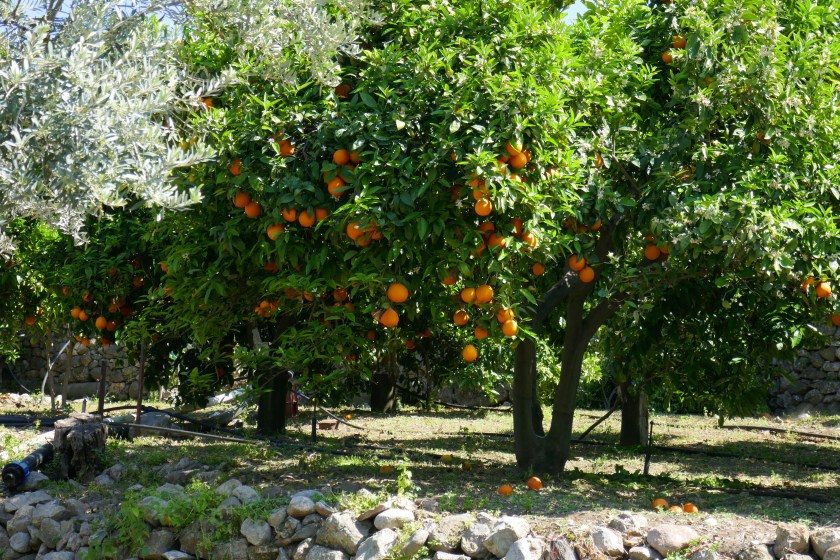
25.04.2017 Epidavros (2)
Orange trees near Epidaurus


Walking in Greece #3 Meteora

Greece (118).JPG
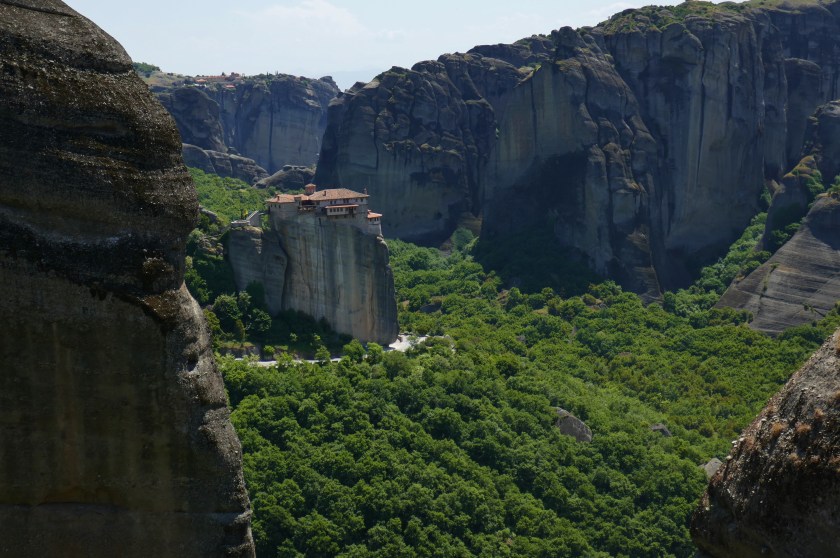
The monasteries in Meteora each sit on a rocky pinnacle

And so to Meteora, a wonderful land of sandstone pinnacles topped with monasteries … Travelling without the campervan was never going to be the same but we were determined to make the most of our now limited time in Greece and we were pleased we stayed and visited Meteora.  We were back on the road but in a car and the first difference we noticed was that we had to find a cafe for our morning coffee [and loo stops]!  Fortunately there are thousands of cafes in Greece.

Many people drive around Meteora but I think the only way to really see the area is on two feet and if you are able to walk around, spend a few days here and get out, exploring the many paths that wind through the trees below the rocky pinnacles and between the monasteries.  You will be rewarded with amazing views away from the many other tourists.  The free map from the tourist office shows most of these paths as dotted lines.  Be warned, the paths generally do not have signs to indicate where they go and can be difficult to find.

We were staying in the village of Kastraki and on our first evening walked through the village and up to the Adrachit, a tall and thin column of sandstone on a col among the spectacular sandstone rocks.  After taking in the views, we took the path towards Agion Pnevma and stopping to take photographs, I heard noises and tracked them down to a tortoise pottering through the grass.  We both watched it fascinated as it climbed a steep boulder, occasionally slipping on the slope but grimly determined to make its way.

The next day we walked to Kalampaka over the Marmaro rock, spotting goats trotting down a steep ridge.  In Kalampaka we followed the back streets finding the beautiful 11th century small Byzantine church at the top of the town.  At the furthest end of Kalampaka is the steep and well-made paved path that climbs up to Agia Trias [Holy Trinity].  After putting on our modest clothes we walked up the steep path cut out of the rock to reach this small monastery.  The tiny chapel was cool and peaceful and heavily decorated with scenes from the bible in brilliant colours.  Outside this peaceful monastery we sat enjoying the views over Kalampaka and the flat river valley beyond and had our picnic lunch.  We followed the road to a flat viewing rock to take in the eroded shapes of the sandstone pinnacles many with monasteries perched impossibly on top.  After some searching we eventually tracked down the path back down, about half-way between the parking for the viewing rock and a junction.  The path descended steeply through the bushes and grassland to a col where the left path returned to Kalampaka and we turned right for Kastraki.  We walked through thick deciduous woodland that was deliciously cool, with huge mossy boulders around us and plane and oak trees.  We reached the road at a hairpin bend and picked up the next path that hugged the bottom of the huge rock pinnacles, spotting some climbers high on a sheer face and many more tortoises by the path.

Having explored the eastern monasteries, we set off for those on the western side of Meteora the next day.  From our hotel we climbed over the impressive and steeply-rounded rocky mound of Doupiani, a barren landscape from a distance, close up it is covered in lichen, saxifrages and grasses that have managed to establish themselves.  This path led to a good bulldozed track which we followed for some time and then joined a pleasant parallel path through oak trees to Agios Demetrios hidden on the side of a pinnacle.  This is an abandoned monastery that has been restored and is in a romantic setting high on the cliff.  We walked up to the flat rock with the statue of Thymios Vlachavas (1760 – 1809) who fought for Greek independence and was executed by Ali Pasha.  From here we had a superb view over the countryside around Meteora; to one side I could see farms, green fields and rounded hills and to the other were weirdly-shaped sandstone pillars.  I would have visited Meteora for the rocks alone; the monasteries felt like a bonus.  We followed paths busy with tortoises and wild flowers that bought us out at Megalo Meteoro, the largest monastery.  We chose to visit Varlaam monastery and found a site that contrasted sharply with Agia Trias.  Varlaam had souvenir stalls outside, a gift shop and museum and is easier to access and therefore more popular with visitors.  The monastery terrace wouldn’t have been out of place in an Italian villa and had wide dramatic views.  Descending back to Kastraki, we managed to find the narrow path from the steps to Megalo Meteoro that took us on a route between two soaring pinnacles.  As we walked underneath Varlaam’s pinnacle we became aware of what sounded like large raindrops falling around us.  We realised the masons on Varlaam were working on the scaffolding above us and what we could hear was mortar falling around us.  We hurried on as a dollop of mortar landed on Mr BOTRA’s arm laughing about health and safety in Greece.

Greece (98).JPG
Looking over the village of Kastraki

Our Greek #vanlife tragedy: be warned it isn’t pretty

27.04 (9) a.jpg
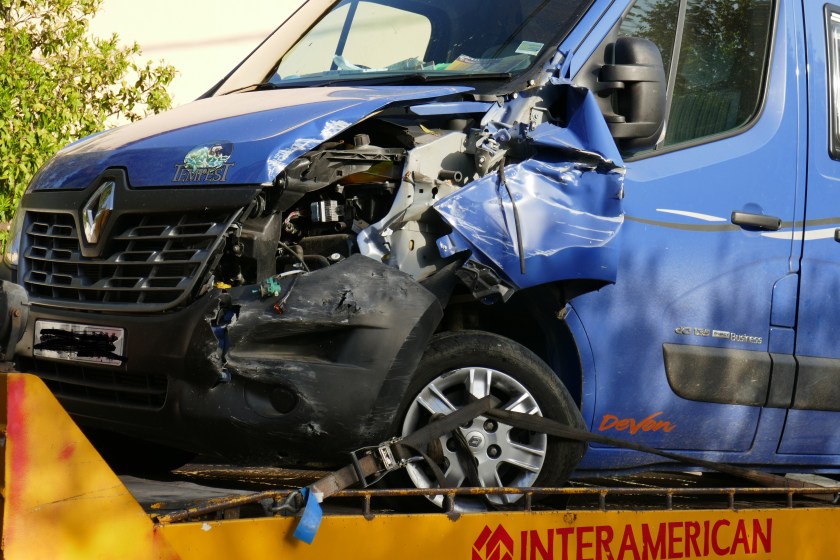
Every time I have to look at these photographs I get another punch in my stomach

We have all made mistakes, haven’t we?  Or are you one of those perfect people that never make them?  Well, we are not perfect and we made a big and costly mistake while we were in Greece and boy have we paid for it.  We were relaxed, we were loving Greece, we were happy and then in just a few minutes, after a moment of inattention, we were thrown in to despair.

I need to get the confession over with … we left the ‘van on a [gentle] slope with the handbrake fully on but what we forgot to do was leave it in gear [it really wasn’t that sort of slope].  The ‘van stayed put for ten minutes and then we watched our much loved campervan and our travelling home roll gently down the slope.  We ran after it, we grabbed the handles but if you have ever tried to stop something that weighs over three tonnes from moving you will know how pointless [and possibly dangerous] that was.  The ‘van stopped when it hit a wall and the photograph above shows that the Renault came off much worse than the wall [that didn’t even have a scratch].

Fortunately, no one was hurt and we have insurance and European breakdown.  Unluckily we were in Greece, as far as we could get from home, and fixing a Renault this far from France proved to be a tough call and our insurance company advised that repatriating the ‘van for fixing in the UK was the best option.  We had to make the difficult decision to leave our ‘van all by itself, waiting for a breakdown lorry to arrive from the UK and to take it the long journey home.

We were just five weeks in to a planned thirteen week trip around southern Europe and every ‘van owner will understand how devastated we were.  We were homeless, we felt lost without the ‘van, dazed after the shock of ‘the incident’ and had only ourselves to blame.  Nevertheless we were physically fine and as our breakdown paid for a hire car, we decided to salvage a little more from the trip.  We spent a few days in Greece visiting Meteora [see the next instalment] when we found that a road trip in a car bears no resemblance to a campervan trip.  The breakdown organised a flight date that suited us.

Getting the ‘van back to the UK took two weeks on the back of a lorry but we could ring the company carrying the repatriation out and check where our lovely blue bus was.  Our ‘van is now in a garage in the UK and the good news is that the insurance company have authorised the repairs.  But the repair is massive and expensive, needs specialist equipment and it will be at least four weeks until we are back on the road.

That one moment of inattention has cost us about eight weeks of camping in the sun, caused many sleepless nights as I relive the horror of it in my nightmares and taught us an important lesson.  We will never leave the ‘van in neutral again, even on what seems to be level ground.

For two travellers who use their ‘van all year and have never gone much more than a fortnight without sleeping in our cosy camper, being without a campervan is harder to bear than a non-campervan owner can even guess.  Without the ‘van I feel lost and as if some part of me is missing, I feel I am living in the wrong life and wonder if in another universe there is a version of me still tootling around southern Europe in an intact campervan.  Although grateful no one was hurt, I am heavyhearted and I gaze with yearning every time we pass any kind of motorhome and I want to stop the owners and tell them, we have a ‘van too, honest.  So if you see us out and about give us some sympathy.

Postscript – I can’t praise enough the service we received from our insurers Safeguard and breakdown, AA, which is included with our Safeguard cover.  We had a named person while the repair was ongoing and were kept up-to-date on progress as our van was repatriated and repaired.  This was an expensive repair but we never felt that they wanted to save money and we were able to discuss the damage in detail and the repair with their engineer.

Walking in Greece #2 The fantastic Pelion Peninsular

Greece (68).JPG
Terraced olive groves on the Pelion peninsular

After just a few weeks in Greece I have to confess I had more photographs of olive trees than anyone can ever really need … I can’t help myself.  I am attracted to the gnarled, twisted trunks, the small grey-green leaves of these trees that make a gentle rustling sound in the breeze and the tiny flowers that eventually become delicious olives.  These Greek olive trees have cultural connections too and each tree is rooted in myth and history.  One Greek myth tells us that the Goddess Athena, the daughter of Zeus, and Poseidon, Zeus’ brother, both coveted the city of Athens [then called Attica].  Yet, while Poseidon drove his trident in to the Acropolis producing a well of salt water, Athena made an olive tree grow next to the well.  Zeus ordered a tribunal to decide which of the two gods should be enshrined in the city and this court decided that the olive tree was the greatest gift and chose Athena. giving the city its name.

We drove through the ancient olive trees around Amfissa to the stuunning mountainous Pelion Peninsular [sometimes Pilion], on the east coast of northern mainland Greece.  Here we found fantastic walking on old cobbled donkey tracks or kalderimis.  These kalderimis were built to bring produce down from the mountains and today these and other paths and tracks take walkers from the rocky coves and beaches on the coast, through the olive groves and up to the mountain villages among the sweet chestnut and beech trees.  Each village of narrow winding streets has a square with a cafe.  In the centre of each square is a plane tree that was planted many decades ago and is now huge and gives generous and welcome shade to the customers in the cafe.

On our first day we walked to the village of Pinakates, following the steep path through the terraced olives.   As we climbed higher we brushed beside mint and thyme plants, releasing the sweet smells and our route was alive with butterflies.  There are springs on the Pelion and alongside the path were narrow  stone channels rushing with clear water.  We tried to play poo sticks at one bridge but the sticks hurtled away in a blur.  The path had a signpost from the coast road, was well marked with red dots and we met few other people walking.  We rested under some shady pine trees and stopped to look at the various chapels on the way.  The paved paths of Pinakates (at 640 metres) weave their way along terraces to the attractive main square, overlooked by the church and with a burbling fountain.  We had the best cheese and spinach pie we had tasted yet in the cafe here, the pastry was crisp and the filling fresh and it was coiled in the traditional pattern.

The next day we explored two mountain villages on a 11 kilometres circular route.  We expected more of the same but this hilly landscape constantly revealed new surprises and landscapes and the walking was never boring.  The ascent to Milies was easier as it is only about 440 metres above sea level and the village was bustling with people as the small tourist train had just arrived at the pretty station.  We continued along the ridge to Vizitsa from a path near the station and soon came to a cool, shady gorge with a waterfall that was a perfect spot to eat our lunch and enjoy a paddle.  We followed a narrow and overgrown path that gave us occasional views over the hills.  At a spring we climbed steps to the chic village of Vizitsa and found a square where two musicians were playing Greek music.  We descended a different way, climbing over a ridge from a tiny white chapel that had great views over the railway line and back to Vizitsa and Milies.  Our little used path then joined another of the narrow water channels as we descended the mountain.  On the hillside dotted with farmhouses we sat enjoying the view and dreamt about moving to a small house with a view of tree-clad mountains and blue sea.

Our time in the Pelion was short and we could have spent longer here but sometimes a campervan trip doesn’t go quite according to plan.  In the next installment I will tell you how our Greek odyssey became a bit of a tragedy and how we dealt with this.

Greece (83).JPG
A terrace with a view on the Pelion peninsular

Walking in Greece #1 at Delphi & Corinth

23.04.2017 Corinth Acrocorinth (16).JPG
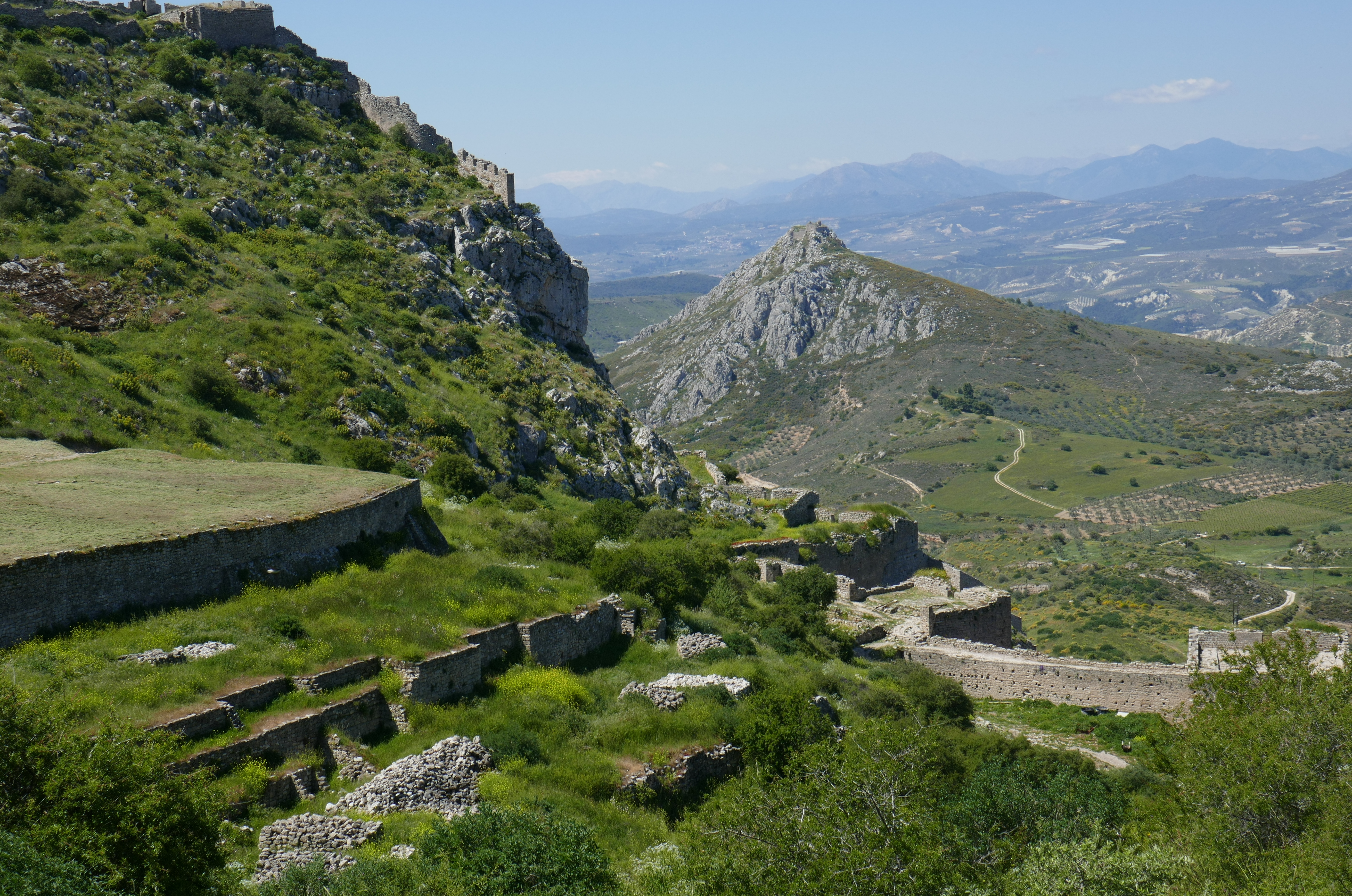
The Acrocorinth has spectacular views

During our three weeks in Greece we saw so many beautiful places, visited plenty of ancient sites and enjoyed some great walking.  I thought I would concentrate on the walks in my blog posts, firstly a very memorable walk from Delphi and then a walk from Ancient Corinth that did include visiting the Acrocorinth.  My second post will tell you about our walks on the stunning Pilion peninsular on the Aegean Sea.

The old zigzag path from Delphi to the beautiful Livadi plateau climbs the hillside from near the Museum of Delphic Festivals at the top of the town and black and yellow markers indicate the E4 path.  The path firstly follows the ridge through flower-rich meadows above the site of the Delphi oracle and the Temple of Apollo [a fantastic site we had visited the day before] and there are good views on to the stadium.  The path soon joins the old stone zigzag route that takes a gentle meandering route up the crag.  This timeless path, that has been used for generations, is broad and cobbled and gave us continuing stunning views down to Delphi and the sea at Itea.  Stopping for a rest was always interesting as around us there was an abundance of flowers, including giant fennel on the lower slopes and lots of tassel hyacinths, hypericum and sage as we climbed higher and we were accompanied by hundreds of butterflies.  Each time the zigzags reached the most easterly point of the crag we had views down in the spectacular rocky gorge above Delphi.  At the top of the crag we entered a sheltered valley of cropped grass, juniper bushes, more flowers and sparse trees with paths branching off across the red earth.   This was such a tranquil and peaceful spot we spent some time here, identifying the flowers, watching the birds and practicing tai chi.  The valley opened out and we reached a wooden water trough, farm buildings and suddenly, after a morning of solitude, met other walkers.  We continued upwards to a grassy meadow on the ridge and had lunch with a view of the snowy massif of Mount Parnassus, cows quietly moving across the meadows in front of us.  We returned the same way.  The walks climbs about 700 metres and we had taken our time and so were out for six hours.  We both agreed it was a fantastic day!

From Ancient Corinth we set off to climb the obvious hill you can see from the town.  This craggy hill is topped by a fortress, the Acrocorinth.  We found the Fountain of Hadji Mustapha easily enough just outside Ancient Corinth.  When we arrived it was swarming with what we christened the Corinth walking group.  The group, like any walking group, were chatting, checking their rucksacks and filling water bottles and we couldn’t get anywhere near it.  Giving up on the fountain and avoiding the starving puppies we took the path behind the fountain.  There were no signs and we quickly misplaced the path and followed a steep route that merely cut off the corner and took us back to the road.  Rather than double-back we chose to walk most of the four kilometres to the Acrocorinth on the road.  On the way back down we realised we should have stayed lower and taken a more gentle path that traversed the hillside.  Fortunately, the road only goes to the fortress and was quiet and it was delightful with so many flowers along the verge and a fantastic view over the bay.  Arriving at the Acrocorinth we were pleased to see the entrance was free and also pleased we had come in the morning as it only opens until 15.00.  The castle was first used by the Greeks from the 4th century BC, in the 12th century first the Frankish took over and then the Ottomans and during their rule the Venetians took control briefly.  Each of these different rulers extended the castle walls outwards and today these walls extend over two kilometres and visitors enter through three defensive gates.  We walked up the steep hillside on marble paths in to the vast castle.  The castle was used as a refuge from pirates by the people of Corinth and they built houses, churches and mosques here so they could survive a siege.  The different occupiers have left a mixture of architectural styles and the buildings that remain are dotted around the hillside.  Getting around these buildings takes some effort as you climb up to the different buildings on what are often very rocky and steep paths bordered by colourful wild flowers.  I breathed in deeply, enjoying the sweet aroma of camomile, its scent released as we crushed the profusion of flowers on the paths.  The animals that now call the Acrocorinth home are hundreds of house martins.  They have found a perfect place to live here: castle walls with nooks and crannies for nests, an abundance of flowers that bring in insects for food and they constantly swoop acrobatically through the air above visitor’s heads.  Health and safety is less of a concern in Greece generally and visitors are expected to use their common sense, so when you reach the outer walls, if you have a head for heights, you can stand on the walls enjoying the terrific views all around, a precipitous drop below and no railings to protect you.     We had a picnic at the high tower looking over the patterns of olive groves below and then found the highest point where there had once been a temple to Aphrodite, followed by a Byzantine church, then a mosque and finally a Venetian belvedere.  The Acrocorinth was a hard to beat place; it had great views, fascinating history and it was free!   Walking back down the hill we met the Corinth walking group once again at the fountain returning from their own walk.

Greece was certainly proving to be excellent for walking.

21.04.2017 Delphi walk to Livadi plateau (18).JPG
Walking on the Livadi Plateau

The beauty of the Italian Apennines

11.04.2017 Pietra di Bismantova from campsite (2).JPG
Pietra di Bismantova, Reggio Emilia in the evening sun

I love being in Italy in our campervan; I love the food, the coffee, the scenery, the wine and the vibrancy.  Every time we go we find new places to enjoy that seem more beautiful than the last time.  On this trip we were travelling across the country to Ancona where we were catching a ferry to Greece.  After a night on the lovely Ligurian coast, we headed inland to cross the Apennines on the superb SS63.  We stopped to admire the attractive fortified village of Castle Verrucolo and enjoyed the fantastic mountains views from the road.  Camping Le Fonti was the perfect place for a couple of nights; with a friendly welcome, fresh bread ordered, a sketch map of local walks and a pitch with a view of the distinctive Pietra de Bismantova (above), we were happy.  The next day we walked up Monti Ventasso, a 1,727 metre hill behind the campsite.  We walked through beech woods dotted with wood anemone, primroses and wild crocuses, a cuckoo calling in the distance.  Taking the path to Santa Marie Maddalena we crossed an exposed and loose scree slope to the grassy meadow where a refuge and chapel sit under the rocky crags of Monti Ventasso.  The steep narrow and rocky path up the east ridge was airy in places, eventually bringing us out on a wide and grassy ridge to the summit, passing a bizarre wooden hinged figure on the way.  The summit gave us great views of the valley, Pietra di Bismantova and Lago Calamone below.  We descended to the lake, a picturesque and sunny spot where a group of young men were noisily playing football on a slope, the ball regularly fell in to the lake and this seemed part of the game.  We climbed upwards to join our previous path and returned the same way having enjoyed a great day’s walking.

The lovely driving continued until we reached built up areas again at Scandiano.  We found the Camper Club Mutina in Modena, a great and well-run sosta that is close to the city but has views over fields and vineyards and we watched hares and a kestrel from our pitch.  We were given a map which included a cycle route to Modena, about 30 minutes of flat cycling and perfect for seeing the sights of Modena.  Modena is clearly a cycling town, everyone from eight to eighty was out on their bikes and we followed a signed route, the MO1, in to the centre that was always off road.  We parked near the Duomo off the cobbled Piazza Grande in the city centre; an impressive white marble building with intricate carvings.  We ambled around, taking in the sights and I loved the Piazza Roma with its fountains and large shallow pools that reflected the surrounding buildings.  Following the narrow streets we spotted a queue of people outside a shop; further investigation revealed it was for Emilia Cremeria ice-cream, so we had to join in.  After queuing we came away with hand-made cornets of pistachio ice-cream; each cornet is filled with molten chocolate first with the creamy-soft ice-cream on top.  When you have enjoyed the fantastic ice-cream you bite through the fresh biscuit wafer and still have the soft chocolate to finish.  It was delicious and I want all ice-cream to be like this from now on.

We spent our last few nights in Italy at Camping Mar Y Sierra near  to the hilltop town of Mondolfo.  Away from the built up Italian coast this was a glorious spot.  We walked along the Valle dei Tufi route that took us through beautiful countryside and in to the pretty town of Mondolfo and we cycled to the stunning walled town of Corinaldo in the sunshine.  The hot weather bought a tremendous thunder storm one night, with hail bouncing off the roof of the ‘van so loud that we couldn’t hold a conversation and lightning brilliant in the sky.  Our next stop Greece …

13.04.2017 Modena city (8).JPG
The beautiful city of Modena