Campervan Touring Around the Vendée & Coastal Loire-Atlantique


Plage Saint-Michel in Batz-sur-Mer

Heading north into the heart of the Vendée we were sure we would find cooler weather but the storm was a surprise.  My smile faded when the receptionist insisted that we walk around the campsite to find a pitch.  Peering outside, lightning was flashing, thunder was rolling and rain poured in sheets and I really would have preferred to take the ‘van around the large site.  But keen to get the kettle on, we set off, sheltering in the sanitary blocks when the storm was in full force.  The weather wasn’t conducive to finding the ideal pitch but I eventually returned dripping to reception with a number.

The rain had spring cleaned the Vendée and the next day we hiked around the nearby Lac du Jaunay on easy-to-follow paths that undulated around the reservoir’s wooded valley.  The birds sang their bestsellers, fresh-scented flowers perfumed the air and buzzards soared above our heads.  Passing a shuttered chateau we rested on a rocky outcrop overlooking the water and watched a group slowly glide around our headland on inflated float tubes, languorously combining fishing with eating sandwiches.

We are not even beginner-level table tennis players but always have a couple of paddles and balls in the Blue Bus as European campsites often have outdoor ping-pong tables.  Spotting one in the field near our pitch we wandered across, quickly giving up playing seriously as the breeze repeatedly whipped the ball across the table top into the long grass! We giggled as time after time one of us raced to retrieve the ball!

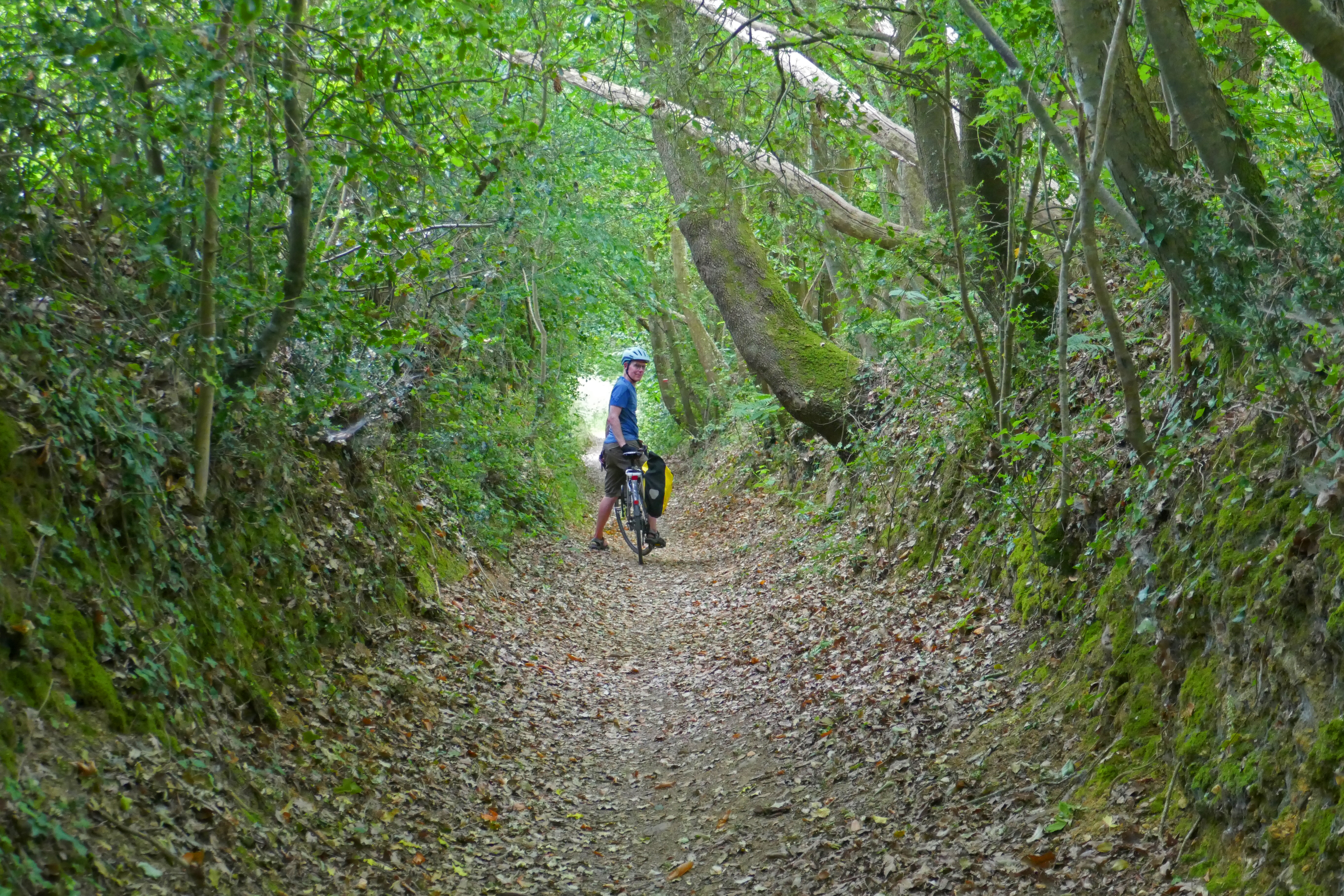
As well as walking, we cycled from the campsite to the winding trail around Coëx that led along the shore of a small reservoir to open fields where hares lolloped and pools where egrets silently strutted.  Another route took us back to the banks of Lac du Jaunay and a shallow inlet where a nursery of mallard ducklings stayed close to mum.  Hearing a clamour of bird calls we searched the surrounding trees and spotted a noisy group of cormorants shuffling and fidgeting among the branches.  Climbing out of the valley we cycled up a shady sunken track and stumbled on an unusual pilgrimage chapel near Martinet.  La Chapelle de Garreau has an ornate outdoor ringing chamber on a balcony below the bell tower.  Inside were colourful abstract stained glass windows and paintings celebrating a local legend that Mary was seen here washing clothes in the River Jaunay.

From Lac du Jaunay we cycled up a sunken track

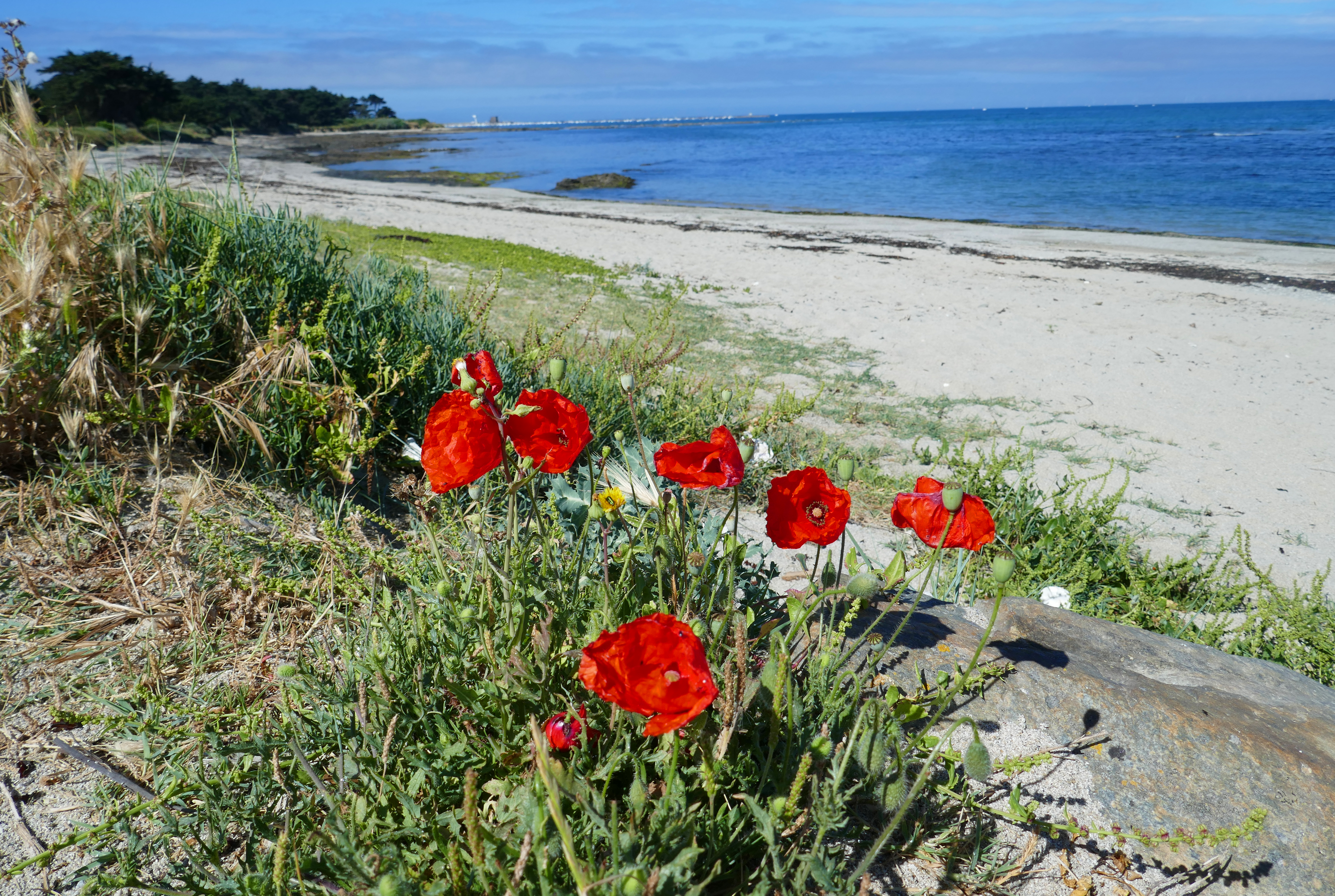
After the pastoral calm of the Vendée interior, La Plaine sur Mer on the Côte de Jade had a breezy buzz.  Geared up for active holidays, we explored the area around Saint-Gildas Point on foot and bikes.  From small harbours and long sandy beaches where red poppies danced in the breeze we reached Saint-Gildas Point, a boating paradise that reverberated with flapping sails and clanking chains.  We ambled around the jumble of concrete bunkers, remnants of the Second World War German occupation, and looking north across the mouth of the River Loire we could see the huge port of Saint-Nazaire and towards Batz-sur-Mer. 

Beyond the point the landscape changes as the coastal path meanders around sheltered coves and bigger waves attract surfers.  We passed wooden shacks perched on stilts above the sea reached by slatted pontoons.  Fishermen apparently suspend a net from poles on these pêcheries to catch plaice.  A series of information boards showed how artists have interpreted these picturesque views over the centuries and we admired the shoreline houses from Victorian turreted mansions with balconies to modernist concrete and glass and cute bungalows with shutters.  The sea was the brightest blue and clusters of yellow flowers clung to the rocks.  We sat on a promontory watching terns diving in the sea and at La Grande Plage in Préfailles we kicked off our sandals and crossed the gritty sand to paddle in the cool Atlantic water. 

Red poppies danced in the breeze near La Plaine sur Mer

A network of inland farm tracks took us south of La Plaine sur Mer to a natural area of coastal moorland that slopes down to the sea cliffs and contrasts with the built-up seaside.  Butterflies sweep among the abundant thistles and gorse bushes and the aroma of sweet-smelling grass after haymaking hung in the air.  We followed sandy paths under wind-gnarled trees to secluded beaches where families played and found our own isolated viewpoint for a picnic

Crossing the impressive bridge that arches over the River Loire at Saint-Nazaire we reached Batz-sur-Mer, where friends of ours live.  The seaside towns of Batz-sur-Mer and Le Croisic were once craggy islands and are now chic resorts, popular with Parisians in search of cooler climes in summer.  The beaches are beautiful and the lively towns abound with stylish shops.

Our friends live near to the campsite and we were soon sitting in their sunny garden catching up over drinks. Our friends are impeccable hosts and that evening they surpassed expectations. Collecting us in their open-top car we enjoyed an evening of French elegance and taste, beginning with cocktails at a beach bar.  Sitting with a ritzy cocktail, a view of the sea and my toes in the warm sand I was living the high life.  We ate in a restaurant overlooking Le Croisic’s harbour where we were welcomed with glasses of pink fizz and an appetiser that got the taste buds working overtime.  The owners were expecting two vegetarians and they had prepared a delicious menu that pleased every sense.  Our main meal, a creamy risotto with roasted vegetable garnishes, was a triumph of colour, flavour and artistry served in a classy black bowl.  It was so perfect I savoured every mouthful and didn’t want it to end.

The next day we drove north through Brittany to Saint-Malo with a campervan full of deliciously warm memories of France and friends.

Saint-Gildas Point is a boating paradise

We stayed at:

Camping RCN La Ferme du Latois – near the village of Coëx, this is a large, peaceful and green campsite with ponds and trees.

We also stayed in two (very different) campsites from the Flower Campings group.

  • Flower Camping La Guichardière – near to La Plaine-sur-Mer and the sea, a well-run site with hedged pitches.
  • Flowers Camping Les Paludiers – we use this site because of its proximity to our friends but it is a bit tired. It is a rambling and sandy site that is popular but the facilities need refurbishment.
Plage Saint-Michel in Batz-sur-Mer

Glengoulandie Camping & Dùn Coillich Community Land

Blossom on fruit trees in the community woodland

From our pitch I was easily distracted from learning French on Duolingo as a dipper flew along the burn below us and disappeared under the bridge where hardy campers walked to the camping field. Further distractions came with the evening insects, as the acrobatic wheeling of sandmartins around our campervan was so much more interesting than language learning!

This was Glengoulandie, a glen in the hills between Loch Tay in the south and Loch Tummel in the north and about 15 minutes drive from the small town of Aberfeldy. Here, if all this avian activity becomes boring [never!] you can always move your attention to the herd of farmed deer on the hillside.

At Glengoulandie we were camping in a hope-filled future. Back in 2001 when a local upland farm came on the market, the community saw land that was overgrazed with limited biodiversity and wanted to manage it better. Today this land is owned and managed by a community land trust. The centre of the land is the hill across the burn from our pitch, Dùn Coillich, at 572m high. Planting and natural regeneration on and around this hill over the past two decades has already created attractive native woodland and the wildlife has followed. This positive story is being repeated in many other communities in Scotland and carries the burden of my hopefulness.

On our first evening we made the most of dry weather and took a short walk through the deer park, contouring around the slopes of Dùn Coillich and down to the burn. As we strolled our first cuckoo of the year called from the woodland.

Following the paths from the glen

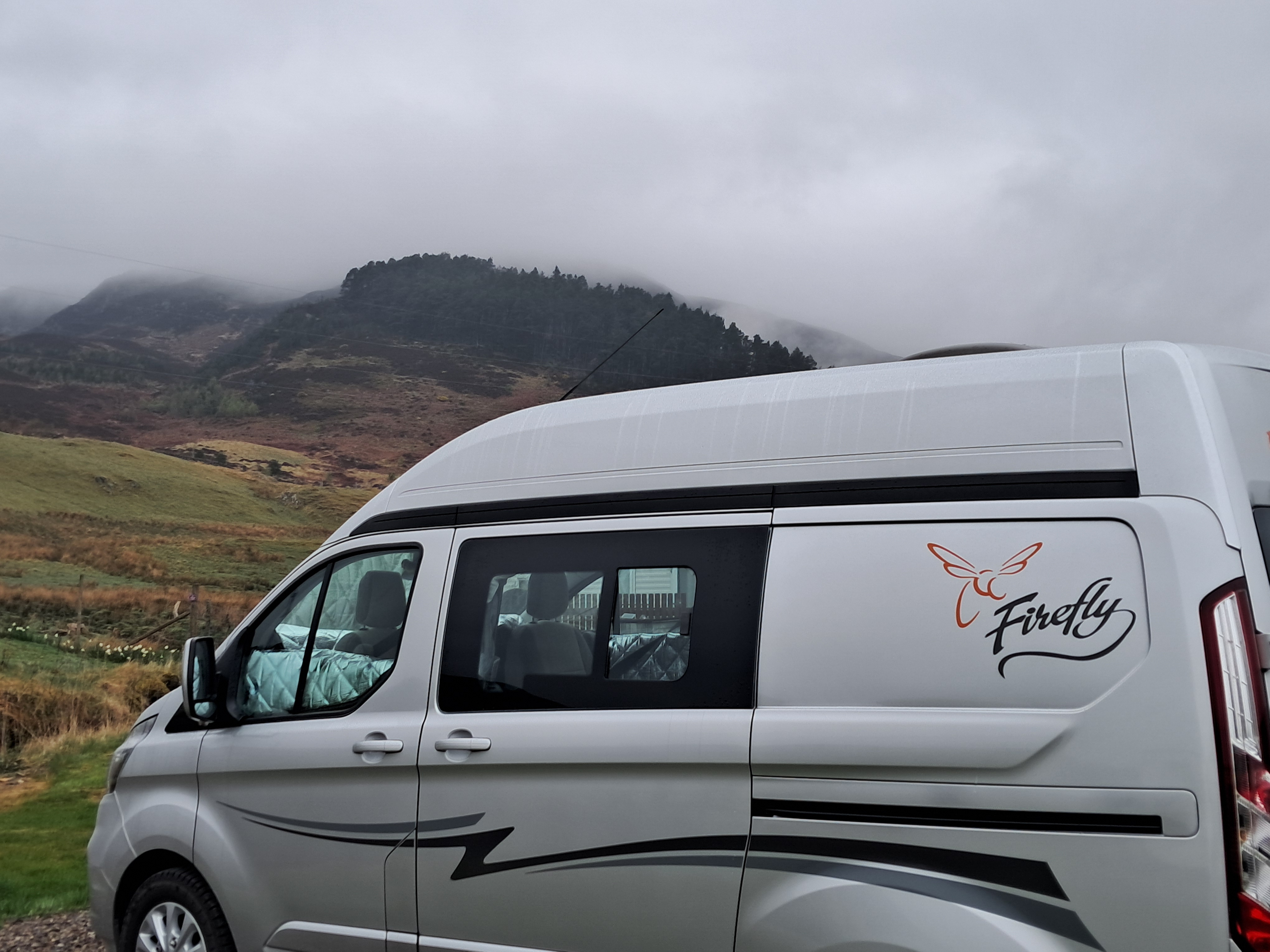
The next day we had planned a longer walk up the hill but the drizzle and low cloud led to a rethink and we enjoyed being lazy in the shelter of our campervan.

By the afternoon, we were ready to stretch our legs and, togged up in waterproofs, we set off on the marked paths around the community land, first following the red route and then the green and white path after climbing the short link path. This was a total of around five kilometres.

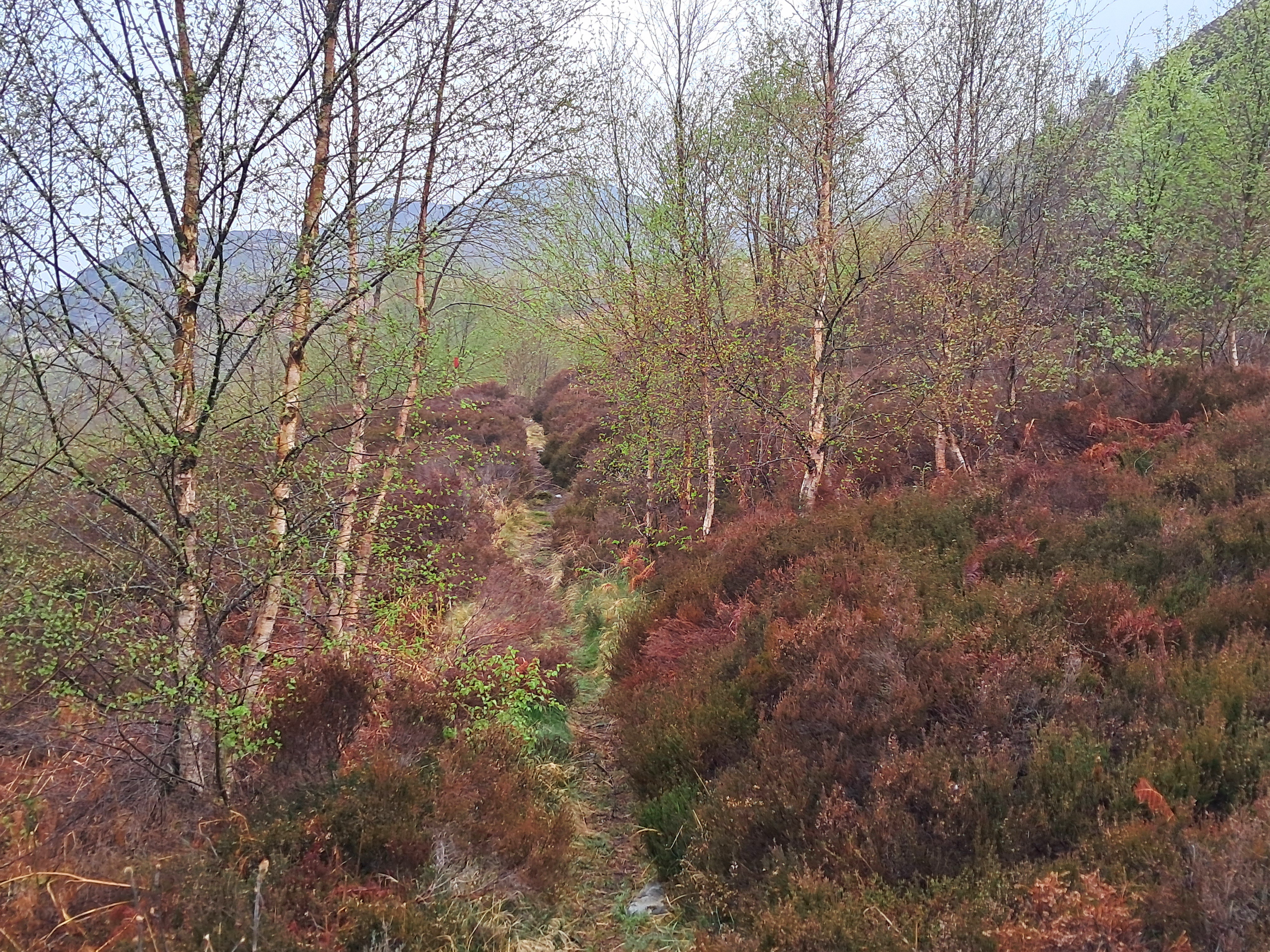
This red route follows an old path above the gorge of the tumbling waters of the Allt Mor, taking us through regenerating woodland of birch and rowan and thickets of sweet-smelling bog myrtle.

Climbing up to the green and white route we were walking through the heart of Dùn Coillich. Even on a damp day the landscape was beautiful and the peace enveloping . The route to the summit branches off from this path but the low cloud put us off climbing higher. Instead, we continued back towards our campervan and reaching the burn we walked on winding paths through delightful lush planted woodland and climbed up to the road to reach the campsite.

Colours on a grey day in Glengoulandie

The regenerating woodland on the community land made Glengoulandie a special place to visit and offers a vision for the future of Scottish landscapes. I am sure we will be back to climb the hill.

The campsite

Glengoulandie Camping and Caravanning is a small site, so don’t all rush there at once! If you like quiet campsites with a laid back feel this will suit you. It has just a few campervan pitches, some static caravans, cabins and space for tents, so with or without a campervan you can stay in this special place. You’ll receive a warm welcome and enjoy hot showers, with adjustable temperature settings. The campsite has a cafe and sells a few essentials but there are no pubs or shops within walking distance.

On our pitch on the Glengoulandie campsite

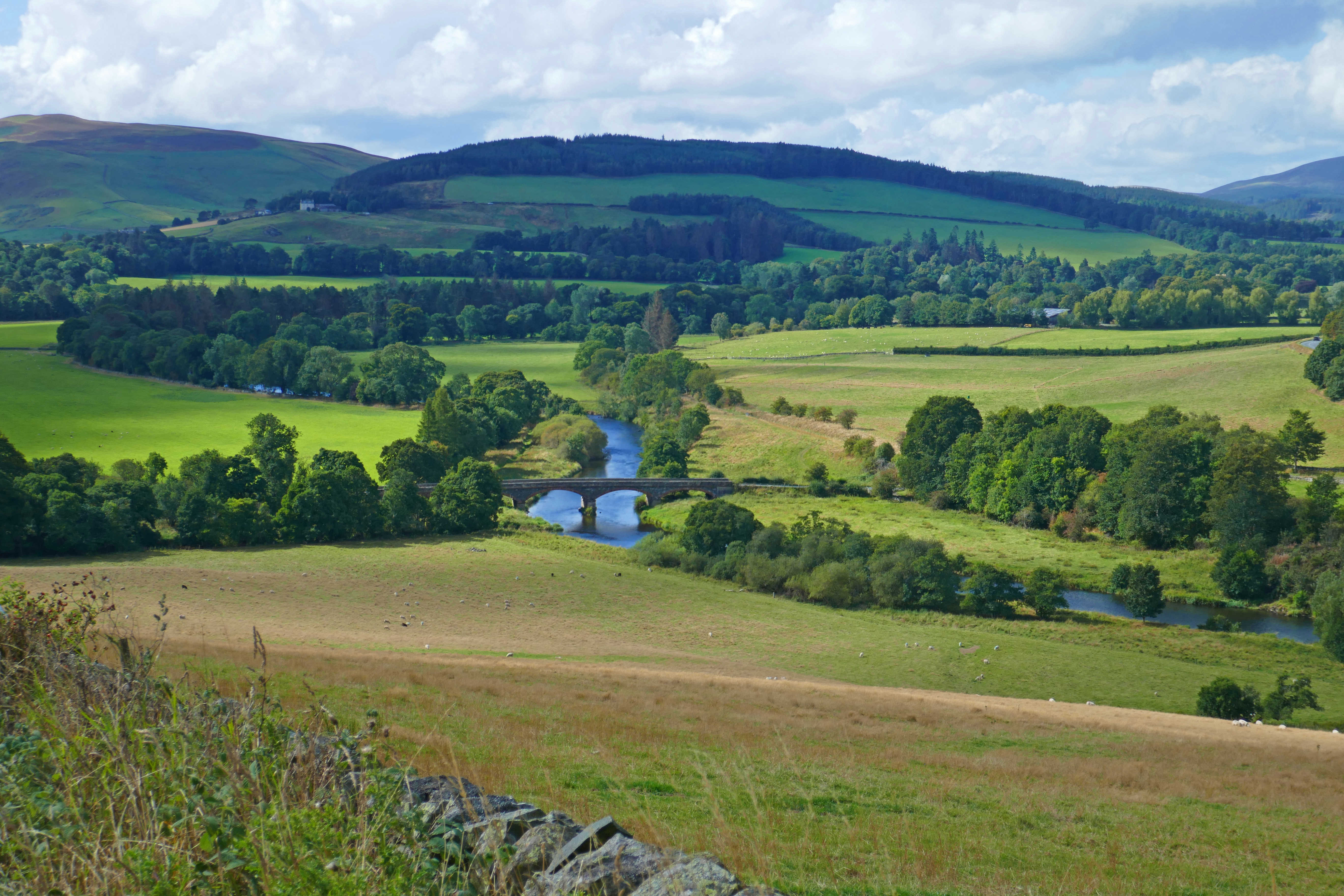
Following the River Tweed in the Scottish Borders

Looking back to the River Tweed near Peebles

Looking below me and taking in the view in to the steep-sided hollow of The Devil’s Beef Tub I was aware we weren’t far from the source of the River Tweed. The ridge we were following over Annanhead Hill and Great Hill is a dividing line, a watershed. To the south and Moffat I could see the valley of the River Annan as it flows west to the Solway. To the north of the ridge the Tweed flows east to the North Sea. I peered over the trees and grassy lumps and bumps but the young Tweed was still hidden.

The River Tweed runs for 156 kms from the hills above Moffat to Berwick-on-Tweed in England, near the Scottish border. The river flows through the borderlands and some suggest its name comes from an old word for border but this name is also closely associated with a woven woollen fabric. Tweed is often in herringbone or hounds tooth check patterns and has been used for years for coats and jackets.

Moffat

From the high ridge above the unforgettably named Devil’s Beef Tub we descended through restored woodland. Since 2009 The Borders Forest Trust have been bringing back the native woodland, wetlands and heathlands around Corehead, restoring the Ettrick Forest. This already flourishing woodland was delightful walking, with the hillside to ourselves we hiked through varied montane scrub and wildflower meadows, joined by butterflies and bird song. We reached the road at Ericstane from where the walking was long but easy back to Moffat, where we were camping.

When in Moffat we always visit Cafe Ariete, a tradition that began some thirty years ago when we lived in Preston and Moffat was the perfect distance for our first brew stop on any trip north. In all this time the cafe has hardly changed, the coffee is excellent and the breakfasts, lunches and cakes are all tasty and served with a smile. Cafe Ariete is always worth the short detour off the M74!

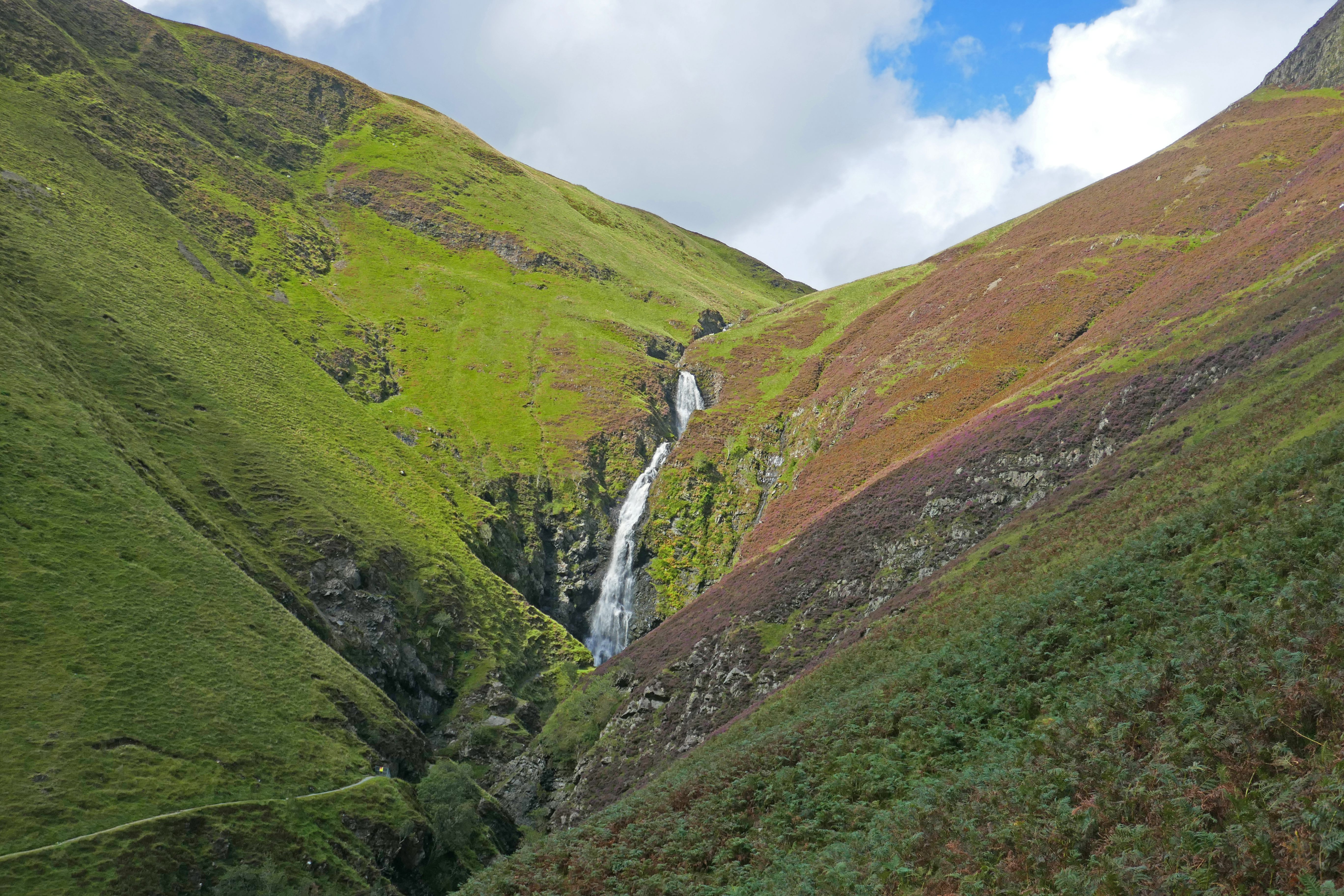
Grey Mares Tail

Grey Mare’s Tail, a waterfall with a 60m drop, is about 20 minutes drive from Moffat. There are two National Trust car parks at the foot of the cascade and from there you can take the short walk to view the falls. We wanted to do more and climbed the steep well-made path above the series of waterfalls. Eventually, the path levels out and meanders through a hummocky landscape to the hidden shore of Loch Skeen, a mountain loch surrounded by crags.

This trip had been planned to follow the River Tweed and we picked it up on the road to Peebles, stopping at Dawyck Botanic Gardens, one of four botanic gardens in Scotland, including Edinburgh. The woodland garden of Dwyck climbs the hillside from the River Tweed floodplain. The landscaping has created a network of sinuous paths among the trees and along the stream, dotted with sculptures and information boards about plant collectors and notable trees. It is a joyful place to visit and worked well on a sunshine and showery day; we could run back to the cafe when dark clouds loomed or shelter under a huge redwood. In September the autumn crocuses were flamboyant and there were early signs of leaves turning.

Peebles & Innerleithen

We had planned this trip after stopping in Peebles briefly last year. It seemed such a lovely small town we wanted to get to know it better. The next morning we parked by the river and walked into the town, filling our bags with goodies, including Selkirk Bannock, from the bakery, browsing the charity shops and enjoying coffee in one of the many cafes.

Our circular walk from Peebles along the River Tweed was only six kilometres long but packed in so much, including natters with friendly locals! From the riverside path we spotted a kingfisher and dippers and had views of Neidpath Castle. On the opposite bank we joined centuries of walkers crossing the hump-backed Old Manor Bridge and climbed uphill, stopping to enjoy the views over the Tweed valley. Our descent through the shady lushness of South Park Wood eventually took us to the old railwayline and back to Peebles.

A little further downstream is the small town of Innerleithen, a spa town and former woollen mill centre. We explored the lovely town and its history and were surprised to meet a local with a grumpy dislike of Peebles! Climbing Pirn Hill [apparently known locally as Windy Knowe], we found a set of stone cairns topped with carved tablets on the Iron Age hillfort site. The view over the town and the Tweed valley is well worth the exertion and I can confirm, it is windy!

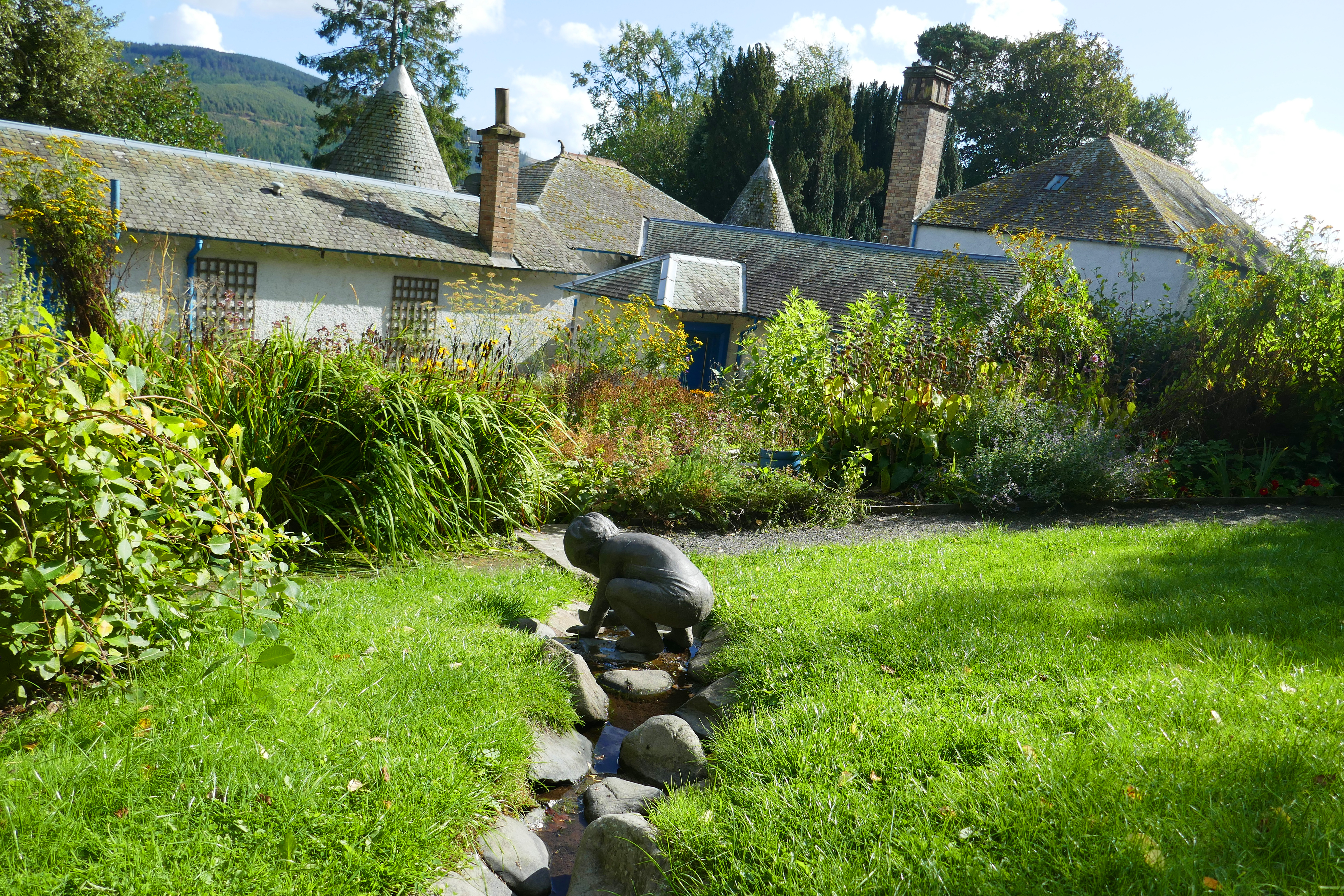
The garden at St Ronan’s Well

Back in the warmth of the valley, we made our way to Innerleithen’s St Ronan’s Wells. The elegant and colourful 19th century pavillion is unmissable on the hillside. In the past two Scottish writers provided advertising for the health-giving properties of the local springs. Robert Burns wrote about the spa during his 18th century travels and Walter Scott’s novel St Ronan’s Well in 1823 encouraged literary tourism. Behind the pavillion we found an idyllic community garden. Full of flowers and herbs, insects and butterflies, with a trickling spring running through it, the garden has winding paths, seating areas and the love that created it seeps from every leaf.

Selkirk

Selkirk is a hilly town that sits on Ettrick Water, a tributary of the Tweed. It is a thigh busting walk from the campsite at the leisure centre to the town, but worth it for the good and ethically-sourced coffee from Three Hills Coffee on the main street.

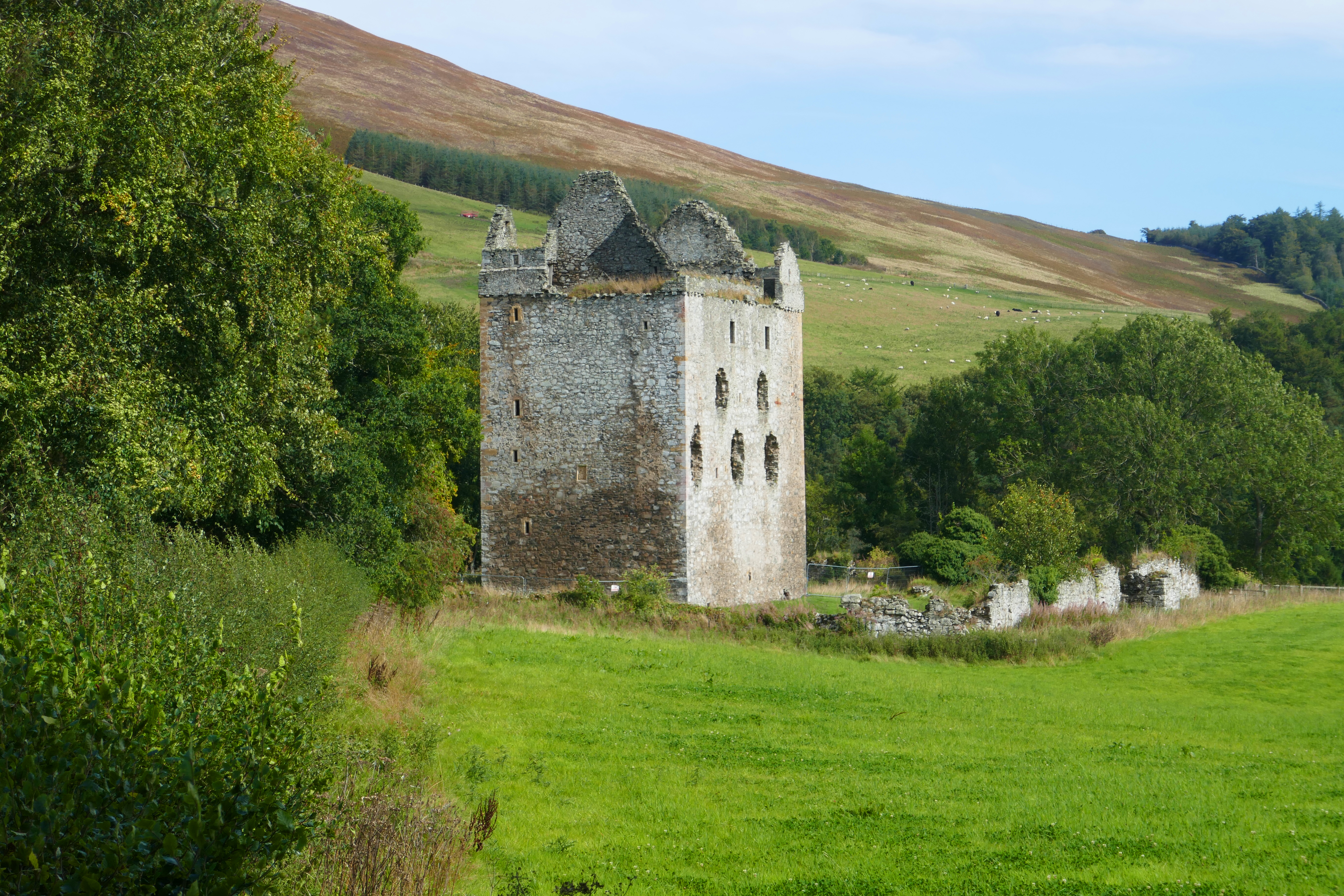
The sun was shining and we planned to complete the Three Bretheren Walk, a classic hike near Selkirk. However, the small car park was packed by the time we arrived. Checking our trusty Walk Highlands app we drove the short distance to Bowhill Estate. The Duchess’s Drive route on the Bowhill Estate was designed for showing off the land to visitors, ascending through woodland to the open moorland. Although on good tracks, the walk was more exhausting than we expected but full of variety and good views across the lumpy Borders countryside. We returned to the car park by the ruins of Newark Tower, whose white stones were bleached by the sun.

Newark Tower at Bowhill

Melrose

We picked up the River Tweed again at Abbotsford, the home of the writer Walter Scott. The large rambling house looks interesting to visit but we concentrated on walking up to Cauldshiels Loch, returning along the bank of the secluded Faldonside Loch before completing our circuit on a woodland path along the River Tweed.

In Melrose we visited the abbey, although due to works being carried out we could only walk around the outside, admiring the red sandstone that blushes when caught by the evening sun. Nearby are two National Trust gardens, Harmony House and Priorwood and, keeping an eye on the weather as showers were heading our way, we sauntered through these two walled gardens. They were both well-stocked and interesting, still full of colour and scents even in mid-September. Priorwood Garden also has an orchard and a stall selling produce from the gardens.

We had planned to spend some time at Berwick-on-Tweed, completing our trip along the River Tweed. However, stuff at home unexpectedly got in the way and Melrose was as far as we got. Until next time!

Faldonside Loch near Abbotsford through the trees

Walking details

Unless otherwise noted, the walks can be found on the Walk Highlands website and app.

The full Devil’s Beef Tub circuit from Moffat is 22.5 km with 521m of ascent. We used a taxi [Moffat Taxis] to get us to the Devil’s Beef Tub viewpoint on the A701 [£10] and walked along the ridge and back to Moffat, reducing the exertion to approximately 15.25 km of walking and only 230m of ascent while retaining lots of interest.

Grey Mare’s Tail and Loch Skeen in the Moffat hills, this 4.5 km walk with 278m of ascent climbs past the series of waterfalls and on to Loch Skeen that is overlooked by craggy hills.

Neidpath Castle and the Tweed walk from Peebles is 6.25 km long with just 89m of ascent. Kingsmeadows car park in Peebles is a large car park and has motorhome spaces.

Pirn Hill Fort Trail in Innerleithen is 2.5 km long with 79m of ascent. Parking is available in a roadside parking area near the entrance to the paths.

The Duchess’s Drive, Bowhill is 11.25 km and 339m of ascent on easy to follow tracks and lanes. There is good parking on the Bowhill Estate for a small charge. The walk is through woodland and across moorland and on lanes by Newark Castle.

Abbotsford has a leaflet of walks you can download, with routes from 2 to 10 km. The Cauldshiels Loch walk is 6.5 km long and takes about two hours from the car park. It was mostly easy to follow, although we did resort to our OS maps as we descended to the River Tweed.

Where we stayed

Moffat Camping & Caravanning Club Site – a good and level site only a few minutes walk from the town.

Tweedside Caravan Park at Innerleithen – this site on the edge of Innerleithen has a small touring area, surrounded by static caravans.

Selkirk Victoria Campsite – on the edge of Selkirk, the pitches are marked out on the tarmac car park at the community-run leisure centre. Campers have keycode access to move the height barrier and access to the three shower rooms and a wash-up sink.

Lilliardsedge Holiday Park – in the countryside between St Boswells and Jedburgh, this is a large site with many statics and a tidy touring area of hardstanding pitches. The site has a restaurant and golf course.

Melrose Caravan and Motorhome Club site – A level site in the town of Melrose and just a few minutes walk from the abbey.

Cycling along the Shady Banks of The Marais Poitevin in France

Cycling in the Marais Poitevin

We had been pottering around France for over a month and crispy baguettes, pungent cheeses and fruity plonk had become our new normal.  Our French, while decades away from word-perfect, improved daily and we were firmly in the campervan relaxation groove.  But southwest France was sweltering and heading north to escape the heat was the only sensible thing to do.  Beyond meeting friends in a couple of weeks time in Batz-sur-Mer on the rugged coast north of the Loire estuary we had no plan.  Sitting by the River Vienne in Confolens we opened the road map and turned the pages, tracing possibilities with suntanned fingers.

Confolens

A rough route north hatched we climbed on our bikes to explore from our riverside campsite.  Negotiating the narrow streets of Confolens we found medieval timber-framed houses, views over its red roofs from a stone gateway and traces of the walls.  We crossed the arched 13th century bridge and pedalled along the Vienne to Saint-Germain-de-Confolens where a ruined castle perches above the picturesque village.   After climbing up to the castle for the panoramic view we chose a shady wobbly table at the hip riverside bar and toasted the sunshine with a heady glass of Pineau. 

Confolens

The Vendée, on France’s Atlantic coast, is loved for its miles of sandy beaches with a rolling green hinterland.  It stretches from almost the River Loire in the north to the edges of the Marais Poitevin in the south and the latter was our first stop.  The Magné campsite near Niort, on the edge of the Marais Poitevin, has spacious pitches, good facilities and was almost perfect.  Morning bread was the only thing missing but an immaculate patisserie was just a few minutes cycle ride away.  My pre-breakfast trips to the bakery were effortless but also agonising as it was jam-packed with temptation and I drooled over the lavish display of cakes every morning.

Cycling Around Coulon

The Marais Poitevin is a verdant arcadia, criss-crossed with waterways that divide forestry and meadows.  With tracks and lanes joining villages of traditional cottages it offers blissful pedalling and, for less than the cost of a pastry, you can buy a useful map showing waymarked cycling circuits.  The path alongside the canalised Sèvre Niortaise from Magné to Coulon was a good introduction to the natural treasurers of the area.  Reaching tourist-welcoming Coulon’s whitewashed riverside buildings with rustic shutters we wound through the streets to the main square and people watched over a coffee.

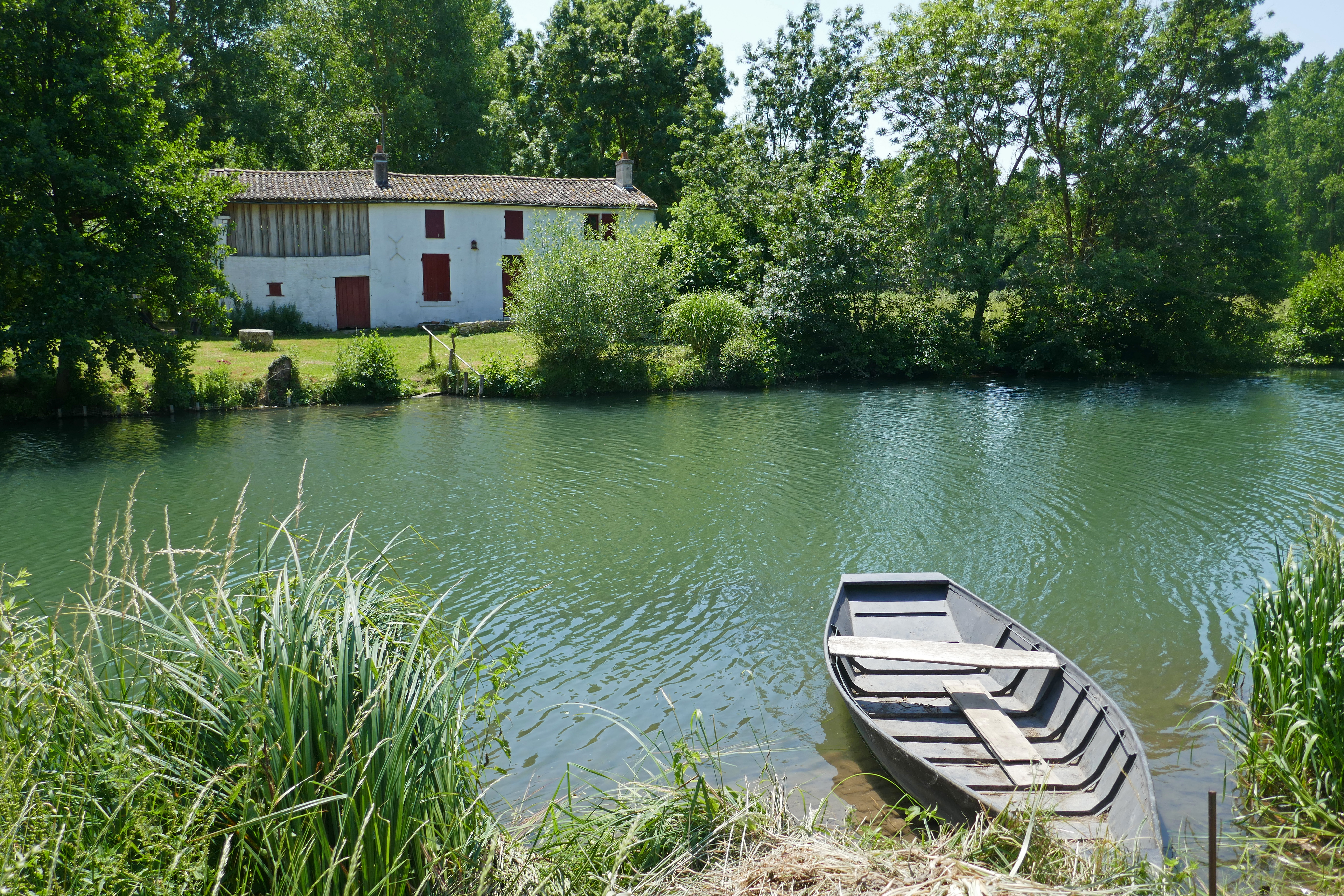
From Coulon we snaked along lanes and tracks through countryside where storks moved stealthily across mown fields and kites wheeled behind combine harvesters.   Between Coulon and Irleau is a raft of waterways only accessible via tracks and dinky arched bridges.  This landscape has been managed for agriculture for centuries and the aquatic labyrinth of conches, or narrow channels, only accessible by kayak or a local flat-bottomed boat, drains into the Sèvre Niortaise.  I had to stop myself photographing every view along a stream luxuriantly overhung with trees or a boat tethered to the bank alongside an isolated cottage, as each seemed better than the last.  We cycled on dazzling white tracks between meadows and unhurriedly watched a herd of drowsy cows.  Cattle egrets prowled around their soft bulky bodies, occasionally stopping and appearing to look deep into the vast depths of a cow’s eye.

An Unexpected Hill

I had expected a fen-like flat landscape but somehow we always found a hill.  North of Coulon on the Number Seven Circuit the green waymarkers were camouflaged among the green roadside vegetation and we were soon on the wrong lane.  Backtracking, we honed our detection skills at junctions as we hunted among bushes for the signs.  Climbing a gravel track in the heavy heat of the afternoon, golden wheat rippled in a breath of wind as we sweated by like slow versions of hill-climbing Tour de France cyclists.  Stopping at the summit we could see across the sweep of the Marais Poitevin to the tower blocks of Niort.  Descending to the Sèvre Niortaise we envied the young people frolicking in the cool water after school and watched a working boat negotiating a lock before tackling the pleasant stretch of towpath back to Magné’s handsome lifting bridge and attractive tree-lined square overlooked by a squat stone church.

On Sunday morning Magné’s square bustled with a lively second-hand clothes market and we joined the shoppers looking for vintage bargains.  Later that day in Coulon we ate our picnic on a shady bench by the river, next to the easels of a group of artists.  While the painters enjoyed their long and convivial French lunch we discreetly admired their artistic impressions of the view.

Whatever Floats Your Boat

On our last day in the Marais Poitevin we put together our own greatest hits, joining up our favourite paths in an ultimate cycle ride.  Our first stop was for coffee in La Garette, a wall-to-wall attractive village where houses with sun-bleached shutters jumble together along the main street.  Our genial waiter wanted to practice his English and we gamely struggled to identify the words among his strong accent, but were grateful when he was distracted by a couple arriving on a flat-bottomed boat with a guide wearing a hat festooned with flowers.

By the afternoon the heat was smothering as we hugged the shady paths lined with pollarded trees and fragrant flowers, finding any excuse to rest.  At La Sotterie we crossed the Sèvre Niortaise and followed it back to Coulon where groups of school children in matching baseball hats were chattering as they climbed into boats. I noticed the flower-hat guide paddling sedately by, not even breaking a sweat.

Once the Marais Poitevin has seduced you, you won’t want to leave and will certainly return, or maybe that is just me!

We stayed at Camping Le Martin Pecheur. This is a small French basic site, just a short distance from the town.

A typical scene in the Marais Poitevin

Cycling along the Dunajec River in Poland

Wooden houses in Zakopane

I met my Polish bike in an industrial area of Krakow, certainly not the usual tourist destination in this popular city. With Dutch-style handlebars, a step-through frame and a well-padded saddle for comfort, this was the perfect utility bike. Once adjusted it served me well for a week of cycling between 25 and 60km for six days along the ups and downs of southern Poland.

In our pre-campervan days we took cycling holidays by the Danube, in France and the Alps. We enjoyed these self-guided trips and were keen to see if we could still manage the cycling on another campervan-less holiday. On a self-guided cycling holiday your route and overnight stops are decided but you can take the ups and downs at your own pace and stop when you want or need to.

The Dunajec cycling holiday blurb reeled us in with copy about relaxing cycling on paths similar to Germany, so we were surprised to find ourselves on day one being dropped off in ZÄ…b, Poland’s highest village, at 1,013 metres above sea level. After taking in the panoramic view of the Tatra Mountains and the first of many wooden churches, the two of us set off pedalling. I was soon testing the brakes on my hired bike on a 20% hill that snaked down to the valley of the tumbling BiaÅ‚y Dunajec [the White Dunajec].

Around Zakopane

On the first day we were only cycling for the afternoon and after the terrifying road descent we climbed steadily through attractive wooden houses with tidy gardens and pottering chickens to the popular resort of Zakopane and our hotel for the night. Evening meals were included in our holiday and the buffet had already opened when we arrived [they eat early in Poland]. We rushed showers to get to the restaurant before the meal finished.

The designer of our route clearly finds downhill cycling fun but it is my least favourite direction. Day two saw us firstly taking our bikes on Zakopane’s modern funicular to Gubałówka at 1,120 m above sea level. Here we made the mistake of relaxing over coffee in the complex of cafes and market stalls at the top of the funicular while watching dark storm clouds gathering over the Tatras.

By the time we had made our way through the crowds around the souvenir stalls that lined the access road it was raining. The rain continued for all 12km of steep downhill cycling on a busy road. I was relieved me and my bike reached the charming wooden houses of Chochołów in one piece. As we joined the Czarny Dunajec [Black Dunajec], which joins the Biały Dunajec in Nowy Targ to form the Dunajec River, the sun came out and we were following flat traffic-free cycle paths through flower-rich meadows, stopping for cold drinks at a cafe for cyclists and walkers. This was the cycling holiday we had dreamt about!

Cycling through meadows to Nowy Targ

Even the second rain storm didn’t spoil the joy of good cycling but after 52km we didn’t have the time or energy to visit Nowy Targ either before the not-quite-so-early dinner or after. We were too busy drying off footwear and waterproofs.

The Wooden Churches of Southern Lesser Poland

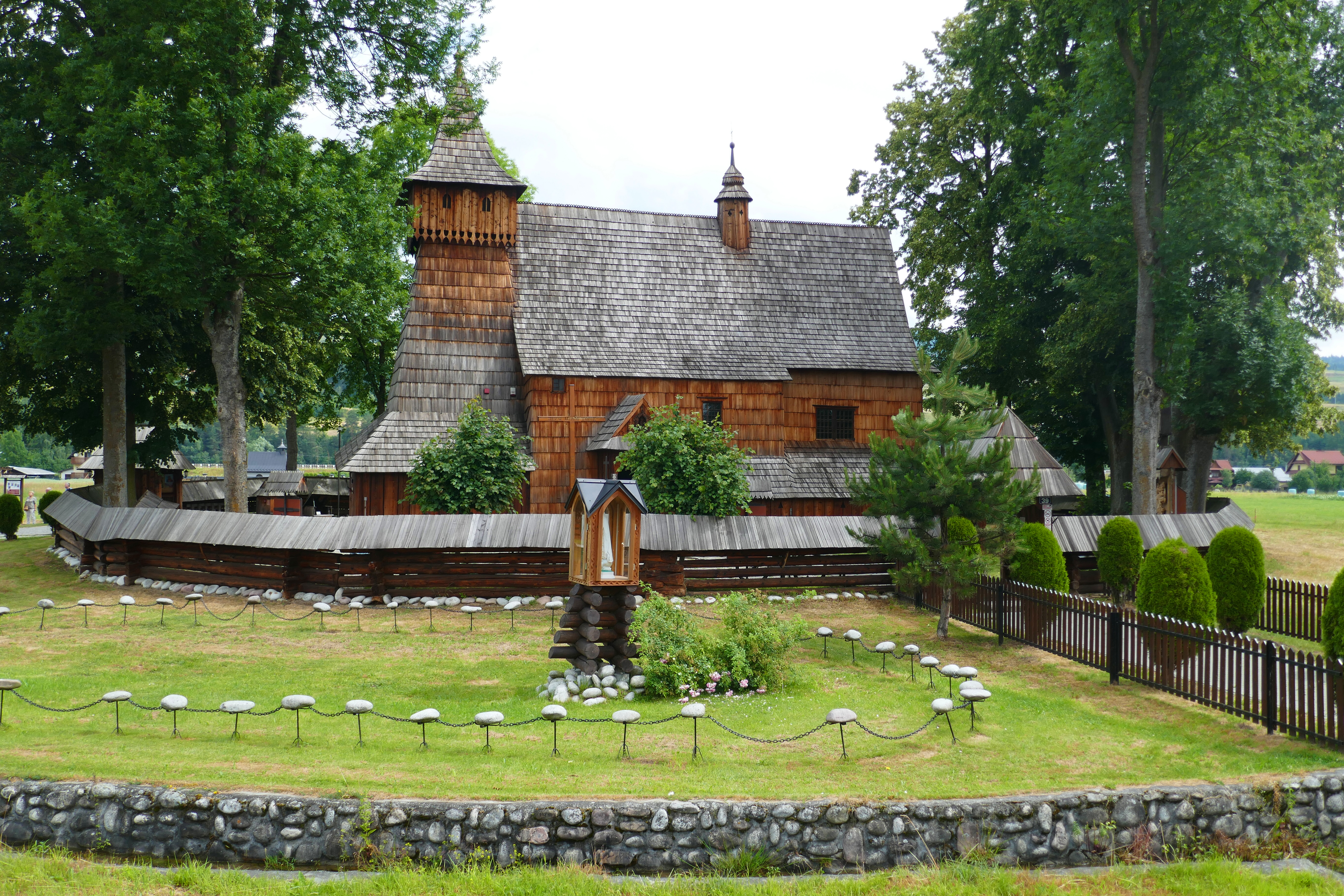
Rain was forecast just after lunch the next day so we cracked on and rolled into our hotel after 40km of off-road cycling. By now my bike and I were a team and we arrived by magic with seconds to spare before the first rain drops appeared! Following the Dunajec, we cycled fast enough to allow time for a coffee stop and to visit the wooden church in Dębno. This exceptional 15th century church is enclosed by an attractive wooden fence and has a stunning painted ceiling. The church in Dębno and five others are a UNESCO World Heritage Site.

After Dębno the Dunajec is dammed forming a reservoir. This area is a popular holiday area with campsites and self-catering chalets and lots of families cycling, many on electric bikes. The cycle path climbs a steep winding hill which I walked up, passed by many smug cyclists using electric to power them up. We stopped to see Niedzica Castle, built by Hungarians in the 14th century, which sits picturesquely over the reservoir.

The wooden church in Dębno

By now cycling every day had become normal. The evening before we would check through the route, deciding if the main route or one of the many alternatives suited us best. We knew where all our stuff fitted when we packed our rucksacks for the morning baggage transfer. We would eat a hearty breakfast, grab the bags of essentials to put in our panniers and find a local shop to buy bread and cheese for lunch.

A Gorge, a Monastery & a Spa Town

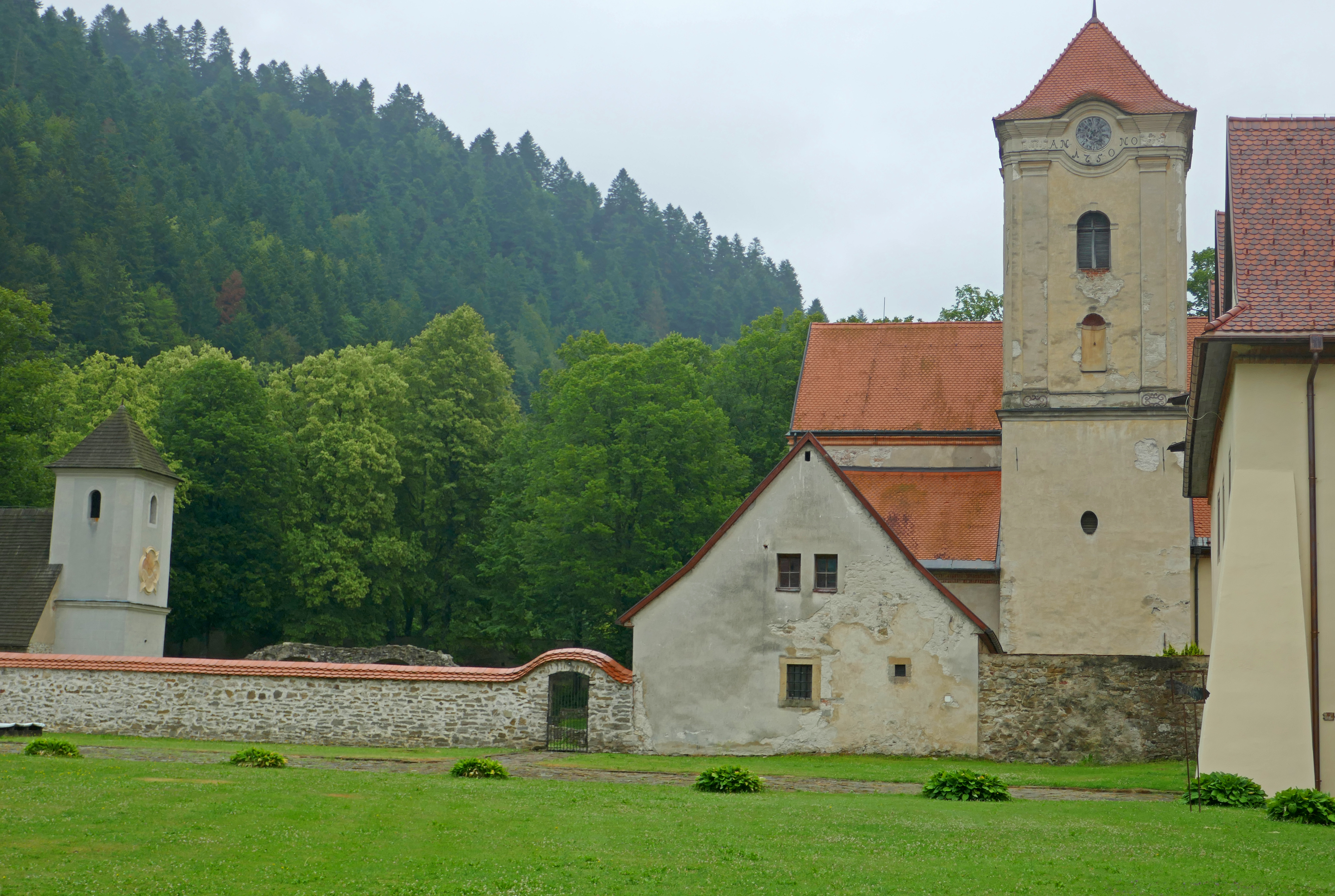
Day four took us through the Dunajec Gorge in the Pieniny National Park and briefly to Slovakia. We had been hugging the border since Zakopane, today we needed to have our Euros handy! With only 30km to cycle we had time for a leisurely visit to Červený kláštor, a former Carthusian and later Camaldolese monastery, that has been restored as a museum.

Červený kláštor

The limestone gorge winds through the mountains to Szczawnica, cyclists and walkers sharing a good path, only the sounds of the gushing river and the birds to accompany us. Rafts navigate the twisting flow of the river as it makes its way between steep wooded slopes. The valley opens out again on the edge of Szczawnica and here we stopped to watch a tall black stork fishing in the rapids.

The pleasant spa town of Szczawnica was a good overnight and after a short cycling day we even had the energy and time to wander around its steep streets in the evening. Fountains were lit up colourfully and other holiday makers enjoyed a constitutional.

The Finish Line

No longer worried we wouldn’t manage the distance, we chose the longer [60km] but less hilly riverside route for the next day, firstly following the now much wider Dunajec and later the Poprad River. We cycled below the hills, through hamlets of neat houses on quiet roads, well away from fast traffic. In Stary Sacz we bought fluffy and sweet PÄ…czki, filled Polish doughnuts and had excellent coffee at the friendly Frida Art Cafe before the final section.

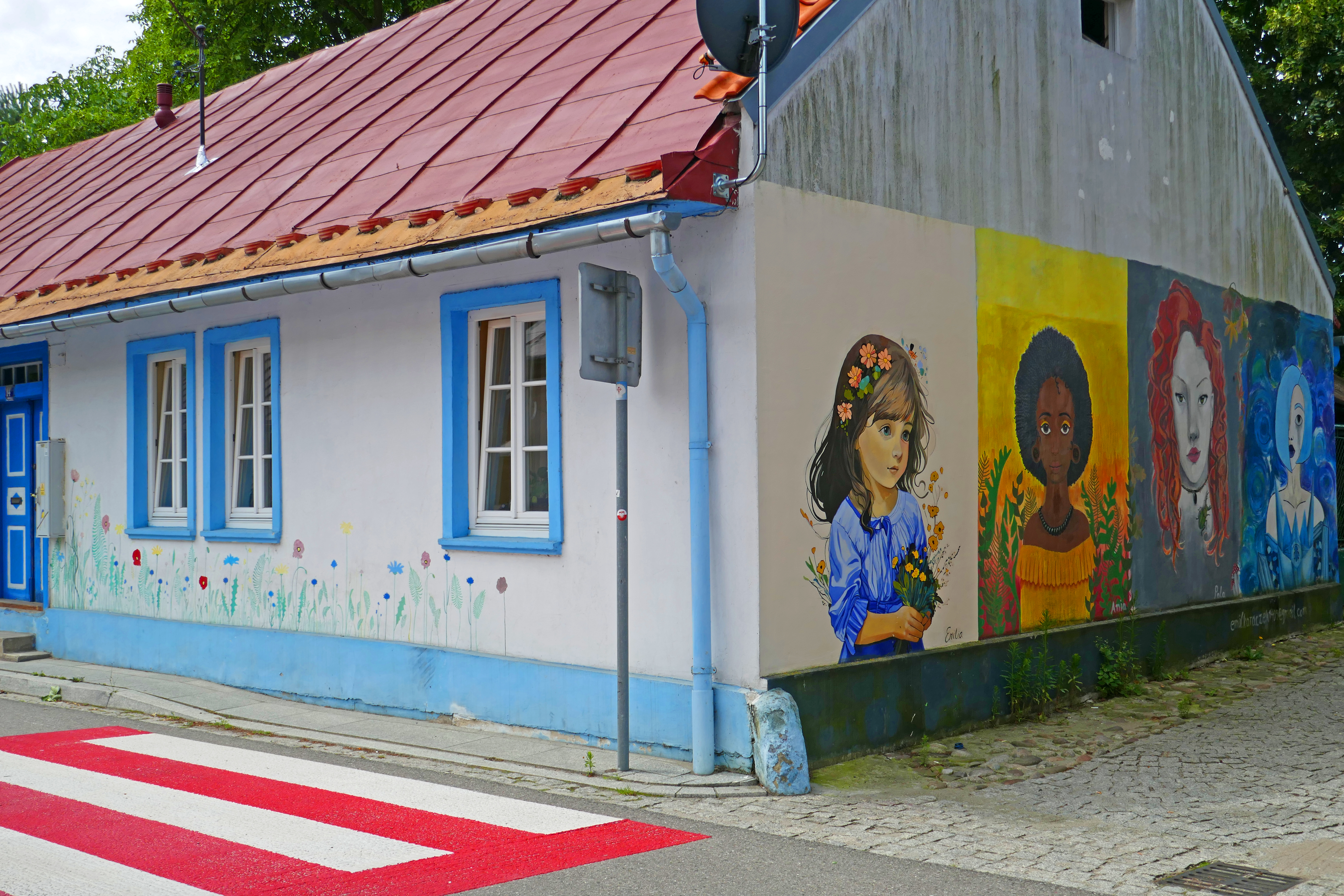
The coffee and the cafe were so good we were back at the Frida Art Cafe the next morning on our way to Nowy Sacz. We sat in the deck chairs on the terrace and made friends with the member of staff who served our cake with handwritten notes wishing us a good day in Polish. This and stopping to admire some of the murals in Stary Sacz meant we didn’t have much time to look around Nowy Sacz’s impressive large market square and cafe-filled streets.

The Dunajec continues flowing for some distance from Nowy Sacz before it reaches the Vistula but our tour through this corner of Poland was at an end. I said a fond farewell to my trusty bike as it was loaded on the trailer.

Murals in Stary Sacz

The Dunajec cycling experience

Overall, we had fun on our Polish cycling holiday, although many aspects were not what we expected. One cyclist was so spooked by the first day’s steep downhill, a near miss with a vehicle and a skid on gravel that they didn’t cycle again for the rest of the week! Although the route was mostly traffic-free from the second half of day two, I would suggest this is a route only for those confident cycling on roads.

The trip is promoted as being on cycle paths as good as anything in Germany but this didn’t quite stack up. Poland has invested in cycling infrastructure in the area but the early road sections and the signage didn’t meet the standard of more established cycle paths. Picnic spots have been provided, but with few other cyclists around in many of the areas we passed through, nice-to-have facilities like cafes have not opened.

The weather in southern Poland is unpredictable, we had temperatures of 30C plus and a chilly day of 16C. We had sunshine, thundery showers and prolonged rainfall.

We were in three star hotels and these were all clean [although one bedroom had a lot of ants] and functional. The plumbing was vintage in a couple of places but delivered a hot shower. The holiday was half-board and despite informing the booking company that we were two vegetarians and this being passed on to the Polish organiser, the message didn’t reach the hotels. Each one dealt with our surprising dietary needs professionally and hospitably, the chef creating something tasty for two hungry cyclists. The meals often involved cheese and eggs and being vegan would have been more challenging

The bikes were sturdy, comfortable and worked well, although it was handy to have the tools to make small adjustments during the first days. We were given a panier and a lock but had to take our own helmets and we wore padded cycling shorts for extra comfort.

Details

We booked our holiday through Freewheel but other companies offer the same trip and it is organised by Bird Cycling based in Krakow in Poland.

The trip began and finished in Krakow and we had an extra day in this beautiful city before our cycling trip. We travelled in July, getting to Krakow over three days, taking the train to Newcastle, the overnight ferry from Newcastle to Ijmuiden / Amsterdam [so expensive for 2 foot passengers] and then trains across Europe, firstly from Amsterdam to Berlin (7-8 hours) and, after an overnight, Berlin to Krakow (7-8 hours) across Poland. I guess flying could have been cheaper but much less of an adventure and more environmentally damaging. We considered using Le Shuttle via Brussels but with the cost of an overnight hotel in Brussels there wasn’t much in it. We would have saved money if we hadn’t travelled in July!

We also spent a week pottering around Germany after our cycling tour, but the costs below relate to the Polish part of the holiday and the return travel:

Eight nights [an extra night in Krakow] with Freewheel £1,674.

Hotel for two nights in Berlin £158.

Trains Amsterdam to Krakow return £276.

Overnight ferry Newcastle to Ijmuiden with meals and bus transfers to railway stations, return £897.

Trains Lancaster to Newcastle return £99 [with railcard].

Total for two people for 12 nights £3,104.

Singing in my Head: Living with Tinnitus

Silence is a gift. If you can sit outdoors or in a room and hear nothing, just the quiet, then feel blessed. For the past eleven years [since 2014] my ears have sung of their own accord. The singing isn’t tuneful and is really more of a scream but I have to live with it and it helps to think of it more kindly. It would be unbearable to imagine my ears were screaming at me, all day and every day. And so, my two ears are singing , even if it is mostly one note with no rhythmn.

I first noticed this in 2013/2014 and my GP referred me to the hospital. They checked out my hearing and found this to be excellent, but have no cure or explanation for the ringing. It just happens and I was left on my own to deal with it. I don’t know if I had spent my years going to concerts of gentle classical music instead of loud rock music I would have been spared, or if Tinnitus was always waiting in the wings until I was in my early 50s to spoil my silences.

I miss the silence. There is never silence with tinnitus. The singing never takes a break. Just occasionally the singing changes tone briefly and becomes higher pitched. It was always louder in the evening than the morning but recently it has annoyingly sung at full volume all day.

Most distressing is when I am in the countryside. I love the sounds of nature, the sound of water, the bird song and the breeze rippling through the leaves. I can still hear all those things with my almost perfect hearing but they are accompanied by the tuneless singing.

The radio and music distracts me from the singing during the day. If I’m reading I am usually lost in the story and the singing doesn’t disturb me. At other times, I try and concentrate on writing or cooking and the tuneless tune is all I can hear. At night I stop my brain from listening to the singing by leaving the World Service on, and this usually sends me to sleep.

I have had to learn to live with the singing as there is nothing to make it go away. Tinitus UK and their Facebook group provide support and carry out research and I am grateful for this. Being part of the tinnitus community I can see that other people have to deal with worse than I do and I do not feel so isolated.

Tinnitus is tough to live with but I have reasons to be grateful. It isn’t life threatening. Now I have strategies in place to sidetrack my brain from the terrible singing I can live my life. Yes, there are times when I am only human and scream, ‘Go away!’ in frustration but meet me and you wouldn’t know what was happening between my ears. I have no idea if the singing will be with me on my death bed or if it will progress to something worse [please no!] In my dreams it will disappear as suddenly as it came.

Santé! Cognac & Jarnac: Here’s to Cycling & Drinking

Riverside houses in Jarnac

Les Lapidiales sculpture park

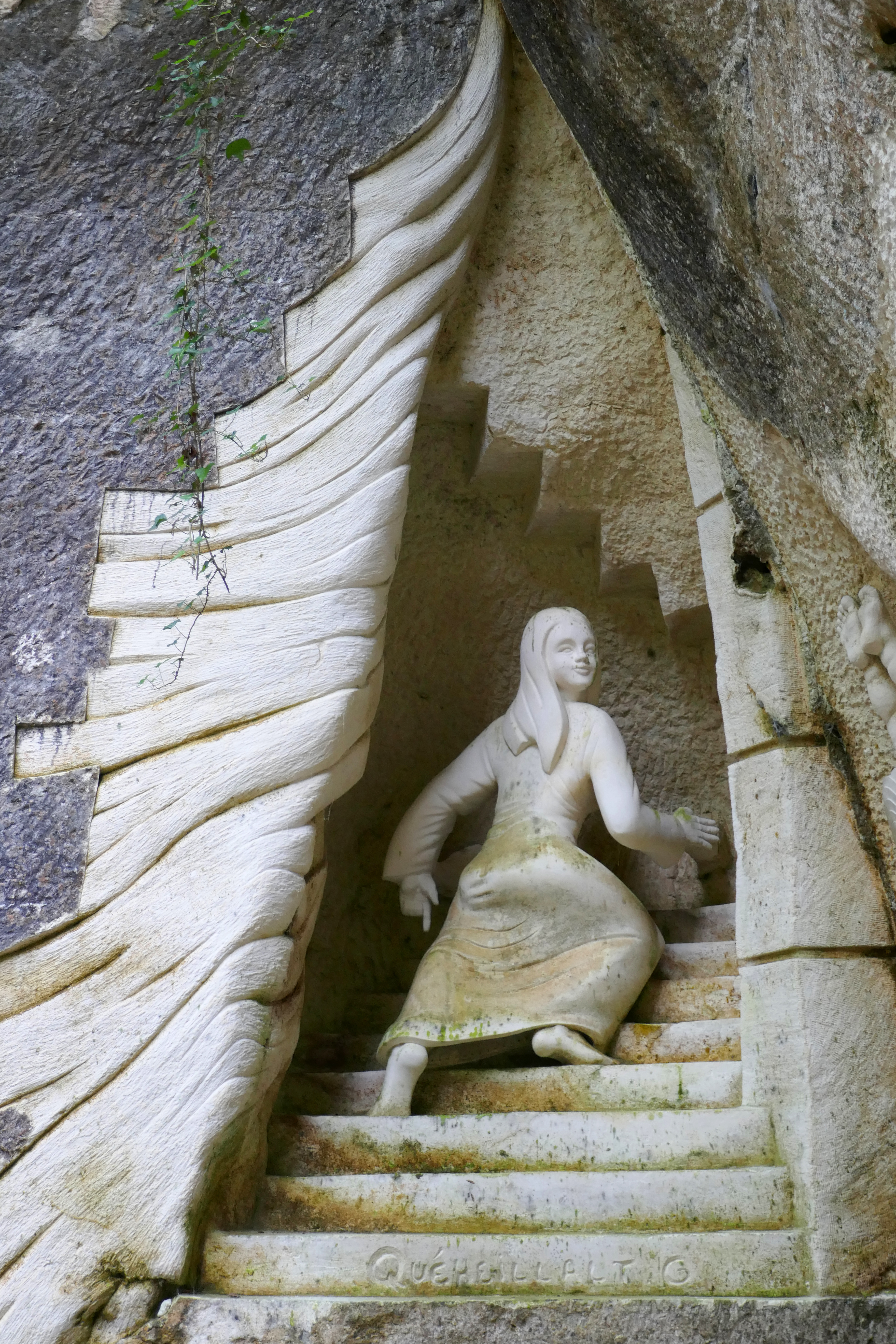
Driving from ÃŽlé de Ré and Cognac we pulled into Les Lapidiales, a sculpture park in a former quarry.  Still being added to, if you are lucky you might see one of the artists at work as they chisel imaginative and fantastical images from rock faces and boulders.  We walked among figures, massive stone heads that peered from overhangs and hidden mythical creatures.  The newer carvings were brilliant white and the greenery on the older sculptures mirrored the surrounding forest.  Many of the works made an impact but the barefoot woman boldly looking back as she climbs a staircase into the rock particularily spoke to me, as the woman’s eyes seemed to say, ‘Follow me!’

A bewitching sculpture at Les Lapidiales

Cognac: City of Taste

Like many people, for us Cognac conjures up the world-famous spirit and exploring the city it was clear it leans on this beverage’s reputation considerably.  There is, however, more to Cognac and we were here because La Flow Vélo, a 290 kilometres (180 miles) cycle route, follows the River Charente through Cognac.

Leaving our bikes near the riverside Cognac warehouses we walked through the city gates and climbed streets of polished cobbles that gleamed in the sunshine.  In the city centre elegant squares and handsome houses festooned with sweet-scented roses oozed taste and prosperity.  We had coffee in the square and bought fresh bread and cheese for a picnic lunch by the duck pond in the central park.

Walking among the Cognac cellars in the afternoon heat we spotted the familiar names of Hennessy and Martell and I was soon intoxicated by the alcohol-rich air.  Tempted into a bar we sipped elegant glasses of Pineau des Charentes Blanc, a heady aperitif of white wine and Cognac that immediately became a firm favourite.

Cobbled streets of Cognac

Jarnac and a Cognac Tour

We planned to stay a few days in Cognac to make the most of the cycling but that evening the campsite suffered a plumbing incident that flooded the shower block and there was no hot water!  Undeterred, we moved our campervan the next morning just half-an-hour upstream to Jarnac, still on La Flow Vélo.  In France, no one bats a Gallic eyelid when you arrive at a campsite at ten in the morning and we were soon bowling along the Charente on two wheels.

The mainly traffic-free riverside paths and tracks through woodland, meadows and vineyards were blissful and easy cycling.  We sat on a bench looking over the clear water of the Charente having lunch while red kites soared overhead, a deer peaked through the trees and swallows skimmed over the water hunting insects as a kingfisher streaked by.

From the leafy edge-of-town campsite we could stroll into Jarnac across a breathtakingly picturesque quay with locks and watermills, or potter around the adjacent island park and nature reserve alive with dragonflies.  In the small shopping area we bought delicious French pastries and scrumptious handmade chocolates shaped like cobble stones. 

Among the streets of typical Charente houses was the family home of the station master whose clever fifth child, François Mitterrand, was French President from 1981 until 1995.  The pinacle of Jarnac’s elegance is the extravagant riverside Maison Courvoisier built in the 19th century Parisian style.  There are a number of Cognac houses in Jarnac but Courvoisier has centre stage and an English tour the next day was a fitting finale to our time in this region.

Cycling before drinking Cognac was sensible and the next morning we pedalled southeast along La Flow Vélo to Châteauneuf-sur-Charente.  The Charente sparkled in the sunshine and the cycling was almost effortless as we followed tracks connecting rustic farmhouses.  A short climb raised the heart rate and swung us away from the river to Bassac, a charming village of stone houses and a former Benedictine monastery.

Back in Jarnac, our Courvoisier guide spoke excellent English, impressed us with her knowledge of British novels and shared our passion for the Lake District.  She led us into shadowy rooms stacked with barrels where I savoured the fiery aromas of maturing Cognac, each cask chalked with its pedigree.  Courvoisier’s logo is a silhouette of Napoleon Bonaparte and the story is that Napoleon took several barrels of Courvoisier to his exile on Saint Helena.

As our guide described the soils and the Cognac year, we learnt about the local grapes and the complex blending process to produce consistent quality.  The tour finishes with a tasting of three different Cognacs, beginning with the VS (very special) Cognac served in a long cocktail.  The neat Cognacs were poured reverently into tulip-shaped glasses to intensify the bouquet.  After the VSOP (very special old pale) we finished with the XO (extra old) which came with a square of dark chocolate and had an intense rich flavour of earthy dried fruits.

We left with new respect for Cognac, the drink and the area, and a new favourite aperitif in pineau des Charentes blanc.

We stayed at:

Camping de Cognac – a great campsite (when they don’t have a water problem) not far from the town centre.

Camping L’ile Madame – a green campsite only 10 minutes walk from the town and quiet out of season.

Both were offering discounts with the ACSI card when we visited.

ÃŽle de Ré: Perfect Camping & Cycling

Cycling towards a storm on the Île de Ré

Exploring the Île de Ré

The ÃŽle de Ré, on France’s Atlantic coast, had been on my must-visit list for as long as we’ve had a campervan. Photographs on social media of the network of traffic-free cycle lanes on a low-lying and beautiful island tempted me, so my expectations were high as we crossed the elegant arched bridge that joins the island to the mainland at La Rochelle.  At just 30 kilometres long, rarely more than a few kilometres wide and almost flat, it didn’t take us long to reach our chosen campsite on the ÃŽle de Ré and already we had spotted throngs of cyclists.   I felt as if the toll bridge had sneaked in a trip through a space-time portal and we had been swept away to the Netherlands!

Based near central La Couarde-sur-Mer, we quickly settled on our hedged pitch and exchanged smiling nods with our Belgian neighbours. We studied the cycling map we had been given by the polite receptionist and my fingers excitedly followed cycle paths heading to every point of the compass.

Saint-Martin-de-Ré

Our first excursion took a path that hugged the coast to the town of Saint-Martin-de-Ré.  The tailwind propelled us like flying machines but highlighted the only downside to cycling on the Île de Ré; the breeze sweeps off the Atlantic and a headwind is hard to avoid. Those social media posts never mentioned the daily battle with the wind!

Crossing the moat into Saint-Martin-de-Ré we admired the herd of Poitou donkeys.  These special donkeys have a shaggy coat that takes the uncombed look to the extreme and they are adorable. Entering through the monumental Porte des Campani we found ourselves inside a fortified enclosure, designed to protect the residents from siege.  Narrow cobbled streets lined with handsome ivory-coloured houses, each trimmed with eye-catching shutters, led to the harbour.  Roses arched over doorways and self-seeded flowers poked through pavements; it is literally wall-to-wall attractive.

Securing our bikes we drank strong French coffee at a pavement café overlooking the boats while chatting to an English couple in search of an oyster-focussed lunch, a local speciality.  We pointed them in the direction we had come as we had passed several oyster bars.  The extent of the harbour fortifications suggested the Île de Ré was once strategically important, but it was the aerial view when we climbed the steep narrow steps to the top of the Saint-Martin bell tower that laid out the town’s defences most clearly. I took photographs of the town’s red roofs that contrasted prettily with the deep-blue sea.  Carefully descending I flinched as the bells loudly boomed the hour. 

Salty excusions

Over the coming days, the winding paths though the ÃŽle de Ré’s salt marshes unrolled before my wheels revealing new panoramas.  We pedalled around mudflats that changed with the ebb and flow of the sea; shallow pools that are managed to produce salt from evaporation and marshland packed with a disarray of colourful wild flowers.  There were so many excuses to stop and take in the natural beauty our progress was never fast!  At salt producers’ stalls we propped up our bikes and dithered over which salt to buy before popping coins in the honesty box.  We halted often to watch graceful avocets and long-legged black-winged stilts on the pools and admire the swifts that performed acrobatics overhead.  One afternoon a gecko crossed our path, scurrying into the grass and a tiny rabbit huddled as cyclists raced by.

Cyclists need food and drink and these were another excuse to rest.  A café in Ars-en-Ré provided good coffee and a bonus was the treasure trove of memorabilia inside, including a collection of oars arranged in the shape of a fan on the ceiling.  Stumbling upon weekly markets we meandered through the colourful and tastefully arranged stalls that sold everything from bread to soap and fresh vegetables to sunhats.

An area of forested dunes that sheltered us from the usual breeze was a perfect picnic spot.  While we ate I took deep breaths to get the full benefit of the sharp woody scent of the pine trees.  Beyond the woodland the tall Phare (lighthouse) des Baleines became visible.  This turned out to be a tourist hotspot with rows of busy restaurants and shops and we bought creamy pistachio ice-cream that was exquisite sustenance for two hot cyclists.

Picturesque villages

Climbing out of the ‘van to get our breakfast bread I noticed the calm; the usual breeze was taking a day off.  After a cycle trip along a lane lined with plush white bungalows shaded under umbrella pines to the supermarket and a long French-style lunch, we set off for a short cycle ride to Loix.  From the salt marshes, we crossed a narrow bridge to Loix’s attractive and sheltered port.  If we had noticed the looming dark clouds we would have stayed in this safe haven.  As it was we were cycling along an exposed stretch of coastline when a squall rushed across like a wet puppy, drenching us before we could reach the inadequate shelter of a hedge until the sun returned.

The scattered villages of the ÃŽle de Ré punctuated our cycling trips.  The island is busy in high season but in May the winding narrow village streets, tightly packed with impossibly lovely white cottages trimmed with shutters painted ice-blue or sage, are sleepy backwaters.  The labyrinth of streets was often confusing but by aiming for the church spire we usually found a square with a café, grocery shop and a stylish homeware establishment.  The distinctive steeple in Ars-en-Ré is visible for some distance.  It is painted black and white and served as a landmark for sailors before the lighthouse was built.

 Île de Ré is an island of two halves.  The salt pans dominate the north and west and in the southeast forest and agriculture separate the villages.  Between Le Bois-Plage-en-Ré and Sainte-Marie-de-Ré we cycled around rows of potatoes, dodging the sprinklers.  There were grapevines and meadows dotted with bright-red poppies that led to a forest trail deep with pine needles that crossed the island to the seaside at La Flotte.

In La Flotte we sat on the delightful promenade lined with benches overlooking an azure sea awash with boats.  The village was buzzing with lunchtime diners as we wandered through. We continued to a peaceful ruined abbey, where the former cloisters have been transformed into a pretty garden.

 ÃŽle de Ré had certainly not disappointed as a place to explore all that is fabulous about France by bicycle. If you don’t have your own, there are plenty of places to hire bikes on the island, including at our excellent campsite, La Tour des Prises.

Pretty streets in Saint-Martin-de-Ré

A Walk Around Morecambe Bay: Part One


Looking across The Bay from the memorial to the cockle pickers who died in February 2004

From Sunderland Point on the estuary of the River Lune in north Lancashire to Walney Island by Barrow-in-Furness, the coastline of Morecambe Bay meanders and loops for around 60 miles, encompassing a large intertidal area and home to many creatures. The tidal range of up to 10 metres transforms the view twice a day, revealing sand banks, skears [banks of stones] and channels. Towns and villages fit in among the sandy beaches, salt marsh, shingle and crags. Everywhere you have a view of sea and sand and a backdrop of hills, either the Lake District fells or the distinctive limestone hills to the south.

From our home in Morecambe we set out to walk around The Bay in a series of day trips over the years, usually using buses and trains. This post covers Sunderland Point to the Cross Bay walk from Arnside to Grange-over-Sands.

Sunderland Point to Middleton

The number five bus takes us to the village of Overton, south of Morecambe and the closest we can get to Sunderland Point by public transport. From Overton we like to climb up to the trig point first for the view across the causeway to the village. The tarmac tidal causeway travels about 2.5km over muddy channels and salt marsh to the village of Sunderland Point. This can be accessed at low tide but is covered by water at most high tides. You can check the tides and access here. Cars can also park at Potts Corner and you can walk to Sunderland Point from there.

I look and listen for birds as we approach the boats and attractive terraces of 18th century houses that make up Sunderland Point, at the southerly end of Morecambe Bay. Each house has a history dating back to the days when this was a busy port. The last house, The Old Hall, is the oldest in the village, built in 1683 for the Pearsons, merchants who traded in cloth, coal and felt hats in the colonies in return for tobacco.

Boats on the River Lune at Sunderland Point

Stumbling along the stony shore you will notice Plover Scar lighthouse and Glasson Dock across the Lune. If the weather is clear you might see Blackpool Tower. Turning around the point to head north you soon reach the Bird Hide and Horizon Line Chamber, an stone domed installation. Go inside and see an inverted view of the Bay. Just beyond stop for a moment at the grave that is thought to commemorate an enslaved black African, who died in 1736, shortly after his arrival here.

You can take the path to cross back to the village here, but to walk more of the coast we continue along the track to Potts Corner. The shoreline always throws up driftwood and shells and we often see egrets feeding in the winding salt marsh channels. Holiday parks take up the coast for a short distance and we head inland on the narrow lane that meanders back to Middleton where we pick up the next bus back to Morecambe.

Heysham to Morecambe

Using the regular bus to Heysham Towers we make our way towards Heysham Port and turn down Moneyclose Lane towards Ocean Edge Caravan Park. After 350m you can turn right off the lane and pick up the paths in Heysham Nature Reserve. These paths are popular with dog walkers. Follow them around the two nuclear power stations to the coast and turn right on to an airy concrete walkway. This stretches about 1km to the lighthouse at the mouth of Heysham harbour. At high tide on a fine day there is no place quite like this; the sea is at your feet on your left while the nuclear power station hums to your right. We were lucky to catch the Isle of Man ferry coming in on our first visit and waved at the captain, who returned the greeting.

Retracing our steps we skirted around Heysham Harbour on the roads to rejoin the shore at Half Moon Bay. The Ship sculpture here is a stunning piece, with two opposing figures on the ends of an outline of a ship’s hull. Paths wind around the grassy headland covered in gorse that rises to the ruins of St Patrick’s Chapel and the much photographed rock-hewn graves.

The paths take you back to Heysham by the picturesque St Peter’s Church, which dates from the Saxons. The view from the churchyard over Morecambe Bay is breathtaking and, if the church is open, pop in to see the Viking gravestone. The nearby Royal is a cosy pub and perfect for refreshments before joining the promenade and walking to the stretch to Morecambe.

The Isle of Man ferry coming in to Heysham Harbour

Morecambe to Carnforth

This is a favourite walk that we can easily do from home. We take the bus to Carnforth and walk back along the coastal path, beginning along the mouth of the River Keer and then skirting the salt marsh to Red Bank Farm. In winter, depending on the tide, there will be plenty of birds including oystercatchers and lapwing.

Just beyond Red Bank Farm is the moving memorial to the cockle pickers who died in Morecambe Bay in February 2004, a reminder of how dangerous the tides can be. Morecambe Bay’s tides move in with speed, along channels and around sand banks and skears in unpredicatable ways. Add river channels and quicksands and you have sands that deserve respect.

From the grassy bank lined with wind-blown trees, the path returns to the shore and can be rough with large pebbles, but it is hard to get lost, all you need to do is keep the sea by your side. There are also lots of places to stop for refreshments. Bay View Garden Centre near Bolton-le-Sands is hard to beat for the view and they serve good food. Red Bank Farm has a cosy cafe, there is a cafe at Hest Bank by the railway crossing and another as you leave the stony shore before the promenade and Morecambe. This walk also has plenty of benches for outdoor picnics.

Reaching the Promenade in Morecambe you will pass the beautiful Venus and Cupid statue. I always stop and admire this statue, finding new meanings each time.

Venus and Cupid

Carnforth to Silverdale

Both Carnforth and Silverdale are on the train line that skirts Morecambe Bay, making this linear walk easy to plan.

From Carnforth you can head straight up Warton Crag but an interesting diversion awaits on the coast beyond the Warton Stock Car Club circuit. Take the road towards Warton, turning off after going under one railway bridge, after another railway bridge you cross the River Keer. Follow the tarmac lane by the railway line and at the end turn left and walk on tracks around the farm and the race circuit, a busy and noisy place on race days but usually quiet. Beyond here you will find an unusual coastline formed by slag heaps from the local iron works that operated from the 19th century up until 1929. There were once five blast furnaces working here and these coastline peaks and iron-red rocks are what remain, now beginning to blend in with the surrounding salt marsh. Explore as much or as little as you wish.

Along the coast from Carnforth

Retracing our steps, we continue through Warton village to climb Warton Crag. If you want refreshments there are a couple of pubs in Warton and a brewery that sells their own beer and food.

There are many ways up Warton Crag and you can choose your own. We like the stony path that is by the picnic site at the top of Coach Road. This takes you steeply through the woodland to a bridleway and possibly drovers road known as Occupation Road. Leave the track on one of the paths to the left to reach the top of Warton Crag. There isn’t a view from the trig point but just nearby you will stand on a limestone crag and have Morecambe Bay laid at your feet, from Heysham and the distinctive power stations to the south to the outline of Barrow-in-Furness across the Bay.

Warton Crag is criss-crossed by footpaths and one will take you back to Occupation Road and turning left you will reach a lane. Turn right to Crag Foot and there turn right and right again for Silverdale railway station opposite the golf club.

Looking across Jenny Brown’s Point to Grange from Warton Crag

Silverdale to Arnside

Once again the Furness Line railway helps linear walkers. Silverdale railway station is some distance from the village but the walk there is superb. Dodging the traffic for a short distance going left from the station, you can pick up a woodland path down to Jenny Brown’s Point. Check the tides, as parts of this path can be under water when the tide is very high. If necessary you can take the lanes to the point.

Jenny Brown’s Point is a special place for many. There is a sense of space on the point, with woodland behind you and Morecambe Bay spread out before you. A tall chimney stands on the shore and channels wind through the sands at low tide. The chimney is probably the remnant of a metal furnace here in the 18th century. Morecambe Bay Partnership have an excellent booklet about the history of this area that you can download here.

From Jenny Brown’s Point paths and a lane wind round the coast to Silverdale. The Silverdale Hotel is an excellent spot for refreshments but don’t linger too long as this is a 12km walk and there are plenty of highlights to come.

Just after the hotel pick up a path across a meadow that takes you to The Cove, another picturesque spot. From here you’ll need to take the road past the caravan site, but it is fairly quiet. There is a path from the Holgates site entrance if you prefer and there is a cafe here too. The road to two more caravan sites on your left gives you access to the coast path around Arnside Knott.

This is a stretch of coastline as delightful as any you will find. The woodland hugs the craggy coast and the sounds of the sea mingle with woodland birds. You will walk above occasional sandy and pebbly bays with views across to Grange-over-Sands. If you’re lucky you will feel as if you have this stretch of coast to yourself and you’ll find a spot to linger.

Turning the corner to the Kent Estuary you cross a boggy area on a good track and then follow the shore to Arnside’s front. Arnside is a popular village with visitors and there are plenty of pubs and cafes.

The Cross Bay Walk

This unique walk isn’t something you can do on your own but it is the best way of understanding what Morecambe Bay is all about. A guided walk across the sands is a safe way to enjoy this experience, so check out the dates for the guided walks and book one.

Using the train makes lots of sense for this walk, as you start in Arnside and finish in Grange-0ver-Sands. The length of the walk varies depending on the tides, quick sands and river channel and the number of fellow walkers depends on the weather and the number of charities involved. We have completed this walk three times now and I have enjoyed it every time.

The walk does involve paddling through the River Kent. It is fun, exhilarating and at moments I stop and look around with awe. Land can seem a distant apparition from the midle of Morecambe Bay and I have a sense of being lost in sand and water. Before the railways this route was used frequently and I often think of the bravery of those travellers from the past crossing to head north or south. Fortunately, the Kings guide, Michael Wilson, is experienced and I always feel in safe hands. 

A string of people walking across Morecambe Bay

With thanks to The Gathering Tide, A Journey Around the Edgelands of Morecambe Bay by Karen Lloyd.

Light and Shadow in Wharfedale

Grassington is always a buzzing village, but on our last visit the throng were in high spirits. A film crew were in town and the usual paved streets were covered in earth and shop windows had drab displays that lacked elegance and light. We learnt they were filming the latest All Creatures Great and Small, the cosy 1930s veterinary TV drama and time in Wharfedale was being wound back almost 100 years.

We stayed almost in the present, browsing the second-hand book shelves in the library for a couple of bargains and grabbing a coffee in a cafe with a 21st century coffee machine before climbing the hill out of the pretty, but hectic, village. We were focussed on completing a favourite walk that has open views over Wharfedale, a craggy hill, a scramble down [or up when we walk in the opposite direction] a dry gorge and numerous stiles over dry-stone walls.

We had started at the Caravan and Motorhome Club Wharfedale site, which is about a 40 minute walk from Grassington. We stay on this campsite regularly and it was an obvious place to use the free overnight voucher the club had sent to members.

From Grassington’s narrow streets we picked up the Dales Way [an 80-mile long distance footpath from Ilkley to the Lake District] on a track that soon opens out to grassy paths across the open moorland. It was a bright spring day and curlew were flying across the moor, their exuberant bubbling call making me smile and evoking memories of previous spring walking days.

The light was so bright it dazzled and the sun had that remembered warmth that gets lost in the dark of winter. A stiff breeze searched out gaps in our clothing, making sure we didn’t get sweaty and another walker wearing shorts had cold-red knees! Below us the River Wharfe’s green flat valley floor was dotted with stone barns.

Leaving the edge of the dale, the moorland is almost treeless, only occasional bushes and trees, still unclothed and baring their winter branches, have managed to avoid the sheep and achieve stunted growth from a gap in a limestone crag. The blue sky is cloudless and vibrant but the startlingly bright March sun washed out any colour in the grasses and rushes. The air tasted fresh and sharp and I breathed in deeply, trying to store the memory of it.

Skirting around the top of Conistone Dib, a dry limestone valley, we continued to Conistone Pie, a flat-topped limestone outcrop that someone once thought was shaped like a pie. In March the sun is still low and on the northern edges of the outcrop the rock created shadows but the south-westerly wind blustered around the sunny side. We circled the outcrop until we found a just-right spot for our lunch and sat with a view over Yorkshire.

After eating, we doubled back to descend Conistone Dib. This dry limestone valley was most likely formed by glacial meltwaters after the last ice age. Whenever we walk here I stop and shut my eyes, imagining the lively stream that once flowed over the crests of the now-dry waterfalls and became tumbling rapids. I can hear the pulse of the clear water as it falls over rocks. After a grassy and less steep section, Conistone Dib narrows and it is even easier to imagine the long-gone waterfall funnelling into the narrow channel, eroding a plunge pool before carving a deep twisting gorge through the limestone. The sun glanced over the gorge and we were walking in shadowy blue depths. Then suddenly, we emerge from Conistone Nib and are once again bathed in bright sunshine as we walk through the village and over the River Wharfe.

We stopped for drinks at the cafe by the fishing lakes and shared a cake. We were looking across to Kilnsey Crag, the limestone overhang that is another glacial remnant. Our final climb of the day was up the track to Kilnsey Moor. The grassy path that cuts across to Malham Moor always has lapwings in the spring and it didn’t disappoint. We followed the quiet lane back to the campsite enjoying the golden evening light after covering about 19km over around eight hours of perfect leisurely walking.