
We had been pottering around France for over a month and crispy baguettes, pungent cheeses and fruity plonk had become our new normal. Our French, while decades away from word-perfect, improved daily and we were firmly in the campervan relaxation groove. But southwest France was sweltering and heading north to escape the heat was the only sensible thing to do. Beyond meeting friends in a couple of weeks time in Batz-sur-Mer on the rugged coast north of the Loire estuary we had no plan. Sitting by the River Vienne in Confolens we opened the road map and turned the pages, tracing possibilities with suntanned fingers.
Confolens
A rough route north hatched we climbed on our bikes to explore from our riverside campsite. Negotiating the narrow streets of Confolens we found medieval timber-framed houses, views over its red roofs from a stone gateway and traces of the walls. We crossed the arched 13th century bridge and pedalled along the Vienne to Saint-Germain-de-Confolens where a ruined castle perches above the picturesque village. After climbing up to the castle for the panoramic view we chose a shady wobbly table at the hip riverside bar and toasted the sunshine with a heady glass of Pineau.

The Vendée, on France’s Atlantic coast, is loved for its miles of sandy beaches with a rolling green hinterland. It stretches from almost the River Loire in the north to the edges of the Marais Poitevin in the south and the latter was our first stop. The Magné campsite near Niort, on the edge of the Marais Poitevin, has spacious pitches, good facilities and was almost perfect. Morning bread was the only thing missing but an immaculate patisserie was just a few minutes cycle ride away. My pre-breakfast trips to the bakery were effortless but also agonising as it was jam-packed with temptation and I drooled over the lavish display of cakes every morning.
Cycling Around Coulon
The Marais Poitevin is a verdant arcadia, criss-crossed with waterways that divide forestry and meadows. With tracks and lanes joining villages of traditional cottages it offers blissful pedalling and, for less than the cost of a pastry, you can buy a useful map showing waymarked cycling circuits. The path alongside the canalised Sèvre Niortaise from Magné to Coulon was a good introduction to the natural treasurers of the area. Reaching tourist-welcoming Coulon’s whitewashed riverside buildings with rustic shutters we wound through the streets to the main square and people watched over a coffee.
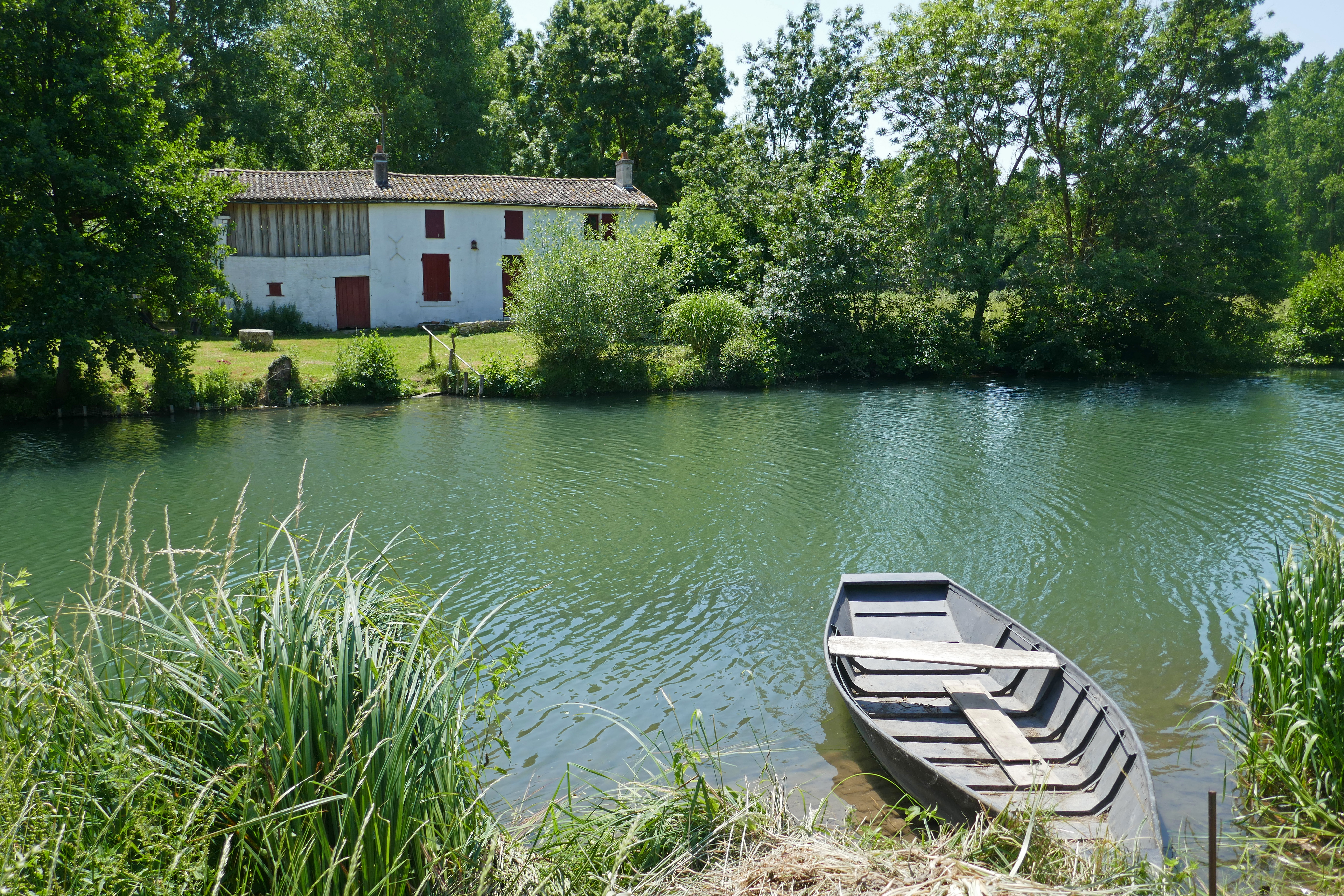
From Coulon we snaked along lanes and tracks through countryside where storks moved stealthily across mown fields and kites wheeled behind combine harvesters. Between Coulon and Irleau is a raft of waterways only accessible via tracks and dinky arched bridges. This landscape has been managed for agriculture for centuries and the aquatic labyrinth of conches, or narrow channels, only accessible by kayak or a local flat-bottomed boat, drains into the Sèvre Niortaise. I had to stop myself photographing every view along a stream luxuriantly overhung with trees or a boat tethered to the bank alongside an isolated cottage, as each seemed better than the last. We cycled on dazzling white tracks between meadows and unhurriedly watched a herd of drowsy cows. Cattle egrets prowled around their soft bulky bodies, occasionally stopping and appearing to look deep into the vast depths of a cow’s eye.
An Unexpected Hill
I had expected a fen-like flat landscape but somehow we always found a hill. North of Coulon on the Number Seven Circuit the green waymarkers were camouflaged among the green roadside vegetation and we were soon on the wrong lane. Backtracking, we honed our detection skills at junctions as we hunted among bushes for the signs. Climbing a gravel track in the heavy heat of the afternoon, golden wheat rippled in a breath of wind as we sweated by like slow versions of hill-climbing Tour de France cyclists. Stopping at the summit we could see across the sweep of the Marais Poitevin to the tower blocks of Niort. Descending to the Sèvre Niortaise we envied the young people frolicking in the cool water after school and watched a working boat negotiating a lock before tackling the pleasant stretch of towpath back to Magné’s handsome lifting bridge and attractive tree-lined square overlooked by a squat stone church.
On Sunday morning Magné’s square bustled with a lively second-hand clothes market and we joined the shoppers looking for vintage bargains. Later that day in Coulon we ate our picnic on a shady bench by the river, next to the easels of a group of artists. While the painters enjoyed their long and convivial French lunch we discreetly admired their artistic impressions of the view.
Whatever Floats Your Boat
On our last day in the Marais Poitevin we put together our own greatest hits, joining up our favourite paths in an ultimate cycle ride. Our first stop was for coffee in La Garette, a wall-to-wall attractive village where houses with sun-bleached shutters jumble together along the main street. Our genial waiter wanted to practice his English and we gamely struggled to identify the words among his strong accent, but were grateful when he was distracted by a couple arriving on a flat-bottomed boat with a guide wearing a hat festooned with flowers.
By the afternoon the heat was smothering as we hugged the shady paths lined with pollarded trees and fragrant flowers, finding any excuse to rest. At La Sotterie we crossed the Sèvre Niortaise and followed it back to Coulon where groups of school children in matching baseball hats were chattering as they climbed into boats. I noticed the flower-hat guide paddling sedately by, not even breaking a sweat.
Once the Marais Poitevin has seduced you, you won’t want to leave and will certainly return, or maybe that is just me!
We stayed at Camping Le Martin Pecheur. This is a small French basic site, just a short distance from the town.
 Back on the road again