We don’t buy gadgets! But this one has been so useful in our campervan I had to share it with you. Wet clothes and shoes draped around our small campervan make me stressed. They get in the way and make the ‘van feel damp. Some ‘vans have luxurious bathrooms with heating and you can hang up clothes there, shut the door and forget about it but this isn’t an option for us. Now, providing we have a hook up, the Aerative shoe and clothes drier takes the strain out of rainy days and laundry.
At £69 this has to be good, so what do get for your money? The Aerative comes in a draw string bag and takes up about the space of a small pair of shoes. Folded up it sits in your shoes but the drier also has a hook that unfastens so you can easily hang it up. It then opens out into a coat hanger shape, with air ducts along the arms. You simply plug it in and press go. It also comes with pegs for items that don’t hang up so easily, such as socks. Another advantage is that it only uses around one amp so won’t blow the campsite electric system or cost you a fortune if you’re on a meter.
To dry a shirt we hang the Aerative from a hook or from a cupboard door handle near to a plug, open the Aerative out fully, hang the shirt on the Aerative and switch on. It does dry fast but this will depend on the fabric of your shirt. We find that often the very bottom of a shirt remains damp and we will turn it upside down and peg it around the hanger to finish it off.
Drying boots and shoes is easy and there is no need to extend the arms into a hanger. In the folded position shown in the photograph above you can place each ‘arm’ in a shoe and switch it on. It takes a long time to completely dry a pair of soaked through boots but this and air drying overnight should mean you have dry boots the next day which is luxury.
The only downside to this useful piece of kit is the noise. It hums like a low-powered hair dryer so is fine while we are sitting reading or cooking but you wouldn’t want it on all the time. If you have a bathroom and can pop it in there and shut the door this will be less of an issue.
Twelve months on, I wouldn’t be without this piece of kit. It still fits in our downsized campervan and feels essential for drying wet gear and washing. If more campsites had a drying room [or it never rained] we probably wouldn’t need an aerative but in the real world …
I haven’t been paid to write this review or received a free piece of kit I merely wanted to share with readers something we have found that has made our camping experiences better.
Occasionally we have a holiday without our campervan [honest] [And we always miss the Blue Bus when we leave it behind]. Our latest short break hardly took us out of Lancashire. Here is the story of our mini adventure over a couple of days when we hiked across the Forest of Bowland.
The walk of around 40 kilometres is best done over two days with an overnight in Slaidburn. You have some options on the route and you may vary it depending on the weather, time of year and how much time you have available. The hike features in the Cicerone Walking in Lancashire book as a 45 kilometres (28 miles) walk and if you want a detailed description this would be worth purchasing.
We put the walk on our wish list recently and for the last six weeks I had been keeping a close eye on the weather forecast but July just got wetter and wetter. This wasn’t the weather I wanted for hiking across empty moorland and I had to wait until early August for a break in the rain and a window of sunshine. Excited, I rang the Hark to Bounty Inn in Slaidburn to book our overnight accommodation and we packed the rucksacks with essentials.
We caught the early bus from Lancaster towards Kirkby Lonsdale, getting off in the village of Wray. From here, if you have time you can take the paths up the wooded Roeburn valley but we headed straight up the lane to High Salter, reducing the walk by two kilometres. This lane was quiet and enjoyable with panoramic views over the Lune valley and to Ingleborough, Pen-y-Ghent and Whernside, the Yorkshire Three Peaks. We passed some rustic wooden sculptures and a well-kept memorial bench surrounded by flower beds.
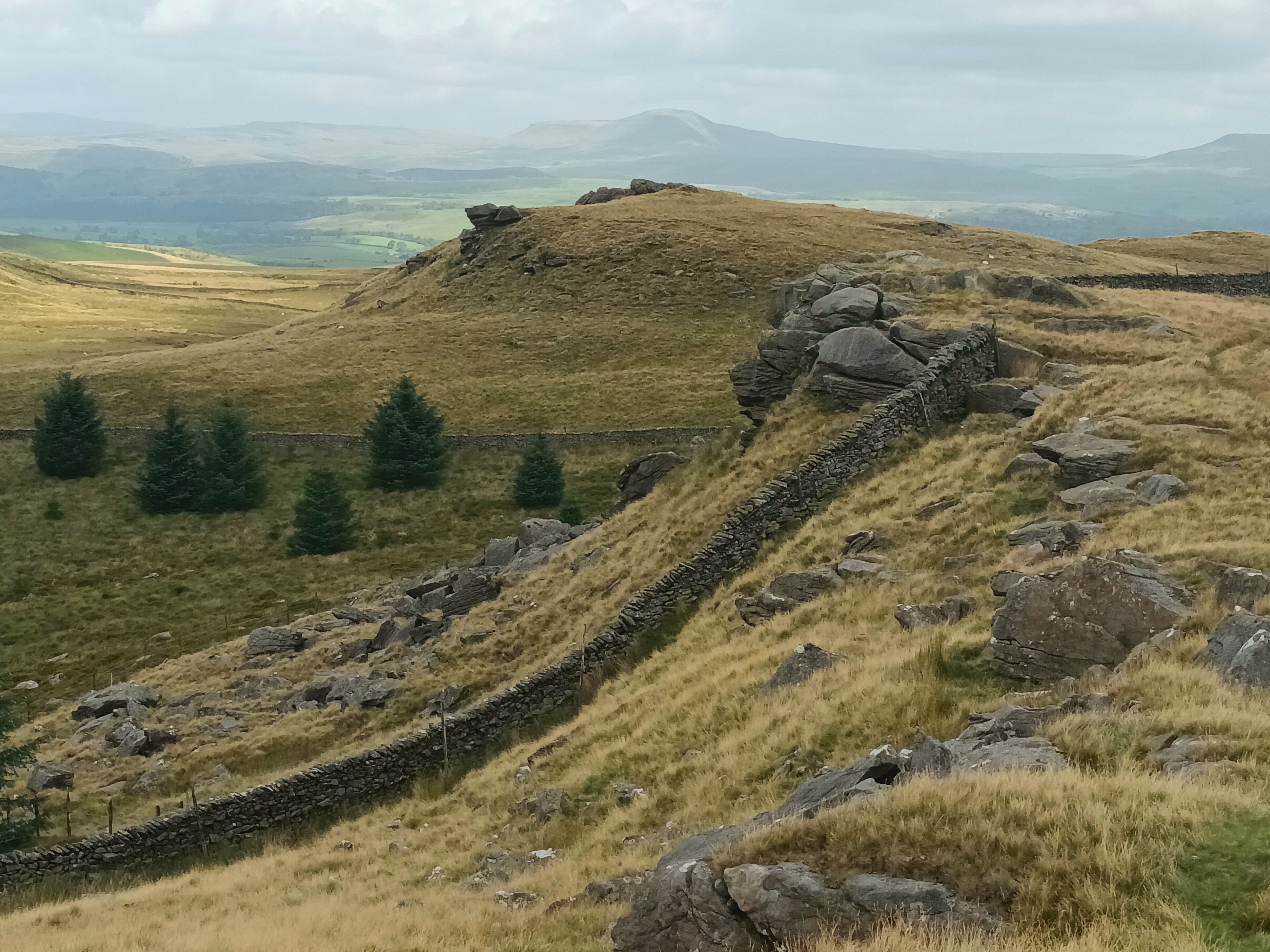
At High Salter we left the last of the farms and reached the gravel track of Salter Fell Road that crosses the moorland to Slaidburn. At first the track climbs steadily up to the watershed, the River Roeburn tumbling below us. From the summit the streams no longer flowed into the River Lune but were heading towards the River Ribble. In this treeless high land the views across the moorland were wide open with the stony track snaking across the landscape. There isn’t much obvious wildlife on these grouse shooting moors but a lizard scuttled away from our feet and a couple of kestrels hovered over the slopes. A herd of belted galloway cows ambled towards us on both verges of the track, forming a moving guard of honour. These calm cows are nevertheless bulky and we walked between them quickly but cautiously.
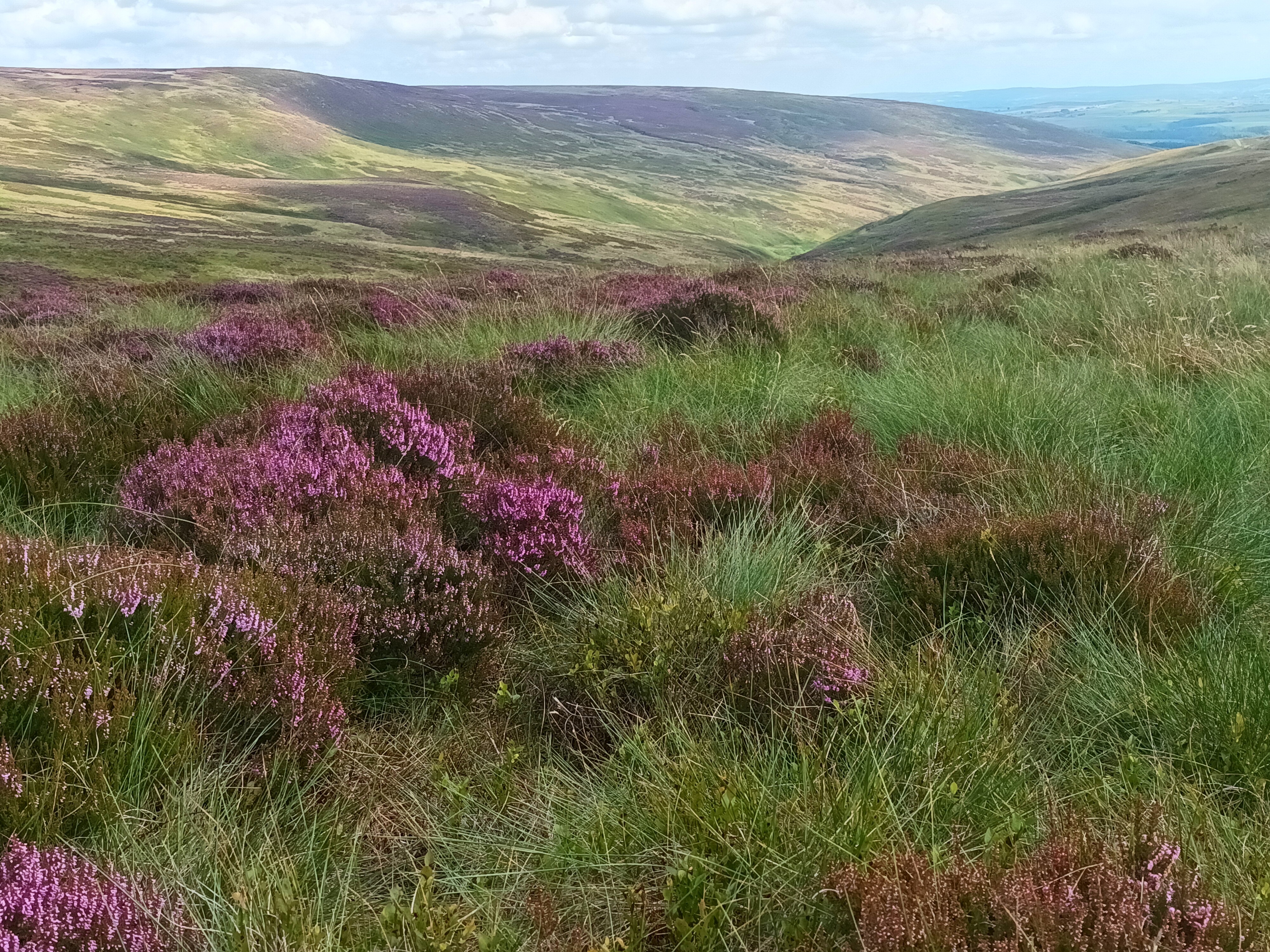
We stopped on a rocky outcrop near the watershed for lunch taking in the view across purple flowering heather. The track is used by off-road bikers and cyclists and a group of scramblers dented the peace and our solitude as they bounced by.
Walking with a heavier than usual rucksack was tiring and we stopped again in the mid-afternoon for cake and I lay back on the heather gazing up at the wispy clouds in the blue sky, waking up a short while later! Up to now route finding had been easy but this changed as we left the Salters Fell Road for Croasdale House on a soggy and overgrown path. Negotiating nettles, farms, stiles, cattle and dogs we eventually reached a lane into Slaidburn. Staying on the track and lanes into Slaidburn would have been easier going and a similar distance although it was harvest time and the narrow country lanes were busy with farm vehicles.
We reached the Hark to Bounty just after they opened at 17.30 and were grateful for a room to rest in with a hot shower and a kettle for tea. The Hark to Bounty is an old inn that is full of character and has a heart of the community feel. The bedrooms are comfortable and individual but not ultra-modern. That evening we ate hearty food in the bar and slept the deep sleep of backpackers. [The Hark to Bounty closed in October 2024, although new tenants are being sought.]
Slaidburn is an unusual village. At first glance it looks timeless and this is in part because it is owned by one family. Sitting in agricultural Lancashire Slaidburn has no modern buildings and is not wall-to-wall holiday lets. The 17th century cottages and farms are rented, the school remains viable and there is still a village shop and pub. Slaidburn also has a handmade chocolate shop, a cafe and a youth hostel available for sole use.
There had been some rain showers overnight but the next morning was fine and after breakfast we once again heaved our rucksacks onto our backs and set off along the River Hodder to Stocks Reservoir and Gisburn Forest. Built in the 1930s, Stocks Reservoir get its name from Stocks-in-Bowland, the village that was flooded.
Gisburn Forest is vast, apparently almost 3,000 acres vast, so it was no surprise that it took us most of the morning to cross it. As is often the way when we can’t see the route for the trees, we got lost more than once and without GPS we would probably still be wandering around the forest! All Gisburn’s acres have plenty of variety and from the shores of Stocks Reservoir we walked through magical vivid-green treescapes, alongside sunny verges where peacock butterflies were thriving and, of course, through dark pine forests. Eventually we emerged with some relief at the highest point, Whelp Stone Crag, and stopped for lunch looking across the farmland towards Yorkshire and our walks end.
The relief was short lived as we still had some kilometres to walk and a bus to catch. We tried to choose the best route from the many lanes and footpaths on the map but twice ended up on an overgrown walled lane that no one had tramped along for some time. Both of these were thick with nettles and brambles and, wearing shorts we emerged with legs covered in scratches and stings. I always react badly to nettle stings and my tingling legs were soon attractively covered in swollen red lumps that only antihistamines can deal with. Anthony doesn’t suffer in the same way but did collect a tick.
After more encounters with young bullocks that herded and trotted curiously behind us, way too close for comfort. We tried to stay calm and walk rather than giving way to the urge to run! A hare bounding over a wall delighted us and we climbed gates that were tied shut with string despite being on a right of way and heaved ourselves and our rucksacks over so many stiles we lost count until we reached the A65 and the bus stop by The Craven Arms in Giggleswick. There is a railway station here but we caught the cheaper bus home, changing in Ingleton.
There is something satisfying about completing a linear walk while carrying your kit and we enjoyed our short trip. The warm weather meant we weren’t laden with lots of extra clothing but we did carry plenty of water as well as spare food [apart from Slaidburn there were no shops or cafes on our route] and our emergency first aid kit.
In May and June this year [2023] we travelled through France for around just over six weeks. We moved around the west [Atlantic] coast in a fairly adhoc way, deciding where to go next as we went along and booking nothing. To help anyone planning their own trip to France I have listed where we stayed by departments below, rather than in the order we visited them.
Every campsite we stayed on was offering a discount with an ACSI card. In France this discount is generally available out of season until the beginning of July and again from the end of August or the beginning of September. The amount we saved varied from just a couple of Euros a night to more and we recovered the cost of the card in around a week. Over a six week trip the ACSI card more than paid for itself.
With a couple of exceptions, the sites all had unisex facilities, most provided toilet paper but not all of them and some provided soap at the sinks in the sanitary blocks. Many of the sites had swimming pools too. We also always paid a tourist tax of around €1/night each. We were often only travelling short distances between campsites and sometimes we arrived before the 12.00 lunch break and this was never a problem.
Loire-Atlantique & Maine-et-Loire
These are the regions around Nantes and Angers. Maine-et-Loire is inland from Nantes around the River Loire and the Loire-Atlantique is the coastal area north and south of the Loire estuary.
Camping Paradis La Promenade, Montjean-sur-Loire This large site on the banks of the Loire has good-sized marked pitches, some open views and indoor and outdoor pools. The facilities are fine, although the showers were warm rather than hot. There was no bread available early in the season but there is a fantastic bakery 700m away in the village that baked their own rich brioche. The village also has a corner shop. We cycled on pleasant off-road paths and quiet lanes by the Loire. ACSI price €17.00/night.
Camping La Guichardière (Flower Campings), La Plaine-sur-Mer – Just a five minute walk from the sea, this slightly sloping site has good-sized hedged pitches with some shade. The pitches are separate from but surrounded by bungalows. The facilities are very smart with good hot showers in roomy cubicles that also have a sink. The site has an indoor and outdoor pool and a pleasant snack bar. We could order bread for the morning. The coast is rugged here with sandy coves and we walked and cycled on the coastal path and inland agricultural tracks. The ACSI price €19.00/night.
Camping Les Paludiers (Flowers Campings), Batz sur Mer – This sandy undulating site has very little shade and some uneven pitches. The facilities are dated and really need a refurbishment. The showers are roomy but not adjustable and only just warm. You were lucky if there is one hook in the shower! We have stayed here before as we have friends who live nearby. It is close to the beach, a pretty town and an area of salt pans. ACSI price €19.00/night.
The Vendée & Deux-Sèvres
These areas are south of the River Loire. The Vendée has a popular Atlantic coastline of sandy beaches but inland is mostly agricultural. La Roche-sur-Yon is the place to go for out-of-town shopping. Deux-Sèvres is also rural, growing cereals and potatoes and apples. The idyllic Marais Poitevin, an area of marshland crisscrossed by picturesque canals and drainage ditches, is in this area too.
RCN la Ferme du Latois, near Coex – This large site has clearly marked grassy pitches around ponds in peaceful countryside. There are four facility blocks and three of these were open when we visited in May. The showers were good and hot with adjustable temperature control and the facilities clean. RCN is a Dutch organisation that runs campsites in the Netherlands and France. They use the profits to provide holidays for people who otherwise would not have the opportunity. The site is north of Lac du Jaunay and we walked there and around half of the reservoir and cycled a local route. ACSI price €17.00/night.
Camping Le Martin-Pêcheur, Magné – On the edge of the Marais Poitevin and near to Niort, this small site suited us very well. The pitches are generous, the facilities are modern and clean with the best showers we had all holiday. There was toilet paper and soap too. They didn’t have morning bread but I enjoyed my five minute cycle ride to the smart bakery in the pretty village before breakfast. There is a supermarket in the village too. The site is handy for picking up the cycle route along the canal to Coulon and there are buses too. We cycled on different lanes and paths through the woodland and fields and fell in love with this picturesque area. ACSI price €19.00/night.
Camping Paradis La Bretonnière, St Julien des Landes – A grassy site with some hedged pitches and touring pitches separate from bungalows. The site is in peaceful countryside south of Lac du Jaunay and has a pool. The showers and toilets are open to the outdoors and this is fine in warm weather and there was plenty of hot water. The village is 2kms away and this has a convenience shop and a cafe. We cycled to Lac du Jaunay and around the quiet countryside. ACSI price €15.00/night.
Charente-Maritime & Charente
The beautiful River Charente runs through these two departments. La Rochelle and the Ile de Ré are in the north of the Charente-Maritime and this coast is popular with tourists. Inland, Charente is quieter and has a tradition of producing cognac and pineau, an aperitif of wine and cognac.
Camping La Tour des Prises, Ile de Ré – This is a popular campsite but well positioned in the centre of the island, allowing us to cycle to either end of the island. The site is walled and the pitches are not enourmous but many of them have solid hedges giving privacy. There are two facilities blocks which are clean and the showers are good with temperature adjustment. There is a pool and morning bread is available. We were given a cycling map when we arrived so we could explore the island. Despite being easy to access and cycle from, the campsite is peaceful. It is about 10 minutes cycle ride to a small supermarket about 2.5kms away. ACSI price €21.00/night.
Camping de Cognac, Cognac – This grassy and shady site by the river is about a 30 minute walk [or a quicker cycle ride] into the city of Cognac. The site has some road noise from the surprisingly busy road that crosses the river. The male and female facilities were roomy and the shower temperature is adjustable. There was no morning bread out of season. La Flow Vélo, a long distance cycle route passes the campsite and you can cycle by the river in either direction. ACSI price €17.00/night.
L’Ile Madame Camping, Jarnac – This level and prettily laid out grassy site is on the edge of Jarnac and a short and attractive walk into the town centre. Jarnac is a lovely place with a small shopping area, an indoor market, an edge of town supermarket and some Cognac houses. The campsite facilities are fine, with good hot showers, although the washing up sinks are outdoors. Campers have to walk to the bakery. Off road cycle routes by the river go in either direction as part of La Flow Vélo. ACSI price €19.00/night.
Camping des Ribieres, Confolens – This popular site has a riverside setting and is near to the tourist town of Confolens that has restaurants, shops, some charming buildings and a 13th century arched bridge. The site has two kayaks you can take onto the River Vienne and you can rent huts and ready-erected tents. Unusually, we found that campers are allocated a pitch even out of season. The facilities are fine, the showers warm but somewhat cramped. The road alongside the campsite is busy and there is some road noise but if you are nearer the river this is negligible. There is a snack van that does a roaring trade. ACSI price €15.00/night.
Dordogne
The large rural Dordogne Department in southwest France is mostly north of the River Dordogne. We spent a few weeks in the Périgord area in the north of the Department. This historical region is sparsely populated and has abundant woodlands and meadows of cattle and crops, cut through by winding steep-sided river valleys.
Camping Chateau le Verdoyer, Champs Romain – In the Périgord countryside this campsite is in the grounds of a traditional-style chateau. Many of the pitches have open views over meadows and woodland and they are marked and some have hedges. There are also pitches with private bathrooms on your pitch but not for the ACSI price! The showers are timed for five and a half minutes and are warm rather than hot but kept clean. The washing up sinks that were available when we stayed here had no roof but others do. There is an indoor and outdoor pool and reception has a small shop, snack bar and morning bread is available. Good evening meals are available in the chateau and they have a vegetarian option. We purchased a local walking map for a few Euros and hiked on the waymarked paths over a few days. The village is about 30 minutes walk away and has a cafe, a corner shop and a free weighbridge. ACSI price €19.00/night.
Camping Brantôme Peyrelevade, Brantôme – This is a large riverside site with plenty of pitches with shade and three sanitary blocks, although they were not open fully when we were there out of season. The pitches are marked out. The facilities are okay and the showers hot. The site is well run and close to the busy tourist town of Brantôme which has an abbey and gardens to visit. There is a good network of local waymarked walks in the woodland and meadows from the site. ACSI price €17.00/night.
Camping La Chatonnière, Jumilhac-le-Grand – This terraced campsite was a big hit with us. It is family-run and friendly, our shady pitch overlooked the river and it was peaceful and tidy. The three facilities blocks are kept clean and eventually we found that the ones nearest reception had the hottest showers. Bread is available at reception and they sell some essentials including local honey. The campsite also sells takeaway pizzas in the evening that are good. The village of Jumilhac-le-Grand is a short walk away uphill and has a corner shop, a pharmacy, a couple of cafes and a beautiful chateau. There are numerous waymarked walks from the village and we hiked along the valley and up and down the steep hillsides of this idyllic countryside. ACSI price €15.00/night.
Ille-et-Vilaine
One of the departments in Brittany, Ille-et-Vilaine spreads inland from the coast around Saint-Malo and Dinard. Rennes, its main town, is in the centre of the department and the name comes from two rivers in the area, the Ille and the Vilaine.
Camping des Chevrets, St Coulomb near Saint-Malo – If we have visited a campsite more than once it means it certainly has our seal of approval. This large and popular site was busier in June than it was at the end of August when we last visited. The weather was warmer too and we chose a shady pitch. There are red squirrels in the trees and direct access to beaches and coastal walks. The facilities are fine although I would have liked some soap for handwashing as we were paying more than other campsites. The campsite has a cafe overlooking the beach and a shop that has morning bread and other essentials. ACSI price €21.00/night.
Domaine de la Ville Huchet, Saint-Malo – We stayed at this site with some trepidation having read very mixed reviews. We would now use it again for one or two nights as it was okay and has good bus [about ten minutes walk to the stop] or cycling access into the fascinating town of Saint-Malo. The site is grassy with trees and marked pitches that are allocated. The reception and snack bar are bright and modern and campers are given maps for Saint-Malo. The facilities are light and airy and the shower temperature is adjustable and so can be as hot as I like it and the cubicles are roomy. ACSI price €21.00/night.




 Back on the road again