Clifton Country Park: #surprisingsalford #20

Salford Clifton Country Park.JPG
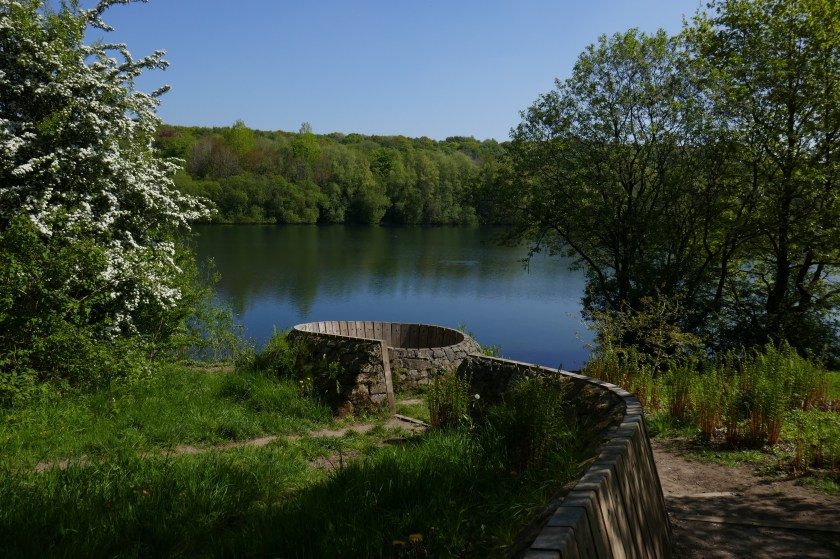
Clifton Country Park and the Lookout sculpture

We chose a gorgeous sunny day to take the bus out to Clifton, just outside the M60.  Although it was mid-week it proved to be a good opportunity to experience just how popular a local facility this country park is as plenty of other people were out enjoying the fine weather and nature reserve.  Clifton Country Park is in the river Irwell valley and is centred around a lake, shown in the photograph.  This lake was created in the 1960s after gravel was extracted for the nearby motorway [then the M62].

As well as the lake this lovely country park has woodland, meadows and pools and is bordered by the river Irwell.  It was once the site of the Wet Earth Colliery, an early deep mine first sunk in 1750s.  The colliery was worked until 1928.  Clifton Country Park also has a cluster of pieces on the Irwell Sculpture Trail that follows the river from Bacup to Salford Quays.  The dynamic trail was updated in 2011 and new sculptures are still added.  The trail is over 33 miles and has over 70 sculptures of which The Look Out at Clifton Country Park is one and is from 2001.

After walking around the lake, we followed the course of the former Fletcher’s Canal which was made navigable by Matthew Fletcher in 1790.  The woodland path is lovely here, with the river Irwell to one side and the remnants of the canal to the other and the bluebells were just finishing when we visited.  Walking back towards the lake we found the old Gal Pit which had a horse gin or horse engine to pull ropes from the pit and an iron sculpture of a Galloway pit pony recreates this today.  Not far away is what is known as Fletcher’s Folly.  In 1805 steam-powered winding machinery was adopted and this chimney was connected to the boiler house by two underground flues which caused maintenance issues.  By the 1890s a new chimney was built leaving this a redundant folly.

With wildlife, history and sculptures there is something for everyone at Clifton Country Park.  If you are interested in detailed history of this area, Salford Council’s leaflet gives a thorough background and a map of the country park and where to find the remnants of the previous industrial use.
Salford University: #surprisingsalford #19

chapel-street-autumn-2016-4
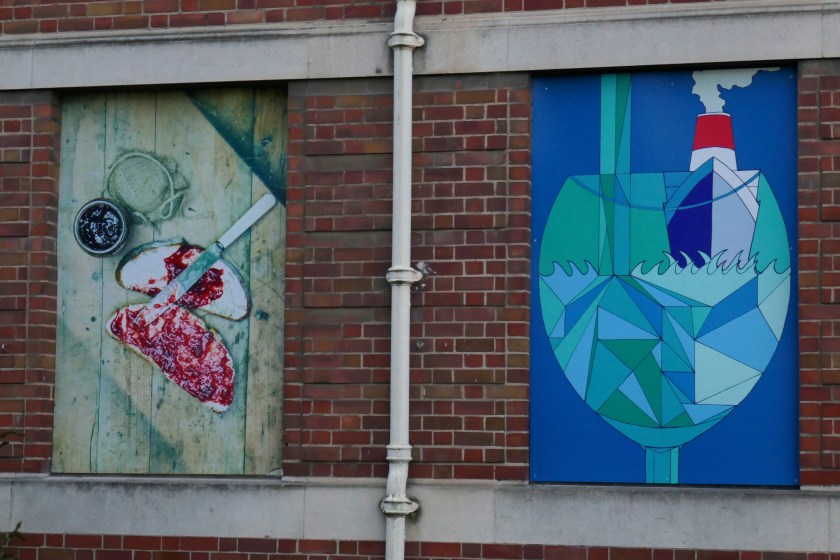
Pictures on The Old Police Station on The Crescent

Our local university, University of Salford, is celebrating its 50th anniversary this year.  Although the history of the institution goes back to 1850 and the Royal Technical College formed in 1921, which in 1958 split in to The Royal College of advanced Technology and the Peel Park Technical College, it wasn’t until 1967 that the Royal College became the University of Salford.  Today the University of Salford has 20,000 students, one of which was our son some years ago; and so our links with Salford began.  The University served him well and its connections with industry and the sandwich degree course he completed with a year gaining useful work experience served him well.

The campus overlooks Peel Park and has an airy and relaxed feel.  More recently the Peel Park main campus has changed beyond recognition and building work is currently a continuous feature.  In 2011 the University also added a Media City campus.  All this development came around the time of redundancies for some staff, as the university reviewed courses and schools and addressed areas that were under-performing.

The Old Police Station faces the main campus of Salford University.  Built in 1957 in brick and Portland stone, the building fell in to disuse in the early 2000s.  In 2011 the building was saved from demolition when the University of Salford had plans to develop the land.  The hope today is to keep the elegant frontage of the building and various plans have been put forward to redevelop the site, although nothing certain yet.  In the meantime the boarded up windows are decorated with images from university students.  This both brightens up the building and is a great way to showcase the student’s work.

Salfordians can be a bit touchy about losing the recognition they feel their city deserves and there was a minor kerfuffle in 2011 when the uni re-branded to become The University of Salford, Manchester.  I can’t get too hot under the collar about this myself as it didn’t make any geographical difference to the campus, it is still our local university.  The addition to the name perhaps made it clear to students unfamiliar with Salford how close the two cities actually are and this might just help it appeal to students keen to be part of the vibrant Manchester student scene.


Centenary Bridge: #surprisingsalford #18

centenary-bridge-1
Centenary Bridge over the Manchester Ship Canal

The opening of the Broadway Link Road in 2010, called Coronet Way, introduced us all to a new view along the Manchester Ship Canal and particularly of the bulk of Centenary Bridge which can be seen as the road climbs over the railway line.  This modern lift bridge joins Trafford Park on the south side of the Manchester Ship Canal with Eccles and the M602 and is an important transport link for the companies on Trafford Park, as well as enabling those of us who live on the northern side of the canal to reach Trafford Park for work and services.  The bridge got its name as it was opened in 1994, the centenary of the opening of the Manchester Ship Canal in 1894; the 36 mile long huge canal to Liverpool and the Irish Sea that took six years to build.

When I am cycling along this road I always stop to admire the bridge and the Manchester Ship Canal.  The day I took this photograph I was deep in composition when I was joined by another cyclist who was keen to join me for a chat.  He was enthusiastic about the spring weather, the view and the joys of cycling.  We talked for some time about bikes and the best panniers; a conversation I would never have had if I hadn’t stopped to enjoy the view.

The Centenary Bridge is one of only three of its type of lift bridge and was the first low-level bridge to be built across the canal since it had opened.  The bridge was the first with a lifting mechanism, rather than a swinging mechanism; the bridge lifts upwards to allow ships to pass through.  The dual carriage way of Centenary Way was constructed in twelve sections and can lift 15 metres above the road level between the four towers.  Each of the striking square towers is 30 metres high and has a framed indentation that says Centenary Bridge in vertical letters.  The control room is on the Salford side of the bridge.

This video show the massive bulk of the dual carriageway being lowered after a ship has gone through on the Manchester Ship Canal.  The raising of the bridge is an awesome sight that we have been lucky enough to catch just once as we drove from Media City.  With reduced traffic on the canal, this doesn’t happen so often these days.  If the Port Salford plans go ahead perhaps it will become a more common sight.


Salford City FC: #surprisingsalford #17

kersal-moor-feb-2017-4
Salford City Football Club

There are big football clubs in Greater Manchester, Manchester United are in Trafford and Manchester City are in Manchester.  Here in Salford we have Salford City FC, a National League North side [this is level six in the English Football league structure].  Salford City play from Moor Lane in Salford, next to Kersal Moor on land that was once Manchester Racecourse.  Salford City have been working their way up the leagues over the past ten years.  Success in the 2007-2008 season saw them secure promotion in to the eighth level, with further promotions in 2014 – 2015 and 2015 – 2016.

It was towards the end of the 2013 – 2014 season that the news broke that five former Manchester United players, Ryan Giggs, Gary Neville, Phil Neville, Paul Scholes and Nicky Butt were taking over the side.  These are five of the six ‘Class of ’92’ players who came through Manchester United’s youth team together to all dazzle us with their skills, successfully playing for Manchester United [David Beckham is the one missing].  These five took on the ownership of a lower league team enthusiastically and the story was told by a BBC documentary Class of ’92 in 2015 and 2016.  Salford is mostly a red [Manchester United] city, rather than blue [although there of course exceptions] and so you might think this was a match made in heaven.  Certainly expectations were high although not everyone was happy with the new ownership.

The club’s history goes back to 1940 when it began as Salford Central.  The name was changed to Salford Amateurs in 1963 and they gained the nickname ‘the Ammies’.  Today, the joint managers Anthony Johnson and Bernard Morley, who have been with the club since 2015 and have recently agreed full-time positions, are working hard to achieve success.  The Salford City players will also turn professional this summer.

In preparation for further promotion, work on the ambitious new stadium at Moor Lane is underway.  The new stadium will hold 5,000 fans and planning permission was granted despite local residents concerns regarding parking.  Anyone who has ever been to a match will wonder just where those 5,000 people are going to put their cars but this development will ensure the team is equipped for higher level football.

Although the team just missed promotion at the end of the 2016/17 season coming 4th, many of us in Salford have got our fingers crossed that Salford City FC are going to continue to do their city proud.


Salford Museum & Art Gallery: #surprisingsalford #16

Peel Park Jan 2017 (2).JPG
Salford Museum & Art Gallery

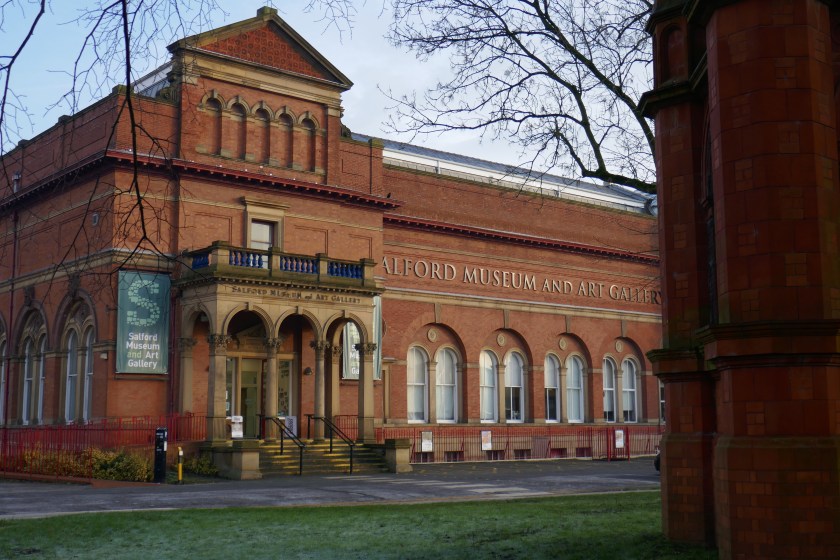
The handsome red brick building of Salford Museum and Art Gallery overlooks Peel Park and is within the Salford University campus.  The building started out as a private house, a mansion known as Lark Hill, and opened as the UKs first unconditionally free public library in 1850, the museum and art gallery following a few months later.  The facility was quickly popular and received an astonishing 1,240 visitors a day in its first year.

Today the library is no longer here but, as well as permanent exhibitions, the Museum and Art Gallery has changing exhibitions of works of arts and stories of the history of Salford, so it is always worth a visit.  The exhibition spaces are light, airy and uncluttered.  The entrance is always welcoming and has something interesting to browse thorugh.

The Victorian Gallery with its stunning ceiling has art works collected from that era.  The Pilkington Gallery showcases items from Pilkington’s, a local firm that created decorative tiles and pottery.  The company was formed by four Pilkington brothers in 1893 and in 1904 they began making pottery in the art nouveau style and their work rivalled that of famous pottery firms from Stoke-on-Trent [or The Potteries].  Salford Museum’s Pilkington collection contains a wide range of the ware Pilkington’s produced between 1900 and the 1970s and when the factory closed in 2010 the museum acquired the Pilkington archive.  This gallery is full of vases, bowls, plates and tiles that are vibrant and beautiful.

Bringing the outside in, Lark Hill Place is a recreation of a Victorian northern shopping street, with gas lamps, a chemists, blacksmiths, toy shop and the Blue Lion Pub [this is recreated from a number of Salford pubs and the original Blue Lion was on Cook Street by the brewery] .  Many of the shop fronts were originally in the streets of Salford and were saved as the city developed and the old shops were demolished.


Metrolink: #surprisingsalford #15

P1020201.JPG

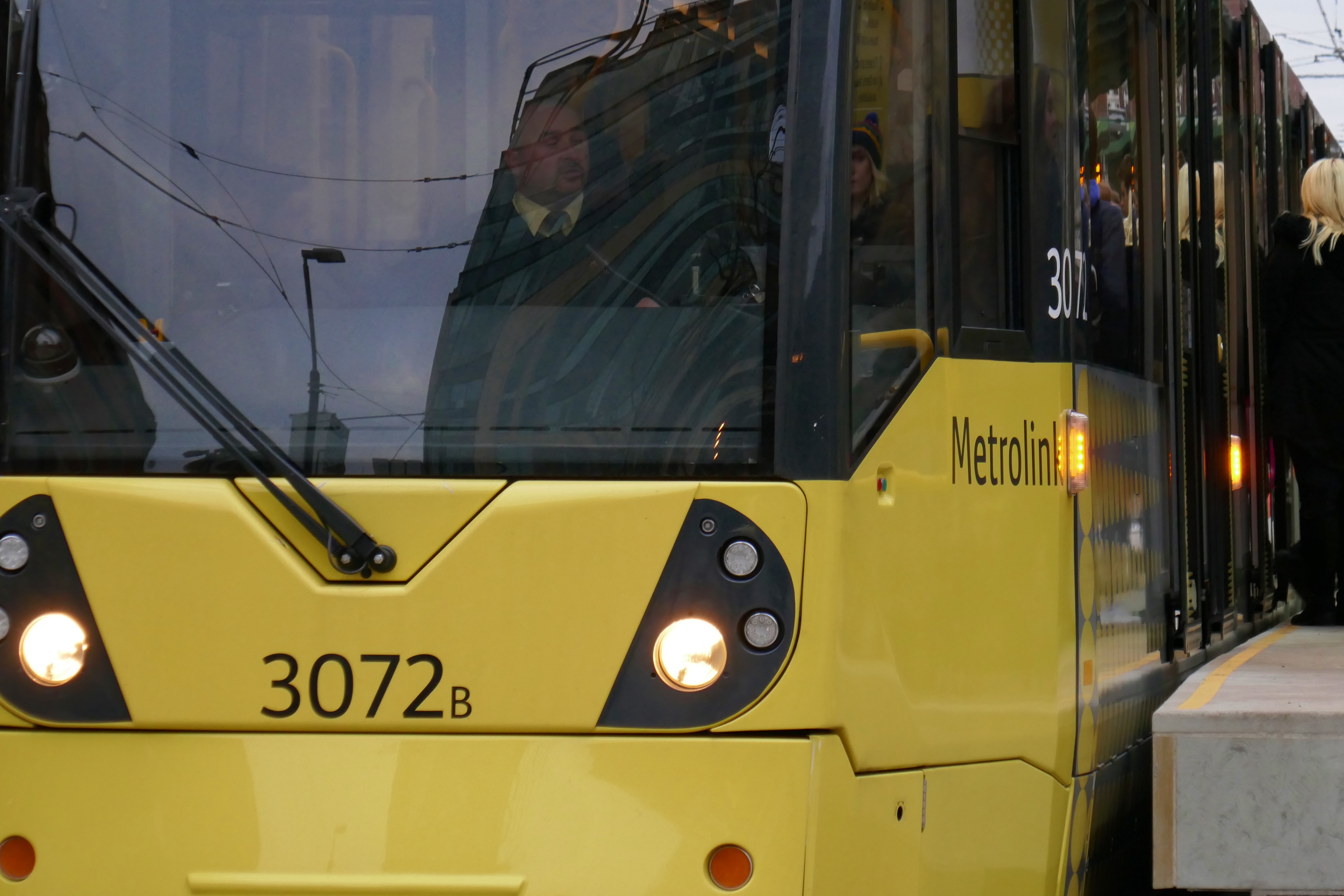
Our tram route is the Eccles Line which was phase two of the Metrolink development in Greater Manchester.  Phase one was the Altrincham to Bury line which opened in 1992 and it wasn’t until 2000 that the line reached Eccles at a cost of £160 million.  Phase one had constructed tram routes on the under-utilised suburban rail network and the plans had been to continue with this process; however, as Salford Quays developed, transforming the old docks with housing, retail, offices and leisure, it was clear the area needed improved public transport and in 1995 the four mile route around Salford Quays to Eccles was agreed and work began in 1997.

When completed, the blue and grey trams initially struggled to compete with the bus route from Eccles.  The direct bus from Eccles, the number 33, ran every ten minutes could beat the tram which takes a meandering way around the quays to reach the city centre.  The new branding and pale yellow and grey trams were introduced in 2008 and for those on or near the Quays, the new yellow trams have become a clean and efficient way to travel and the trams are now often full.  The tram is cheaper than the bus and much more scenic and it is always my public transport of choice.

We chose our home in Salford as much because of the easy access to the tram stop as anything else.  Using the Metrolink network we can now travel around Greater Manchester easily, making the most of day and weekend tickets as the network has expanded.  We like the real time information about when to expect the next tram [on the rare occasion that we have a ten minute wait for the next tram we can always walk to the next stop] and an app that makes buying tickets easy.

Whenever I travel on the tram in to Manchester I will always look to see what is happening on Ontario Basin where the water sport centre is, there are often people messing about in boats here but I might have my head in a book and miss this attraction.  Whatever is distracting me, my personal rule is to always take the time to look at the view as the tram crosses The Manchester Ship Canal between Exchange Quay and Pomona station [this is a station of many jokes as it is rare for anyone to get on or off at Pomona and if they do the passengers will joke that they must be lost].  As the tram crosses the bridge you have a fantastic view along the canal in to Manchester, in a morning the sun will be rising behind the city, there might be swans on the water and nothing is ever so important that you cannot take a minute to enjoy it.  Pomona island, straggling Salford, Trafford and Manchester, is then laid out before you, still a wildlife haven in the city although its days are numbered as development has now started at the Cornbrook end.  Work has now started on the new Trafford Centre line [now completed].  This will join the network at Pomona and I am sure in a few years this station will be as busy as any other and those days of stopping at the ‘ghost’ station will just be a memory.

River Irwell: #surprisingsalford #14

River Irwell Jan 2017 (2).JPG
A misty River Irwell in winter sunshine

The river Irwell winds its way around Salford in deep meanders.  I think that a river can make or break a city, they are great places for strolling along and sitting beside and messing about on.  Salford [and Manchester too] certainly doesn’t make enough of its river until it becomes the Manchester Ship Canal at Salford Quays where it is celebrated, used for recreation and enjoyed.  The Irwell is only 39 miles long, rising near Bacup in Lancashire, the river comes in to Greater Manchester in Bury and makes its way through Salford from Clifton Country Park.

Rivers are interesting because they are always changing.  We have walked along the river in spring and summer, watching the Canada Geese, the black-headed gulls and the various ducks and stood and watched the boats on the quays.  On Christmas Day a few years ago we followed the Irwell from Salford to the Manchester boundary and back to the Quays and on Boxing Day in 2015, horrified, we watched the swollen river as it flooded large areas of Salford, including people’s homes.

Mr BOTRA would cross the Irwell on his way to work in Manchester and he usually stopped on the bridge to see what wildlife was around.  On many days he would spot a bright blue and green kingfisher flitting along the river bank.  The Irwell was once a salmon river but pollution in the 19th century and in to the first half of the 20th century left a river that was lifeless.  As industries have closed and the cleanup of the river undergone and restocked, the Irwell is now able to sustain many fish eating birds and we often see cormorants and herons on our walks along the banks.

I have a dream that one day Salford City Council will decide to make more of its riverside location beyond Salford Quays and they will close off Chapel Street to traffic, creating a huge square between The Old Pint Pot and Salford University.  In my dream this square will have open views with steps down to the river and Peel Park and a bridge crossing the Irwell over to the meadow.  People will gather here on sunny evenings and fine weekends, sit outside cafes enjoying the view accompanied by good food or a drink, young people will sit on the steps or practice on their skateboards, families will promenade around the paths, children gleefully running up and down the steps and they will all feel lucky to be living in such a beautiful city.


Polish Shops: #surprisingsalford #13

P1020640.JPG
The Polish shop on Langworthy Road

Time was when you had to travel to the USA to get Reece’s sweet peanut butter cups, Poland to find Polish curd cheese or Ireland to buy Tayto crisps but today in Salford our local supermarkets all have a ‘World Food’ aisle or two and you can buy these delicacies, as well as large bags of red lentils and basmati rice and goodies from Spain, Caribbean islands and other Asian countries.  Much as I love trying the local food when we travel I also love being able to get some of my favourites when I am at home and I am truly grateful to all those people who have been prepared to leave their own country and move to the UK and created the demand for food from other countries.

In the 2011 census 1.6% of the Salford population spoke Polish.  These people and those from other countries add new and interesting flavours to our city and different outlooks.  Of course, since the Brexit vote, many of these people are feeling insecure and even friends who moved here decades ago are concerned about their ability to stay.

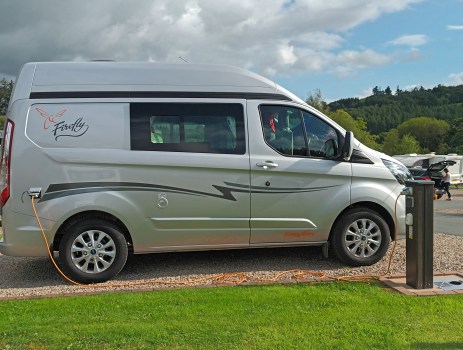
But for now I am able to enjoy shopping in our local Polish shop.  I walk in and I am always greeted with ‘dzien dobry’ and I like to confuse the staff by replying in Polish, although in truth that and thank you [Dziękuję] is pretty much the extent of my Polish.  We visited Poland in 2007 in our campervan and at the time I could manage some of the language needed to book us in to a campsite but most of this has been forgotten in the haze of other languages.

I love that many of the items the shop sells are a mystery to me; I might as well be in one of the gloomy small grocery shops we found in Poland.  Mostly I just buy the delicious rye bread, although I sometimes return with other delicacies such as paprika crisps and cream cheese with chives.  I drool over the large jars of gherkins but know that with Mr BOTRA having no interest in pickled vegetables I would struggle to get through so many.


Kersal Moor: #surprisingsalford #12

Kersal Moor Feb 2017 (3).JPG
A view from the top of Kersal Moor

This is the sacred mountain of Greater Manchester!  It was on a trip to a Saturday afternoon match at Salford City Football Club that I first spotted Kersal Moor and added it to my list of Salford places to explore in retirement.  Google maps and research revealed that this is a Local Nature Reserve and an area of moorland and perfect for exploring on a sunny day.  I walked to Kersal Moor, climbing the hill from the Irwell, following the straight and narrow Blackfield Lane from Bury New Road, a lane that can be seen on the 1848 map when Kersal Moor was not the peaceful spot it is today but was the busy Manchester Race Course.  What is now Moor Lane cut across the centre of the oval course.  My route bought me out in front of St Paul’s Church, which isn’t on the 1848 map but is shown on the 1894 map, along with a school further west on Moor Lane which has since been demolished.  This church community first met in the old grandstand of the race course in 1850, as the race course was no longer in use, and a fund was set up to build the church which was consecrated in 1852.

I wandered through St Paul’s graveyard first, enjoying the hint of spring in the air and failed to find the grave to the chemist Robert Angus Smith, an environmentalist who is known as the ‘father of acid rain’ after he made the connection between industrial pollution and acidity of urban rainfall in the 1850s.

Leaving the graveyard by an old gate I was on Kersal Moor and soon climbing up to the viewpoint across the sand and gravel soil that was formed from glacial deposits at the end of the last ice age.  Kersal Moor is covered in heather, gorse and birch trees and is lively with bird song.  The reward for my uphill walk was views over the trees with Manchester to the south and Prestwich to the north.

I followed the well-marked paths above Singleton Brook that is the boundary between Salford and Bury, looking down on the site of a former dye works and found some of the remains of the school that was on Moor Lane.  Returning back to St Paul’s I found the plaque telling me that the race course was here for around 160 years, from 1687 to 1846.  Whitsuntide was the main race meetings with crowds of over 100,000 gathering to enjoy the racing, betting and drinking and it was a profitable time for pick-pockets.

The plaque also remembers that this was the site of Chartist rallies in 1838 and 1839 when over 30,000 workers met to demand the right to vote and for parliamentary reform.  It was this history of public gatherings that caused Friedrich Engels to refer to Kersal Moor as ‘Mons Sacer’ [sacred mountain] of Manchester, referring to the hill in Rome that the common citizens withdrew to in 494 BC as part of their civil protest that led to political representation for the common citizens through the offices Tribune of the Plebes.

If you have never visited Kersal Moor take the time to get there and think about the layers of history here, from the Neolithic people who left tools here, the riotous race meetings, the worshippers, reformers and school children playing games.


Ordsall Hall: #surprisingsalford #11

Ordsall autumn 2016 (13).JPG
Ordsall Hall dressed for a wedding

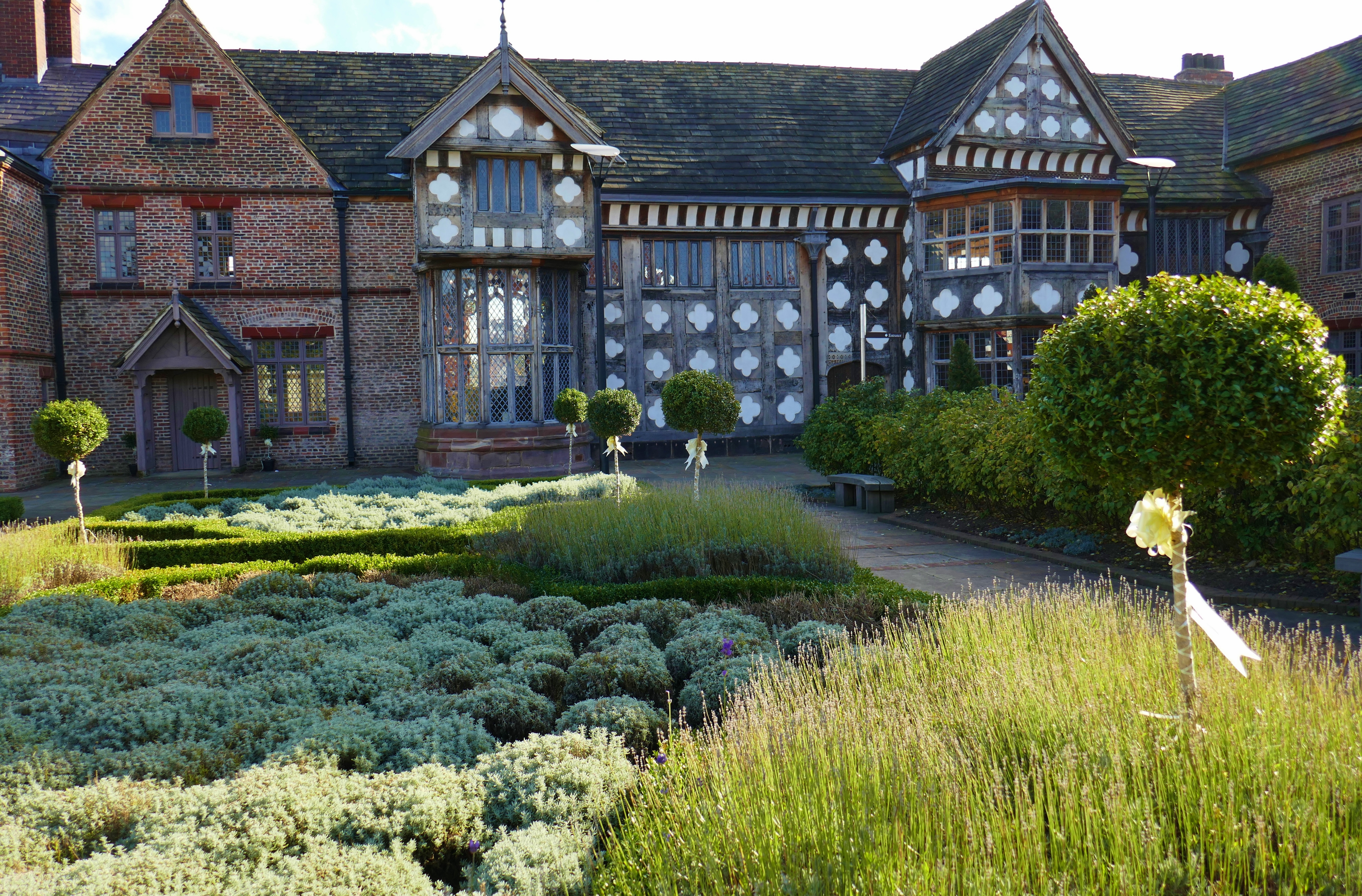
So you’ve got an image of Salford.  This might include cobbled streets of terraced houses, the tower blocks and bright lights of Media City and maybe green public parks if you have read all of my #surprisingsalford series, but a beautiful Tudor manor house is probably not featuring in your mind’s eye and yet Salford is where you will find Ordsall Hall.  Today Ordsall Hall is in many ways the jewel in the crown of Salford.  It had fallen in to disrepair and when we arrived in Salford it was covered in scaffolding being refurbished.  Over two years the building was fully restored and re-opened and it is now a place for visitors and as a venue for weddings or meetings.

Ordsall Hall is a Grade 1 listed building that is timber-framed and parts of it date back to the 14th century.  From the outside Ordsall Hall is a handsome combination of brick and timber-frame set in lawns and restored gardens.  Inside the building has many treasures including a Great Hall, medieval stained glass and a rare Italianate plaster ceiling from the 1500s.

With a history spanning over 800 years, Ordsall Hall has seen many dramas and lives and there is talk of ghosts that haunt the building.  The house came in to the ownership of the Radclyffe family in 1335, who made their mark on the building.  By 1380 Sir John Radclyffe had extended the house to include a great hall, five chambers, a chapel, stables and a dovecote.  In the 16th century Sir Alexander Radclyffe became the High Sheriff of Lancashire and he built the current great hall and a brick house on the west end of the house, which is thought to have been the home of the bailiff.  The cost of this extension and the English Civil War left Alexander, a Royalist, in prison and in financial hardship and his son and heir sold Ordsall Hall to Colonel John Birch in 1662.  There is a legend that Guy Fawkes and Robert Catesby plotted to overthrow King James in 1605 at Ordsall Hall.

The house changed ownership many times over the years; from 1872 until 1875 the artist Frederic Shields lived at Ordsall Hall.  He was friends with John Ruskin and in a letter to Ruskin described the house as ‘the happiest refuge I have ever nested in’.  But Salford changed after this period and the fields and woodland that had surrounded Ordsall Hall were replaced with factories and terraced housing, the Hall was on the edge of Manchester Docks and would have been surrounded by noise and bustle.  Amazingly, the hall stayed and was used by Haworth’s Mill, a cotton spinning factory on Ordsall Lane, as a working men’s club with a gym, skittle alley and bowling green.  A men’s social club survived through a major restoration and the building was used as Manchester Theological College until 1940.

Salford Council purchased Ordsall Hall in 1959 and it was opened to the public in 1972 as a house and local history museum before undergoing the renovation and reopening in 2011.  It is now a building Salford is justifiably proud of.