Cycling along the Dunajec River in Poland

Wooden houses in Zakopane

I met my Polish bike in an industrial area of Krakow, certainly not the usual tourist destination in this popular city. With Dutch-style handlebars, a step-through frame and a well-padded saddle for comfort, this was the perfect utility bike. Once adjusted it served me well for a week of cycling between 25 and 60km for six days along the ups and downs of southern Poland.

In our pre-campervan days we took cycling holidays by the Danube, in France and the Alps. We enjoyed these self-guided trips and were keen to see if we could still manage the cycling on another campervan-less holiday. On a self-guided cycling holiday your route and overnight stops are decided but you can take the ups and downs at your own pace and stop when you want or need to.

The Dunajec cycling holiday blurb reeled us in with copy about relaxing cycling on paths similar to Germany, so we were surprised to find ourselves on day one being dropped off in ZÄ…b, Poland’s highest village, at 1,013 metres above sea level. After taking in the panoramic view of the Tatra Mountains and the first of many wooden churches, the two of us set off pedalling. I was soon testing the brakes on my hired bike on a 20% hill that snaked down to the valley of the tumbling BiaÅ‚y Dunajec [the White Dunajec].

Around Zakopane

On the first day we were only cycling for the afternoon and after the terrifying road descent we climbed steadily through attractive wooden houses with tidy gardens and pottering chickens to the popular resort of Zakopane and our hotel for the night. Evening meals were included in our holiday and the buffet had already opened when we arrived [they eat early in Poland]. We rushed showers to get to the restaurant before the meal finished.

The designer of our route clearly finds downhill cycling fun but it is my least favourite direction. Day two saw us firstly taking our bikes on Zakopane’s modern funicular to Gubałówka at 1,120 m above sea level. Here we made the mistake of relaxing over coffee in the complex of cafes and market stalls at the top of the funicular while watching dark storm clouds gathering over the Tatras.

By the time we had made our way through the crowds around the souvenir stalls that lined the access road it was raining. The rain continued for all 12km of steep downhill cycling on a busy road. I was relieved me and my bike reached the charming wooden houses of Chochołów in one piece. As we joined the Czarny Dunajec [Black Dunajec], which joins the Biały Dunajec in Nowy Targ to form the Dunajec River, the sun came out and we were following flat traffic-free cycle paths through flower-rich meadows, stopping for cold drinks at a cafe for cyclists and walkers. This was the cycling holiday we had dreamt about!

Cycling through meadows to Nowy Targ

Even the second rain storm didn’t spoil the joy of good cycling but after 52km we didn’t have the time or energy to visit Nowy Targ either before the not-quite-so-early dinner or after. We were too busy drying off footwear and waterproofs.

The Wooden Churches of Southern Lesser Poland

Rain was forecast just after lunch the next day so we cracked on and rolled into our hotel after 40km of off-road cycling. By now my bike and I were a team and we arrived by magic with seconds to spare before the first rain drops appeared! Following the Dunajec, we cycled fast enough to allow time for a coffee stop and to visit the wooden church in Dębno. This exceptional 15th century church is enclosed by an attractive wooden fence and has a stunning painted ceiling. The church in Dębno and five others are a UNESCO World Heritage Site.

After Dębno the Dunajec is dammed forming a reservoir. This area is a popular holiday area with campsites and self-catering chalets and lots of families cycling, many on electric bikes. The cycle path climbs a steep winding hill which I walked up, passed by many smug cyclists using electric to power them up. We stopped to see Niedzica Castle, built by Hungarians in the 14th century, which sits picturesquely over the reservoir.
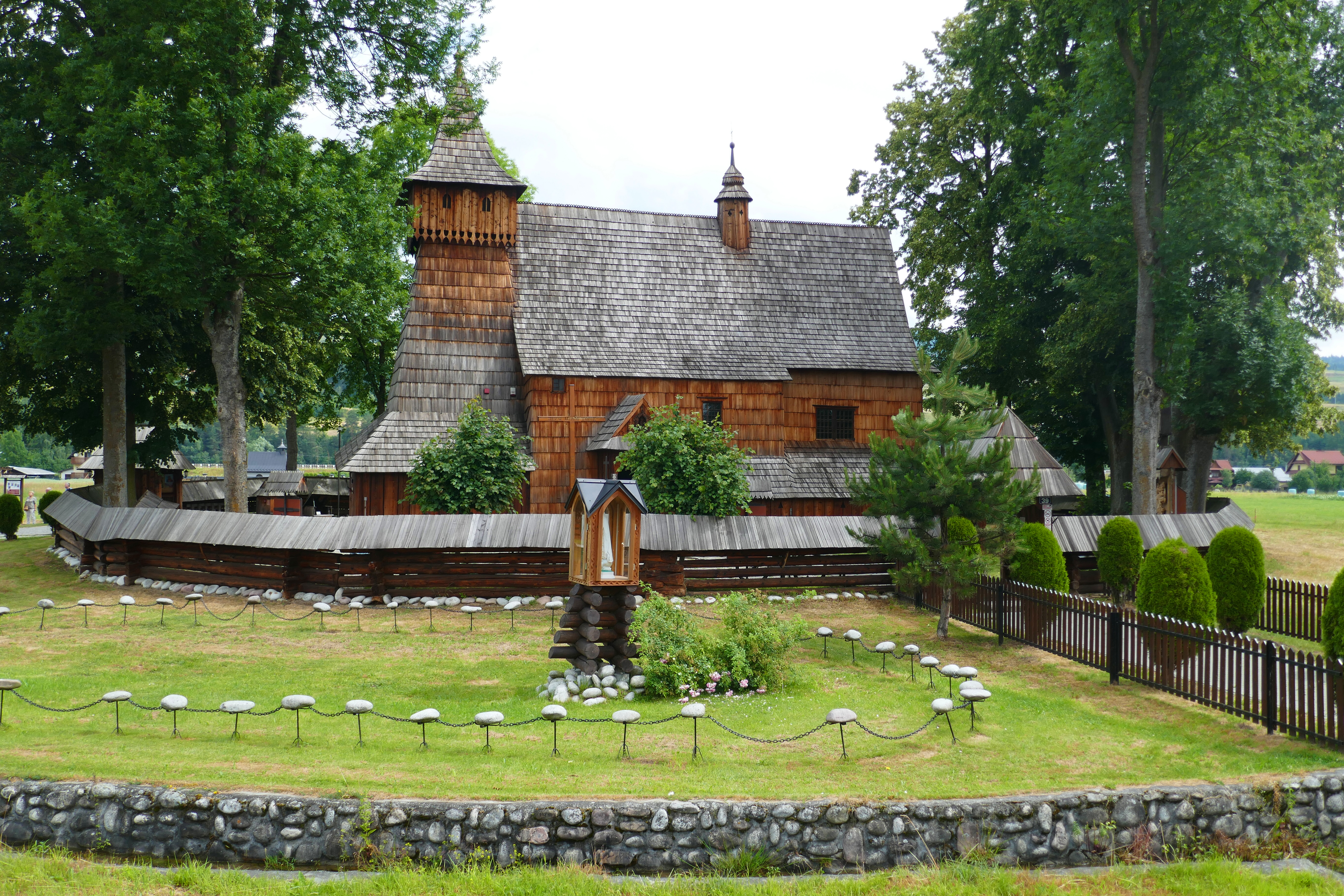
The wooden church in Dębno

By now cycling every day had become normal. The evening before we would check through the route, deciding if the main route or one of the many alternatives suited us best. We knew where all our stuff fitted when we packed our rucksacks for the morning baggage transfer. We would eat a hearty breakfast, grab the bags of essentials to put in our panniers and find a local shop to buy bread and cheese for lunch.

A Gorge, a Monastery & a Spa Town

Day four took us through the Dunajec Gorge in the Pieniny National Park and briefly to Slovakia. We had been hugging the border since Zakopane, today we needed to have our Euros handy! With only 30km to cycle we had time for a leisurely visit to Červený kláštor, a former Carthusian and later Camaldolese monastery, that has been restored as a museum.
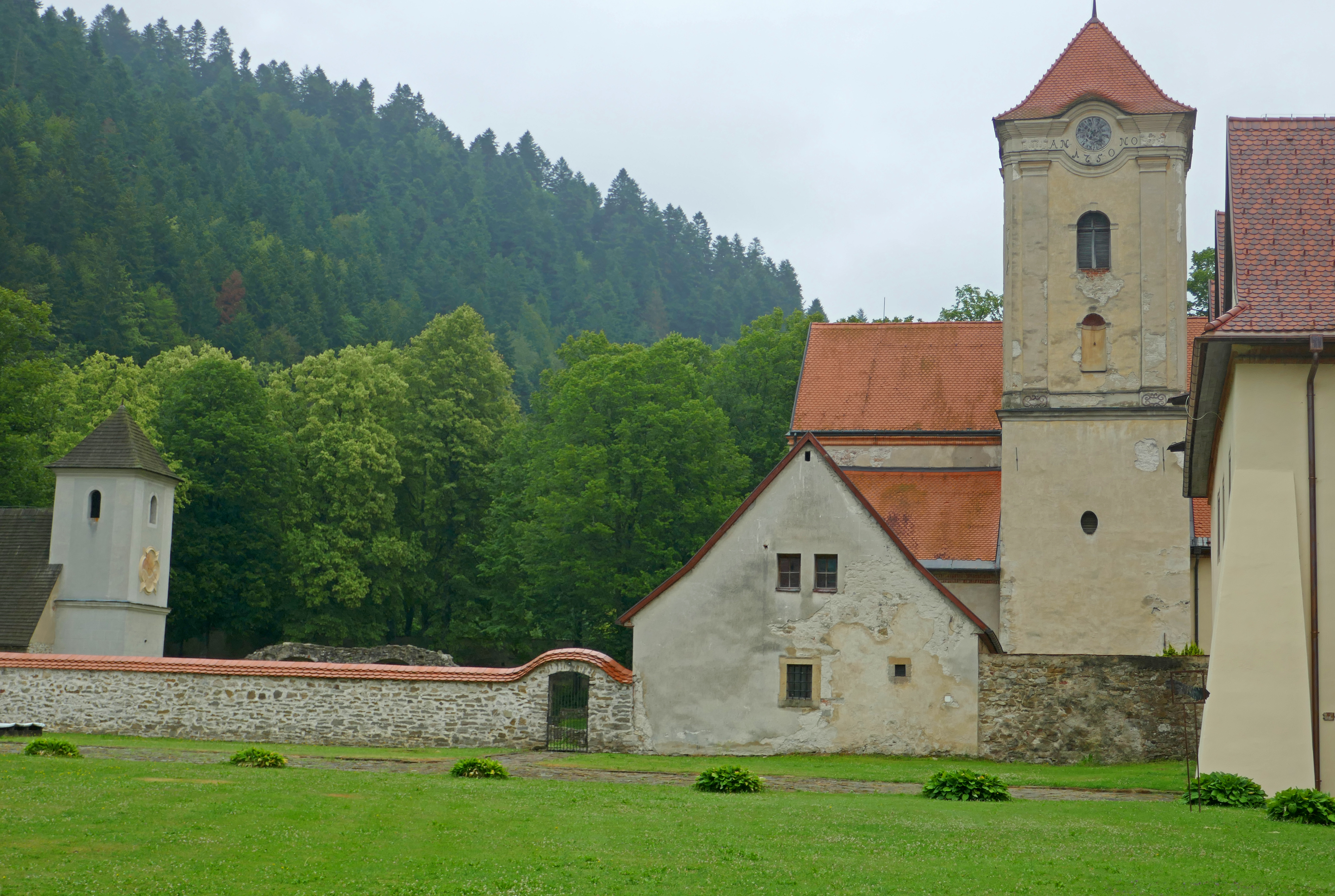
Červený kláštor

The limestone gorge winds through the mountains to Szczawnica, cyclists and walkers sharing a good path, only the sounds of the gushing river and the birds to accompany us. Rafts navigate the twisting flow of the river as it makes its way between steep wooded slopes. The valley opens out again on the edge of Szczawnica and here we stopped to watch a tall black stork fishing in the rapids.

The pleasant spa town of Szczawnica was a good overnight and after a short cycling day we even had the energy and time to wander around its steep streets in the evening. Fountains were lit up colourfully and other holiday makers enjoyed a constitutional.

The Finish Line

No longer worried we wouldn’t manage the distance, we chose the longer [60km] but less hilly riverside route for the next day, firstly following the now much wider Dunajec and later the Poprad River. We cycled below the hills, through hamlets of neat houses on quiet roads, well away from fast traffic. In Stary Sacz we bought fluffy and sweet PÄ…czki, filled Polish doughnuts and had excellent coffee at the friendly Frida Art Cafe before the final section.

The coffee and the cafe were so good we were back at the Frida Art Cafe the next morning on our way to Nowy Sacz. We sat in the deck chairs on the terrace and made friends with the member of staff who served our cake with handwritten notes wishing us a good day in Polish. This and stopping to admire some of the murals in Stary Sacz meant we didn’t have much time to look around Nowy Sacz’s impressive large market square and cafe-filled streets.

The Dunajec continues flowing for some distance from Nowy Sacz before it reaches the Vistula but our tour through this corner of Poland was at an end. I said a fond farewell to my trusty bike as it was loaded on the trailer.
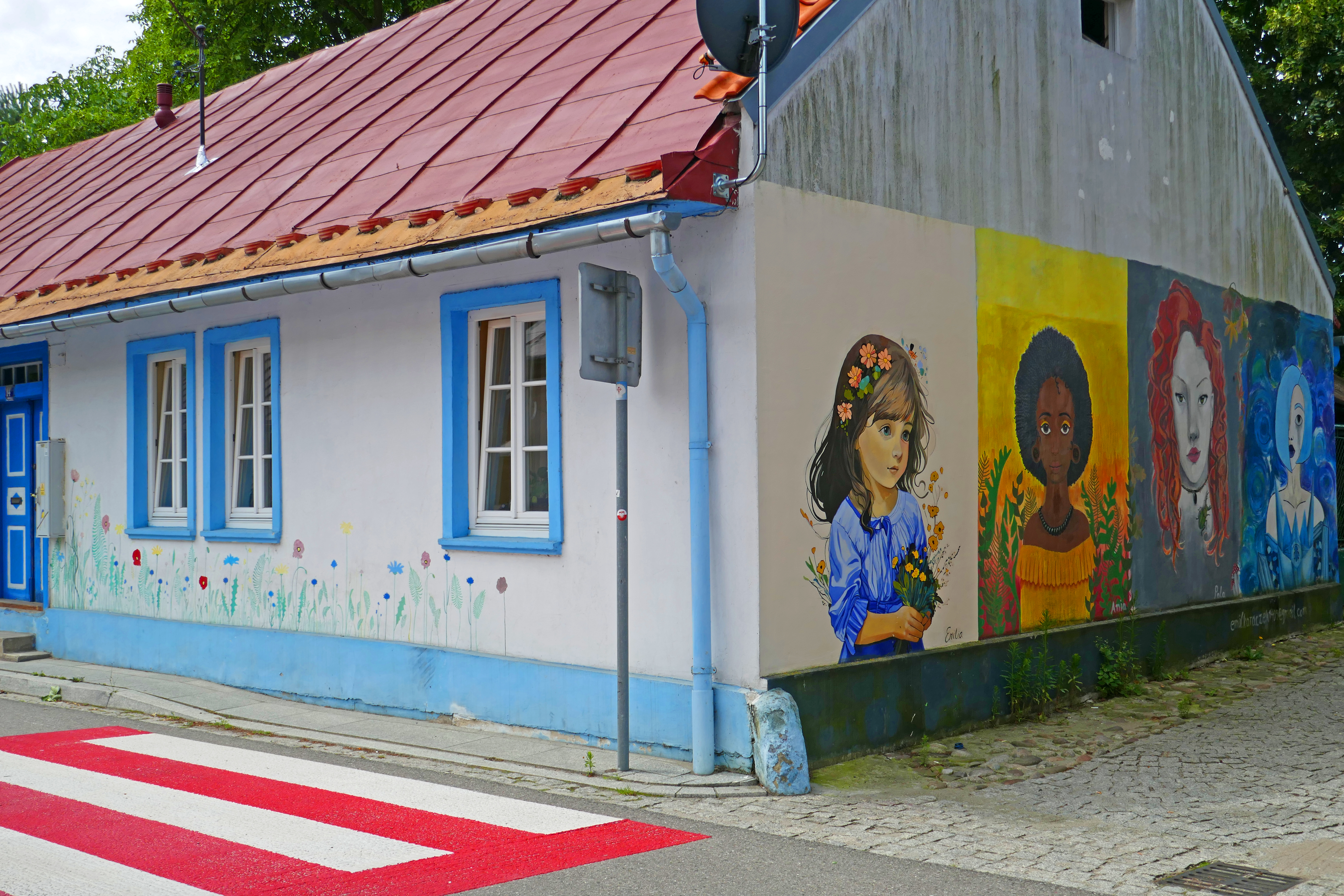
Murals in Stary Sacz

The Dunajec cycling experience

Overall, we had fun on our Polish cycling holiday, although many aspects were not what we expected. One cyclist was so spooked by the first day’s steep downhill, a near miss with a vehicle and a skid on gravel that they didn’t cycle again for the rest of the week! Although the route was mostly traffic-free from the second half of day two, I would suggest this is a route only for those confident cycling on roads.

The trip is promoted as being on cycle paths as good as anything in Germany but this didn’t quite stack up. Poland has invested in cycling infrastructure in the area but the early road sections and the signage didn’t meet the standard of more established cycle paths. Picnic spots have been provided, but with few other cyclists around in many of the areas we passed through, nice-to-have facilities like cafes have not opened.

The weather in southern Poland is unpredictable, we had temperatures of 30C plus and a chilly day of 16C. We had sunshine, thundery showers and prolonged rainfall.

We were in three star hotels and these were all clean [although one bedroom had a lot of ants] and functional. The plumbing was vintage in a couple of places but delivered a hot shower. The holiday was half-board and despite informing the booking company that we were two vegetarians and this being passed on to the Polish organiser, the message didn’t reach the hotels. Each one dealt with our surprising dietary needs professionally and hospitably, the chef creating something tasty for two hungry cyclists. The meals often involved cheese and eggs and being vegan would have been more challenging

The bikes were sturdy, comfortable and worked well, although it was handy to have the tools to make small adjustments during the first days. We were given a panier and a lock but had to take our own helmets and we wore padded cycling shorts for extra comfort.

Details

We booked our holiday through Freewheel but other companies offer the same trip and it is organised by Bird Cycling based in Krakow in Poland.

The trip began and finished in Krakow and we had an extra day in this beautiful city before our cycling trip. We travelled in July, getting to Krakow over three days, taking the train to Newcastle, the overnight ferry from Newcastle to Ijmuiden / Amsterdam [so expensive for 2 foot passengers] and then trains across Europe, firstly from Amsterdam to Berlin (7-8 hours) and, after an overnight, Berlin to Krakow (7-8 hours) across Poland. I guess flying could have been cheaper but much less of an adventure and more environmentally damaging. We considered using Le Shuttle via Brussels but with the cost of an overnight hotel in Brussels there wasn’t much in it. We would have saved money if we hadn’t travelled in July!

We also spent a week pottering around Germany after our cycling tour, but the costs below relate to the Polish part of the holiday and the return travel:

Eight nights [an extra night in Krakow] with Freewheel £1,674.

Hotel for two nights in Berlin £158.

Trains Amsterdam to Krakow return £276.

Overnight ferry Newcastle to Ijmuiden with meals and bus transfers to railway stations, return £897.

Trains Lancaster to Newcastle return £99 [with railcard].

Total for two people for 12 nights £3,104.

A Glasgow Getaway: #2 Campervan-less travel

The Glasgow Necropolis at sunset

A couple of nights in Glasgow has been on my wishlist for some years and a birthday celebration was the ideal time to enjoy 48-hours in this handsome Scottish city. Plans were hatched and the decision was made to leave the campervan at home. Leaving our almost-blue campervan behind is hard and feels disloyal but one of the reasons for down-sizing our ‘van was a hankering to try other sorts of holidays again. So we patted it’s bonnet, gently explained and planned a train and hotel-based trip. It would be interesting to see how it compared to life on the road.

Train & Hotel

The train is an easy way for us to get to Glasgow as Lancaster is on the main West Coast Line. We had pre-booked cheap seats and while we ate our picnic lunch and read our novels we sped over the border and we pulled into the stunning Glasgow Central Station on time.

We had chosen a hotel a hop and a skip from Glasgow Central. Grasshoppers Hotel (since unfortunately closed) has a strange name but excellent reviews and we booked two nights online. The hotel is on the top floor of one of the buildings around Glasgow Central and climbing the stairs to the hotel [there is a lift] we passed drab Scotrail offices and seriously started to doubt our decision. We needn’t have worried, as soon as you reach the hotel floor you are in hushed luxury. Our high-ceiling room was stylish, warm and not a whisper of train engines reached us. The only quirk was the odd sliding door into the bathroom.

As well as tea and coffee making in your room, this hotel has a special feature. The welcoming lounge overlooks the vast glass roof of the railway station. Here you can browse books, make drinks and pick up a slice of cake, with vegan options always available or a bowl of ice-cream. When we asked if these were homemade, we were told the night staff make these delicious cakes in the wee hours.

Finding Free Things to do in Glasgow

It was a sunny afternoon as we strode out across the city to Glasgow Necropolis. This large Victorian garden cemetery sits on a hill near Glasgow Cathedral and on the edge of the city centre. The tombs and grave monuments compete for attention with their intricate carvings and statues and are evidence of the flourishing economy of 19th century Glasgow.

Later in the evening we strolled around the city and found a bar for drinks before retiring to our hotel room with a money-saving picnic.

The next morning, fuelled by a good hotel breakfast, we caught a train to Pollokshaws West. There are regular trains for this 30 minutes journey and we were soon walking through Pollok Country Park, enjoying the frosty morning air. We followed The White Cart Water through this former estate to the walled and woodland gardens around Pollok House before swinging around to The Burrell Collection. Some of the 9,000 objects that make up The Burrell Collection are displayed in an airy and modern museum in Pollok Country Park that is free to enter. The collection has something for everyone and includes Chinese art, medieval stained glass and tapestries. We concentrated on some of the paintings by French artists including Manet, Cezanne and Degas and my favourite without doubt, for it’s colour and life, was Degas’ The Red Ballet Skirts. The Thinker by Auguste Rodin was also a treat to have the chance to see.

Back in the city centre we walked by the River Clyde to Glasgow Green, a large urban park. We were last here on a chilly and wet day in 2021 listening to the speakers at the end of the march during COP26. This time we had chance to wander and visit The People’s Palace, the city’s museum of popular history, where we learnt about living in Glasgow tenements and taking your laundry to the communal steamies. And all for free!

Not Everything was Free

One of the reasons for coming to Glasgow was The Purple Cat Cafe and it was here we headed for tea and fun with cats. While we ate cakes, cats of all colours and ages raced across bridges above our heads, hurtled down walkways, slept in fluffy baskets, played with toys and rubbed around our legs. I laughed blissfully.

That evening we ate at Mono Cafe Bar just off Argyle Street, another wonderful place that gave an unpromising first impression. We had sauntered by this cafe bar during the daytime, it wasn’t open and frankly it looked gloomy and univiting. But, in the same way that the floor of the hotel surprised us, at night the lights were lit, the venue came alive and we entered a warm and welcoming space that served delicious, hearty and creative vegan food. I cannot recommend this place enough and it was the perfect birthday treat.

Our last morning in Glasgow took us to The Tenement House, a National Trust property with an astonishing story. This middle-class tenement takes you back to the first half of the 20th century when Miss Agnes Toward, a shorthand typist, lived here with her mother and later alone. As an independent woman, she valued her possessions and never de-cluttered. When she died she left a unique personal archive in a flat that had been empty for ten years while she was in hospital. The flat is a treasure trove of old cards, china dogs, mantle clocks and antique wallpaper. Agnes Toward’s story has occupied my mind since and I think of her often. If you get the chance, do visit.

Comparing Hotel & Campervan

As we sat on the train returning south I pondered on how this trip had compared to one in a campervan. Although it is possible to visit cities with a campervan and we have done this many times from York to Pisa, for a couple of days exploration a city centre hotel is a hard act to beat. We could crash in our room for a couple of hours between sightseeing, we didn’t have to carry lots of kit around and the sights were mostly on our doorstep. Being in the hotel meant we enjoyed some of Glasgow’s nightlife too. Much as I love our campervan, for this sort of short break the hotel wins for convenience.

Travelling to and from Glasgow by train was effortless and relaxing and cost the two of us £38 return [with a railcard], booked about a month in advance. Driving the 300+ miles would have cost around £50 just for diesel.

Of course, at £90/night for bed and breakfast it was more expensive than any campsite we’ve stayed on. We did save money by minimising our eating out and finding free things to do. In 2024, a night at the Caravan and Motorhome Club Strathclyde Country Park Club Campsite would be around £30/night at the same time of year [but our hotel was much quieter than this surrounded-by-motorways campsite]. Even if you add the cost of public transport in and out of the city and try and cost the impossible-to-price convenience, the hotel can’t be described as a budget option … but it was my birthday!

Crossing the Forest of Bowland in a Mini Adventure

Occasionally we have a holiday without our campervan [honest] [And we always miss the Blue Bus when we leave it behind]. Our latest short break hardly took us out of Lancashire. Here is the story of our mini adventure over a couple of days when we hiked across the Forest of Bowland.

The walk of around 40 kilometres is best done over two days with an overnight in Slaidburn. You have some options on the route and you may vary it depending on the weather, time of year and how much time you have available. The hike features in the Cicerone Walking in Lancashire book as a 45 kilometres (28 miles) walk and if you want a detailed description this would be worth purchasing.

We put the walk on our wish list recently and for the last six weeks I had been keeping a close eye on the weather forecast but July just got wetter and wetter. This wasn’t the weather I wanted for hiking across empty moorland and I had to wait until early August for a break in the rain and a window of sunshine. Excited, I rang the Hark to Bounty Inn in Slaidburn to book our overnight accommodation and we packed the rucksacks with essentials.

We caught the early bus from Lancaster towards Kirkby Lonsdale, getting off in the village of Wray. From here, if you have time you can take the paths up the wooded Roeburn valley but we headed straight up the lane to High Salter, reducing the walk by two kilometres. This lane was quiet and enjoyable with panoramic views over the Lune valley and to Ingleborough, Pen-y-Ghent and Whernside, the Yorkshire Three Peaks. We passed some rustic wooden sculptures and a well-kept memorial bench surrounded by flower beds.

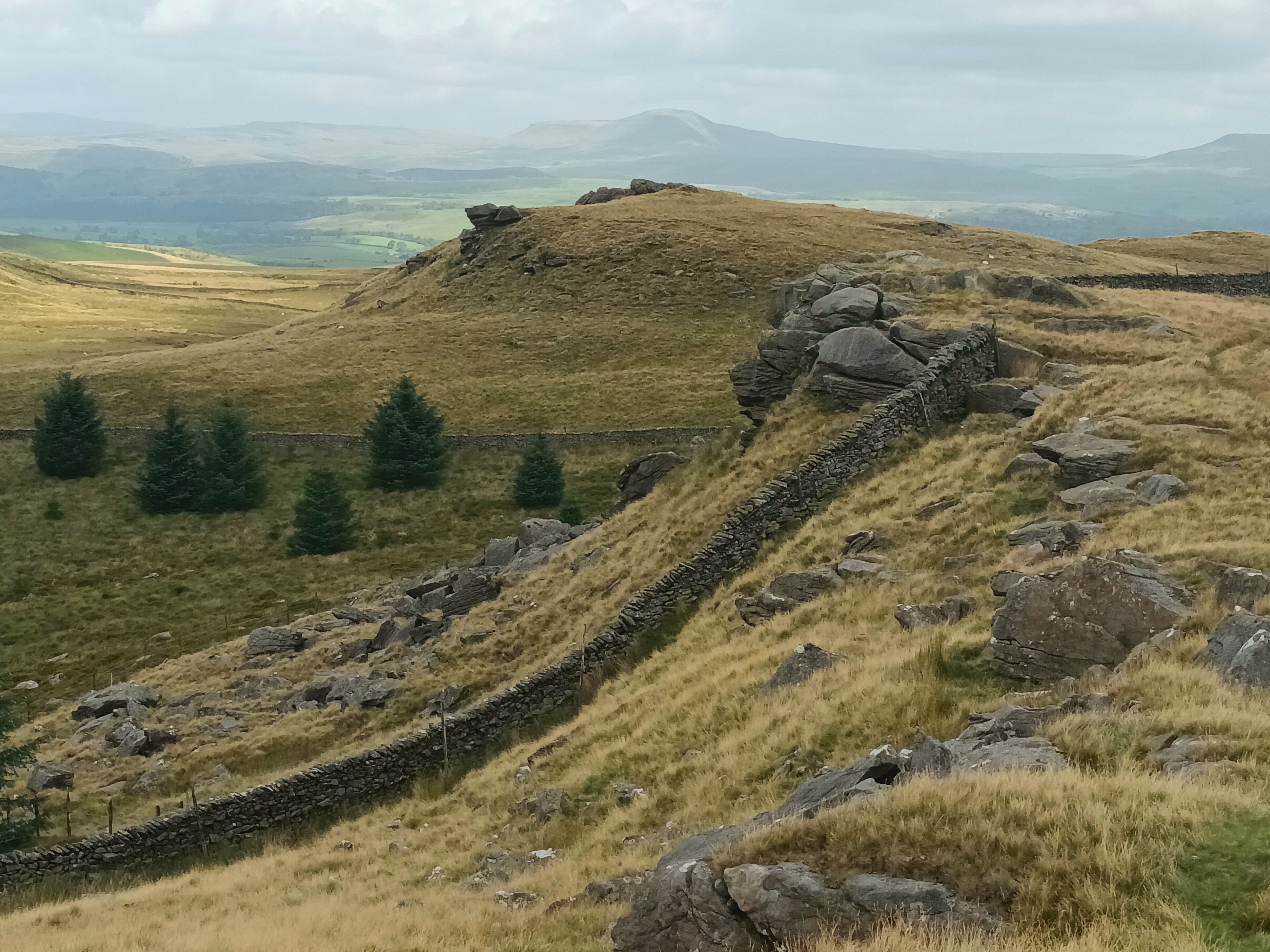
At High Salter we left the last of the farms and reached the gravel track of Salter Fell Road that crosses the moorland to Slaidburn. At first the track climbs steadily up to the watershed, the River Roeburn tumbling below us. From the summit the streams no longer flowed into the River Lune but were heading towards the River Ribble. In this treeless high land the views across the moorland were wide open with the stony track snaking across the landscape. There isn’t much obvious wildlife on these grouse shooting moors but a lizard scuttled away from our feet and a couple of kestrels hovered over the slopes. A herd of belted galloway cows ambled towards us on both verges of the track, forming a moving guard of honour. These calm cows are nevertheless bulky and we walked between them quickly but cautiously.

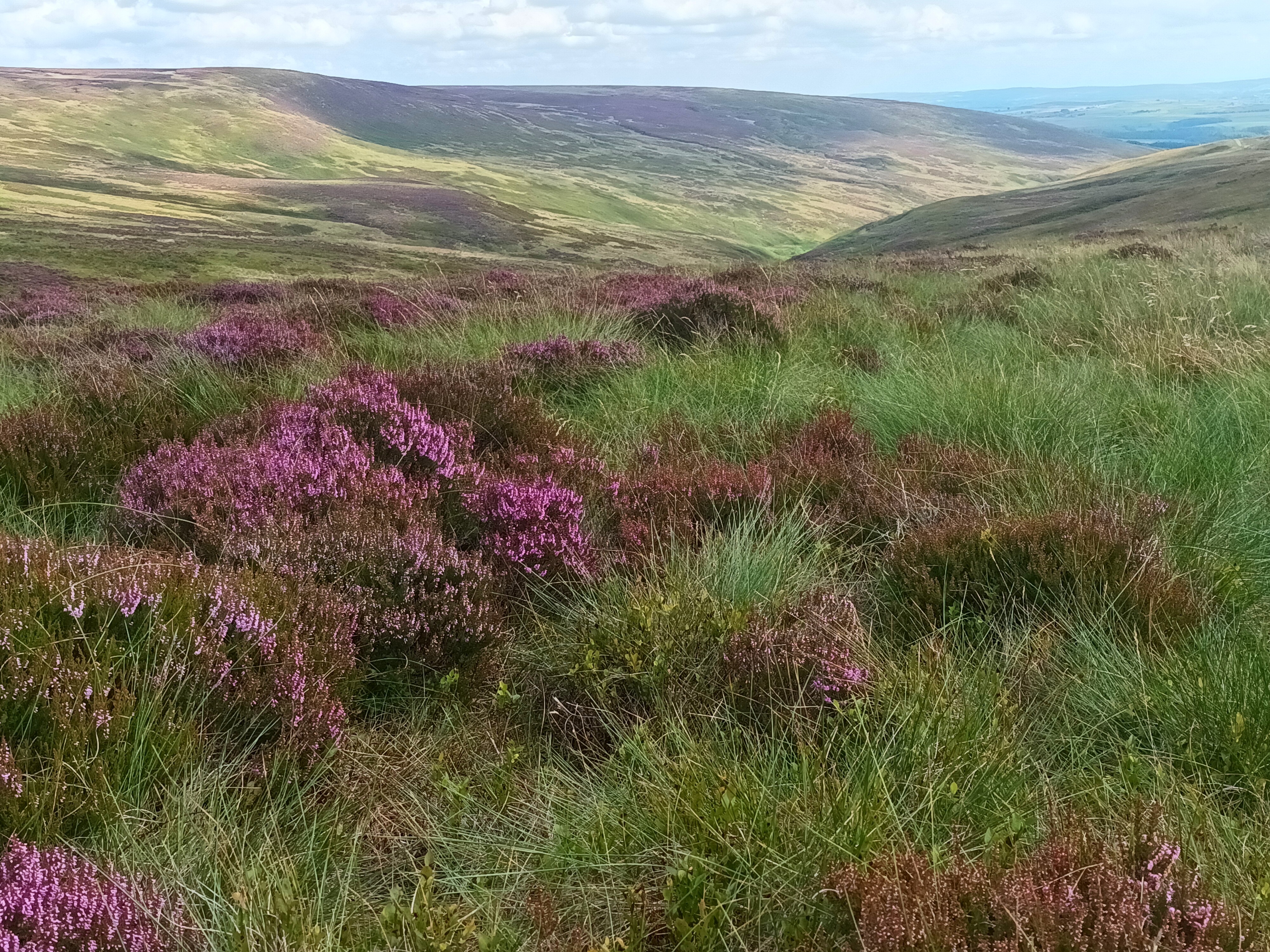
We stopped on a rocky outcrop near the watershed for lunch taking in the view across purple flowering heather. The track is used by off-road bikers and cyclists and a group of scramblers dented the peace and our solitude as they bounced by.

Walking with a heavier than usual rucksack was tiring and we stopped again in the mid-afternoon for cake and I lay back on the heather gazing up at the wispy clouds in the blue sky, waking up a short while later! Up to now route finding had been easy but this changed as we left the Salters Fell Road for Croasdale House on a soggy and overgrown path. Negotiating nettles, farms, stiles, cattle and dogs we eventually reached a lane into Slaidburn. Staying on the track and lanes into Slaidburn would have been easier going and a similar distance although it was harvest time and the narrow country lanes were busy with farm vehicles.

We reached the Hark to Bounty just after they opened at 17.30 and were grateful for a room to rest in with a hot shower and a kettle for tea. The Hark to Bounty is an old inn that is full of character and has a heart of the community feel. The bedrooms are comfortable and individual but not ultra-modern. That evening we ate hearty food in the bar and slept the deep sleep of backpackers. [The Hark to Bounty closed in October 2024, although new tenants are being sought.]

Slaidburn is an unusual village. At first glance it looks timeless and this is in part because it is owned by one family. Sitting in agricultural Lancashire Slaidburn has no modern buildings and is not wall-to-wall holiday lets. The 17th century cottages and farms are rented, the school remains viable and there is still a village shop and pub. Slaidburn also has a handmade chocolate shop, a cafe and a youth hostel available for sole use.

There had been some rain showers overnight but the next morning was fine and after breakfast we once again heaved our rucksacks onto our backs and set off along the River Hodder to Stocks Reservoir and Gisburn Forest. Built in the 1930s, Stocks Reservoir get its name from Stocks-in-Bowland, the village that was flooded.

Gisburn Forest is vast, apparently almost 3,000 acres vast, so it was no surprise that it took us most of the morning to cross it. As is often the way when we can’t see the route for the trees, we got lost more than once and without GPS we would probably still be wandering around the forest! All Gisburn’s acres have plenty of variety and from the shores of Stocks Reservoir we walked through magical vivid-green treescapes, alongside sunny verges where peacock butterflies were thriving and, of course, through dark pine forests. Eventually we emerged with some relief at the highest point, Whelp Stone Crag, and stopped for lunch looking across the farmland towards Yorkshire and our walks end.

The relief was short lived as we still had some kilometres to walk and a bus to catch. We tried to choose the best route from the many lanes and footpaths on the map but twice ended up on an overgrown walled lane that no one had tramped along for some time. Both of these were thick with nettles and brambles and, wearing shorts we emerged with legs covered in scratches and stings. I always react badly to nettle stings and my tingling legs were soon attractively covered in swollen red lumps that only antihistamines can deal with. Anthony doesn’t suffer in the same way but did collect a tick.

After more encounters with young bullocks that herded and trotted curiously behind us, way too close for comfort. We tried to stay calm and walk rather than giving way to the urge to run! A hare bounding over a wall delighted us and we climbed gates that were tied shut with string despite being on a right of way and heaved ourselves and our rucksacks over so many stiles we lost count until we reached the A65 and the bus stop by The Craven Arms in Giggleswick. There is a railway station here but we caught the cheaper bus home, changing in Ingleton.

There is something satisfying about completing a linear walk while carrying your kit and we enjoyed our short trip. The warm weather meant we weren’t laden with lots of extra clothing but we did carry plenty of water as well as spare food [apart from Slaidburn there were no shops or cafes on our route] and our emergency first aid kit.